What Is OpenClaw? A Plain-English Guide for Business Leaders
OpenClaw is an AI agent that works 24/7 on hardware you own. 350,000+ GitHub stars in weeks. Here's what it actually does, how it connects to your tools, and why Jensen Huang compared it to Linux.
What Is OpenClaw?
OpenClaw is an open-source AI agent that runs on your own hardware and works 24/7 — monitoring your email, updating your CRM, drafting responses, and handling repetitive tasks without waiting for you to ask. It’s not a chatbot. It’s closer to a digital employee that never sleeps, never takes PTO, and connects to over 10,000 tools through Composio.

That distinction matters. When Jensen Huang — NVIDIA’s CEO and the man running a $3.4 trillion company — compared OpenClaw to Linux at Computex 2025, he wasn’t being hyperbolic. He was making a prediction: every company will run OpenClaw infrastructure, just like every company runs Linux today.
The numbers back him up. OpenClaw hit 350,000+ GitHub stars in its first weeks, surpassing what Linus Torvalds’ Linux achieved over 30 years on the platform. According to Gartner’s 2025 AI Infrastructure forecast, 40% of enterprises will deploy AI agent frameworks by 2027 — up from under 5% in 2024.
Why Are 350,000+ Developers Paying Attention?
OpenClaw became the fastest-growing open-source project in GitHub’s history because it solved a problem everyone recognized: AI tools that talk versus AI agents that act. Developers, CTOs, and executives saw the same gap — ChatGPT could draft an email, but couldn’t send it, check for replies, and follow up on its own.
Peter Steinberger, the Austrian developer who created the project (originally called Clawdbot), built exactly that. An agent that connects to real tools and takes real actions. The open-source community responded immediately.
But the real accelerant was NVIDIA. Their engineers now actively contribute to OpenClaw’s security stack. The official OpenClaw account confirmed this on X, and NVIDIA responded publicly. According to NVIDIA’s developer documentation, their NemoClaw enterprise reference design adds policy guardrails, privacy routing, and Docker sandboxing — making OpenClaw production-ready for corporations.
That combination — open-source accessibility plus enterprise-grade security from the world’s most valuable semiconductor company — is why the adoption curve looks nothing like previous open-source projects.
How Does OpenClaw Connect to Business Tools?
OpenClaw connects to your existing tools through Composio, an integration middleware that supports 10,000+ applications. Email, Google Workspace, Slack, Salesforce, HubSpot, Notion, Linear, GitHub — if your company uses it, OpenClaw can probably connect to it.
Here’s the critical part: Composio handles authentication via OAuth, so the AI agent never sees your raw credentials. Your API keys and tokens live in Composio’s vault, not in the agent’s memory or config files. According to Deloitte’s 2025 Enterprise AI Adoption Survey, 71% of AI projects stall at the security review stage. Composio’s credential isolation is specifically designed to clear that hurdle.
In practice, this means your agent can send emails from your account, update CRM records, create calendar events, and post Slack messages — all without ever having access to your passwords. We’ve configured Composio integrations across 150+ executive deployments at beeeowl. The typical setup connects 5-8 tools on day one.
What Makes OpenClaw Different from ChatGPT and Claude?
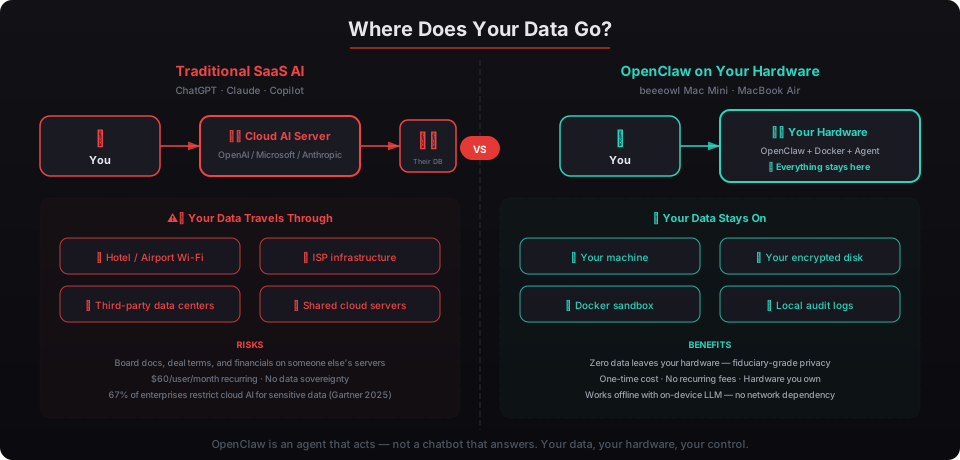
ChatGPT and Claude are cloud-based chatbots you interact with through a browser. You ask a question, they answer. You close the tab, they stop working. OpenClaw is a self-hosted autonomous agent that runs on your hardware continuously — checking, acting, and reporting whether you’re at your desk or asleep.
The difference is the gap between a tool and an employee. According to McKinsey’s 2025 State of AI report, companies deploying autonomous AI agents see a 28% reduction in executive administrative time within 90 days. That’s roughly 780 hours per year.
There’s also the data question. When you use ChatGPT Enterprise ($60 per user per month), your prompts travel to OpenAI’s servers. Microsoft Copilot ($30 per user per month) routes through Microsoft’s cloud. OpenClaw runs locally. Your board communications, deal terms, and financial models stay on hardware you physically control.
For a CEO preparing investor updates or a VC managing deal flow, that’s not a philosophical preference. It’s a fiduciary responsibility.
What Does a Deployment Actually Look Like?
A beeeowl OpenClaw deployment takes one day. We ship pre-configured hardware (Mac Mini at $5,000 or MacBook Air at $6,000) or deploy to a hosted VPS ($2,000). Every tier includes OS security hardening, Docker sandboxing, firewall configuration, Composio OAuth setup, and one fully configured agent with integrations.
Day one looks like this: we configure the agent for your highest-friction workflow — email triage, investor update drafts, competitive intelligence monitoring, or CRM hygiene. We connect 5-8 tools through Composio. By the end of the day, your agent is running.
Most executives we’ve deployed for start seeing measurable time savings within two weeks. According to Accenture’s 2025 Technology Vision report, 83% of C-suite executives plan to deploy AI agents within 18 months, but only 12% have started. That 71-point intention-action gap is where first-mover advantage lives.
The hardware ships within one week. Every deployment includes authentication, audit trails, access controls, and one year of monthly mastermind calls — group sessions where clients share workflows, integrations, and best practices.
Why Does Jensen Huang Think Every Company Needs This?
Jensen Huang didn’t compare OpenClaw to Linux casually. At Computex 2025, he placed it alongside Linux, HTML, and Kubernetes — the three technologies that defined computing’s last three decades. His thesis: OpenClaw is “the operating system for agentic computers.”
NVIDIA backed the claim with NemoClaw, their enterprise reference design that adds the security and governance layers corporations require. They also assigned engineers to OpenClaw’s security advisories — a level of corporate commitment that signals long-term infrastructure bet, not a marketing partnership.
According to Andreessen Horowitz’s 2025 AI market analysis, 60% of current SaaS workflows will be partially or fully automated by AI agents within three years. The shift from SaaS dashboards to autonomous agents isn’t coming — it’s underway. Harvard Business Review’s 2025 analysis found that companies adopting infrastructure in the first wave achieve 31% lower total cost of ownership versus late adopters.
OpenClaw is that infrastructure. The companies deploying it now — configuring agents, building institutional knowledge about which workflows to automate — will compound that advantage every week. The ones waiting will start from zero when they eventually decide to move.
How Do You Get Started?
Pick one workflow. Not a committee, not a six-month pilot. One repetitive task that eats 3-5 hours of your week — email triage, investor updates, deal flow monitoring, board prep.
Deploy on hardware you control. Your agent will handle sensitive communications, financial data, and strategic documents. That information shouldn’t live on someone else’s servers. beeeowl’s hosted setup starts at $2,000. Mac Mini deployments at $5,000 include the hardware, shipped and configured.
Connect one integration first. Let the agent prove value on a single workflow before expanding. In our experience across 150+ deployments, executives who start with email triage or CRM hygiene see the fastest ROI — usually within the first two weeks.
The technology is here. NVIDIA is backing it. 350,000+ developers have endorsed it. The only variable is when you deploy — and how much advantage you’re willing to give your competitors while you decide.