Connecting OpenClaw to Gmail, Calendar, Slack, and 40+ Tools via Composio
How Composio's OAuth middleware connects your OpenClaw agent to 850+ apps without exposing API keys — and why credential isolation matters for executives.
How Does Composio Connect OpenClaw to Your Business Tools?
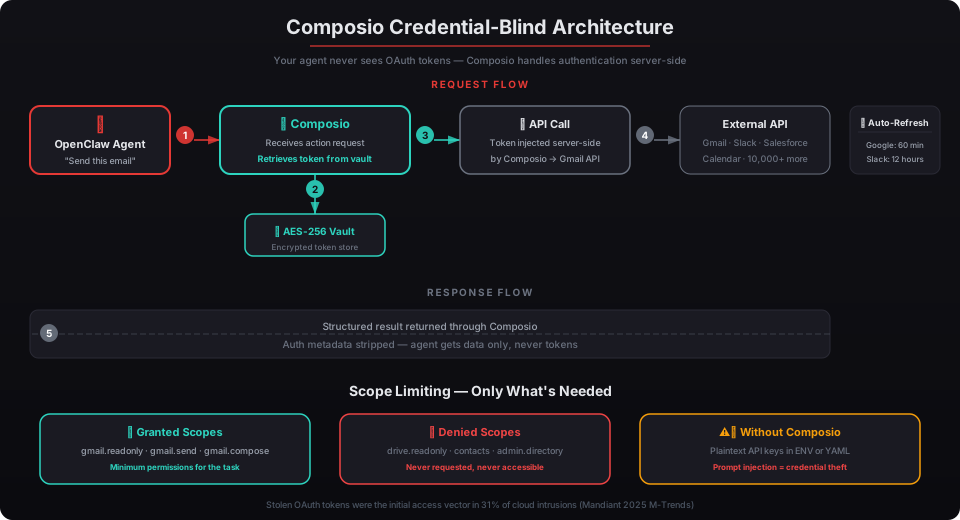
Composio is OAuth middleware that sits between your OpenClaw agent and every external tool it needs to access. The agent sends action requests — “check my calendar for conflicts,” “draft a reply to this email” — and Composio handles authentication, executes the action, and returns the result. Your agent never touches a credential.

This architecture solves the single biggest security problem in AI agent deployments. Verizon’s 2025 Data Breach Investigations Report found that 44% of AI-related breaches involved exposed API credentials — keys stored in plain text config files, environment variables left in Git repos, tokens hardcoded into agent configurations. Composio eliminates that entire attack surface.
We chose Composio as the default integration layer for every beeeowl deployment after evaluating five alternatives. It’s the only solution that gives us OAuth-hosted credential management, 850+ pre-built app connectors, and MCP-compatible tool definitions that plug directly into OpenClaw’s architecture — see our deep dive on the Model Context Protocol.
Why Can’t the Agent Just Use API Keys Directly?
It can. That’s actually how most DIY OpenClaw installations work — you generate an API key for Gmail, another for Slack, paste them into a YAML config file, and the agent reads them at startup. It works. It’s also a security incident waiting to happen.
Here’s what a raw API key configuration looks like in a typical OpenClaw setup:
# DANGEROUS: keys visible to the agent and stored in plain text
integrations:
  gmail:
    api_key: "AIzaSyD-EXAMPLE-KEY-9x8f7g6h5j4k3l2"
    client_secret: "GOCSPX-EXAMPLE-SECRET"
  slack:
    bot_token: "xoxb-1234567890-EXAMPLE-TOKEN"
  salesforce:
    access_token: "00D5g000004EXAMPLE!TOKEN.HERE"
Every credential sits in a file the agent can read. If the agent gets prompt-injected — and according to the OWASP 2025 Top 10 for AI Applications, prompt injection is the #1 attack vector — the attacker can extract every key. Gartner’s 2025 AI Security Framework noted that 61% of organizations deploying AI agents haven’t implemented credential isolation, meaning the agent has direct access to every connected service’s authentication tokens.
Composio flips this model entirely. The agent doesn’t know your credentials exist. It knows it can “send email” and “read calendar” — it has no concept of the OAuth token that makes those actions possible.
How Does Composio’s OAuth Flow Actually Work?
The setup takes three steps. First, you install the Composio CLI and authenticate:
# Install the Composio CLI
pip install composio-core

# Authenticate with your Composio account
composio login
Then you add an integration. Let’s use Gmail as the example — it’s the most common first integration for our executive clients:
# Add Gmail integration
composio add gmail

# This opens your browser to Google's OAuth consent screen
# You approve the specific permissions the agent needs
# Composio stores the resulting OAuth token — the agent never sees it
Behind the scenes, Composio is doing four things:
- Redirecting to Google’s OAuth consent screen — you see exactly what permissions you’re granting
- Receiving the OAuth token from Google after you approve
- Encrypting the token with AES-256 and storing it in Composio’s vault
- Registering the available actions (send email, read inbox, search messages) as MCP-compatible tool definitions that OpenClaw can call
The agent’s view of Gmail after this process looks nothing like the raw API key approach:
# What the agent sees — actions, not credentials
available_tools = composio.get_tools(
    actions=[
        Action.GMAIL_SEND_EMAIL,
        Action.GMAIL_READ_INBOX,
        Action.GMAIL_SEARCH_MESSAGES,
        Action.GMAIL_CREATE_DRAFT,
    ]
)

# The agent calls an action — Composio handles auth
result = composio.execute_action(
    action=Action.GMAIL_SEND_EMAIL,
    params={
        "to": "investor@example.com",
        "subject": "Q1 Board Deck — Final",
        "body": "Attached is the finalized Q1 board deck..."
    }
)
No token. No key. No secret. The agent knows what it can do but has zero knowledge of how the authentication works. Forrester’s 2025 AI Integration Security report called this pattern “credential-blind architecture” and ranked it as the most effective mitigation against credential theft in agentic AI systems.
Which Integrations Matter Most for Executives?
We’ve deployed OpenClaw for CEOs, CFOs, CTOs, VCs, and managing partners. After 40+ deployments, clear patterns emerge in which integrations deliver the most value per role. Here are the top integrations we configure on day one, organized by what the agent can actually do with each:
| Integration | What the Agent Can Do | Best For |
|---|---|---|
| Gmail | Read, send, draft, search, label, archive emails | All roles |
| Google Calendar | Check availability, create events, find conflicts, send invites | All roles |
| Slack | Read channels, post messages, DM, search history, set reminders | All roles |
| Salesforce | Pull pipeline data, update deal stages, generate forecast summaries | CEO, CFO, Partner |
| HubSpot | Read CRM contacts, track deals, pull marketing metrics | CEO, Partner |
| Notion | Read/write docs, update databases, search knowledge base | CTO, CEO |
| Linear | Track issues, read sprint progress, pull engineering metrics | CTO |
| Google Sheets | Read/write spreadsheets, pull financial data, update trackers | CFO, VC |
| Google Drive | Search files, read documents, organize folders | All roles |
| Zoom | Schedule meetings, pull recordings, check upcoming calls | All roles |
| DocuSign | Check signature status, send reminders, pull completed docs | CFO, Partner |
| Jira | Read tickets, track sprints, pull velocity metrics | CTO |
| Airtable | Read/write records, search bases, update deal trackers | VC |
| Stripe | Pull revenue data, check subscription status, read invoices | CFO, CEO |
| QuickBooks | Read financial reports, check AP/AR, pull P&L summaries | CFO |
| GitHub | Read PRs, check CI status, pull repo activity | CTO |
| Telegram | Send/receive messages, create group notifications | CEO, VC |
| Send/receive messages for mobile agent access | All roles |
Every beeeowl deployment includes 5-8 of these integrations configured and tested on day one. Most clients add 3-5 more within the first month as they discover new workflows. Deloitte’s 2025 AI in the Enterprise report found that AI agents connected to 5+ business tools delivered 3.2x more value than single-tool deployments, measured by executive time saved per week — see our one-day deployment guide.
How Is Credential Isolation Different from Just Using Environment Variables?
Environment variables are better than hardcoded keys in a config file, but they’re still accessible to the agent process. The agent runs, it reads GMAIL_TOKEN from the environment, and now that credential exists in the agent’s memory. A prompt injection attack or a memory dump exposes it.
Here’s the comparison:
# Approach 1: Environment variables (common, but still risky)
export GMAIL_TOKEN="ya29.a0EXAMPLE..."
export SLACK_TOKEN="xoxb-EXAMPLE..."
# The agent process can read these at any time

# Approach 2: Composio (credential-blind)
composio add gmail    # Token stored in Composio's vault
composio add slack    # Agent process never receives the token
# The agent calls actions through Composio's API — no token in memory
With Composio, the credential never enters the agent’s process memory. The agent makes an HTTP request to Composio’s local service saying “send this email with these parameters.” Composio attaches the OAuth token server-side and forwards the request to Google’s API. The response comes back through Composio, stripped of any authentication metadata.
IBM’s 2025 Cost of a Data Breach Report found that breaches involving AI agent credential exposure cost an average of $5.2 million — 23% more than traditional credential breaches — because a compromised AI agent typically has access to multiple services simultaneously. If an attacker extracts one token from environment variables, they often find five or six more in the same process memory.
What Happens When OAuth Tokens Expire?
OAuth tokens are intentionally short-lived — Google’s tokens expire after 60 minutes, Slack’s after 12 hours. This is a security feature, not a bug. If a token gets leaked, the window of exposure is hours, not months (unlike a static API key that never expires unless manually rotated).
Composio handles token refresh automatically. When a token approaches expiration, Composio uses the stored refresh token to get a new access token from the provider. The agent doesn’t know this happened. It keeps calling actions, and Composio keeps handling the auth cycle.
# Check integration status and token health
composio integrations list

# Output:
# gmail       connected    token valid (refreshes in 23m)
# slack       connected    token valid (refreshes in 8h)
# salesforce  connected    token valid (refreshes in 1h)
# calendar    connected    token valid (refreshes in 41m)
For our executive clients, this means zero maintenance. You don’t re-authenticate every hour. You don’t rotate keys on a schedule. The system handles it. According to a 2025 Ponemon Institute study on credential management, organizations using automated token rotation experienced 71% fewer credential-related incidents than those managing tokens manually.
How Do You Add a New Integration After Deployment?
This is one of the things we deliberately made simple. After your beeeowl deployment is live, adding a new integration takes about 5 minutes. No code changes. No config file editing. No SSH into your system.
# Connect to your deployed OpenClaw instance
composio whoami
# Output: Connected to beeeowl-deployment-[client-id]

# Add HubSpot integration
composio add hubspot
# Browser opens -> HubSpot OAuth consent -> Approve -> Done

# Verify the integration
composio integrations list
# hubspot    connected    token valid

# The agent immediately has access to HubSpot actions
# No restart required
The agent discovers new tools dynamically through MCP (Model Context Protocol), the open standard created by Anthropic that OpenClaw uses for tool connectivity. When you add HubSpot through Composio, the new actions — read contacts, check deal stages, pull pipeline data — appear in the agent’s available tool list within seconds.
We configure 5-8 integrations during every beeeowl deployment, but we also walk every client through the process of adding new ones themselves. It’s intentionally self-service after day one. McKinsey’s 2025 AI Adoption report found that AI deployments with self-service extensibility had 2.7x higher user satisfaction and 40% faster time-to-value compared to deployments that required vendor involvement for every change.
How Does Composio Handle Permissions and Scope Limiting?
When you add an integration through Composio, you control exactly which permissions the agent gets. Gmail access doesn’t mean “full access to your entire Google account.” It means the specific scopes you approve on the OAuth consent screen.
For a typical executive Gmail integration, we configure these scopes:
- Read email — the agent can read your inbox to summarize and prioritize
- Send email — the agent can draft and send on your behalf (with approval workflows if configured)
- Create drafts — the agent can prepare emails for your review
- Search messages — the agent can find specific emails by keyword, sender, or date
The agent doesn’t get access to Google Drive, Google Contacts, YouTube, or any other Google service unless you explicitly add those integrations separately. Each integration is scoped independently.
# View current scopes for an integration
composio integrations get gmail --show-scopes

# Output:
# gmail scopes:
#   - gmail.readonly
#   - gmail.send
#   - gmail.compose
#   - gmail.modify (labels/archive only)
#
# NOT included:
#   - drive.readonly
#   - contacts.readonly
#   - calendar.events (separate integration)
This follows the principle of least privilege — a security concept that the NIST Cybersecurity Framework 2.0 (updated February 2025) ranks as the single most impactful access control measure for AI systems. Your agent gets exactly the access it needs and nothing more.
What’s the Difference Between Composio and Building Custom Integrations?
You could skip Composio entirely and build direct API integrations for each tool. OpenClaw supports custom tool definitions through MCP. Some engineering teams prefer this approach because it gives them maximum control.
Here’s what that looks like in practice:
# Custom integration approach (without Composio)
# You build and maintain this for EVERY tool
import google.auth
from googleapiclient.discovery import build

credentials = google.auth.load_credentials_from_file(
    "service-account-key.json"  # Stored locally, agent-accessible
)
service = build("gmail", "v1", credentials=credentials)

# You handle: token refresh, error handling, scope management,
# credential storage, rotation, audit logging...
# Multiply this by 8-10 integrations.
For a single integration, the custom approach is fine. For 8-10 integrations across Gmail, Calendar, Slack, Salesforce, and the rest, you’re maintaining OAuth flows, token refresh logic, error handling, and credential storage for each one individually. That’s a full-time engineering job.
Composio gives you pre-built, tested connectors for 850+ apps with consistent error handling, automatic token refresh, and centralized credential management. For our clients — who are CEOs and CFOs, not DevOps engineers — the Composio approach means their agent works on day one and they never think about OAuth again.
Gartner estimates that maintaining custom integrations for an AI agent costs $15,000-$40,000 per year in engineering time across 10+ integrations. Composio’s approach reduces that to near-zero ongoing maintenance for the integrations layer.
How Does beeeowl Configure Composio During a Deployment?
Every beeeowl deployment follows the same integration setup process. On deployment day, we:
- Install Composio inside the Docker container alongside OpenClaw
- Walk you through OAuth consent for each integration — you see every permission screen and approve explicitly
- Test every integration end-to-end: send a test email, create a test calendar event, post a test Slack message
- Configure scope limits per integration — minimum permissions for each tool
- Verify credential isolation — confirm the agent process has no access to stored tokens
- Document your integration list — which tools are connected, what the agent can do with each one
The whole integration setup takes about 45 minutes of your time (the OAuth consent screens require your login). The rest of the deployment — Docker hardening, firewall configuration, authentication setup, audit trail configuration — happens without you in the room.
After deployment, you can add new integrations yourself with the composio add command, or request that we add them during your monthly mastermind call. Either way, every new integration follows the same OAuth flow — you approve permissions, Composio stores credentials, and the agent gains new capabilities without ever touching a key.
Why Does Credential Architecture Matter More Than You Think?
If you’re a CEO reading this, the technical details of OAuth vs. API keys might seem like an engineering decision. It’s not. It’s a risk decision.
A compromised API key for your Gmail gives an attacker persistent access to every email in your account — board communications, M&A discussions, investor updates, legal correspondence. A compromised OAuth token gives them 60 minutes of scoped access to specific actions, and you can revoke it instantly from your Google admin console.
The 2025 Verizon DBIR found that the median time to detect credential theft in AI systems was 197 days. For static API keys, that’s 197 days of full, unrestricted access. For OAuth tokens with automatic rotation, the real exposure window is measured in minutes, because stolen tokens expire before anyone notices they’re gone.
This is why every beeeowl deployment uses Composio by default. It’s not optional. It’s not a premium add-on. It’s the baseline architecture because credential security isn’t somewhere we cut corners.
Your OpenClaw agent should be the most useful tool in your daily workflow. It should also be the most secure. With Composio, you get both without compromise.