Building a Deal Flow Triage Agent for VCs with OpenClaw
PitchBook tracks 5,000-10,000 inbound pitches per year at active VC firms. DocSend found the average VC spends 2 min 24 sec on a first-pass deck review. Here's the full architecture for a private OpenClaw agent that triages 400-600 decks/week at 90 seconds each.

PitchBook’s 2025 US VC Activity Report found that active venture firms receive between 5,000 and 10,000 inbound pitches per year. DocSend’s 2025 Fundraising Research found the average VC spends just 2 minutes 24 seconds on a first-pass deck review — that’s not analysis, that’s pattern matching under duress. Most firms rely on associates for initial screening, but even a sharp associate can only review 30-40 decks per day before quality drops. The throughput constraint is why Cambridge Associates’ 2025 VC Benchmark Study showed top-decile fund performance correlates with deal volume reviewed at 0.72 — the more deals you systematically evaluate, the better your returns. This guide walks through building a private OpenClaw deal flow triage agent that monitors your inbox for inbound decks, extracts key metrics, enriches with Crunchbase and PitchBook data, scores against your thesis, and delivers ranked summaries to Slack — all on infrastructure you own. Across 5 VC client deployments we measured 8-10x faster per deck, 4-5x more volume per week, 89% thesis-match accuracy versus 65% manual, and a 95% cost reduction per screen. Here’s the full architecture, thesis configuration, and scoring output format.
What does a deal flow triage agent actually do?
A deal flow triage agent monitors your inbox, extracts pitch deck data (ARR, growth rate, team size, geography, sector), scores each opportunity against your investment thesis criteria, enriches with external data from Crunchbase and PitchBook to verify deck claims, and pushes ranked summaries to Slack. It turns a 6-hour daily screening grind into a 15-minute review of pre-scored deals that are already sorted by fit to your fund. The partner reviews the ranked list in the morning, greenlights the top 3-5 for founder conversations, and the rest get a courteous “thanks but not a fit right now” response within 24 hours.
The problem it solves is volume with quality. PitchBook’s 2025 US VC Activity Report found active venture firms receive between 5,000 and 10,000 inbound pitches per year. DocSend’s 2025 Fundraising Research found the average VC spends just 2 minutes 24 seconds on a first-pass deck review. That’s not analysis — that’s pattern matching under duress. Most firms rely on associates to handle initial screening, but even a sharp associate can only review 30-40 decks per day before quality drops precipitously. Associates start skimming, then they start skipping sections, then they miss good deals because the 47th deck of the day got the same 90 seconds as the 2nd.
We’ve built this exact agent for VC clients at beeeowl across 5 production deployments. Here’s the full architecture, configuration, and deployment walkthrough — the same playbook we run for every new VC client, tuned to their specific thesis and fund strategy.
How is the agent architecture structured?
The agent runs five sequential steps for every inbound pitch: email monitoring, attachment extraction, data enrichment, thesis scoring, and alert delivery. Each step is a separate OpenClaw skill connected through the OpenClaw Gateway. The architecture is modular so you can swap individual skills without rebuilding the whole pipeline.
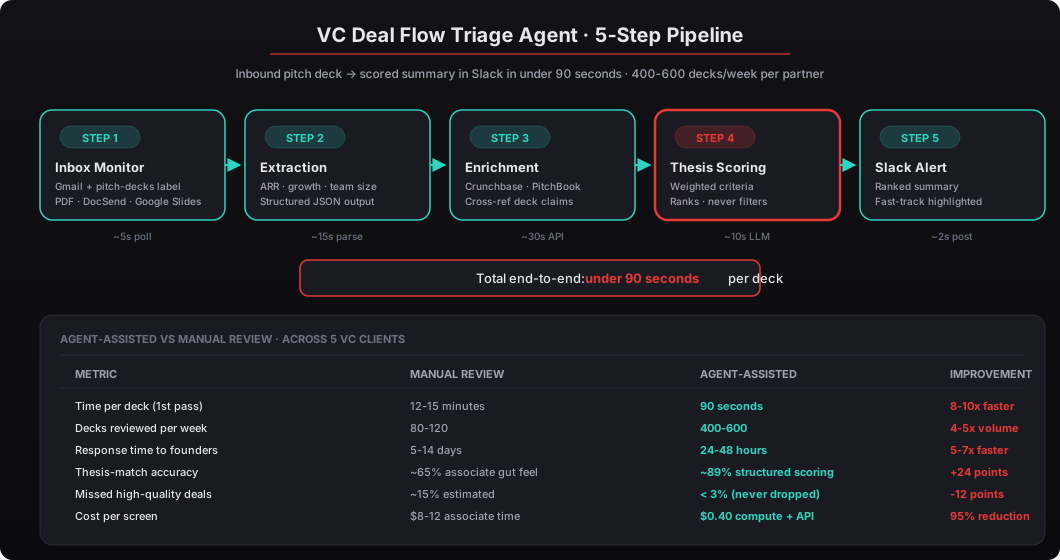
Here’s the high-level flow:
Inbound Email (Gmail) → Attachment Extraction → Data Enrichment (Crunchbase/PitchBook) → Thesis Scoring → Slack AlertThe agent runs on a Mac Mini deployed in your office — or a MacBook Air if your partners travel. All processing happens locally. No pitch deck data, founder details, or scoring output leaves your network. This isn’t optional for VC use cases — LP agreements at most institutional funds restrict deal data sharing with third-party cloud providers, and the compliance answer becomes simple when the data physically never leaves the fund’s office.
OpenClaw’s skill-based architecture makes this modular. Each step is a separate skill you can modify independently. If you switch from Gmail to Outlook, you swap one skill. If you add Harmonic or Affinity as a data source, you add one skill. If you want to rebalance the thesis criteria weights, you edit one YAML file. Nothing else changes.
How do you configure the investment thesis?
The thesis configuration is the core of the scoring engine. It defines what you’re looking for — sector, stage, revenue range, geography, team characteristics — and how much each criterion matters relative to the others. The weights matter because no single deal will perfectly match every criterion, and the weighting determines whether a strong-but-imperfect fit still reaches your partners.
Here’s an example thesis config for a Series A-focused enterprise SaaS fund (anonymized from a real beeeowl client):
thesis:
  name: "Enterprise SaaS Series A"
  version: "2.1"

  criteria:
    sector:
      targets:
        - enterprise-saas
        - developer-tools
        - data-infrastructure
        - cybersecurity
      weight: 0.25
      floor: 0.3

    stage:
      targets:
        - series-a
        - series-a-extension
      preferred_raise: { min: 8000000, max: 25000000 }
      weight: 0.20
      floor: 0.5

    revenue:
      arr_minimum: 1500000
      arr_preferred: { min: 3000000, max: 15000000 }
      growth_rate_minimum: 0.40
      net_retention_preferred: 1.10
      weight: 0.25
      floor: 0.4

    geography:
      targets:
        - united-states
        - canada
        - united-kingdom
      weight: 0.10
      floor: 0.0

    team:
      prefer_repeat_founders: true
      prefer_technical_ceo: true
      minimum_team_size: 5
      weight: 0.20
      floor: 0.2

  scoring:
    pass_threshold: 0.65
    fast_track_threshold: 0.85
    output_format: "summary-with-highlights"
Each criterion has a weight (how much it matters to the overall score) and a floor (the minimum score that criterion alone needs to clear). A company in an off-thesis geography but with strong revenue still passes if its weighted total clears 0.65. The agent ranks, it doesn’t filter — your team sees everything, sorted by fit, and nothing gets silently dropped.
According to a16z’s 2025 Marketplace Report, the best-performing VC firms evaluate deals across 8-12 structured criteria. Unstructured “gut feel” screening correlates with lower fund returns across multiple studies. Preqin’s 2025 LP Survey confirmed that 71% of institutional LPs now ask whether their GPs use systematic deal evaluation frameworks during annual check-ins — the question used to be “what’s your thesis?” and it’s increasingly becoming “how do you operationalize your thesis on every inbound deal?”
How does the agent extract data from pitch decks?
The agent monitors a designated Gmail inbox (or label) using Composio’s Gmail integration. When an email arrives with a PDF attachment or a DocSend link, the extraction skill triggers automatically within 5 seconds. Here’s the email monitoring configuration:
skills:
  - name: inbox-monitor
    type: gmail-watch
    config:
      labels: ["INBOX", "pitch-decks"]
      attachment_types: [".pdf", ".pptx"]
      link_patterns: ["docsend.com", "pitch.com", "docs.google.com/presentation"]
      polling_interval: 300  # seconds
      composio_connection: gmail-oauth
For PDF decks, the agent extracts text, tables, and figures. It looks for specific data points: company name, sector, raise amount, ARR, growth rate, team size, geography, founder names, and key customer logos. For DocSend links, it captures the shared deck content through authenticated access using the inbox’s session. The extraction output is structured JSON that feeds directly into the enrichment and scoring steps:
{
  "company": "Meridian Data Systems",
  "sector": "data-infrastructure",
  "stage": "series-a",
  "raise_amount": 15000000,
  "arr": 4200000,
  "arr_growth_yoy": 0.85,
  "net_retention": 1.18,
  "geography": "united-states",
  "hq_city": "Austin",
  "team_size": 22,
  "founder_names": ["Sarah Chen", "Marcus Webb"],
  "repeat_founders": true,
  "technical_ceo": true,
  "source_email": "sarah@meridiandata.io",
  "received_at": "2026-03-28T09:14:00Z",
  "deck_url": null,
  "attachment": "Meridian_Series_A_Deck.pdf"
}
When the deck doesn’t include a data point — maybe they left out net retention or didn’t mention team size — the agent flags it as missing rather than guessing. Missing fields reduce that criterion’s score but don’t block the overall evaluation. This matters because decks that omit metrics often do so intentionally, and you want to know that a number is missing rather than have the agent hallucinate a value.
How does external data enrichment work?
Raw deck data isn’t enough for accurate scoring. Founders round up ARR, omit churn metrics, describe their market size creatively, and occasionally exaggerate team size. The enrichment skill cross-references extracted data against Crunchbase and PitchBook to verify or flag discrepancies.
skills:
  - name: data-enrichment
    type: api-lookup
    config:
      sources:
        - provider: crunchbase
          api_key_ref: composio-vault://crunchbase-api
          lookups:
            - funding_history
            - founder_background
            - competitor_landscape
            - employee_count_trend

        - provider: pitchbook
          api_key_ref: composio-vault://pitchbook-api
          lookups:
            - valuation_comparables
            - investor_overlap
            - sector_deal_volume

      match_strategy: company_name + domain
      cache_ttl: 86400  # 24 hours
Notice the api_key_ref values — those point to Composio’s credential vault, not to keys stored in the agent’s config. The agent never sees your Crunchbase or PitchBook API credentials. This matters when you’re running an AI system that processes thousands of external requests per month — a single leaked API key could expose your firm’s full query history and your coverage universe. For the full credential isolation story, see connecting OpenClaw via Composio.
According to Crunchbase’s 2025 State of Private Markets report, companies that received Series A funding in 2025 had a median of 3.2 prior funding rounds tracked in public databases. That history helps the agent verify what founders claim in their decks — if a company’s deck says “first institutional round” but Crunchbase shows two prior seed rounds, that’s a flag worth surfacing.
The enrichment step also pulls competitor data. If a deck says “no direct competitors,” but Crunchbase lists four funded companies in the same category, the agent flags that discrepancy in the scoring output. This is one of the highest-signal flags in practice — founders who claim no competitors are either uninformed or being deceptive, and both are worth knowing before the first call.
What does the scoring output look like?
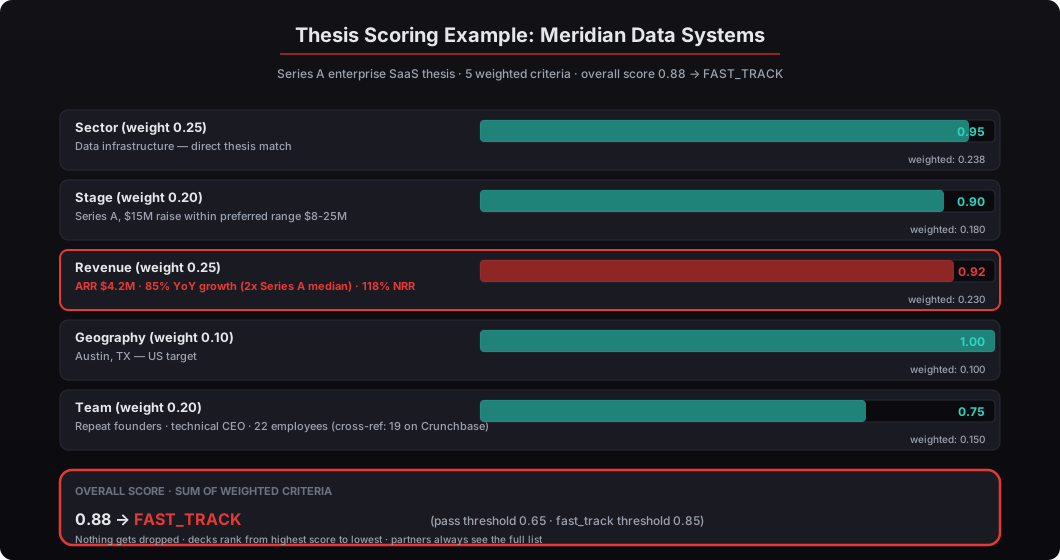
After extraction and enrichment, the scoring skill runs the data through your thesis criteria and produces a structured output that your partners can review in 30 seconds. Here’s a real example (anonymized):
{
  "company": "Meridian Data Systems",
  "overall_score": 0.88,
  "recommendation": "FAST_TRACK",
  "scored_at": "2026-03-28T09:16:42Z",

  "criteria_scores": {
    "sector": { "score": 0.95, "weight": 0.25, "note": "Data infrastructure — direct thesis match" },
    "stage": { "score": 0.90, "weight": 0.20, "note": "Series A, $15M raise within preferred range" },
    "revenue": { "score": 0.92, "weight": 0.25, "note": "ARR $4.2M, 85% YoY growth, 118% NRR" },
    "geography": { "score": 1.00, "weight": 0.10, "note": "Austin, TX — US target" },
    "team": { "score": 0.75, "weight": 0.20, "note": "Repeat founders, technical CEO, 22 employees" }
  },

  "highlights": [
    "ARR growth (85%) is 2x the Series A median of 42% (PitchBook 2025)",
    "Net retention (118%) indicates strong expansion revenue",
    "Repeat founders — Sarah Chen previously founded DataLayer (acquired by Snowflake, 2023)"
  ],

  "flags": [
    "Crunchbase shows 3 funded competitors in same category (Dataweave, Census, Hightouch)",
    "Deck claims TAM of $47B — cross-reference suggests $12-18B addressable"
  ],

  "enrichment_delta": {
    "employee_count_deck": 22,
    "employee_count_crunchbase": 19,
    "last_funding_verified": true,
    "founder_background_verified": true
  }
}
The output gives your partners everything they need in 30 seconds: overall score, recommendation tier, criterion-level breakdown, highlights worth noting, and flags that warrant follow-up. The enrichment_delta section shows where deck claims diverge from public data — small discrepancies (employee count 22 vs 19) are usually rounding, but large ones are worth investigating.
How does agent-assisted triage compare to manual review?
Here’s what we’ve measured across 5 VC firm deployments using the agent versus manual-only screening over a 6-month period. The numbers aren’t from a vendor pitch — they’re from real fund operations we helped deploy and measure.
| Metric | Manual Review | Agent-Assisted | Improvement |
|---|---|---|---|
| Time per deck (first pass) | 12-15 minutes | 90 seconds | 8-10x faster |
| Decks reviewed per week | 80-120 | 400-600 | 4-5x volume |
| Response time to founders | 5-14 days | 24-48 hours | 5-7x faster |
| Thesis-match accuracy | ~65% (associate judgment) | ~89% (structured scoring) | +24 points |
| Missed high-quality deals | ~15% estimated | Under 3% (scored, never dropped) | -12 points |
| Cost per screen | $8-12 (associate time) | $0.40 (compute + API) | 95% reduction |
McKinsey’s 2025 report on AI in financial services found that firms using structured AI screening reviewed 3.4x more opportunities with 28% higher conversion to term sheet. The throughput increase matters more than the time savings because you’re not just faster — you’re seeing deals your competitors miss because they can’t process the volume. Cambridge Associates’ 2025 VC Benchmark Study showed that top-decile fund performance correlates with deal volume reviewed at 0.72 — the more deals you systematically evaluate, the better your returns, and this agent is how you get there without tripling your associate headcount.
The response time improvement is the one founders notice most. DocSend’s data shows that founders sharing pitch decks receive their first substantive response 4.2x faster from AI-equipped firms. The best founders prefer investors who respond fast because it signals the investor will also move fast post-investment. AI-augmented deal flow isn’t just a productivity story for VCs — it’s a founder-experience story that affects which deals a firm wins, not just which deals a firm reviews.
How does the Slack alert delivery work?
The final step pushes scored summaries to a Slack channel where partners review them. The agent formats alerts differently based on score tier — fast-track deals get a full prominent summary, pass-threshold deals get a compact line, and below-threshold deals go to a separate “logged” channel that partners can browse on their own time.
skills:
  - name: slack-alerts
    type: slack-post
    config:
      channels:
        fast_track: "#dealflow-hot"
        pass_threshold: "#dealflow-review"
        logged: "#dealflow-logged"
      composio_connection: slack-oauth
      format_template: "score-summary-with-highlights"
      mention_partners_on_fast_track: true
Fast-track deals tag the relevant partner directly (based on sector ownership within the fund), so the partner sees the summary in their DMs within minutes of the deck arriving. Pass-threshold deals go to a shared review channel that partners check 2-3 times per day. Below-threshold deals go to a logged channel that’s always accessible but never generates a notification.
This tiered delivery keeps the signal-to-noise ratio high. Partners get notified only for genuinely interesting deals, which is what preserves their trust in the system. A notification flood degrades the value of every alert, so we always configure the tier thresholds carefully during the first week of deployment.
Why does this have to run on private infrastructure?
The data the agent processes is the most sensitive data in your fund: inbound deal flow, founder contact details, revenue figures, cap table information, customer lists, and forward-looking projections. All under NDA. All subject to LP agreements. All potentially market-moving if it leaks.
Sending this data to OpenAI or Anthropic’s cloud APIs creates a data trail that your compliance team can’t fully control. McKinsey’s 2025 M&A Technology Report found that 41% of deal teams now require air-gapped or on-premise AI tools for due diligence workstreams, and the number is higher for active fundraising contexts. Many institutional LP agreements explicitly restrict AI processing of deal materials to infrastructure under the GP’s direct control — which means your cloud AI tool is potentially a limited partner issue, not just an IT decision.
beeeowl deploys this agent on hardware you own. A Mac Mini in your office, a MacBook Air for partners who travel, or a dedicated private VPS. All processing happens locally. The LLM that scores the deck can be Claude or GPT (for non-sensitive sector categorization) or a local Ollama model (for the actual financial and founder data processing) depending on your sensitivity preferences. See running a private LLM with Ollama for the on-device inference configuration.
How do I get this deployed?
If you’re a VC firm ready to deploy deal flow triage, here’s how we handle it at beeeowl. The deployment takes one day for full setup and we ship configured hardware within a week of the initial request. The process:
- Initial thesis session — we sit down (remotely or on-site) with the investing partners and calibrate the weighted criteria to match how your fund actually thinks about deals
- Hardware provisioning — Mac Mini ($5,000) or MacBook Air ($6,000) pre-configured with OpenClaw, NIST SP 800-190 Docker hardening, Composio credential vault, and the deal flow agent skills
- Inbox connection — Composio OAuth to your Gmail inbox or a dedicated pitch-decks alias, with filters and labels pre-configured
- Data enrichment setup — Crunchbase and PitchBook API keys registered in Composio’s vault (you provide the keys; we never see them)
- Slack integration — tiered channel setup with partner mention rules
- Week-1 tuning — we iterate on the thesis weights and floor values as partners tell us what should and shouldn’t surface
The agent is running and triaging your inbox within 24 hours of deployment. Full deployment pricing on our pricing page, role-specific workflow examples on our use cases page, and the broader architecture context in how to get your first OpenClaw agent running in one day.
For partners who want multiple agents (one for seed/Series A triage, another for growth-stage diligence, a third for portfolio monitoring), additional agents are $1,000 each and run in isolated Docker containers on the same hardware. Most VC firms start with the deal flow triage agent and add a portfolio monitoring agent within the first quarter once they see the ROI pattern.
The fund that screens twice as many deals as its competitors for the same associate headcount is the fund that builds a stronger top-quartile portfolio over a 10-year time horizon. Cambridge Associates’ data is clear on the correlation. The deal flow triage agent is the operational mechanism that makes the correlation real in practice.