OpenClaw Agent-to-Agent Communication: Setting Up A2A Protocol
Google's A2A protocol lets OpenClaw agents discover and delegate tasks to each other. Learn how to set up multi-agent communication with the A2A Gateway plugin.
What Is A2A and Why Does It Matter for Multi-Agent OpenClaw Deployments?
A2A (Agent-to-Agent) is an open protocol that lets AI agents discover each other’s capabilities and delegate tasks between themselves over a standardized interface. Google created it, the Linux Foundation now governs it, and as of March 2026 the specification’s GitHub repository has surpassed 21,000 stars — making it one of the fastest-adopted agent communication standards in the industry.

Here’s the core idea: each agent publishes an Agent Card — a JSON manifest served at /.well-known/agent-card.json — describing what it can do, what inputs it accepts, and how to authenticate. Other agents discover these cards, evaluate capabilities, and send structured task requests over JSON-RPC 2.0. No custom integrations. No hardcoded API calls between systems. One protocol handles discovery, delegation, and response.
For OpenClaw deployments, A2A solves a specific problem. If you’ve read our guide on single-agent vs multi-agent architectures, you know that most executive teams outgrow a single agent within 60 to 90 days. A2A gives those separate agents a way to talk to each other without compromising their isolated security boundaries.
How Does A2A Compare to MCP — and Do You Need Both?
A2A and MCP solve different problems, and yes, you’ll likely run both. MCP (Model Context Protocol) defines how an agent communicates with tools — Gmail, Slack, databases, internal APIs. A2A defines how agents communicate with each other. Think of MCP as how your CEO talks to their phone, and A2A as how your CEO talks to their CFO.
The distinction matters because tool-calling and task delegation have fundamentally different requirements. When an agent calls a tool via MCP, it expects a deterministic response — here’s the email, here’s the calendar event, here’s the query result. When an agent delegates a task to another agent via A2A, the response is non-deterministic. The receiving agent might need minutes to complete research, might ask clarifying questions, or might stream partial results back incrementally.
A2A handles this through a task lifecycle model with defined states: submitted, working, input-required, completed, and failed. According to Google’s protocol specification, this state machine was designed specifically to support long-running, multi-step agent workflows — not just fire-and-forget API calls. Gartner’s 2026 Multi-Agent AI report estimates that 33% of enterprise AI deployments running multiple agents will adopt a formal inter-agent protocol by 2028, with A2A currently leading adoption.
Both protocols run over JSON-RPC 2.0, so they share transport mechanics. But they serve different layers of the architecture. Every beeeowl deployment includes MCP configuration out of the box, and we’re now configuring A2A for clients running two or more agents.
What Does a Multi-Agent Executive Deployment Actually Look Like?
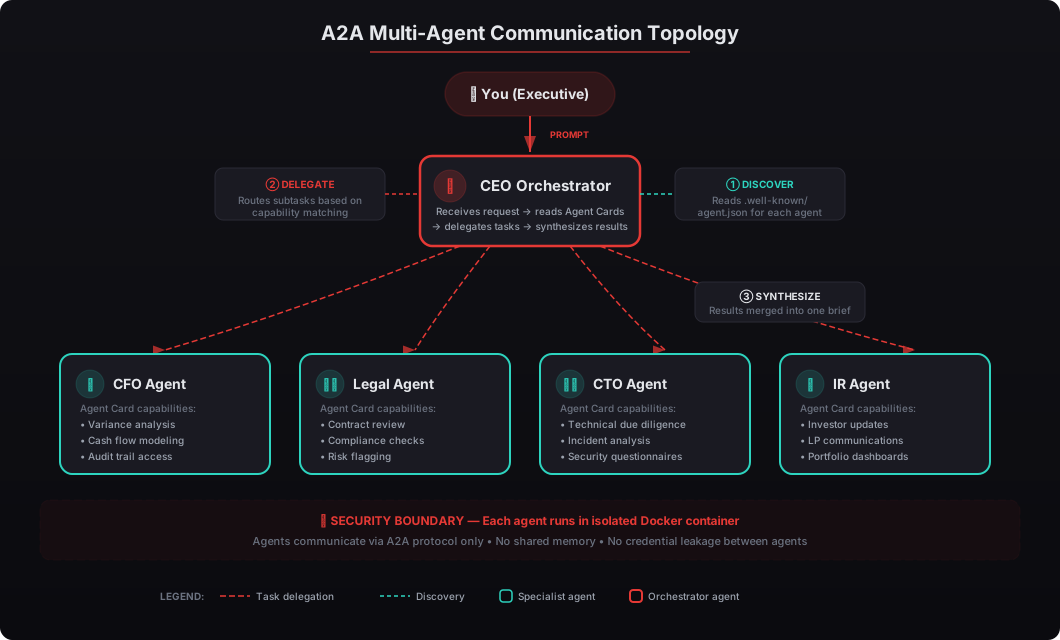
Picture a five-person executive team: CEO, CFO, CTO, a managing partner, and an investor relations lead. Each has their own OpenClaw agent running on dedicated infrastructure with isolated Docker sandboxes and separate Composio OAuth connections. Without A2A, these agents operate in complete isolation. Useful, but limited.
With A2A, the CEO’s primary agent becomes a coordinator. It discovers what each specialist agent can do by reading their Agent Cards, then delegates accordingly. The CEO asks: “Prepare a board meeting brief covering Q1 revenue, engineering velocity, and the latest LP update.” Instead of one agent struggling across three domains, three things happen simultaneously.
The CFO’s agent receives a task to compile Q1 revenue variance analysis. The CTO’s agent gets a request for engineering velocity metrics and incident summary. The investor relations agent pulls the latest LP communication draft. Each agent works within its own security boundary, accessing only its own data sources and credentials. Results flow back to the CEO’s agent, which assembles the brief.
McKinsey’s 2025 State of AI report found that organizations using specialized AI agents for domain-specific tasks saw 42% higher output quality compared to single general-purpose agents. A2A makes that specialization practical by providing the communication layer these agents were missing.
The real value isn’t just parallel execution — it’s that each agent maintains its own trust boundary. The CEO’s agent never touches the CFO’s raw financial data directly. It sends a task, gets a result. Least privilege, enforced at the protocol level.
How Do You Set Up the OpenClaw A2A Gateway Plugin?
The openclaw-a2a-gateway is an open-source plugin that implements A2A protocol v0.3.0 for OpenClaw. It turns any OpenClaw instance into both an A2A server (receiving tasks from other agents) and an A2A client (sending tasks to other agents). Installation takes about 10 minutes per agent.
Start by cloning the plugin into your OpenClaw instance’s custom skills directory:
cd /opt/openclaw/custom_skills
git clone https://github.com/win4r/openclaw-a2a-gateway.git
cd openclaw-a2a-gateway
pip install -r requirements.txt
Next, configure the Agent Card. This is the JSON manifest that tells other agents what this instance can do. Create or edit agent-card.json:
{
  "name": "CFO Financial Agent",
  "description": "Handles variance analysis, cash flow modeling, and compliance monitoring",
  "url": "https://cfo-agent.internal:8443",
  "version": "1.0.0",
  "capabilities": {
    "streaming": true,
    "pushNotifications": false
  },
  "skills": [
    {
      "id": "variance-analysis",
      "name": "Revenue Variance Analysis",
      "description": "Compiles quarterly variance reports with commentary"
    },
    {
      "id": "cashflow-model",
      "name": "Cash Flow Scenario Modeling",
      "description": "Runs 90-day cash flow projections across multiple scenarios"
    }
  ],
  "authentication": {
    "schemes": ["bearer"]
  }
}
The Agent Card’s skills array is where you define exactly what this agent exposes to others. Keep it narrow — only list capabilities you want external agents to invoke. This is your attack surface. We cover this principle in depth in our security hardening checklist.
Finally, start the A2A gateway as a sidecar service:
python -m a2a_gateway \
  --port 8443 \
  --agent-card ./agent-card.json \
  --openclaw-url http://localhost:3000 \
  --auth-token $A2A_BEARER_TOKEN
The gateway now serves the Agent Card at /.well-known/agent-card.json and accepts task submissions on the A2A endpoint. Repeat this process on each agent you want to connect.
How Do You Connect Two Agents in 20 Minutes?
With both agents running the A2A gateway, connecting them is straightforward. You need three things: network connectivity, bearer token exchange, and client-side discovery configuration.
Step 1: Network connectivity. Both agents need to reach each other over HTTPS. For hardware deployments on the same local network, this works out of the box. For agents on different networks — a Mac Mini at the office and a MacBook Air for travel — we recommend Tailscale as the mesh VPN layer. It creates encrypted point-to-point connections without exposing anything to the public internet. Setup takes under 5 minutes.
Step 2: Bearer token exchange. Generate a shared secret for each agent pair. Don’t reuse tokens across pairs — if agent A talks to agents B and C, use separate tokens for each relationship. Store them in environment variables, never in config files:
export A2A_TOKEN_CFO=$(openssl rand -hex 32)
export A2A_TOKEN_CTO=$(openssl rand -hex 32)
Step 3: Register remote agents. On the CEO’s agent, configure the A2A client to discover the other agents:
a2a_peers:
  - name: "CFO Financial Agent"
    discovery_url: "https://cfo-agent.internal:8443/.well-known/agent-card.json"
    auth_token: "${A2A_TOKEN_CFO}"
  - name: "CTO Engineering Agent"
    discovery_url: "https://cto-agent.internal:8443/.well-known/agent-card.json"
    auth_token: "${A2A_TOKEN_CTO}"
The CEO’s agent fetches each Agent Card at startup, caches the capabilities, and can now route tasks to the appropriate specialist. According to the A2A specification GitHub issue #6842 on the OpenClaw repository, the community has been requesting native A2A support since early 2026. The gateway plugin fills that gap today.
Total time from zero to two connected agents: about 20 minutes. We’ve done this setup across 40+ multi-agent deployments. The pattern holds whether you’re connecting two agents or five.
How Do You Lock Down A2A Communication?
A2A opens a communication channel between agents, which means it opens an attack surface. Every connection should be treated as a potential entry point. Here’s how we harden A2A at beeeowl.
Bearer token rotation. Tokens should rotate on a 30-day cycle minimum. Automate this with a cron job that generates new tokens, distributes them to both sides of each connection, and restarts the gateway services. A 2026 OWASP report on agent security found that 58% of compromised multi-agent deployments used static, never-rotated authentication tokens.
Capability scoping. Only expose the minimum skills each agent needs to share. Your CFO agent might have 15 internal capabilities, but the Agent Card should only list the 2-3 that other agents can invoke. Everything else stays internal. This is least privilege applied at the protocol level — consistent with what we configure for credential security via Composio.
Network isolation. A2A traffic should never traverse the public internet. Use Tailscale, WireGuard, or a dedicated VLAN. If both agents run on the same Mac Mini, bind the A2A gateway to 127.0.0.1 and skip network exposure entirely.
Request logging and audit trails. Every A2A task submission and response should be logged to an append-only audit trail. The gateway plugin supports structured logging out of the box. Pipe it into your existing audit infrastructure for a complete picture of inter-agent communication.
TLS everywhere. Even on a private network, enforce TLS between agents. Self-signed certificates are fine for internal use — the trust anchor is your own CA, not a public one. Mutual TLS (mTLS) adds client certificate verification on top of bearer tokens for defense in depth.
NIST’s 2026 AI System Security Guidelines (SP 800-218A) specifically recommend “authenticated, encrypted channels for all inter-agent communication” in multi-agent architectures. A2A over TLS with bearer authentication satisfies that requirement.
What Are the Limitations of A2A Today?
A2A is powerful, but it’s version 0.3.0 — still early. There are three limitations worth knowing before you commit to a multi-agent architecture.
First, there’s no built-in service mesh or registry. Each agent needs to know the discovery URLs of its peers at startup. For two to five agents, this is manageable. For larger deployments, you’ll want a central registry — something the Linux Foundation working group has flagged as a priority for v1.0. The current workaround is a shared YAML configuration file that lists all known agents.
Second, streaming support varies. The protocol spec supports streaming responses via Server-Sent Events, but not every agent framework implements it consistently. OpenClaw’s gateway plugin supports streaming for task status updates, but full response streaming depends on the underlying model and skill configuration. For time-sensitive executive workflows, we configure polling intervals of 5-10 seconds as a fallback.
Third, the ecosystem is still forming. While A2A has 21,000+ GitHub stars and strong backing from Google, NVIDIA, Microsoft, and Salesforce, the number of production-ready A2A plugins for OpenClaw is limited. The openclaw-a2a-gateway is the most mature option today. Expect this to change rapidly — the Linux Foundation governance structure virtually guarantees broader tooling support by late 2026.
Despite these limitations, A2A is the clear frontrunner for inter-agent communication. The alternative — building custom webhook integrations between agents — creates the same brittle integration mess that MCP solved for tool-calling. A2A solves it for agent-to-agent.
What Should You Do Next?
If you’re running a single OpenClaw agent today, A2A isn’t urgent — but it’s worth understanding because your deployment will likely grow. Most executive teams we work with add a second agent within 90 days, and A2A becomes the natural connection layer.
If you’re already running multiple agents in isolation, A2A is the missing piece. Twenty minutes of setup gives your agents the ability to coordinate, delegate, and specialize — without compromising the trust boundaries that justified separate deployments in the first place.
We configure A2A as part of every multi-agent deployment at beeeowl. Additional agents are $1,000 each beyond the first, and that includes full A2A gateway setup, Agent Card configuration, bearer token management, and network isolation. Check our full pricing breakdown to see how multi-agent deployments fit your organization.
The executives we work with don’t want to manage agent infrastructure. They want an AI team that works the way their human team works — specialized roles, clear delegation, secure communication. A2A makes that real.