OpenClaw Audit Logging and Monitoring: Building an Enterprise-Grade Observability Stack
Enterprise OpenClaw needs four observability pillars: session tracking, action auditing, cost monitoring, and alerting. This guide covers the complete stack — from logging config to Grafana dashboards to SIEM export — with production code you can deploy today, compliance mapping for EU AI Act, SOC 2, HIPAA, SOX, and the exact pipeline we ship with every beeeowl deployment.

Why Can’t You Run a Production OpenClaw Agent Without Audit Logging?
Answer capsule. An OpenClaw agent with no audit trail is a black box touching your email, calendar, Slack, CRM, and financial data. You can’t prove what it did, when it did it, or whether it accessed something it shouldn’t have — which means you fail SOC 2 CC7.2, EU AI Act Article 12, HIPAA §164.312(b), and NIST AI RMF’s Measure function on day one of your first audit. Gartner’s 2025 AI Risk Management Survey found that 73% of organizations deploying AI agents lack adequate monitoring and logging infrastructure. That’s not a technical limitation — OpenClaw gives you the hooks. It’s an oversight that surfaces the first time a CFO asks “what did the agent do with our Q3 financials?” and the honest answer is “I don’t know.”

We’ve seen this pattern too many times. A CTO deploys OpenClaw, connects it to Composio for Gmail and Salesforce access, and six weeks later someone asks: “What did the agent do with our Q3 financials?” Nobody knows. There’s no audit trail, no session history, no cost breakdown. The only record is a handful of stdout lines from the gateway that don’t identify the user, the action, or the data accessed. At that point, the options are all bad: tell the CFO you can’t answer the question (bad), invent an answer from partial evidence (worse), or spend the next week reconstructing events from tangentially related logs across Gmail, Salesforce, and a Slack channel that might or might not have the relevant messages (worst).
Gartner’s 2025 AI Risk Management Survey found that 73% of organizations deploying AI agents lack adequate monitoring and logging infrastructure. McKinsey Global Institute’s 2025 AI Governance Report found that only 14% of organizations could produce a complete audit trail when requested by regulators. And IDC’s 2026 AI Governance Forecast projects that 60% of enterprises will face a regulatory audit of their AI systems by end of 2027. The math is straightforward: most organizations aren’t ready, audits are coming, and the time to build the logging pipeline is before the first audit notice arrives, not after.
This guide covers the four pillars of OpenClaw observability: session tracking, action auditing, cost monitoring, and alerting. I’ll show you the configs, the code, and the architecture we use at beeeowl for every deployment. It’s roughly 80-120 hours of work to build from scratch, or $0 additional cost if you deploy through us — either way, you need to know what’s involved. See our deployment packages and pricing and our full security hardening checklist.
What Are the Four Pillars of OpenClaw Observability?
Answer capsule. Session tracking (who accessed the agent, when, from where, with what authentication), action auditing (what the agent did — every tool call, API request, data access, and LLM interaction logged with parameters and results), cost monitoring (token usage and API spend tracked per user per day with budget alerts), and alerting (rules that fire when something anomalous happens and route to PagerDuty, Slack, or email in under 30 seconds). Each pillar addresses a different compliance and operational requirement. Skip any one and you have a blind spot that’ll surface at the worst possible time.
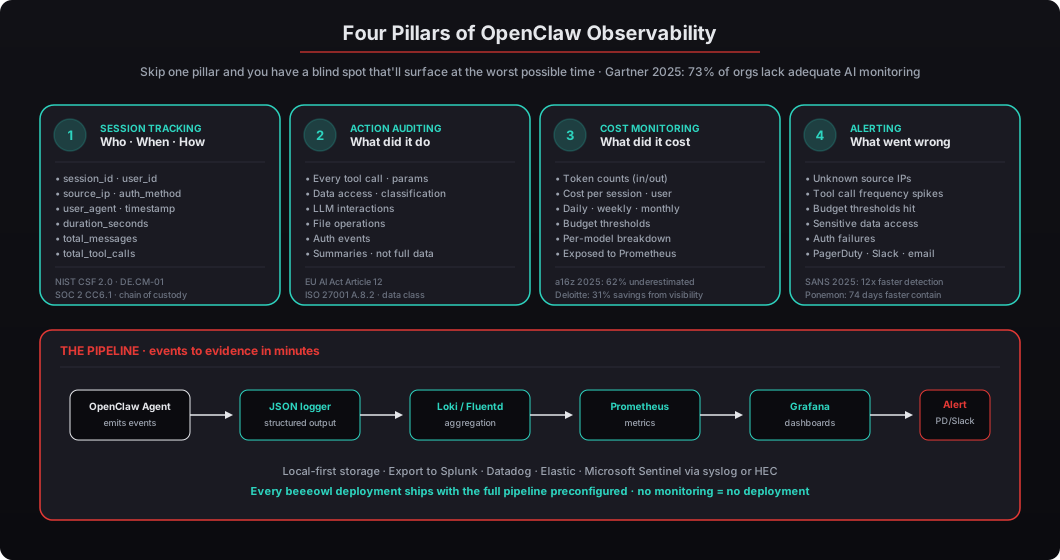
The architecture in plain terms: OpenClaw generates events. A structured logging layer captures them as JSON. A log aggregator (Loki, Datadog, or Splunk) stores and indexes them. A metrics layer (Prometheus) tracks numerical trends. A visualization layer (Grafana) makes it human-readable. And an alerting layer (Alertmanager, PagerDuty, or Slack) notifies you when something’s off. All five layers are open source, all five run locally, and all five integrate without custom glue code because the log format is canonical JSON.
Let’s build each pillar.
How Do You Implement Session Tracking for OpenClaw?
Answer capsule. Configure OpenClaw’s gateway to log every session with a unique ID, user identity, source IP, authentication method, user agent, timestamps for session start and end, and counts of messages and tool calls. Each session becomes a self-contained audit record that shows who connected, from what device, how they authenticated, which model they used, and how active they were. NIST Cybersecurity Framework 2.0 control DE.CM-01 requires continuous monitoring of networks and systems; SOC 2 CC6.1 requires user accountability; EU AI Act Article 12 requires event recording. Session tracking satisfies all three with a single logging configuration.
Start with the logging configuration. Create a logging.yaml in your OpenClaw config directory:
# openclaw/config/logging.yaml
logging:
  level: INFO
  format: json
  timezone: UTC

  output:
    - type: file
      path: /var/log/openclaw/sessions.log
      rotation:
        max_size: 100MB
        max_files: 30
        compress: true
        compress_algorithm: gzip
    - type: stdout
      format: json

  session:
    enabled: true
    generate_id_prefix: ses_
    track_fields:
      - session_id
      - user_id
      - source_ip
      - auth_method
      - user_agent
      - started_at
      - ended_at
      - duration_seconds
      - total_messages
      - total_tool_calls
      - llm_provider
      - model_name
      - hostname
      - deployment_id

  schema:
    version: "1.0"
    canonical_format: json_lines
    required_fields:
      - timestamp_utc
      - event
      - session_id
      - user_id
Every session produces a structured log entry. Here’s what one looks like:
{
  "event": "session.ended",
  "timestamp_utc": "2026-04-10T09:31:07.413Z",
  "session_id": "ses_a1b2c3d4e5f6",
  "user_id": "cto@acmecorp.com",
  "source_ip": "192.168.1.42",
  "auth_method": "token",
  "user_agent": "beeeowl-client/2.1.4 (macOS 15.4 arm64)",
  "started_at": "2026-04-10T09:14:22.001Z",
  "ended_at": "2026-04-10T09:31:07.413Z",
  "duration_seconds": 1005,
  "total_messages": 14,
  "total_tool_calls": 7,
  "total_llm_calls": 14,
  "llm_provider": "anthropic",
  "model_name": "claude-sonnet-4.5",
  "hostname": "beeeowl-mini-0042",
  "deployment_id": "client-acmecorp-mac-mini-01",
  "session_outcome": "completed_normally"
}
That single entry tells you who connected, from what device, how they authenticated, what model they used, how active the session was, and whether it ended normally. It’s 16 fields, roughly 600 bytes, and it satisfies multiple compliance requirements at once.
According to the Ponemon Institute’s 2025 Cost of a Data Breach Report, organizations with mature security logging contained breaches 74 days faster than those without. Seventy-four days. That’s the difference between a contained incident (maybe a few thousand dollars in response costs) and a board-level data breach (typically $4-6 million in direct costs plus reputational damage). The logging infrastructure that would have prevented the board-level outcome costs ~$100 per year in storage and ~120 hours in one-time setup. The ROI math is not subtle.
For multi-user deployments (each executive gets their own agent), tag sessions with the user’s identity. This matters for SOC 2 CC6.1, which requires logical access controls and user accountability. See our walkthrough of GDPR, SOC 2, and EU AI Act compliance for AI agents in 2026 for the complete compliance mapping.
How Do You Audit Every Action an OpenClaw Agent Takes?
Answer capsule. Log every tool call, API request, data access, LLM interaction, and file operation with full context: what was called, what parameters were passed, what was returned (as a summary, not full content), and how long it took. Tag each entry with a data classification label (public, internal, confidential, restricted). Log the OpenClaw version, the session ID, and the user ID on every event. This is your forensic record. When the CFO asks what the agent did with the vendor contract database last Tuesday, you pull the audit log and answer with evidence in under a minute — not with “I’ll get back to you after the weekend” and a panicked investigation.
Action auditing is the most granular pillar. OpenClaw’s agent loop follows a predictable cycle: receive message, reason about it, call a tool (via Composio, MCP, or direct API), receive the result, respond. Every step in that cycle needs a log entry.
Add the action audit configuration:
# openclaw/config/audit.yaml
audit:
  enabled: true
  log_path: /var/log/openclaw/audit.log
  format: json_lines
  tamper_evident: true        # write to append-only volume

  include_events:
    - tool_calls              # every Composio or MCP call
    - api_requests            # every raw API call
    - data_access             # every read/write with resource ID
    - llm_interactions        # every LLM prompt and response metadata
    - file_operations         # every file read/write
    - auth_events             # login/logout/failures
    - config_changes          # any change to agent config
    - credential_use          # every OAuth token use (through Composio)

  tool_calls:
    log_parameters: true
    log_response_summary: true
    log_response_full: false       # avoid logging raw sensitive data
    max_response_chars: 500
    include_duration_ms: true
    include_result_status: true

  data_classification:
    default: internal
    patterns:
      - match: "gmail.*"
        classification: confidential
      - match: "salesforce.*"
        classification: confidential
      - match: "financial.*"
        classification: restricted
      - match: "drive.*board.*"
        classification: restricted

  sensitive_fields:
    redact:
      - password
      - api_key
      - secret
      - token
      - ssn
      - credit_card
      - routing_number
      - account_number
    redact_replacement: "[REDACTED]"
Here’s an example audit entry for a Composio tool call to Gmail:
{
  "event": "tool.call",
  "timestamp_utc": "2026-04-10T09:17:44.312Z",
  "schema_version": "1.0",
  "session_id": "ses_a1b2c3d4e5f6",
  "user_id": "cto@acmecorp.com",
  "deployment_id": "client-acmecorp-mac-mini-01",
  "tool": "composio.gmail.search",
  "action_category": "data_read",
  "parameters": {
    "query": "from:investor-relations subject:Q1 revenue",
    "max_results": 10,
    "folder": "INBOX/Investors"
  },
  "response_summary": "returned 3 emails matching query (IDs redacted)",
  "response_hash_sha256": "a1b2c3d4e5f6...",
  "duration_ms": 842,
  "status": "success",
  "data_classification": "confidential",
  "permission_check": {
    "result": "PASS",
    "scope": "gmail.readonly",
    "folder_restriction": "INBOX/Investors"
  },
  "openclaw_version": "0.3.14",
  "model_metadata": {
    "prompt_tokens": 2847,
    "completion_tokens": 631,
    "model": "claude-sonnet-4.5"
  }
}
Notice the data_classification field tagged as “confidential.” We tag every action with a sensitivity level based on the tool and the resource. This aligns with ISO 27001 Annex A.8.2 (information classification) and makes it trivial to filter for high-risk operations during an audit — if the auditor asks “show me every access to restricted data in March 2026,” you run one jq query against the audit log and have the answer in seconds.
Notice also the response_summary instead of the full response. This is the most important design decision in the audit configuration. Full responses might contain sensitive client data — emails, financial figures, personal information — and logging them creates a secondary data exposure risk (the log file itself becomes a treasure trove for an attacker). A summary like “returned 3 emails matching query” gives you forensic value without creating the exposure, and the response_hash_sha256 gives you a tamper-evident reference you can correlate with the original data if needed later.
For EU AI Act Article 12 compliance, you need to demonstrate that your AI system maintains logs sufficient to reconstruct the system’s decision-making process. The McKinsey Global Institute’s 2025 AI Governance Report found that only 14% of organizations deploying AI agents could produce a complete audit trail when requested by regulators. Don’t be in the 86%. The audit configuration above produces logs that pass the Article 12 test because every tool call is attributed, timestamped, classified, and hash-verifiable — which is exactly what “sufficient to reconstruct” means in practice.
How Do You Monitor Token Usage and API Costs?
Answer capsule. Track every LLM API call with input/output token counts, model used, estimated cost in USD, and attribution to a session, user, and time period. Aggregate into dashboards showing daily spend, per-user consumption, per-model breakdown, and trend lines. Set budget thresholds at 50%, 80%, and 100% of expected monthly spend and alert on each one. Without per-session cost attribution, your AI infrastructure costs are invisible until the invoice arrives at the end of the month. a16z’s 2025 AI Infrastructure Report found that 62% of enterprises underestimated their LLM API costs by 40% or more in the first year of deployment — because they weren’t measuring at the session level and didn’t know which workflows were expensive.
Here’s a cost tracking configuration:
# openclaw/config/cost_monitoring.yaml
cost_monitoring:
  enabled: true
  log_path: /var/log/openclaw/costs.log
  metrics_endpoint: http://localhost:9090/metrics
  currency: USD

  pricing:  # per 1M tokens, USD — update quarterly
    anthropic:
      claude-sonnet-4.5:
        input: 3.00
        output: 15.00
      claude-opus-4.5:
        input: 15.00
        output: 75.00
      claude-haiku-4.5:
        input: 0.25
        output: 1.25
    openai:
      gpt-4o:
        input: 2.50
        output: 10.00
      gpt-4o-mini:
        input: 0.15
        output: 0.60
    google:
      gemini-2.0-pro:
        input: 1.25
        output: 5.00

  aggregation:
    intervals:
      - hourly
      - daily
      - weekly
      - monthly
    group_by:
      - user_id
      - model
      - session_id
      - tool
      - deployment_id

  budgets:
    daily_warning: 50.00
    daily_critical: 100.00
    monthly_soft_cap: 1500.00
    monthly_hard_cap: 2000.00

  alerts:
    on_daily_warning: slack
    on_daily_critical: pagerduty
    on_monthly_soft_cap: slack
    on_monthly_hard_cap: pagerduty
    on_unusual_model: slack   # e.g. Opus used when Sonnet is expected
Each LLM call produces a cost log entry:
{
  "event": "llm.cost",
  "timestamp_utc": "2026-04-10T09:17:43.100Z",
  "session_id": "ses_a1b2c3d4e5f6",
  "user_id": "cto@acmecorp.com",
  "deployment_id": "client-acmecorp-mac-mini-01",
  "provider": "anthropic",
  "model": "claude-sonnet-4.5",
  "input_tokens": 2847,
  "output_tokens": 631,
  "cache_read_tokens": 1200,
  "cache_write_tokens": 0,
  "estimated_cost_usd": 0.0180,
  "estimated_cost_components": {
    "input": 0.00854,
    "output": 0.00947,
    "cache_read": 0.00030
  },
  "cumulative_session_cost_usd": 0.1247,
  "cumulative_daily_cost_usd": 4.82,
  "cumulative_monthly_cost_usd": 127.35,
  "budget_status": "within_warning_threshold"
}
Now expose these metrics to Prometheus for visualization. Here’s a simple exporter script:
#!/bin/bash
# openclaw-cost-exporter.sh
# Parses cost logs and exposes Prometheus metrics

COST_LOG="/var/log/openclaw/costs.log"
METRICS_FILE="/var/lib/prometheus/openclaw_costs.prom"

# Daily cost by user
jq -r 'select(.event == "llm.cost") |
  "openclaw_daily_cost_usd{user=\"\(.user_id)\",model=\"\(.model)\"} \(.cumulative_daily_cost_usd)"' \
  "$COST_LOG" | tail -n 50 > "$METRICS_FILE"

# Total token usage (input)
jq -r 'select(.event == "llm.cost") |
  "openclaw_tokens_total{user=\"\(.user_id)\",direction=\"input\"} \(.input_tokens)"' \
  "$COST_LOG" >> "$METRICS_FILE"

# Total token usage (output)
jq -r 'select(.event == "llm.cost") |
  "openclaw_tokens_total{user=\"\(.user_id)\",direction=\"output\"} \(.output_tokens)"' \
  "$COST_LOG" >> "$METRICS_FILE"

# Cumulative monthly cost
jq -r 'select(.event == "llm.cost") |
  "openclaw_monthly_cost_usd{user=\"\(.user_id)\"} \(.cumulative_monthly_cost_usd)"' \
  "$COST_LOG" | tail -n 20 >> "$METRICS_FILE"
Deloitte’s 2025 Enterprise AI Cost Survey reported that organizations with per-session cost attribution reduced their LLM spend by 31% within three months — simply because they could see which workflows were expensive and optimize them. Visibility changes behavior. The executive who discovers that “draft this investor update” is costing $4.50 per run and running 4 times per day without them noticing will immediately ask why it’s so expensive and whether there’s a cheaper approach. The executive who doesn’t have that visibility will discover it in the annual budget review with a very surprised expression.
How Do You Set Up Alerting for Anomalous Agent Activity?
Answer capsule. Define Prometheus alerting rules that fire when sessions originate from unknown IPs, tool calls exceed normal frequency (e.g., more than 20 per minute), daily cost thresholds are breached, authentication fails more than 3 times in 10 minutes from the same source, or agents access data outside their authorized scope. Route severity-tagged alerts through Alertmanager to PagerDuty (critical) or Slack (warning) so your team can respond in minutes rather than days. The SANS Institute’s 2025 Incident Response Survey found that organizations with automated alerting detected threats 12x faster than those relying on manual log review.
Here’s a Prometheus alerting rules file for OpenClaw:
# prometheus/rules/openclaw_alerts.yml
groups:
  - name: openclaw_security
    interval: 30s
    rules:
      # 1. Session from unknown IP
      - alert: UnknownSourceIP
        expr: openclaw_session_unknown_ip_total > 0
        for: 1m
        labels:
          severity: critical
          pillar: session_tracking
        annotations:
          summary: "Session from unrecognized IP address"
          description: "User {{ $labels.user }} connected from {{ $labels.source_ip }}"
          runbook: "https://runbooks.beeeowl.com/unknown-ip"

      # 2. Tool call frequency spike
      - alert: ExcessiveToolCalls
        expr: rate(openclaw_tool_calls_total[5m]) > 20
        for: 2m
        labels:
          severity: warning
          pillar: action_auditing
        annotations:
          summary: "Unusual tool call frequency detected"
          description: "{{ $labels.user }} averaging {{ $value }} tool calls/min (baseline: 2-5/min)"

      # 3. Daily budget warning (50 USD)
      - alert: DailyBudgetWarning
        expr: openclaw_daily_cost_usd > 50
        for: 1m
        labels:
          severity: warning
          pillar: cost_monitoring
        annotations:
          summary: "Daily API spend approaching limit"
          description: "Current spend: ${{ $value }} (threshold: $50)"

      # 4. Daily budget critical (100 USD)
      - alert: DailyBudgetCritical
        expr: openclaw_daily_cost_usd > 100
        for: 1m
        labels:
          severity: critical
          pillar: cost_monitoring
        annotations:
          summary: "Daily API spend exceeded critical threshold"
          description: "Current spend: ${{ $value }} — investigate immediately"

      # 5. High volume of sensitive data access
      - alert: SensitiveDataAccess
        expr: openclaw_sensitive_access_total > 5
        for: 5m
        labels:
          severity: critical
          pillar: action_auditing
        annotations:
          summary: "High volume of sensitive data access"
          description: "{{ $labels.user }} triggered {{ $value }} sensitive data events"

      # 6. Authentication failures
      - alert: AuthFailures
        expr: rate(openclaw_auth_failures_total[10m]) > 3
        for: 1m
        labels:
          severity: critical
          pillar: session_tracking
        annotations:
          summary: "Multiple authentication failures detected"
          description: "{{ $value }} auth failures in 10 minutes from {{ $labels.source_ip }}"

      # 7. Outbound to non-allowlisted host
      - alert: NonAllowlistedEgress
        expr: openclaw_egress_blocked_total > 0
        for: 30s
        labels:
          severity: critical
          pillar: action_auditing
        annotations:
          summary: "Agent attempted outbound to non-allowlisted destination"
          description: "Target: {{ $labels.dest_ip }} from {{ $labels.user }}"

      # 8. Log file size decrease (tamper signal)
      - alert: AuditLogTamper
        expr: openclaw_audit_log_size_bytes < openclaw_audit_log_size_bytes offset 5m
        for: 1m
        labels:
          severity: critical
          pillar: tamper_evidence
        annotations:
          summary: "Audit log size decreased - possible tamper"
          description: "Log file shrank from {{ $labels.prev_size }} to {{ $value }} bytes"
Wire these to your notification channels in Alertmanager:
# alertmanager/config.yml
global:
  resolve_timeout: 5m
  slack_api_url: "YOUR_SLACK_WEBHOOK_URL"

route:
  receiver: default
  group_by: ['alertname', 'user_id']
  group_wait: 30s
  group_interval: 5m
  repeat_interval: 1h
  routes:
    - match:
        severity: critical
      receiver: pagerduty-oncall
      continue: true
    - match:
        severity: warning
      receiver: slack-ops
    - match:
        pillar: tamper_evidence
      receiver: security-incident-response

receivers:
  - name: slack-ops
    slack_configs:
      - channel: "#openclaw-alerts"
        send_resolved: true
        title: '{{ .CommonAnnotations.summary }}'
        text: '{{ .CommonAnnotations.description }}'

  - name: pagerduty-oncall
    pagerduty_configs:
      - service_key: "YOUR_PAGERDUTY_KEY"
        severity: critical

  - name: security-incident-response
    pagerduty_configs:
      - service_key: "YOUR_SECURITY_PAGERDUTY_KEY"
    email_configs:
      - to: "security@yourcompany.com"
        send_resolved: true
These rules aren’t theoretical. At beeeowl, every deployment ships with these eight rules preconfigured, tuned to the client’s usage patterns during the first week of operation and then locked in. We adjust thresholds based on actual behavior — the “20 tool calls per minute” threshold is right for most executive deployments but too aggressive for deployments handling bulk data processing, where we raise it to 60.
How Do You Store Logs for SIEM Integration and Long-Term Retention?
Answer capsule. Keep logs local-first in structured JSON format on the hardware the agent runs on, rotate them daily with gzip compression, retain 90 days locally, and optionally export to your SIEM (Splunk, Datadog, Elastic, or Microsoft Sentinel) via Fluentd, syslog, or direct HEC API ingestion for 12-month archival. This satisfies SOC 2 CC7.3 (response to identified anomalies), EU AI Act Article 12 (log retention appropriate to system purpose), HIPAA §164.312(b) (audit controls for PHI systems), and SOX §404 (internal controls for public companies). The local-first approach matters for privacy: your OpenClaw logs might contain metadata about executive communications and financial queries, and shipping raw logs to a cloud SIEM without filtering would itself be a data exposure risk.
Here’s a Fluentd configuration for exporting OpenClaw logs to multiple destinations:
# fluentd/openclaw.conf
<source>
  @type tail
  path /var/log/openclaw/*.log
  pos_file /var/log/fluentd/openclaw.pos
  tag openclaw.*
  <parse>
    @type json
    time_key timestamp_utc
    time_format %Y-%m-%dT%H:%M:%S.%LZ
  </parse>
</source>

<filter openclaw.**>
  @type record_transformer
  <record>
    hostname "#{Socket.gethostname}"
    environment production
    service openclaw-agent
    deployment_tier mac-mini-pro
  </record>
</filter>

<filter openclaw.**>
  @type grep
  <exclude>
    key data_classification
    pattern /^restricted$/
  </exclude>
</filter>

# Local retention: 90 days with compression
<match openclaw.**>
  @type copy

  # Local archive (always)
  <store>
    @type file
    path /var/log/openclaw/archive/
    compress gzip
    <buffer time>
      timekey 1d
      timekey_wait 10m
      flush_mode immediate
    </buffer>
  </store>

  # Forward to Loki (local aggregation)
  <store>
    @type loki
    url http://loki:3100
    extra_labels {"service": "openclaw", "environment": "production"}
    <label>
      event
      user_id
      session_id
      data_classification
      severity
    </label>
  </store>

  # Optional: forward to Splunk HEC (12-month archival)
  <store>
    @type splunk_hec
    hec_host splunk.internal.yourcompany.com
    hec_port 8088
    hec_token YOUR_HEC_TOKEN
    index openclaw_audit
    source openclaw
    sourcetype _json
    <buffer>
      flush_interval 10s
      retry_max_interval 60
    </buffer>
  </store>

  # Optional: forward to Datadog
  <store>
    @type datadog
    api_key YOUR_DATADOG_API_KEY
    service openclaw
    dd_source openclaw-agent
    dd_tags "environment:production,deployment:mac-mini"
  </store>
</match>
Forrester’s 2025 Security Analytics Wave rated Splunk, Datadog, and Microsoft Sentinel as the top three SIEM platforms for AI workload monitoring. All three ingest structured JSON natively, which is why we use JSON as the canonical log format in the first place — it’s universally compatible with every SIEM on the market without custom parsers.
For retention, the EU AI Act Article 12 requires logs to be kept for a period appropriate to the intended purpose of the AI system — typically 12-24 months for high-risk systems. SOC 2 typically expects 12 months. HIPAA expects 6 years for PHI-related audit records. SOX expects 7 years for public company internal controls. FINRA 4511 expects 3-6 years for broker-dealer records. We default to 90 days locally (on the hardware the agent runs on) plus 12-month SIEM archival for most clients, with longer retention configured per client based on their specific regulatory regime.
The local-first filtering step is critical. Notice the grep filter that excludes entries classified as restricted from the SIEM export path. Those entries stay local on the hardware and are never shipped to a third-party service, which keeps the highest-sensitivity data in a single location under the client’s direct control. Less sensitive events (internal, confidential) still go to the SIEM for incident response workflows, but the restricted-tier data stays local.
What Does the Full Compliance Mapping Look Like?
Answer capsule. The same four-pillar stack satisfies the logging requirements of EU AI Act Article 12, SOC 2 Type II (CC6.1, CC7.2, CC7.3), NIST AI RMF 1.0, HIPAA §164.312(b), SOX §404, California CCPA amendments, Colorado AI Act (effective 2026), PCI-DSS v4.0 Requirement 10, and FINRA 4511 — one pipeline, ten frameworks. The reason is that structured audit logging with user attribution, tamper-evident storage, and SIEM-compatible export is the foundational primitive that every compliance framework requires, just with different specific language.
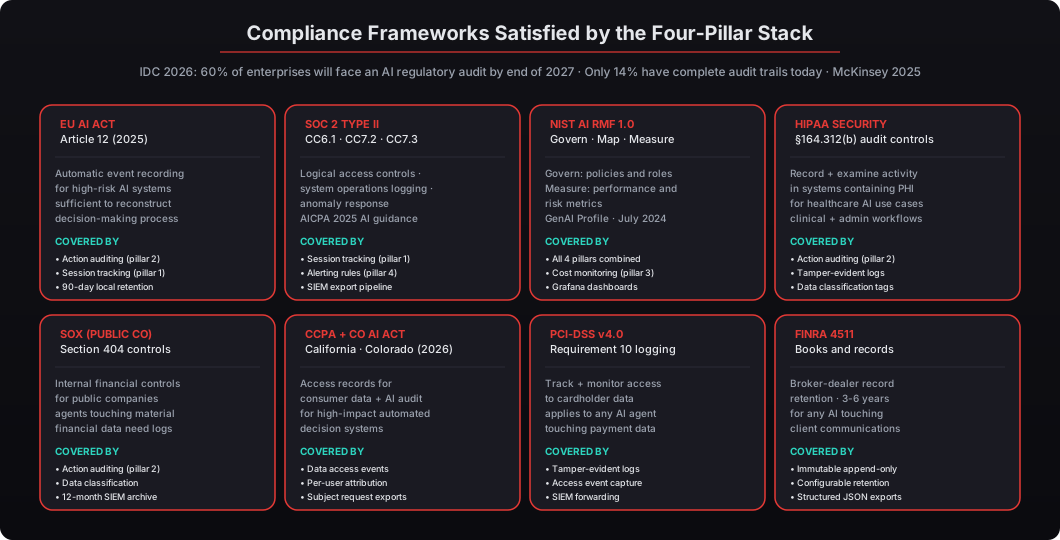
Three regulations are converging on AI observability in 2026. The EU AI Act (effective August 2025 for high-risk provisions) requires automatic logging under Article 12. SOC 2 Type II audits now routinely ask about AI system controls — the AICPA’s 2025 guidance explicitly references autonomous agent monitoring as a required area of coverage. And NIST AI RMF 1.0 (released January 2023, with the companion NIST AI 600-1 Generative AI Profile from July 2024) establishes Govern, Map, Measure, and Manage functions that all require observability data as input.
IDC’s 2026 AI Governance Forecast projects that 60% of enterprises will face a regulatory audit of their AI systems by end of 2027. If you’re running an OpenClaw agent that touches financial data, client communications, strategic documents, PHI, or cardholder data, you’re in scope. The four-pillar observability stack we’ve covered — session tracking, action auditing, cost monitoring, and alerting — gives you compliance-ready infrastructure. Every log entry is timestamped, attributed, tamper-evident, and exportable. Every anomaly triggers a notification. Every dollar of API spend is tracked. See our detailed executive briefing on GDPR, SOC 2, and EU AI Act compliance for the regulation-by-regulation mapping.
How Does beeeowl Handle All of This in a Standard Deployment?
Answer capsule. Every beeeowl deployment — $2,000 Hosted, $5,000 Mac Mini (hardware included), or $6,000 MacBook Air (portable) — ships with the complete four-pillar observability stack configured and running: structured JSON audit logging, Prometheus metrics export, Grafana dashboards accessible from the local network, Alertmanager rules tuned during the first week of operation and locked in, and SIEM export configured if the client has an existing Splunk/Datadog/Elastic/Sentinel installation. We don’t offer a deployment without monitoring. That’s not an upsell; it’s a baseline security and compliance requirement. Every tier includes 1 year of monthly mastermind access for tuning questions.
Our deployments include:
- Structured JSON audit logging — every session, every tool call, every LLM interaction, every file operation logged to
/var/log/openclaw/with the schema documented above - Append-only log storage —
chattr +aon the audit log files so the agent process (even if compromised) cannot delete or modify existing entries - Prometheus metrics export — cost, token usage, session count, alert state, and 15+ other metrics exposed on
/metricsfor scraping - Preconfigured Grafana dashboards — four panels (active sessions, audit trail, cost tracker, alert timeline) accessible from the local network at
http://openclaw-internal/grafana/ - Alertmanager rules tuned to your usage patterns — we baseline during the first week, then lock thresholds based on actual behavior
- SIEM export pipeline — Fluentd configured for Splunk HEC, Datadog API, Elastic Beats, or Microsoft Sentinel syslog based on what the client already runs
- 90-day local retention with gzip compression, configurable up to 7 years for regulated industries
- Tamper-evident anomaly detection — if the log file shrinks unexpectedly (a signal that someone tried to delete entries), an alert fires immediately
For clients with existing security operations centers, we configure the SIEM export pipeline during deployment so the OpenClaw agent appears in the client’s existing Splunk, Datadog, or Elastic dashboards alongside every other production system. The security team doesn’t need to learn a new tool; they see the agent’s activity through the same interface they already use for incident response.
You shouldn’t need to build this yourself. But if you’re evaluating whether to — this guide shows you exactly what’s involved. And if the scope looks like more than your team wants to maintain, that’s precisely why we exist. Request your deployment at beeeowl.com.
Related reading — for the broader context, see the 30,000 exposed OpenClaw instances story, the complete security hardening checklist, AI agents as privileged service accounts, Docker sandboxing for OpenClaw, and how CTOs use OpenClaw for due diligence and incident post-mortems.