CISO Briefing: How to Evaluate OpenClaw Against AWS Bedrock, Azure AI Foundry, and Google Vertex for Enterprise AI Deployment in 2026
AWS Bedrock, Azure AI Foundry, and Google Vertex are the three hyperscaler enterprise AI platforms. OpenClaw on Mac Mini is the fourth option that CISOs evaluate. Here's the structured comparison across 12 security dimensions for 2026 deployment decisions.

CISOs evaluating enterprise AI deployment in 2026 typically narrow the buying decision to three hyperscaler options — AWS Bedrock with Bedrock Guardrails and Knowledge Bases, Microsoft Azure AI Foundry (formerly Azure AI Studio, rebranded mid-2024), and Google Vertex AI with Gemini Enterprise. OpenClaw on Mac Mini is the fourth option that increasingly appears in mid-market CISO buying processes because the hyperscaler options share three structural concerns that don’t have clean cloud solutions. First, shared responsibility model boundaries that put the cloud vendor inside the trust perimeter for AI inference — which the firm cannot fully supervise during a FINRA, SEC, or HIPAA examination. Second, sovereign data residency questions for non-US firms and regulated US firms where data jurisdiction has compliance implications. Third, audit logging completeness — the cloud vendor controls log retention, log integrity guarantees, and log access in ways the firm cannot independently verify. OpenClaw on Mac Mini removes all three concerns by moving AI inference inside the firm’s physical perimeter. For mid-market CISOs (500-5,000 employees), the comparison reveals that OpenClaw matches or exceeds hyperscaler platforms on 8 of 12 security dimensions and trails meaningfully on only 2 (planetary-scale availability and multi-region failover). For executive-tier workflows where data sovereignty, supervisory clarity, and audit integrity matter more than scale, OpenClaw is the architecture CISOs increasingly choose. This article walks through the 12 dimensions, the comparison across all four options, and the buying framework we use with mid-market security teams in 2026.
Why is OpenClaw on Mac Mini even in the CISO buying conversation?
OpenClaw earns a seat at the CISO buying table because the hyperscaler enterprise AI platforms — Bedrock, Azure AI Foundry, Vertex — share three structural problems that mid-market CISOs find genuinely difficult to solve through cloud security tooling. Each problem has a name in the security operating model literature: shared responsibility ambiguity, sovereign data residency, and supervisory perimeter expansion. Each becomes acute when the AI workflow processes data classifications above “public” or “internal-general.”
I’ve sat through CISO briefings at financial services, healthcare, defense-adjacent manufacturing, and professional services firms over the last 24 months. The conversation pattern is consistent: the CISO has read AWS, Azure, and Google’s AI shared responsibility frameworks, has talked to their compliance team about how the BAA/SOC 2 scope maps to AI workflows, and has concluded that for the most sensitive workflows the cloud architecture introduces dependencies that don’t simplify the security operating model. Buy secure OpenClaw online deployments started appearing in these conversations in 2025 because the on-premises architecture resolves the structural concerns without requiring the CISO to design custom cloud security controls.
The deployment economics matter for mid-market firms. AWS Bedrock pricing at $0.001-$0.075 per 1,000 tokens of inference plus storage plus Knowledge Base hosting plus operational tooling (CloudTrail, GuardDuty, Macie for AI workflows) typically lands at $50K-$500K annually for executive-tier AI workloads at mid-market scale. OpenClaw on Mac Mini at $5,000 per executive deployment one-time, with Section 179 deductibility, scales to a 10-executive deployment at $50,000 total — one-time. The cost differential pays for additional security headcount or red team engagements that genuinely improve the firm’s overall security posture.
What does the shared responsibility model look like for enterprise AI?
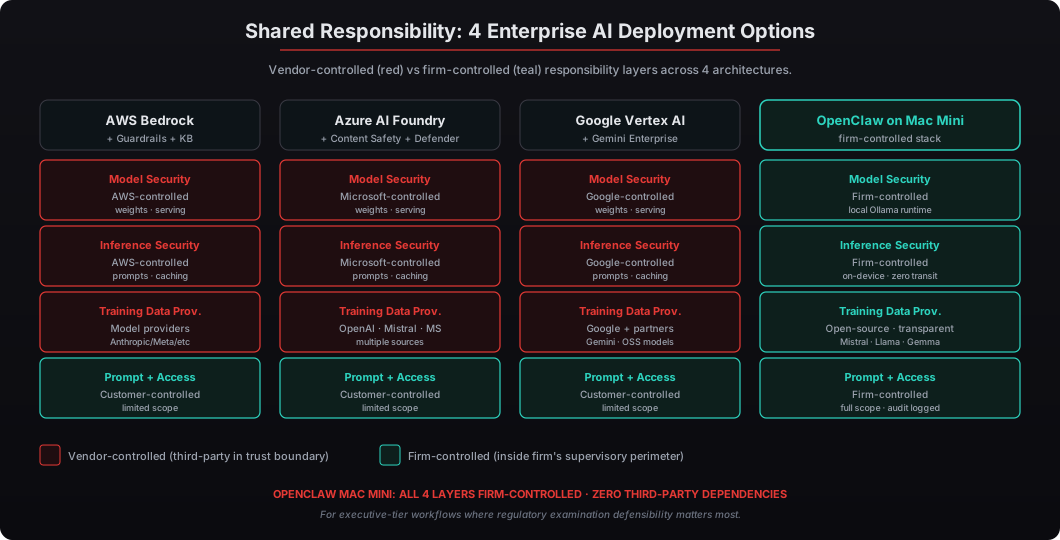
Cloud shared responsibility models traditionally put infrastructure security with the vendor and application security with the customer. AI shared responsibility adds three new layers that the traditional model doesn’t fully address.
Model security — the foundation model itself, including the model weights, the inference engine, and the model serving infrastructure. AWS controls Bedrock model serving; Azure controls Foundry model serving; Google controls Vertex model serving. The CISO cannot independently verify model integrity at runtime, cannot inspect model weight provenance, and cannot terminate vendor employee access to the inference layer.
Inference security — how prompts and outputs are processed, including transient caching, abuse monitoring, and any reserved usage of prompts for service improvement. All three hyperscalers reserve narrow rights for service improvement under specific conditions; the customer cannot fully prohibit these usages without contractual amendments that not all firms can negotiate.
Training data provenance — what the model has been trained on, including potential intellectual property exposure if the model has been trained on competitive intelligence or industry-confidential data. Foundation model providers (Anthropic, OpenAI, Meta, Google, Mistral) do not provide complete training data manifests; the CISO cannot verify that the model has not seen competitively sensitive data from competitors.
For traditional cloud workloads, the shared responsibility model is well-understood and CISO teams have operating procedures to manage it. For AI workloads, the three new layers create vendor dependencies that don’t have clean security operating procedures yet — most CISO teams are still building these procedures through 2025-2026. OpenClaw on Mac Mini moves all three layers inside the firm’s perimeter, which eliminates the new dependencies entirely at the cost of running smaller foundation models (7-13B parameters) than the largest hyperscaler offerings.
What are the 12 security dimensions CISOs actually evaluate?
The CISO buying framework for enterprise AI in 2026 typically covers 12 dimensions. Each maps to a control area the security team needs to satisfy during board reporting, regulatory examination, and incident response planning.
| Dimension | AWS Bedrock | Azure AI Foundry | Google Vertex | OpenClaw on Mac Mini |
|---|---|---|---|---|
| Shared responsibility clarity | Vendor-heavy | Vendor-heavy | Vendor-heavy | Firm-only |
| Sovereign data residency | Multi-region available | Multi-region available | Multi-region available | Firm office only |
| BAA / SOC 2 scope | Standard cloud | Standard cloud | Standard cloud | Not applicable |
| Audit log completeness | CloudTrail managed | Azure Monitor managed | Cloud Logging managed | Firm-controlled |
| IAM integration | AWS IAM native | Entra ID native | Google Workspace native | macOS user accounts |
| Model supply chain | AWS-vetted partners | Microsoft-vetted | Google-vetted + own | Open-source models |
| AI red team maturity | Established | Established | Established | Emerging |
| Prompt injection defense | Bedrock Guardrails | AI Content Safety | Safety Filters | OpenClaw sandboxing |
| MNPI / PII handling | Cloud-side filtering | Cloud-side filtering | Cloud-side filtering | Local — never transmitted |
| Supervisory perimeter | Extended to vendor | Extended to vendor | Extended to vendor | Contained at firm |
| FedRAMP / GovCloud | Yes (GovCloud) | Yes (Azure Gov) | Yes (Assured Workloads) | Not applicable |
| Total security ops cost | $200K-$2M/year | $200K-$2M/year | $200K-$2M/year | $5K one-time + ~$10K/year |
The pattern is clear. Hyperscalers win on scale (multi-region failover, planetary availability), government workload coverage (FedRAMP), and integration with existing identity/security tooling. OpenClaw wins on shared responsibility clarity, supervisory perimeter, MNPI/PII handling, and total cost of security operations. The CISO buying decision is rarely “one or the other” — it’s “which architecture for which workload tier.”
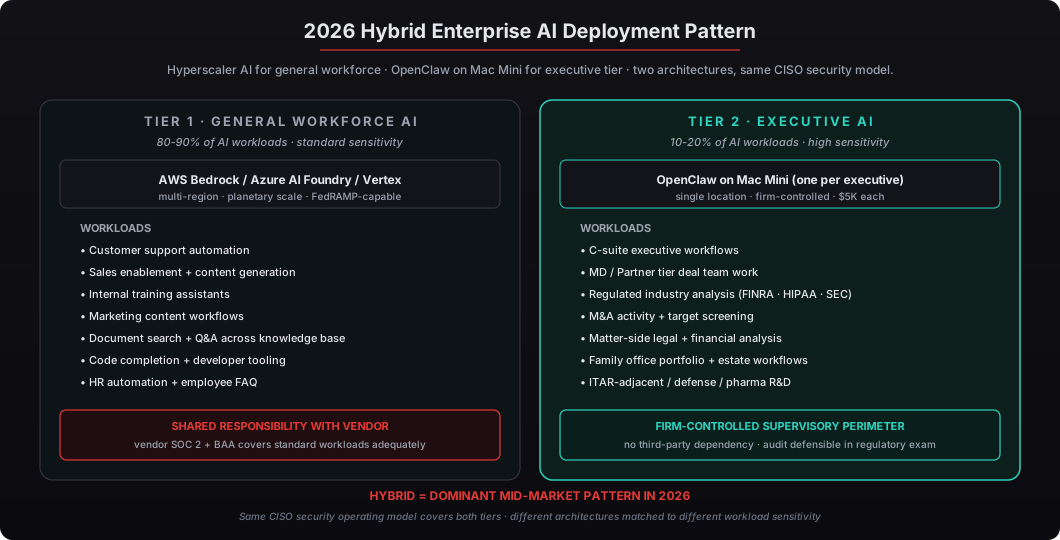
For most mid-market firms, the deployment pattern is hybrid: hyperscaler AI for high-volume, lower-sensitivity workflows (customer support, sales enablement, internal training) and OpenClaw on Mac Mini for executive-tier, high-sensitivity workflows (matter analysis, financial reporting, M&A activity, regulated industry workflows). The Mac Mini deployment covers the 10-20% of workloads where the hyperscaler shared responsibility model is hardest to defend during regulatory examination.
How does shared responsibility play out in practice during a regulatory exam?
The structural test for shared responsibility happens during regulatory examination. The CISO needs to demonstrate, on demand, that the firm controls who accesses what data, when, under which session context, with what retention, and with what supervisory oversight. For cloud AI workloads, this demonstration becomes complicated.
A FINRA examiner asks: “Show me the audit trail for AI-assisted analysis on the matter ABC dated October 15, 2025.” For cloud AI, the response involves CloudTrail logs (or Azure Monitor, or Cloud Logging), which the cloud vendor manages. The firm cannot independently verify that the logs are complete — that no entries have been deleted, that the timestamps are accurate, that the user identification ties back to the firm’s IAM with full provenance. The vendor’s SOC 2 Type II report attests to the audit log integrity, but the examiner is asking for the firm’s direct demonstration, not a third-party attestation.
For OpenClaw on Mac Mini, the response is direct. The audit logs live on the firm’s hardware, with hash-chain integrity that the firm can demonstrate at any point. The user identification ties directly to the macOS account, which ties directly to the firm’s directory. The session context, prompt history, model invocation, and output generation are all logged locally with no vendor dependency. The examiner can be shown the audit trail with the firm’s CCO or CISO walking through every entry, with no third-party reference needed.
This isn’t a hypothetical. The SEC’s 2024 risk alert on AI tool usage in investment advisory contexts specifically flagged “the customer’s ability to demonstrate supervisory control over third-party AI tools” as a focus area for upcoming examinations. The FINRA 2025 examination priorities included AI tool usage as a top-five focus. For firms in the regulatory crosshairs, the on-premises architecture is the cleanest defense.
What’s the procurement path for adding OpenClaw alongside hyperscaler AI?
Most CISOs add OpenClaw on Mac Mini as a complementary architecture rather than a replacement for hyperscaler AI. The typical deployment pattern: keep AWS Bedrock or Azure AI Foundry for general workforce productivity AI; add OpenClaw on Mac Mini for the executive tier (C-suite, MD/Partner tier, regulated workflow operators).
Procurement is straightforward. One Mac Mini per executive at the deployment tier, with Composio integrations scoped to the executive’s specific tool stack (typically Office 365 or Google Workspace + the firm’s primary document management + the executive’s preferred CRM). Each Mac Mini ships with macOS hardening, OpenClaw runtime, Mistral 7B Q4_K_M or Llama 3.1 8B local model via Ollama, Secure Enclave-backed Keychain credential storage, and audit logging with hash-chain integrity.
Buy preconfigured OpenClaw at $5,000 per executive with one-week delivery. For mid-market firms with 10-25 executive-tier users, total deployment cost lands at $50,000-$125,000. Section 179 tax deduction makes the after-tax cost approximately $32,500-$81,250 in the 35% federal bracket. The deployment integrates with the firm’s existing security operating procedures — macOS hardening fits standard endpoint security baselines, the audit logs ship to the firm’s SIEM via standard syslog integration, and the Keychain credential storage uses the same Apple Secure Enclave that protects TouchID and FileVault.
When is OpenClaw definitively NOT the right answer?
OpenClaw on Mac Mini is structurally wrong for three categories of workload. CISOs should not consider it for:
-
Federal civilian agency, DoD impact level 4-6, or intelligence community workloads — these require FedRAMP authorization, which OpenClaw does not have. AWS GovCloud, Azure Government, or Google Cloud Assured Workloads are the right architectures.
-
Customer-facing AI at planetary scale — chatbots serving millions of end users need multi-region failover and 99.999% uptime that single-location Mac Mini cannot provide. AWS Bedrock, Azure AI Foundry, or Google Vertex are the right architectures.
-
Foundation model training or fine-tuning workloads — Mac Mini handles inference well but is not built for training. Training requires NVIDIA H100/H200 clusters or equivalent.
For everything between these three categories — which is most enterprise AI workloads for most mid-market firms — OpenClaw on Mac Mini sits in the architecture buying decision alongside the hyperscalers. The CISO’s job is to map each workload tier to the appropriate architecture, document the security operating procedure for each tier, and ensure that the firm’s overall security posture covers all tiers with appropriate controls.
For mid-market CISOs evaluating their 2026 enterprise AI deployment, the hybrid pattern — hyperscaler for general workforce, OpenClaw for executive tier — is the dominant model we see in actual firm deployments. Order OpenClaw system with one Mac Mini per executive, one-week delivery, fully configured with the firm’s existing IAM and audit logging integration. Standard $5,000 per deployment, Section 179 deductible in year one, no recurring per-token cost, and no vendor in the shared responsibility model trust boundary.