The Architecture, Engineering & Construction Firm AI Buying Guide: Protecting Design IP and Client Drawings on Private Hardware
AEC firms handle design IP, structural calculations, and client-confidential drawings that cannot go through cloud AI for IP protection, ITAR dual-use exposure, and engineer-of-record liability reasons. Here's the private AI deployment guide for 30-150 person AEC practices in 2026.

Architecture, Engineering, and Construction firms generate design intellectual property that includes structural calculations, Building Information Modeling (BIM) files, environmental analyses, site assessments, and client-confidential drawings under NDA. Three structural problems with cloud AI — design IP leakage into training corpora, ITAR-adjacent dual-use exposure under 22 CFR Parts 120-130, and engineer-of-record liability questions — combine to make cloud AI platforms unsuitable for matter-side AEC workflows in the way they’re unsuitable for investment banking deal team work. The American Institute of Architects released 2024 guidance advising firms to obtain explicit written client consent before processing project documents through cloud AI, adding a procedural burden that scales poorly across an active project portfolio. Private OpenClaw on Mac Mini hardware solves all three problems for $5,000 per principal engineer or design partner. The configuration runs Mistral 7B or Llama 3.1 8B locally for design IP analysis, handles document workflows around Revit, AutoCAD, and Civil 3D files without uploading model data to cloud infrastructure, and supports Composio integrations to Box, Procore, BIM 360, SharePoint, and standard project management systems. For a 50-person AEC firm with 8 principals, total deployment cost lands at $40,000 — Section 179 tax treatment drops the after-tax cost to approximately $26,000 in the 35% federal bracket. This article is the AEC-specific buying guide: the IP and liability framework, the workflows that genuinely benefit from private AI, the comparison against Autodesk Construction Cloud AI and Bentley iTwin AI, and the procurement path for principals at 30-150 person architecture, engineering, and construction firms.
Why is cloud AI structurally problematic for AEC firms?
Three problems combine to make cloud AI architecturally unsuitable for AEC matter-side work. First, design IP protection — Autodesk and Bentley both reserve broad rights for AI service improvement in their cloud AI Terms of Service, which creates legitimate concerns for firms with proprietary structural systems, unique architectural detail libraries, or competitive design approaches that constitute the firm’s actual competitive advantage. Second, ITAR-adjacent dual-use exposure — AEC firms working on defense facilities, energy infrastructure, nuclear sites, telecommunications backhaul, and other dual-use sectors face 22 CFR Parts 120-130 export control obligations. Cloud AI vendor BAAs and addenda explicitly exclude ITAR-controlled technical data in most cases, meaning these firms cannot use cloud AI on project data without breaking export control compliance. Third, engineer-of-record liability — the engineer who signs and seals the drawings must demonstrate complete supervisory control over analytical tools used in the design record, which is legally awkward when the analysis runs on third-party infrastructure where the firm cannot inspect, control, or terminate vendor access.
I’ve spent the past year in AEC firm conversations across the US Northeast, Midwest, and West Coast. The pattern is the same as in investment banking and law: every firm wants AI productivity, and every general counsel or risk manager has spent 2024-2025 documenting why cloud AI cannot process client project data without raising structural problems. The firms that move first are the ones that figure out private deployment — and for AEC, the Mac Mini OpenClaw configuration is the only architecture that fits the mid-market firm cost envelope while satisfying the IP, ITAR, and liability constraints simultaneously. Buy preconfigured OpenClaw ships one Mac Mini per principal within one week, configured for AEC matter-side work.
The AIA guidance from 2024 is worth reading in full. The Document Committee — the body that maintains standard AIA contracts (A101, B101, and related forms used by most US AEC firms) — explicitly noted that standard AIA contracts do not implicitly authorize cloud AI processing of client confidential information. The recommendation: disclose any AI tool usage to clients as part of standard engagement terms and obtain explicit written consent before processing project documents through cloud AI services. The procedural burden — per-project consent letters, AI tool disclosure schedules, ongoing audit obligations to clients — adds friction to every engagement and makes cloud AI a net negative for many firms once the compliance overhead is factored in.
What AEC workflows actually benefit from private AI on Mac Mini?
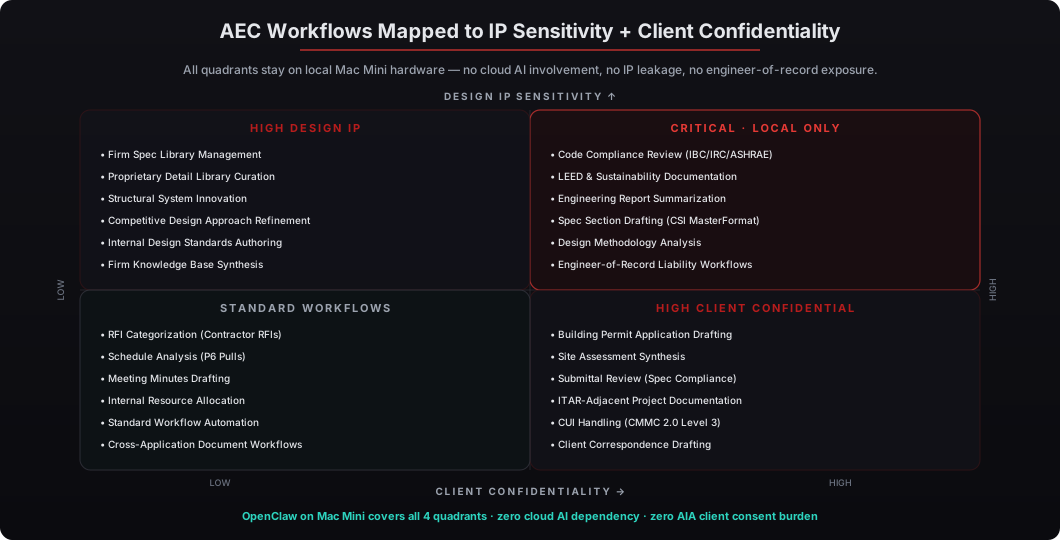
Eight workflow categories drive most AEC private AI adoption. Each is high-frequency, document-heavy, and touches project data that should not leave the firm for IP or liability reasons.
| Workflow | Frequency | Document Type | Why Private AI |
|---|---|---|---|
| Code compliance review (IBC/IRC/ASHRAE/state) | Per design | Specifications + drawings | Firm IP + engineer liability |
| Building permit application drafting | Per project | Specifications + zoning | Client-confidential |
| LEED/sustainability documentation | Per certification | Energy models + analyses | Firm methodology IP |
| RFI categorization and response drafting | Daily during CA | Contractor RFI logs | Project communications |
| Submittal review with spec compliance | Per submittal | Contractor submittals | Spec interpretation |
| Specification section drafting (CSI MasterFormat) | Per section | Firm spec library | Firm IP — competitive |
| Engineering report summarization | Per deliverable | Analyses + reports | Engineer liability |
| Site assessment synthesis | Per site | Environmental + surveys | Client-confidential + ITAR-adjacent |
Code compliance review is the workflow that drives most initial adoption. Every design phase requires verification against IBC (International Building Code), IRC (International Residential Code), ASHRAE energy standards, state-specific building codes, and increasingly, climate resilience requirements (IBC Appendix N, ASCE 7 wind loads, FEMA floodplain standards). A senior engineer spends 15-30% of their time on code compliance research and review. Private AI agents that handle this workflow on local hardware — with the firm’s own annotated code library, project-specific scope, and engineer’s review at every step — typically compress that 15-30% time allocation to 5-8% without compromising the engineer’s analytical control over the result.
For firms running 50-100 active projects at any given time, the productivity gain is meaningful. The economics support the deployment cost trivially: for a $50,000/year engineer spending 20% of time on code review, recovering even half of that productivity returns $5,000/year per engineer — paying back the Mac Mini hardware in one year per principal.
How does this compare to Autodesk Construction Cloud AI and Bentley iTwin AI?
Autodesk Construction Cloud AI (rolled out 2024-2025) and Bentley iTwin AI provide vendor-native AI features integrated with the firm’s existing AEC software stack. Autodesk’s AI features include automated coordination assistance, clash detection summarization, document categorization within Construction Cloud, and integration with Revit-based workflows. Bentley’s iTwin AI provides similar capabilities for civil engineering and infrastructure projects in OpenRoads, OpenBuildings, and the iTwin platform.
These vendor-native tools are useful for workflows that stay inside the vendor’s tooling — coordinating BIM coordination meetings, summarizing model clashes, organizing the document library. The gap is two-fold. First, workflows that cross application boundaries: project communications, RFI handling, code research, client correspondence, specification drafting outside the model files. These don’t fit naturally inside Autodesk or Bentley’s tools because they involve project artifacts (emails, RFIs, specifications) that live elsewhere. Second, workflows that involve confidential design IP that the firm doesn’t want feeding into the vendor’s AI training pipeline — the unique structural systems, proprietary detail libraries, and competitive design approaches that represent the firm’s actual competitive moat.
| Capability | Autodesk Construction Cloud AI | Bentley iTwin AI | OpenClaw on Mac Mini |
|---|---|---|---|
| Revit coordination automation | Yes (native) | No | Limited (document-side only) |
| OpenRoads/OpenBuildings integration | No | Yes (native) | Limited (document-side only) |
| Code compliance research | Limited | Limited | Strong — local LLM + firm code library |
| RFI categorization (cross-app) | Limited | Limited | Strong — Composio integration |
| Specification drafting | Limited | Limited | Strong — local LLM + firm spec library |
| Client correspondence drafting | No | No | Strong — local LLM + Outlook integration |
| Design IP isolation | No (training pipeline) | No (training pipeline) | Strong — data stays on Mac Mini |
| ITAR compliance | Limited | Limited | Strong — air-gap capable |
Most AEC firms we work with run both. Vendor AI handles in-software automation for the Revit/AutoCAD/Civil 3D workflows where it adds the most value. OpenClaw handles the cross-application document workflows, the confidential IP analysis, and the workflows where engineer-of-record liability matters. Buy OpenClaw system for one Mac Mini per principal, shipped within one week.
What about firms working on government, defense, or critical infrastructure?
AEC firms working on government, defense, or critical infrastructure projects face ITAR (22 CFR Parts 120-130) export control obligations and often Controlled Unclassified Information (CUI) requirements under NIST SP 800-171 or the emerging CMMC 2.0 framework if the project involves Department of Defense work. CISA’s 2024 critical infrastructure guidance added specific provisions for AI tool usage in design and engineering workflows for the 16 critical infrastructure sectors.
Cloud AI cannot satisfy ITAR’s US-persons-only access requirements without significant additional contractual safeguards. Most cloud AI vendor BAAs and addenda explicitly exclude ITAR-controlled technical data, meaning firms processing export-controlled designs through cloud AI face direct compliance exposure. The penalties for ITAR violations are severe — civil fines up to $500,000 per violation, criminal penalties including imprisonment, and debarment from federal contracting. For AEC firms with even 5-10% of revenue from defense-adjacent or critical infrastructure work, the ITAR exposure alone justifies private deployment.
Private OpenClaw on Mac Mini, configured for air-gap or controlled-access operation, is the architecture that defense-adjacent AEC firms actually deploy. The hardware sits in a controlled-access room — typically the same room where the firm’s defense contract drafting happens, often the principal-in-charge’s private office or a dedicated SCIF-adjacent workspace. The data never leaves, the ITAR compliance story is one sentence (“the controlled technical data lives in hardware we physically possess”), and the deployment satisfies CMMC 2.0 Level 3 requirements for the most sensitive workflows. Our air-gapped OpenClaw configuration guide covers the defense-specific deployment pattern in detail.
What does the deployment architecture look like for a 50-person AEC firm?
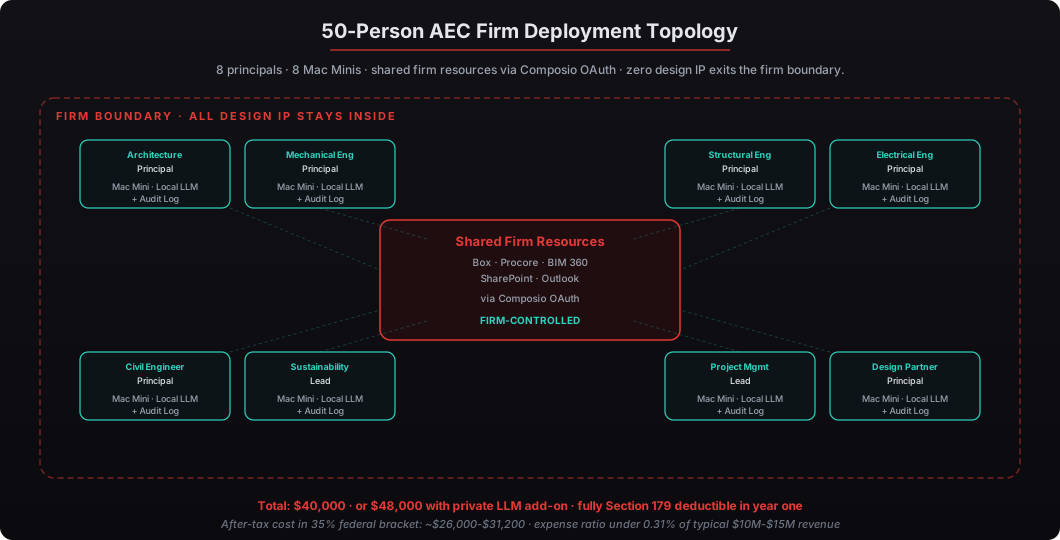
The standard deployment is one Mac Mini per principal engineer or design partner. For a 50-person firm with a typical partnership structure of 8 principals (architects, mechanical engineers, structural engineers, electrical engineers, civil engineers, sustainability lead, project management lead, and design partner), that’s 8 Mac Mini deployments. Each principal has full agent access for their discipline workflows, with Composio integrations scoped to their project portfolio.
Each deployment includes:
- OpenClaw runtime on macOS with hardened configuration, Docker sandboxing for skill isolation, and launchd-managed auto-start
- Local LLM via Ollama running Mistral 7B Q4_K_M for matter-side reasoning — design IP and project data never leaves the Mac Mini
- Composio OAuth credential vault stored in macOS Keychain (Secure Enclave-backed) for the principal’s Box, Procore, BIM 360, SharePoint, Outlook, and any firm-specific project management system
- Audit log with tamper-evident hash-chain integrity for engineer-of-record liability defensibility
- Firm code library loaded as agent reference for code compliance workflows — annotated IBC, ASHRAE, state-specific codes, and project-specific authority having jurisdiction (AHJ) interpretations
For 8-principal firms, total deployment cost lands at $40,000 (8 × $5,000). With the on-device LLM add-on ($1,000 each) for IP-sensitive workflows, the total rises to $48,000. Section 179 tax treatment makes the deployment fully deductible in the year placed in service — after-tax cost in the 35% federal bracket lands around $26,000-$31,200. For firms generating $10M-$15M in annual revenue, the expense ratio sits between 0.17% and 0.31% — well within the typical IT and software expense budget for AEC firms of this size.
What about smaller firms — 10-30 person practices?
Smaller AEC firms typically deploy fewer Mac Minis with concentrated principal access. A 12-person architecture firm might deploy 2-3 Mac Minis — one for the principal-in-charge, one for the project architect lead, and optionally one for the sustainability/design technology lead if the firm runs that function in-house. Total deployment cost: $10,000-$15,000. Section 179 deduction makes the after-tax cost approximately $6,500-$9,750.
For these smaller firms, the deployment math is even more favorable. The principal’s time is the firm’s single most expensive resource — typically $200-$400/hour billable rate. If private AI returns 5-10 hours per week of senior productivity (which is conservative for AEC code research and document workflows), the deployment pays back in 4-8 weeks. After that, every additional hour is pure margin improvement.
The minimum viable deployment for a small AEC practice is one Mac Mini for the principal. We’ve worked with sole-practitioner architects and one-person structural engineering firms where a single Mac Mini handles their entire AI workflow needs. Order OpenClaw system at the $5,000 tier with the on-device LLM add-on ($1,000) for $6,000 total — fully deductible under Section 179 in the year placed in service.
What does ongoing operation look like — IT burden, updates, support?
The IT burden for Mac Mini OpenClaw deployments is minimal. Most AEC firms in the 30-150 person range have either a small in-house IT team (1-3 people) or a managed services provider relationship for desktop, server, and network support. The Mac Mini deployment fits naturally into either model.
Updates happen through standard macOS Software Update for OS-level patches and through beeeowl-shipped quarterly OpenClaw runtime updates. The runtime updates are delivered as signed packages that the firm’s IT or MSP can review before deployment. We provide release notes, breaking change documentation, and a rollback path for every update.
Support is included through the year-one mastermind access — monthly group calls where principals and IT teams share workflow patterns, troubleshooting tips, and new skill development. Beyond year one, firms can extend the mastermind access annually if they find the community valuable. Most firms also add a beeeowl support contract for direct technical support, which is priced by deployment count.
Backup and disaster recovery uses standard Time Machine for system-level backup and our shipped OpenClaw backup tooling for project-specific configuration backups. For firms with disaster recovery requirements (HIPAA-adjacent healthcare facility designers, defense contractors with CMMC requirements), we configure the Mac Mini for off-site encrypted backup to firm-controlled NAS or storage infrastructure. The backup is encrypted with keys held only by the firm — beeeowl has no access to the firm’s project data at any point in the deployment lifecycle.
For AEC firms ready to evaluate private AI for design IP protection, ITAR compliance, and engineer-of-record liability defensibility, the Mac Mini OpenClaw configuration is the architecture that matches your actual constraints. Order OpenClaw system with one Mac Mini per principal, the on-device LLM add-on for IP-sensitive workflows, and Composio integration for the firm’s project management stack. Standard delivery is one week from order, with Section 179 tax treatment available in the year placed in service.