EU AI Act Phase 3 Deadline (August 2026): What US Multinationals With European Operations Must Do Before Q3
August 2, 2026 brings the EU AI Act's high-risk system obligations into force. US firms with EU customers, EU employees, or EU-resident decision subjects face €35M or 7% global turnover penalties for non-compliance. Here's the deployment guide for US multinationals.


The EU AI Act enters its third and most extensive phase of applicability on August 2, 2026. Phase 3 brings the high-risk AI system obligations into force under Article 6 and Annex III — covering AI used in employment decisions, education and vocational training, access to essential private services (banking, insurance, credit scoring), access to essential public services, law enforcement, migration and border control, and administration of justice. US multinationals are squarely in scope under Article 2’s extraterritorial reach: any AI system ‘placed on the EU market’ or ‘whose output is used in the Union’ triggers obligations regardless of where the AI provider is located. The penalty structure is severe — up to €35M or 7% of global turnover for prohibited practice violations, €15M or 3% for high-risk system non-compliance, and €7.5M or 1.5% for incorrect information to competent authorities. For a $2B revenue US multinational, that’s approximately $140M maximum exposure per prohibited practice violation and $60M per high-risk obligation violation. For US multinationals with European employees, customers, or decision subjects, the most defensible compliance architecture is private AI deployment that keeps EU-affecting AI workflows on hardware physically located inside the EU or under clear firm control with documented data flow boundaries. This article walks through the Phase 3 timeline, the high-risk system definitions, the eight Article 6 obligations, the practical compliance gap analysis US firms face between May and August 2026, and the private AI deployment pattern we ship for multinationals running OpenClaw on Mac Mini in EU offices.
What does the EU AI Act Phase 3 deadline on August 2, 2026 actually require?
Phase 3 brings Article 6 high-risk AI system obligations into full applicability. The Act’s phased applicability timeline is: February 2, 2025 — prohibited practices under Article 5 take effect (social scoring, manipulative AI, biometric categorization based on sensitive attributes); August 2, 2025 — general-purpose AI (GPAI) model obligations under Article 53 take effect; August 2, 2026 — full applicability for high-risk AI systems under Articles 6-49; August 2, 2027 — extended obligations for high-risk AI systems already on the market before August 2026.
Phase 3 is the deadline that captures most US multinational AI workloads. High-risk systems are defined in Annex III of the Act and cover AI used in seven categories of high-risk use cases:
- Employment, workers management, and access to self-employment — recruitment, candidate screening, performance evaluation, task allocation, promotion, termination
- Education and vocational training — admissions decisions, candidate scoring, assessment of learning outcomes, anti-cheating systems
- Access to and enjoyment of essential private services — credit scoring, insurance pricing and risk assessment, banking customer eligibility
- Access to essential public services and benefits — eligibility for public assistance, emergency services dispatch
- Law enforcement — risk assessment of natural persons, evidence evaluation, predictive policing (with significant constraints)
- Migration, asylum, and border control management — visa decisions, asylum risk assessment, border security risk
- Administration of justice and democratic processes — judicial decision support, electoral system AI
Each high-risk system must meet eight specific obligations under Articles 9-17 plus undergo conformity assessment under Article 43 before placement on the market. The conformity assessment typically requires third-party assessment for the most sensitive high-risk applications.
I’ve spent the past six months in multi-national compliance team conversations about Phase 3 preparation. The pattern is consistent: large firms with established EU operations and dedicated EU compliance teams are reasonably well-prepared; mid-market US multinationals with smaller EU footprints (50-500 EU employees) are materially behind on the assessment and remediation timeline. For the latter group, the order OpenClaw system configuration deployed in EU offices is the architecture that simplifies the compliance documentation most cleanly.
Does the EU AI Act apply to US companies that have never sold in Europe?
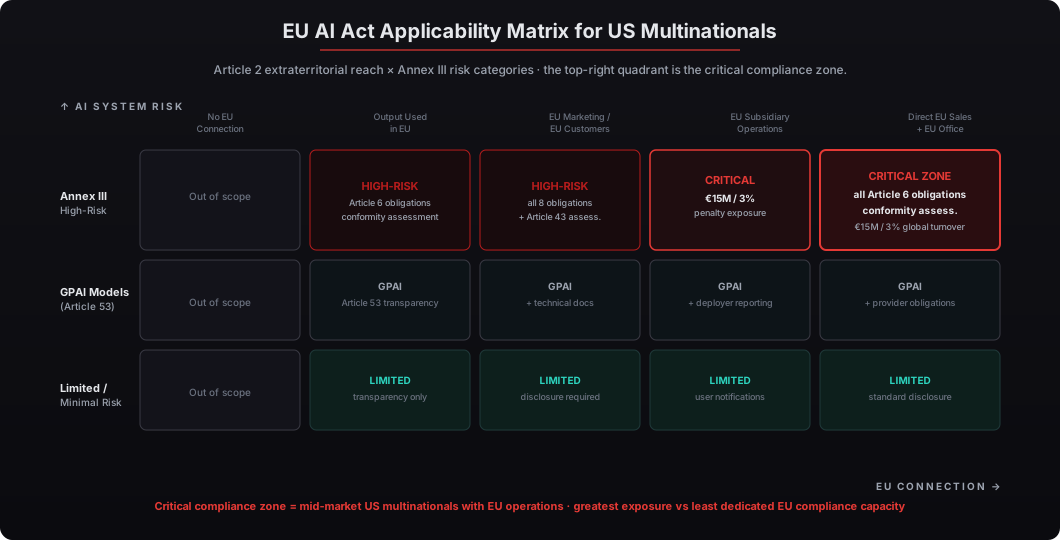
The Act’s extraterritorial reach is genuinely broad. Article 2 covers AI systems “placed on the market in the Union, put into service in the Union, or whose output is used in the Union” regardless of where the provider is established. US firms with European customers, European employees, European-resident decision subjects (anyone the AI system makes decisions about who is located in the EU), or whose AI system output is used by an EU-based deployer all fall under the Act.
For US multinationals, this typically captures:
- HR systems that include European employees — any candidate screening, performance evaluation, or workforce analytics AI that touches EU-resident staff
- Customer service systems with European customers — chatbots, support automation, and customer routing AI that interact with EU residents
- Marketing and advertising systems targeting European users — recommendation engines, ad targeting, content personalization affecting EU residents
- Financial decisioning systems with European counterparties — credit scoring, transaction risk, fraud detection involving EU customers
- Insurance underwriting systems for European policyholders — risk pricing, claims processing affecting EU residents
- Healthcare AI affecting European patients — diagnostic decision support, treatment recommendation systems
The output-used-in-Union test is particularly broad. An AI system operated entirely in the US whose recommendations are used by an EU-based deployer (an EU subsidiary, EU partner firm, EU consultant) triggers Act obligations. The supply chain framing of the Act means many B2B AI providers find themselves in scope because their customer’s deployers happen to be EU-based.
What are the eight Article 6 compliance obligations for high-risk AI systems?
The Article 6 obligations are extensive and specific. Each must be documented, maintained throughout the system lifecycle, and produced on demand during competent authority examination.
| Article | Obligation | Practical Implementation |
|---|---|---|
| Article 9 | Risk management system | Documented risk identification, evaluation, mitigation, lifecycle review |
| Article 10 | Data governance | Training data quality, representativeness, bias documentation, data minimization |
| Article 11 | Technical documentation | Architecture, components, data flows, intended use, performance metrics |
| Article 12 | Record-keeping | Automatic event logging, log integrity, retention through system lifecycle |
| Article 13 | Transparency to deployers | Instructions for use, capabilities/limitations disclosure |
| Article 14 | Human oversight | Designed-in human review capability, intervention mechanisms |
| Article 15 | Accuracy, robustness, cybersecurity | Performance benchmarks, robustness testing, security controls |
| Article 17 | Quality management system | Compliance strategy, post-market monitoring, incident response |
Plus Article 43 conformity assessment before placement on the market, typically requiring third-party assessment for the most sensitive high-risk systems.
For US multinationals running cloud AI on high-risk workloads, satisfying these obligations requires extensive documentation of vendor architecture, vendor data flows, vendor training data provenance, and vendor security controls. The documentation effort is substantial because the cloud architecture spans multiple vendor systems, regions, and contractual relationships.
For US multinationals running OpenClaw on Mac Mini in EU offices, the documentation is materially simpler. The architecture is contained: one Mac Mini per executive, local model inference, on-device audit logs, documented Composio integrations with specific OAuth scopes. The Article 10 data governance documentation references open-source model cards (Mistral 7B, Llama 3.1 8B, Gemma 4) which provide upstream training data provenance. The Article 12 record-keeping is satisfied by OpenClaw’s hash-chain audit logs that the firm directly controls. The Article 11 technical documentation describes a single-tenant, single-location architecture rather than a multi-vendor, multi-region cloud topology.
Buy OpenClaw system deployments for US multinational EU offices include EU-specific compliance documentation as part of the standard configuration — a Phase 3 readiness package that maps each obligation to specific architectural elements the firm can demonstrate during competent authority examination.
What are the actual penalties under the EU AI Act?
Article 99 establishes three penalty tiers. The headline numbers are large enough to materially affect any US multinational’s annual financial reporting.
| Penalty Tier | Max Penalty | Applicable Violations |
|---|---|---|
| Article 5 prohibited practices | €35M or 7% global turnover | Social scoring, manipulative AI, biometric categorization on sensitive attributes |
| Article 6-43 high-risk obligations | €15M or 3% global turnover | Failure to meet Article 6 obligations, conformity assessment failures |
| Misleading information to authorities | €7.5M or 1.5% global turnover | Incorrect, incomplete, or misleading information to competent authorities |
For a $2B revenue US multinational:
- Maximum prohibited practice violation: $140M
- Maximum high-risk obligation violation: $60M
- Maximum misleading information violation: $30M
EU member states designate competent authorities with enforcement powers. Initial enforcement is expected to focus on prohibited practices and the largest high-risk system providers. Mid-market US multinationals are not expected to be early enforcement targets, but the penalty exposure becomes meaningful by 2027-2028 as competent authorities establish examination cadence and enforcement priorities.
The European Data Protection Board (EDPB) has issued guidance suggesting that AI Act compliance and GDPR compliance will be examined in coordinated fashion, with overlap on data governance (Article 10) and data subject rights provisions. For US multinationals already subject to GDPR enforcement, the AI Act layer extends the supervisory framework without entirely new infrastructure.
What’s the practical timeline for US multinationals to achieve compliance by August 2, 2026?
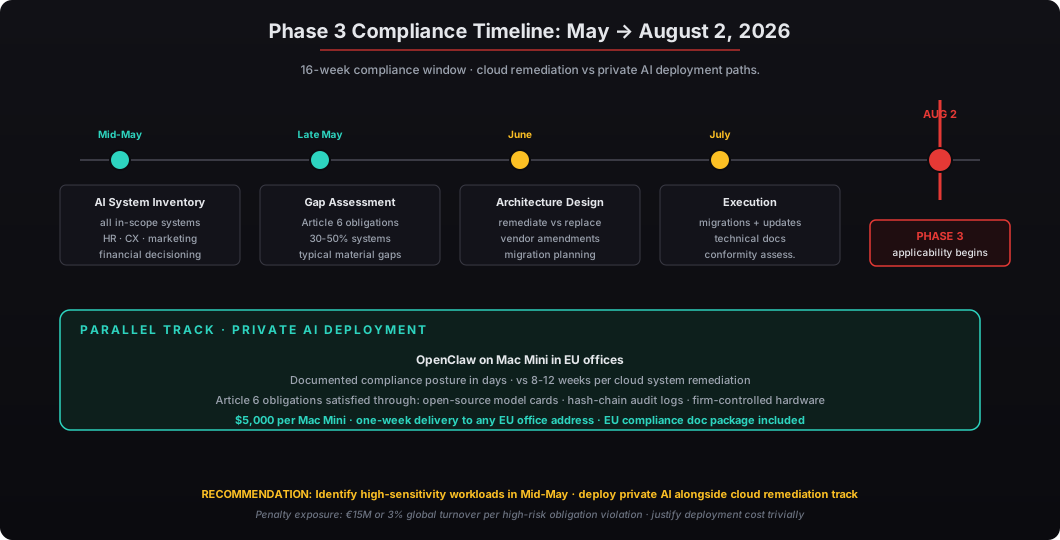
The compliance window is tight but achievable for firms that start in May 2026. The realistic timeline:
Mid-May 2026 (NOW): Complete high-risk AI system inventory. Identify every AI system that touches EU employees, customers, decision subjects, or output users. For US multinationals with established EU operations, this typically takes 2-4 weeks of dedicated compliance team effort. Mid-market firms often discover 15-25 in-scope AI systems they hadn’t previously catalogued — primarily SaaS tools embedded in HR, customer service, and marketing functions.
Late May 2026: Assess each system against Article 6 obligations. Identify compliance gaps for each high-risk system. The assessment typically reveals that 30-50% of in-scope systems have material gaps — usually around data governance documentation (Article 10), training data provenance, or human oversight design (Article 14).
June 2026: Design compliance architecture. For systems that can be remediated through additional documentation, contract amendments with vendors, or configuration changes, document the eight Article 6 obligations. For systems that cannot be remediated cleanly — typically because the vendor cannot provide adequate documentation or because the architecture is fundamentally incompatible with Article 6 — consider replacement with EU-compliant alternatives or restriction of EU use.
July 2026: Execute migrations and updates. Complete technical documentation, conduct conformity assessment where required (typically third-party assessment for the most sensitive systems). Train EU staff on operating procedures.
August 2, 2026: Phase 3 applicability begins. Firms with complete compliance posture are ready for competent authority examination. Firms with conditional compliance accept residual risk and continue remediation through Q4 2026.
For US multinationals where the in-scope AI workload includes executive workflows, M&A activity, financial analysis, or other high-sensitivity functions, the private AI deployment pattern is materially simpler than retrofitting cloud AI for Article 6 compliance. OpenClaw on Mac Mini deployed in EU offices, with one device per executive, provides a documented compliance posture in days rather than the 8-12 weeks typical for cloud AI compliance remediation.
What does the deployment look like for US multinationals with EU offices?
The standard configuration is one Mac Mini OpenClaw deployment per executive in each EU office, deployed within one week with EU-specific compliance documentation. For a typical mid-market US multinational with 3 EU offices (London, Frankfurt, Paris) and 4-6 executive-tier users per office, the deployment scales to 12-18 Mac Minis total.
Each deployment includes:
- Mac Mini M4 Pro hardware deployed at the executive’s EU office address, with documented physical location for Article 11 technical documentation
- macOS hardening with FileVault, Gatekeeper, SIP, and Secure Enclave-backed Keychain credential storage
- OpenClaw runtime with Docker sandboxing, hash-chain audit logging for Article 12 record-keeping, and approval gates for Article 14 human oversight
- Local LLM via Ollama with Mistral 7B Q4_K_M, Llama 3.1 8B, or Gemma 4 — all open-source models with documented training data provenance for Article 10 data governance
- Composio integration with EU-region OAuth scopes for the executive’s tool stack (typically Office 365 or Google Workspace EU instances)
- EU compliance documentation package mapping each Article 6 obligation to specific architectural elements
Total cost for a 15-Mac Mini deployment lands at $75,000-$90,000 depending on private LLM add-on inclusion. Section 179 tax deduction is US-side; EU-side tax treatment varies by member state but generally allows accelerated depreciation for capital equipment. For US multinationals with 8-figure annual EU revenue, the Phase 3 compliance investment is a 0.5-1% expense ratio against EU revenue and a fraction of the maximum penalty exposure under Article 99.
For US multinationals approaching Phase 3 with significant compliance work ahead, buy secure OpenClaw online for EU office deployment is the architecture that simplifies the documentation burden most cleanly. Standard delivery is one week to any EU office address, with the EU compliance documentation package included in the deployment. For multinationals with EU operations that processed AI-assisted decisions in 2025, order OpenClaw system deployments are typically the fastest path to documented Phase 3 readiness before the August 2, 2026 deadline.