The Independent RIA AI Playbook: How $50M-$500M Registered Investment Advisors Deploy Private AI Under SEC Marketing Rule, Fiduciary Duty, and Amended Reg S-P
RIAs in the $50M-$500M AUM range face SEC Marketing Rule, fiduciary duty, and amended Reg S-P obligations that make cloud AI structurally awkward. Private OpenClaw on Mac Mini is the deployment pattern that satisfies all three at $5,000 per principal.

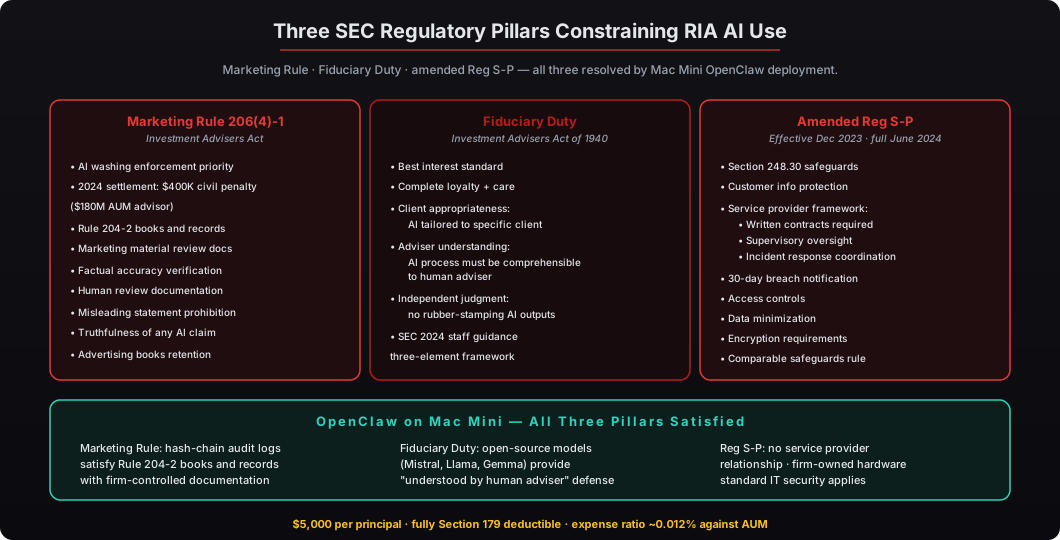
Registered Investment Advisors in the $50M-$500M AUM range sit in a regulatory sweet spot where private AI deployment makes overwhelming sense. They’re large enough to afford a $5,000 hardware purchase per principal, small enough to lack a dedicated in-house IT and security engineering team, and squarely subject to three SEC regulatory frameworks that make cloud AI structurally awkward for client-facing workflows: the SEC Marketing Rule (Rule 206(4)-1), fiduciary duty under the Investment Advisers Act of 1940, and amended Regulation S-P with full compliance required since June 2024. The SEC’s 2024 AI Risk Alert specifically flagged “AI washing” — claiming AI capabilities the firm doesn’t actually have — as a Marketing Rule enforcement priority, with the first AI-related Marketing Rule settlement landing in late 2024 against a $180M AUM advisor. For a typical 4-principal RIA managing $200M AUM, total Mac Mini OpenClaw deployment cost lands at $20,000-$24,000 — a 0.01-0.012% expense ratio against AUM and approximately one quarter’s portion of annual compliance budget. Section 179 tax treatment makes the after-tax cost approximately $13,000-$15,600 in the 35% federal bracket. This article walks through the SEC regulatory framework, the workflows that drive RIA private AI adoption, and the deployment configuration we ship for RIAs running OpenClaw alongside their portfolio management and CRM systems.
Why is the $50M-$500M AUM range the sweet spot for private AI deployment?
The $50M-$500M AUM RIA segment combines three properties that drive the deployment math. First, the AUM tier produces enough revenue (typically $500K-$5M in annual advisory fees at 1% blended fee rate) to justify capital expenditure on tools that improve advisor productivity. Second, the firm size — typically 4-15 total staff including 2-6 principal advisors — is too small for dedicated in-house IT or security engineering. The firm relies on outsourced IT support, off-the-shelf compliance technology, and the principals doing their own tool selection. Third, the regulatory framework — SEC registration with the home-state plus SEC if AUM exceeds the $100M-$125M federal registration threshold — creates ongoing compliance obligations that scale faster than headcount.
I’ve worked with RIA principals across the US Mountain West, Texas, and Southeast over the past year. The pattern is consistent: every principal wants AI productivity, every principal has personally tried ChatGPT or Claude for client portfolio analysis, and every principal has eventually concluded that the cloud AI tools create more compliance work than they save. The boutiques that move first are the ones that identify private deployment as the structural answer. For RIAs at this AUM scale, the buy preconfigured OpenClaw configuration deployed one Mac Mini per principal is the architecture that fits the cost envelope and the regulatory framework simultaneously.
The deployment economics are favorable. A 4-principal RIA at $200M AUM typically generates $2M in annual advisory fees, with principal compensation in the $400K-$600K range and operating margin around 25-35% depending on the firm’s expense structure. The $20,000-$24,000 deployment cost is approximately 1-1.2% of revenue, 8-12% of one principal’s annual compensation, and 0.01-0.012% of AUM. Section 179 treatment makes the after-tax cost approximately $13,000-$15,600 — the equivalent of one principal taking a long weekend off rather than billing client time.
Why is the SEC Marketing Rule a structural problem for cloud AI?
The Marketing Rule (Rule 206(4)-1) prohibits investment advisers from making any untrue statement of material fact or any misleading statement of material fact in any advertisement. The Rule applies broadly to all firm communications that could reasonably be expected to receive a response from a prospective client — websites, social media, email marketing, client letters, podcast appearances, conference presentations, anything that could be construed as advertising the firm’s services.
AI-generated marketing content creates two distinct compliance problems under the Marketing Rule.
AI washing — claiming AI capabilities the firm doesn’t actually have, or overstating AI sophistication in marketing materials. The SEC has flagged AI washing as an enforcement priority since the 2024 AI Risk Alert. The first AI-related Marketing Rule settlement (late 2024, $180M AUM advisor) involved a firm that claimed proprietary AI portfolio optimization capabilities in marketing materials when the actual workflow involved off-the-shelf ChatGPT prompts with no quantitative testing. The settlement included a $400,000 civil money penalty plus prohibition from further AI-related marketing claims without specific SEC review.
AI-generated content review — the firm remains responsible for any AI-generated marketing material’s factual accuracy, but cloud AI tools complicate the record-keeping required to demonstrate that human review occurred before publication. The Marketing Rule’s books and records requirements (Rule 204-2) require documentation of the review and approval process for advertising materials. When the AI generates the content in vendor infrastructure, the firm’s review documentation has to reconstruct the AI’s contributions and the human’s review steps — a documentation burden that scales poorly across an active marketing program.
Local OpenClaw deployments with on-device audit logs provide cleaner Marketing Rule defensibility. Every AI-assisted marketing review action is logged with hash-chain integrity that the firm directly controls. The AI generation, the human review, and the approval decisions are all captured in firm-controlled records that satisfy Rule 204-2 books and records requirements without third-party vendor dependency.
What does amended Regulation S-P require for AI tools processing client data?
Amended Reg S-P (December 2023, full compliance June 2024) requires registered investment advisers to develop, implement, and maintain written policies and procedures for the protection of customer information. Section 248.30 specifically addresses safeguards including access controls, data minimization, and oversight of service providers that handle customer information.
The “service provider” framework is the key issue for cloud AI. Reg S-P requires written contracts with service providers that handle customer information, ongoing supervisory oversight of those service providers, and incident response coordination. Cloud AI tools that process client portfolio data, client correspondence, or client-identifying information fall under this framework — but most cloud AI BAAs and standard contractual addenda don’t fully address Reg S-P specifics like incident response timelines (Reg S-P requires notification to affected customers within 30 days of breach discovery in many cases), customer information minimization requirements, and the requirement that service providers implement comparable safeguards to the firm itself.
The CCO at most RIAs has to either negotiate custom Reg S-P amendments with each cloud AI vendor (a substantial legal cost for a firm with $50M-$500M AUM) or accept that the cloud AI usage creates conditional compliance exposure that’s hard to resolve cleanly.
Private OpenClaw on Mac Mini removes the service provider relationship entirely. The AI tool is firm-owned hardware, no third-party service provider is involved in the inference process, and Reg S-P obligations are satisfied through standard firm-controlled IT security. The Mac Mini’s macOS hardening, FileVault encryption, and Secure Enclave-backed Keychain credential storage all map to standard Reg S-P safeguards (access controls, data encryption, credential protection) that the firm directly controls.
How does fiduciary duty under the Investment Advisers Act constrain AI use?
Fiduciary duty under the Investment Advisers Act of 1940 imposes a “best interest” standard requiring the adviser to act in the client’s best interest with complete loyalty and care. For AI tools that influence investment recommendations, the SEC’s 2024 staff guidance addressed three specific elements of the fiduciary standard:
-
Client appropriateness — the AI’s outputs must be appropriate for the specific client’s risk profile, financial situation, and investment objectives. The adviser must demonstrate that AI recommendations are tailored to the individual client, not generic AI outputs applied uniformly.
-
Adviser understanding — the AI tool’s analytical process must be understood by the human adviser. The adviser cannot delegate the “best interest” determination to a black-box AI; the adviser must understand how the AI reached its conclusions enough to evaluate them.
-
Independent judgment — the adviser must exercise independent judgment rather than rubber-stamping AI outputs. The AI is a tool that supports the adviser’s analysis, not a substitute for the adviser’s fiduciary judgment.
Cloud AI tools where the inference process happens in vendor infrastructure complicate element (2) substantially. The adviser cannot inspect the cloud AI’s reasoning process at the model level, cannot verify that the model has been trained on appropriate data, and cannot independently evaluate the model’s analytical methodology. The fiduciary “understood by the human adviser” element becomes harder to defend during examination.
Local OpenClaw deployments running open-source models (Mistral 7B, Llama 3.1 8B, Gemma 4) provide cleaner fiduciary defensibility. The adviser can review the model card, understand the model architecture, and integrate model outputs into recommendations with a clearer “understood by the human adviser” story. The local audit logs capture every AI-assisted recommendation decision, the human review steps, and the final fiduciary determination — a complete record that maps directly to the SEC’s 2024 staff guidance.
What RIA workflows actually benefit from private AI on Mac Mini?
Eight workflow categories drive most RIA private AI adoption. Each is high-frequency, client-data-sensitive, and benefits from staying on firm-controlled hardware.
| Workflow | Frequency | Data Sensitivity | Why Private AI |
|---|---|---|---|
| Portfolio review automation | Quarterly | High | Client portfolio data + recommendations |
| SEC Form ADV Part 2 maintenance | Continuous | Regulatory | Internal compliance flow |
| Quarterly client communications | Quarterly | High | Personalized portfolio commentary |
| Investment recommendation due diligence | Per decision | High | Research + decision rationale |
| Marketing Rule compliance review | Per material | Regulatory | Marketing materials review log |
| Email correspondence review | Daily | High | Compliance flag identification |
| Client onboarding documentation | Per onboarding | High | KYC + risk profile data |
| Compliance manual updates | As-needed | Regulatory | Regulatory change tracking |
Portfolio review automation is the highest-value workflow for most principals. Before quarterly client review meetings, the principal needs to review each client portfolio against their objectives, identify any rebalancing needs, prepare commentary on market events affecting positions, and assemble a personalized review document. A typical 50-client principal spends 15-25 hours per quarter on these reviews. Private AI agents that handle the analysis prep on local hardware — pulling from Orion/Tamarac/Black Diamond positions, news commentary from research providers, and the firm’s internal investment policy — can compress that to 5-8 hours of principal review time per quarter while improving the depth of analysis.
SEC Form ADV Part 2 maintenance is the second-highest value. Part 2 must be amended within 30 days of any material change to firm operations, fee structures, compliance personnel, disclosed conflicts, or services offered. A specialized OpenClaw skill watches firm operations data for triggering events and produces draft amendments for CCO review — operating entirely on local firm data with no cloud AI involvement.
How does the cost compare to typical RIA technology budgets?
For a 4-principal RIA managing $200M AUM, total Mac Mini OpenClaw deployment cost lands at $20,000-$24,000 (4 × $5,000-$6,000 depending on private LLM add-on inclusion). Typical RIA technology budgets in this AUM range run $50,000-$150,000 annually across:
- Portfolio management systems — Orion ($75-$150/month per advisor), Tamarac ($100-$200/month per advisor), Black Diamond ($65-$130/month per advisor)
- CRM — Salesforce Financial Services Cloud ($150-$300/month per user), Wealthbox ($50-$150/month per user), Redtail ($35-$99/month per user)
- Compliance technology — Hearsay Systems for social media compliance ($50-$100/month per advisor), Smarsh for archiving ($35-$75/month per user), ComplySci for compliance management ($200-$500/month)
- General office IT — Microsoft 365 Business Premium ($22/month per user), Adobe Acrobat Pro ($20/month per user), VoIP services
- Cybersecurity — endpoint protection, email security, MFA, backup ($50-$100/month per user)
The Mac Mini deployment is 15-50% of annual tech budget, one-time, and fully Section 179 deductible in the year placed in service. After-tax cost in the 35% federal bracket lands at $13,000-$15,600. The expense ratio against AUM is 0.01-0.012% — well below the SEC’s “small adviser” threshold and below most firms’ carriage commission expense ratio.
For 8-principal RIAs at $400M AUM, total deployment cost lands at $40,000-$48,000 — still a 0.01-0.012% expense ratio against AUM. For 12-principal RIAs at $500M+, the cost scales linearly but the per-principal expense ratio drops further because revenue scales with AUM while deployment cost is per-principal.
What does the deployment architecture actually look like for a typical RIA?
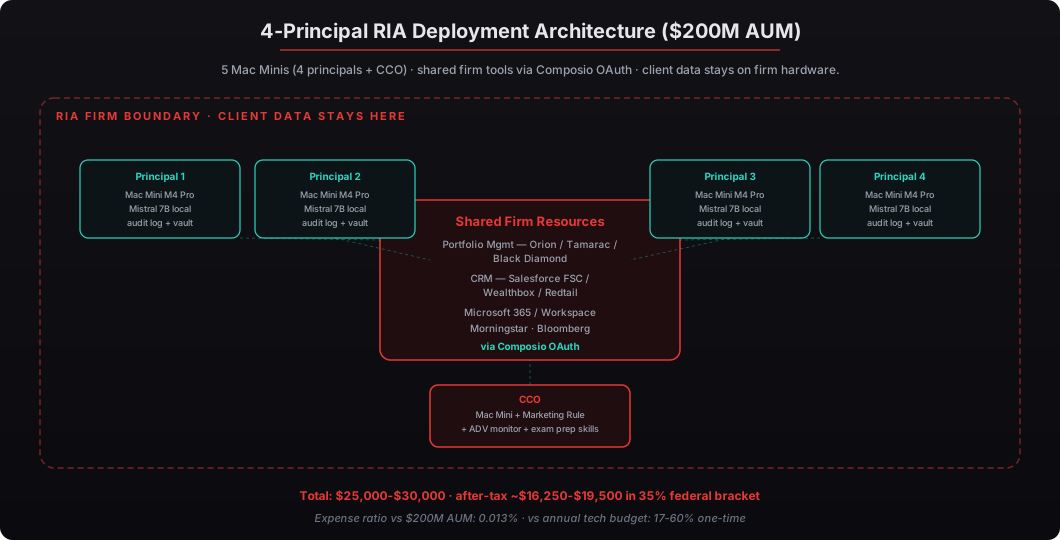
The standard configuration is one Mac Mini per principal advisor, plus optionally one Mac Mini for the firm’s CCO if compliance workflows are concentrated. For a 4-principal firm with a separate CCO, total deployment is 5 Mac Minis at $25,000-$30,000 total cost.
Each principal deployment includes:
- OpenClaw runtime on macOS with hardened configuration, Docker sandboxing, and launchd-managed auto-start
- Local LLM via Ollama running Mistral 7B Q4_K_M (default) or Llama 3.1 8B for client-data-sensitive workflows — client portfolio data never leaves the Mac Mini
- Composio OAuth credential vault stored in macOS Keychain (Secure Enclave-backed) for portfolio management platform (Orion/Tamarac/Black Diamond), CRM (Salesforce FSC/Wealthbox/Redtail), Microsoft 365 or Google Workspace, and research providers
- Audit log with tamper-evident hash-chain integrity for Marketing Rule compliance review documentation and Reg S-P incident response readiness
- Specialized RIA skills pre-installed: portfolio review automation, ADV Part 2 monitoring, Marketing Rule compliance review, client communication drafting templates
For the CCO deployment, the configuration includes additional skills focused on Marketing Rule compliance review automation, ADV Part 1 and Part 2 maintenance, and SEC examination preparation workflows. The CCO deployment integrates with the firm’s existing compliance technology (ComplySci or equivalent) through standard API connections.
What about Form ADV filing and SEC examination preparation?
Form ADV Part 2 maintenance is one of the highest-value RIA AI workflows. The deployment includes a specialized skill that watches for material changes in firm operations, fee structures, compliance personnel, and disclosed conflicts that would trigger Part 2 amendments under Section 204-1. The skill operates entirely on local firm data without sending anything to cloud AI — important because Form ADV contents are firm-confidential until filed publicly.
For SEC examination preparation, the deployment provides assistance with:
-
Examination request response drafting — the SEC’s typical document production requests cover 12-36 months of firm records including correspondence, marketing materials, trade tickets, client communications, and compliance documentation. The OpenClaw skill assists with document categorization, relevance review, and response timeline planning.
-
Document production assembly — pulling responsive documents from firm document management systems (typically Egnyte, ShareFile, or Microsoft 365 SharePoint), organizing by SEC request item, and producing the document index that accompanies SEC document production.
-
Timeline reconstruction — building chronologies of firm operations, decisions, and communications relevant to specific examination focus areas. The reconstruction pulls from email systems, CRM activity logs, and portfolio management transaction history.
-
Compliance Q&A preparation — assisting the CCO with preparation for the SEC’s typical compliance officer interview, including standard topic areas (Marketing Rule, Custody Rule, Code of Ethics, Compliance Program adequacy) and firm-specific topics raised in the examination scope letter.
These workflows are highly sensitive — the SEC examination context is non-public and confidential, and the firm has a strong interest in preventing any leakage of examination scope or preparation strategy to external parties. Local OpenClaw deployments provide the highest available confidentiality for examination preparation workflows.
For RIAs ready to deploy private AI alongside their existing portfolio management and CRM systems, buy OpenClaw system with one Mac Mini per principal advisor plus the CCO. Standard delivery is one week from order, fully configured with Composio integrations for the firm’s tech stack and specialized RIA skills pre-installed. Section 179 tax deduction makes the after-tax cost approximately 65% of the sticker price in the 35% federal bracket, and the deployment fits cleanly within typical RIA annual technology budgets.