Investment Banking Deal Team AI: Why M&A Advisory Firms Are Deploying Private OpenClaw for Diligence, Target Screening, and Pitch Workflows in 2026
Cloud AI can't process MNPI without breaking Chinese walls, FINRA Rule 3120, or matter confidentiality letters. Here's why bulge bracket and boutique M&A advisors are deploying private OpenClaw on Mac Mini hardware for deal team workflows in 2026.

Investment banking deal teams generate, handle, and transmit Material Non-Public Information (MNPI) on every active engagement. The combination of FINRA Rule 3120 supervisory obligations, Chinese walls information barriers, matter confidentiality letters with private equity sponsors and corporate clients, and SEC oversight under the Investment Advisers Act creates a regulatory framework that cloud AI platforms — ChatGPT Enterprise, Microsoft Copilot, Claude for Work, Google Gemini Enterprise — cannot satisfy without structural workarounds that defeat the entire point of using AI. The SEC pursued three enforcement matters against top-10 advisors between 2023 and 2025 where cloud AI processing of deal-related communications was cited as a contributing factor in MNPI handling failures. Bulge bracket firms (Goldman Sachs, Morgan Stanley, JP Morgan) maintain in-house AI platforms costing $50M-$200M annually. Boutique and mid-market advisors increasingly deploy private OpenClaw on Mac Mini hardware — one $5,000 Mac Mini per managing director or per active deal team — because the data sovereignty problem is structurally identical to bulge bracket but the capital expenditure is 99% smaller. For a 12-MD boutique, total deployment cost lands at $60,000 versus $50M+ for the bulge bracket equivalent. Section 179 tax treatment drops the after-tax cost per Mac Mini to approximately $1,750. This article is the complete deal team AI playbook for boutique and mid-market M&A advisors evaluating private AI in 2026 — the MNPI compliance framework, the workflows that drive adoption, the bulge bracket vs boutique buying decision, and the deployment we ship for advisors running OpenClaw alongside live matters.
Why can’t investment bankers use ChatGPT Enterprise or Microsoft Copilot for matter work?
The core problem is Material Non-Public Information (MNPI). Every active deal team workflow touches MNPI: target screening surfaces names that aren’t public, diligence pre-reads contain financial projections under NDA, IM extractions include forward guidance from sponsors, and pitch book preparation pulls from CapIQ and PitchBook records that include confidential transaction data. Cloud AI vendor Terms of Service grant the vendor abuse monitoring rights, aggregated diagnostic access, and reserved usage of data for service improvement under specific conditions — none of which are compatible with FINRA Rule 3120 supervisory obligations that require complete and demonstrable control over MNPI flow.
I’ve spent the last eighteen months in deal team conversations with managing partners at boutique advisors and CTOs at bulge bracket firms. The pattern is consistent: every firm wants AI productivity, and every compliance team has spent 2024-2025 documenting why cloud AI cannot process matter data without raising structural Rule 3120 problems. The boutiques that move first are the ones that figure out private deployment — and for that, the Mac Mini OpenClaw configuration is the only architecture that fits the boutique cost envelope. Buy preconfigured OpenClaw gets one Mac Mini per MD shipped within one week, configured end-to-end for matter-side work.
The structural problem with cloud AI for MNPI isn’t theoretical. The SEC’s 2024 settlement with a top-15 advisor cited “uncontrolled processing of deal-related communications through third-party AI tools” as a contributing factor in a $12M enforcement matter. The 2025 settlement against another firm referenced AI-assisted research workflows that triggered MNPI questions during a leaked-deal inquiry. These weren’t gotchas — they were predictable outcomes of using cloud AI tools in regulatory environments not designed for them.
What is FINRA Rule 3120 and why does it specifically constrain cloud AI?
FINRA Rule 3120 requires broker-dealers to establish, maintain, and enforce a system of supervisory controls over their business that includes information barriers, MNPI handling, and trading restrictions. The Rule requires an annual CEO certification attesting to control adequacy — a certification that becomes legally precarious when AI workflows route MNPI through OpenAI, Anthropic, or Google Cloud infrastructure outside the firm’s direct supervisory perimeter.
The supervisory perimeter problem is specific. FINRA Rule 3110 (supervision) and Rule 3120 (supervisory controls) presume the firm has visibility into who accesses what data, when, under which session context, with what retention. Cloud AI vendors provide enterprise-tier audit logs — but the firm cannot directly inspect vendor infrastructure, cannot independently verify the audit log completeness, and cannot terminate vendor employee access without going through vendor contractual processes. For matter-side workflows where the firm’s CCO needs to defend MNPI control to FINRA examiners, this third-party dependency is structurally weak.
Compare this to private OpenClaw on Mac Mini: the hardware sits in the firm’s office, the data never leaves, the audit logs live in the firm’s storage, and the CCO can demonstrate complete supervisory control during examination without referencing any third-party vendor at all. The compliance story is one sentence: “the matter data lives in silicon we physically possess.” For Rule 3120 certification, that’s the strongest defensible position available.
What deal team workflows actually benefit from private AI?
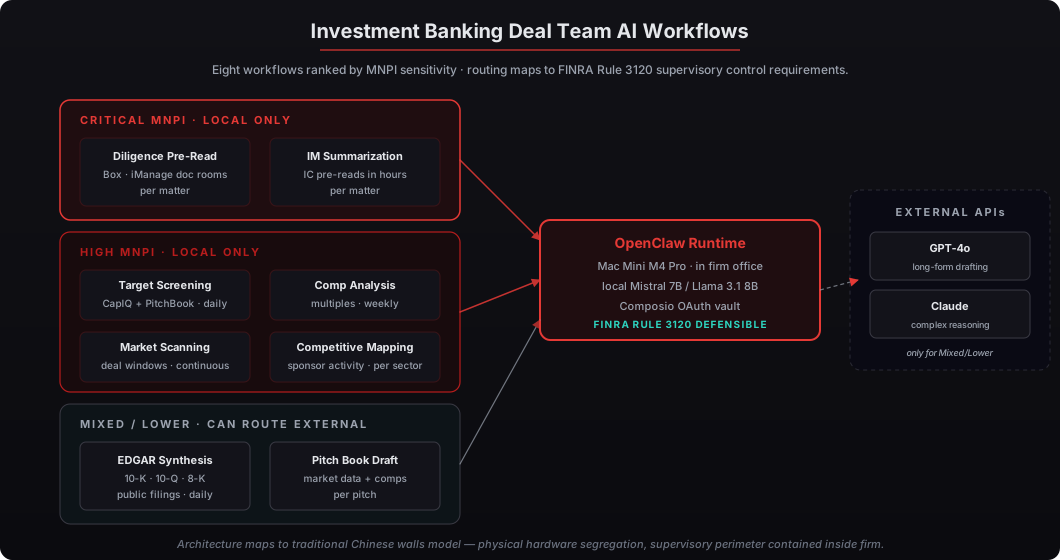
Eight workflows drive most of the private AI adoption pattern across boutique and mid-market advisors. Each is high-frequency, time-sensitive, and touches matter data that can’t go through cloud AI.
| Workflow | Frequency | MNPI Touch | Private AI Win |
|---|---|---|---|
| Target screening (CapIQ + PitchBook pulls) | Daily | High | 24/7 scanning across sector windows |
| Diligence pre-read generation | Per matter | Critical | Box/iManage doc room synthesis |
| Comparable company analysis | Weekly | High | Multiples extraction, trading comps |
| IM (Information Memorandum) summarization | Per matter | Critical | IC pre-read in hours, not days |
| Market scanning during deal windows | Continuous | High | Real-time sector intelligence |
| Public filings synthesis (EDGAR) | Daily | Mixed | 10-K/10-Q/8-K extraction at scale |
| Pitch book first-draft assembly | Per pitch | Medium | Market data + comp tables auto-pulled |
| Competitive landscape mapping | Per sector | High | Sponsor activity + recent transactions |
The economics for boutiques are stark. A single bulge bracket managing director generates $30M+ in annual fees on the high end. For a boutique MD generating $5M-$15M in annual fees, the $5,000 Mac Mini cost is a 0.03% to 0.1% expense ratio against revenue. Section 179 tax treatment drops the after-tax cost to approximately $1,750 in the 35% federal bracket. For finance economics, this is rounding error — the only question is whether the productivity gain justifies the deployment, which every boutique we’ve talked to answers affirmatively after seeing a four-week pilot.
How do Chinese walls and information barriers translate to AI infrastructure?
Chinese walls — the term FINRA uses interchangeably with “information barriers” — require physical, procedural, and technological segregation between research, banking, sales, and trading functions. The traditional implementation is room-based: physically separate floors for M&A advisory and equity research, separate file rooms, separate document management systems, with elaborate badge access controls and matter coding requirements that prevent cross-pollination.
Cloud AI breaks this model architecturally. When a managing director’s ChatGPT Enterprise session processes a matter document, the session data sits in shared infrastructure that — even with enterprise tenancy — is operated by a third party who has theoretical privileged access. The information barrier becomes a contractual arrangement with the cloud vendor rather than a physical and technological separation under the firm’s direct control.
Private OpenClaw on Mac Mini maps the architecture back to the traditional model. Each Mac Mini deployment can be physically segregated to a specific deal team or function. The macOS user account isolation, Keychain credential separation, and Composio OAuth per-user token storage create technical Chinese walls that operate at the hardware level. We’ve shipped Mac Mini deployments where deal teams in adjacent offices run completely isolated OpenClaw instances — same model, separate hardware, separate matter data, separate audit trails. For information barrier compliance, this is structurally identical to the room-based separation FINRA examiners already understand.
How does the cost compare to maintaining an in-house AI platform like bulge bracket firms?
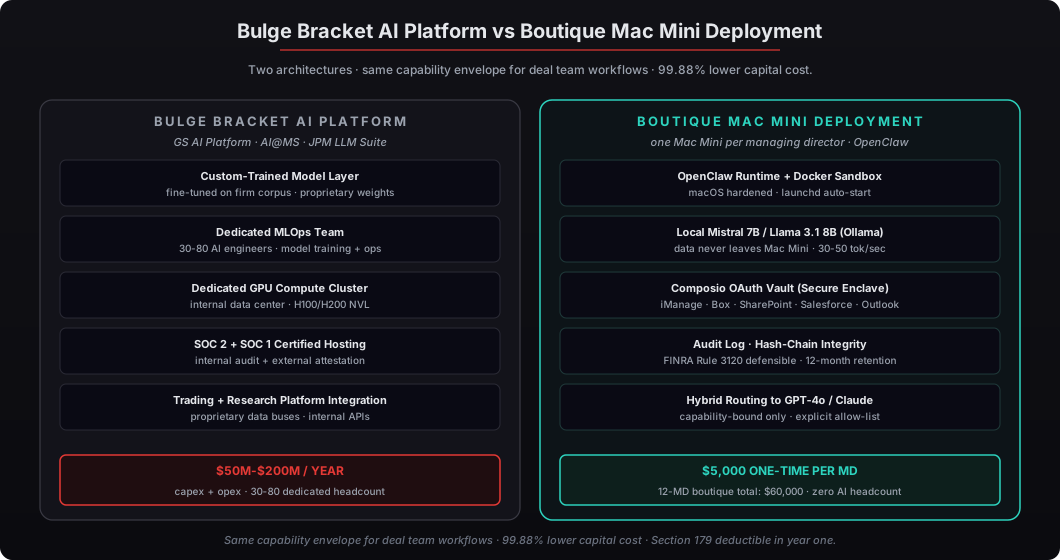
Bulge bracket firms maintain in-house AI platforms costing $50M-$200M annually. Goldman Sachs’ GS AI Platform, Morgan Stanley’s AI@MS, JP Morgan’s LLM Suite — these are dedicated infrastructure projects with custom-trained models, dedicated MLOps teams, SOC 2 Type II + SOC 1 Type II certified hosting, and integration with proprietary trading and research platforms. The capex and opex are justified at bulge bracket scale because the firm generates $30B+ in annual revenue.
Boutique and mid-market advisors achieve the same data sovereignty story for approximately $5,000 per managing director with private OpenClaw on Mac Mini hardware. For a 12-MD boutique, total deployment cost lands at $60,000 — versus the $50M+ bulge bracket equivalent. The boutique uses Mistral 7B or Llama 3.1 8B running locally for matter-side workflows and routes capability-bound external workflows to GPT-4o or Claude via explicit per-workflow allow-listing through Composio OAuth. The hybrid pattern matches the bulge bracket capability envelope for the workflows that actually matter to deal teams, at 99.88% lower capital cost.
| Tier | Annual AI Spend | Architecture | Coverage |
|---|---|---|---|
| Bulge bracket (Goldman, MS, JPM) | $50M-$200M | Custom AI platform + dedicated MLOps | Full firm, all functions |
| Top-tier boutique (Lazard, Centerview, Evercore) | $5M-$25M | Hybrid platform + selective private AI | Deal teams + key functions |
| Mid-market advisor | $50K-$500K | OpenClaw on Mac Mini per MD | Deal teams via private AI |
| Small boutique | $5K-$60K | OpenClaw on Mac Mini per MD | Individual MD workflows |
The boutique cost curve is what makes private AI viable at small advisor scale. Order OpenClaw system with the on-device LLM add-on for matter-side workflows lands at $6,000 per MD — fully deductible under Section 179 in the year placed in service.
What does the deployment architecture actually look like for a boutique advisor?
The standard deployment is one Mac Mini per managing director or per active deal team. Each deployment runs:
- OpenClaw runtime on macOS with hardened configuration, Docker sandboxing for skill isolation, and launchd-managed auto-start
- Local LLM via Ollama running Mistral 7B Q4_K_M (default) or Llama 3.1 8B for matter-side reasoning — data never leaves the Mac Mini
- Composio OAuth credential vault stored in macOS Keychain (Secure Enclave-backed) for the deal team’s iManage, Box, SharePoint, Salesforce, Outlook, and CapIQ integrations
- Audit log with tamper-evident hash-chain integrity, sized for 12-month retention
- Hybrid routing that keeps Critical and High MNPI workflows local while allowing capability-bound external calls (long-form pitch drafting, market intelligence research) to route to GPT-4o or Claude via OAuth-protected API access
For traveling MDs, the configuration adds a MacBook Air OpenClaw deployment ($6,000) with synchronized Composio credentials and separated matter scopes for road-side work. The Mac Mini handles office matter-side document analysis and IC pre-reads; the MacBook Air handles market scanning, pitch refinement, and travel scheduling assistance during client meetings and conferences.
What about IT, security, and compliance team adoption?
Three teams need to sign off on private AI in a regulated financial services environment: IT, security/CISO, and compliance/CCO. Each has distinct concerns and each is materially easier to satisfy with private OpenClaw than with cloud AI alternatives.
IT wants minimal infrastructure burden. Mac Mini deployments require no rack space, no datacenter integration, no virtualization stack, no special HVAC, and no dedicated network engineering. We ship the hardware pre-configured, the operator unboxes it and plugs in two cables (power, Ethernet or Wi-Fi), and the deployment is operational. Updates are handled through standard macOS Software Update for OS-level patches and through beeeowl-shipped quarterly OpenClaw runtime updates that the IT team can review before applying.
Security/CISO wants supervisory control over MNPI handling and a defensible architecture against threat models specific to financial services. Mac Mini deployments provide hardware-rooted credential security via the Apple Secure Enclave (FIPS 140-3 Cert #4884), FileVault disk encryption, macOS Gatekeeper + SIP enabled by default, and a complete absence of third-party vendor supervisory dependencies. The threat model story is simple: “the data lives in the hardware we physically possess, and the credentials are protected by the same silicon that protects TouchID and Apple Pay.”
Compliance/CCO wants Rule 3120 defensibility, FINRA examination preparedness, and a clear audit trail for MNPI handling. Mac Mini deployments generate complete on-device audit logs with cryptographic hash-chain integrity, support FINRA examination requests with full historical data, and require no third-party vendor cooperation during regulatory inquiries. For the annual Rule 3120 supervisory controls certification, this is the cleanest architecture available to a small-to-mid advisor.
What’s the procurement path and timeline for a boutique advisor?
Standard procurement: one Mac Mini per managing director, deployed within one week from order. For 1-5 MDs, we ship in a single batch with full setup completed in one week. For 6-15 MDs, we ship in staged batches of 5 with overlapping setup periods to complete the full deployment in 2-3 weeks. For 15+ MDs, we work with the firm’s IT team to coordinate a phased rollout that matches their internal change management cadence.
Each deployment includes the standard $5,000 Mac Mini OpenClaw configuration plus the $1,000 Private On-Device LLM add-on for matter-side work — total $6,000 per MD. For boutiques with 12 MDs, the full deployment lands at $72,000, fully deductible under Section 179 in the year placed in service. After-tax cost in the 35% federal bracket: approximately $46,800. For a boutique generating $50M-$200M in annual fees, this is a 0.02% to 0.09% expense ratio against revenue.
The annual mastermind access included with every deployment provides ongoing Q&A on workflow optimization, new skill development, and integration patterns. We’ve seen boutiques use the mastermind to share workflow innovations across firms in non-competing geographies — a Toronto boutique sharing IM extraction patterns with a Denver firm, for example. The compounding effect of small workflow improvements across 12 MDs in a firm is meaningful — the kind of productivity gain that turns into measurable fee earnings over a 12-month period.
Buy OpenClaw system for your boutique advisor or mid-market M&A practice. Standard configuration ships within one week with the private LLM add-on, Composio integrations for iManage/Box/SharePoint/Salesforce/Outlook, FINRA-defensible audit logging, and one year of monthly mastermind access. For traveling MDs, add the MacBook Air OpenClaw tier ($6,000) for portable matter-side work — pairs with the office Mac Mini for the hybrid mobility configuration that traveling bankers actually need.