beeeowl vs SetupClaw vs DIY: Honest Comparison of OpenClaw Deployment Options
Three paths to OpenClaw in production: DIY (free software, 20-40 hours of engineering, $4,120-$8,340 real Y1 cost), SetupClaw/RoofClaw ($3,000+ without hardware), beeeowl ($2,000 hosted to $6,000 MacBook Air with hardware included). Here's the transparent comparison.

Three paths exist for deploying OpenClaw in production in 2026: DIY self-hosting, SetupClaw or RoofClaw, or beeeowl. They’re all legitimate, and I’m going to walk through all three honestly — including where our competitors do well — because you deserve a real comparison, not a sales page disguised as a blog post. The short version: Censys published scans in March 2026 showing over 30,000 OpenClaw instances exposed on the public internet running default configurations. Shadowserver tracked a 340% increase in scanning activity targeting OpenClaw’s default ports between January and March 2026. CVE-2026-25253 is a real remote code execution vulnerability in the default gateway configuration. DIY deployments fail security review at alarming rates when the operator doesn’t have deep Docker, OAuth, and NIST SP 800-190 experience. Professional services address these vectors; most DIY setups don’t. beeeowl starts at $2,000 hosted (cheapest professional option), is the only service that includes hardware in the deployment price, and is the only service that offers a MacBook Air portable tier. This article lays out all three options across every dimension that matters.
What are your actual options for deploying OpenClaw in 2026?
Three paths exist, and they’re all legitimate choices for different buyer profiles. You can hire beeeowl for the cheapest professional entry price with hardware included and structured community support. You can hire SetupClaw or RoofClaw if you already own your hardware and want a managed deployment from an established competitor. You can DIY if you have an experienced DevOps engineer with specific OpenClaw, Docker, and NIST SP 800-190 expertise, and you’re willing to invest 20-40 hours upfront plus ongoing maintenance. Each involves real trade-offs in cost, time, security posture, hardware flexibility, and ongoing support.
Jensen Huang told the audience at NVIDIA Computex 2025 that every company needs an OpenClaw strategy. He’s right. But “having a strategy” and “deploying it well” are two very different things. Gartner estimates that by end of 2026, over 40% of enterprise AI deployments will involve some form of agent framework, and OpenClaw is the fastest-growing option in that category. That growth is exactly why the deployment question matters so much — the gap between “OpenClaw installed” and “OpenClaw production-ready” is substantial, and the cost of getting the gap wrong shows up in security incident statistics.
Let me break down all three options in detail, starting with price and working through security, time investment, hardware flexibility, and ongoing support.
How does beeeowl compare to SetupClaw and RoofClaw on price?
beeeowl starts at $2,000 for a hosted cloud deployment. SetupClaw and RoofClaw both start around $3,000 for comparable hosted setups. That’s a $1,000 difference at the entry level — meaningful, but not the whole story and not where most of the differentiation happens.
Where the pricing comparison gets more interesting is hardware. beeeowl’s Mac Mini tier is $5,000 with hardware included in that price — you pay $5,000 once, and we ship you a fully configured Mac Mini M4 Pro with 24GB unified memory. The MacBook Air tier — designed for executives who travel — is $6,000 with hardware included. SetupClaw and RoofClaw typically charge their base setup fee on top of hardware you’ve already purchased yourself. When you see “$3,000 for setup,” you still have to buy the Mac Mini or comparable device separately at retail price (typically $599-$1,299 depending on configuration).
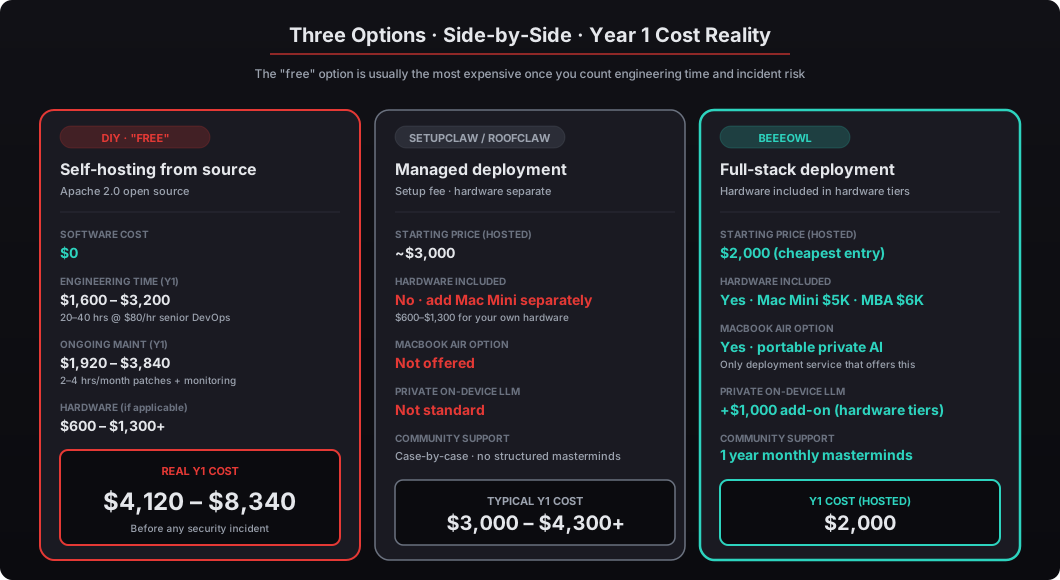
DIY costs nothing in software licensing — OpenClaw is open source under the Apache 2.0 license — but the time investment is the real price tag, and we’ll get to that math in a moment. Every beeeowl tier includes one fully configured agent with Composio OAuth integrations, security hardening, and authentication. Additional agents cost $1,000 each per executive. The in-person setup add-on is $2,000 on top of a hardware tier if you want our team on-site. See our security hardening methodology for what’s included in every deployment.
What does the side-by-side comparison actually look like?
Here’s the honest breakdown across every dimension that matters in deployment evaluation. I want to be clear: SetupClaw and RoofClaw are real businesses doing real work. They’ve helped a lot of people get OpenClaw running, and their teams take security seriously. The comparison below isn’t about who’s “better” in absolute terms — it’s about what’s included and what isn’t.
| Feature | beeeowl | SetupClaw / RoofClaw | DIY Self-Hosting |
|---|---|---|---|
| Starting price | $2,000 (hosted) | ~$3,000 (hosted) | $0 (software only) |
| Hardware tiers | $5K Mac Mini, $6K MacBook Air (included) | Setup fee only — hardware separate | You source and configure |
| Setup time | 1 day, ships within 1 week | 1-3 days typical | 20-40+ hours for most teams |
| Security hardening | Full (Docker, firewall, auth, audit trails, NIST SP 800-190) | Included in most packages | Your responsibility entirely |
| Hardware included in price | Yes (Mac Mini and MacBook Air tiers) | No | No |
| MacBook Air option | Yes — portable AI for traveling executives | No | Possible but unsupported |
| Private on-device LLM add-on | +$1,000 — data never leaves your machine | Not offered as standard | Possible with Ollama, you configure |
| In-person setup | +$2,000 add-on for hardware tiers | Varies by provider | N/A |
| Ongoing community access | 1 year of monthly mastermind calls included | No structured community | Community forums, GitHub Issues |
| Client-provided hardware | Yes, with in-person setup add-on | Typically the default | Yes |
| Composio OAuth setup | Included — credentials never exposed to bot | Varies | Manual configuration |
| Satisfaction coverage | 7-day refund (Hosted) + fix-it coverage (hardware) | Varies by provider | N/A |
Why is DIY OpenClaw deployment riskier than people think?
The appeal of DIY is obvious and legitimate. OpenClaw is free under Apache 2.0. Docker is free. Composio has a free tier for small usage. You’ve got engineers on staff. Why pay anyone to install open-source software? The answer is that the software is free but the security hardening that makes it production-ready is not, and the gap between “installed” and “hardened” is where most DIY deployments fail.
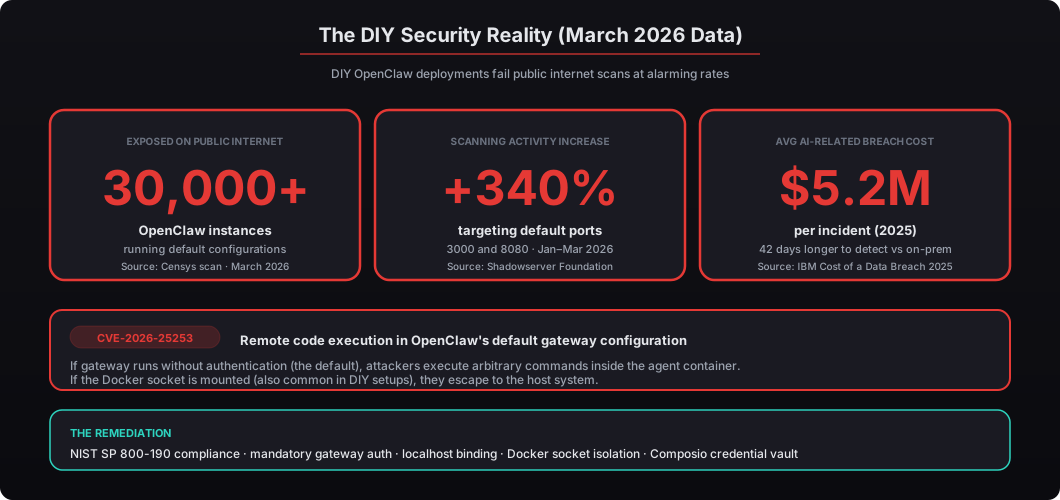
Censys published scan results in March 2026 showing over 30,000 OpenClaw instances running on the public internet with default configurations. No authentication. No firewall rules. Docker sockets mounted directly into agent containers. These aren’t hobby projects — Censys’s scanners found them running at companies, at startup accelerators, at a couple of VC funds, and at at least one Fortune 500 subsidiary. The pattern is consistent: engineer spins up OpenClaw from the quickstart guide, forgets to configure authentication, doesn’t read the hardening docs, and now the agent is accessible from anywhere.
Shadowserver Foundation tracked a 340% increase in scanning activity targeting OpenClaw’s default ports (3000 and 8080) between January and March 2026. Attackers are actively looking for these deployments because each one represents a potential foothold into the agent’s connected services — Gmail, Slack, Salesforce, HubSpot, financial tools. A compromised OpenClaw agent with Composio integrations can become a pivot point into the entire executive’s tool stack.
CVE-2026-25253 made the risk concrete. It’s a remote code execution vulnerability in OpenClaw’s default gateway configuration. If your gateway runs without authentication (which is the out-of-the-box default in the quickstart setup), an attacker can execute arbitrary commands inside your agent container. If the Docker socket is mounted inside the container (also common in DIY setups that follow tutorial examples), they can escape to your host system. The CVE was disclosed responsibly and patched in the upstream project, but the patched version requires an affirmative configuration change that DIY operators often miss.
The National Institute of Standards and Technology (NIST) Container Security Guide (SP 800-190) covers exactly this class of vulnerability. Most DIY deployers haven’t read it. Most professional deployment services have. According to IBM’s 2025 Cost of a Data Breach Report, the average AI-related breach cost reached $5.2 million globally and took 42 days longer to detect than traditional breaches. For a C-suite executive running OpenClaw with access to Gmail, Slack, Calendar, and financial tools through Composio integrations, the exposure surface is enormous. The breach cost math dwarfs any deployment fee.
What does DIY really cost when you count your time?
Let’s do the math honestly, using conservative assumptions that a skeptical CFO would accept.
A senior DevOps engineer in the US earns a median of $165,000 annually according to Glassdoor’s 2025 compensation data — roughly $80 per hour loaded cost. Most DIY OpenClaw deployments take 20 to 40 hours for initial setup, based on reports across the OpenClaw GitHub Discussions and Reddit communities. That’s $1,600 to $3,200 in engineering time just for initial setup, and that’s assuming the engineer already knows Docker, Composio, OAuth flows, NIST SP 800-190, and OWASP’s 2025 Top 10 for AI Applications. If they have to learn any of that on the job, the hour count doubles.
That initial cost doesn’t include ongoing maintenance. Stack Overflow’s 2025 Developer Survey found that 62% of developers spend over 30 minutes daily on infrastructure maintenance tasks for production systems. For an OpenClaw deployment with multiple integrations, expect at minimum 2 to 4 hours per month in updates, monitoring, incident response, and troubleshooting when an integration breaks because a vendor changed their API. At $80 per hour, that’s $160 to $320 per month in ongoing maintenance, or $1,920 to $3,840 per year.
Add it all up. DIY Year 1 cost:
- Initial engineering: $1,600 to $3,200
- Ongoing maintenance (Y1): $1,920 to $3,840
- Hardware (if using Mac Mini): $599 to $1,299
- Total real Y1 cost: $4,120 to $8,340
Suddenly the “free” deployment costs more in the first year than beeeowl’s most expensive tier ($6,000 MacBook Air with hardware included) and costs significantly more than beeeowl’s Hosted Setup ($2,000). The “free” option is often the most expensive option once you count engineering time honestly. That’s not marketing. That’s arithmetic.
And this math assumes the engineer gets everything right the first time. The 30,000 exposed instances on the public internet tell us that most don’t. Factor in a single security incident — even a minor one requiring incident response, audit review, and remediation — and the DIY cost blows past any professional service by an order of magnitude. IBM’s 2025 breach cost data says the AI-related incident average is $5.2M. A single incident that costs even 10% of the average is $520,000 — more than 100x the beeeowl Hosted setup fee.
What security hardening do professional services actually include?
This is where the real value sits — and where all three professional services (beeeowl, SetupClaw, RoofClaw) separate themselves from DIY. Every professional deployment from every reputable vendor addresses the same baseline security controls, because the threat model is the same regardless of who does the work.
Every beeeowl deployment includes: mandatory gateway authentication, all services bound to localhost only (never 0.0.0.0), Docker container isolation with read-only filesystems and cap_drop: ALL, Composio OAuth credential isolation (credentials are never exposed to the bot itself or visible in the agent’s process memory), explicit firewall allowlists at both the OS and container level, full audit trails on every agent action, role-based access controls, adversarial security testing before deployment handoff, and NIST SP 800-190 compliance across all five container security controls.
SetupClaw includes similar security measures — they take hardening seriously, and that’s worth acknowledging explicitly. RoofClaw does as well. The OWASP Foundation’s Top 10 for LLM Applications specifically flags prompt injection and insecure plugin design as critical risks. Professional deployment services address these vectors. Most DIY setups don’t. The gap between “professional” and “DIY” on security posture is much larger than the gap between any two professional services on the same dimension.
The difference between beeeowl and competitors on security isn’t the baseline hardening itself — it’s the additional layers and the ongoing support. NVIDIA actively contributes engineers to OpenClaw’s security architecture. The NemoClaw enterprise reference design provides the security foundation we build on. When Jensen Huang compared OpenClaw to Linux, HTML, and Kubernetes, he wasn’t just making an analogy — he was signaling NVIDIA’s long-term infrastructure commitment. For the full OpenClaw hardening deep-dive, see our security hardening methodology.
Who should choose each option?
Choose beeeowl if: You want the lowest professional entry price ($2,000 hosted — $1,000 less than SetupClaw or RoofClaw). You want hardware included in the price — we’re the only service that bundles the Mac Mini or MacBook Air into the deployment fee. You want the MacBook Air option for portable private AI — we’re the only service that offers this configuration. You value the 1 year of monthly mastermind community access as part of the package. Or you want the Private On-Device LLM option ($1,000 add-on) where your data never leaves your machine. We’re built specifically for C-suite executives and founders — that’s our entire focus, and it’s reflected in the tier design.
Choose SetupClaw or RoofClaw if: You already own the hardware you want to use (a Mac Studio, an older Mac Mini, a MacBook Pro) and don’t need beeeowl’s hardware-included pricing. You don’t need the MacBook Air portability option. You’re comfortable with a higher starting price ($3,000 vs $2,000 for hosted) in exchange for an established brand. They’re real businesses delivering real work — and if they’re the right fit for your situation, go with them. We’re not trying to win every deal. We’re trying to be the clearest fit for C-suite executives who want the combination of low entry price, included hardware, portable AI option, and structured community support.
Choose DIY if: You have an experienced DevOps engineer with specific OpenClaw, Docker, and Composio expertise. You’re willing to invest 20-40 hours upfront plus ongoing maintenance. You’ve read NIST SP 800-190 and can implement its recommendations from memory. You understand the CVE-2026-25253 attack vector well enough to prevent it and audit for it. You’re willing to pay the real Y1 cost of $4,120-$8,340 in engineering time and accept the security incident risk. DIY is a valid choice — if you have the right person doing it. Most companies that think they have the right person don’t, and the 30,000 exposed instances on the public internet are the evidence.
What about the MacBook Air option — does portable AI actually matter?
For traveling executives, it matters a lot. A Mac Mini sits in your office or data closet — useful when you’re there, useless when you’re not. A MacBook Air with OpenClaw goes with you to board meetings, investor dinners, client sites, and international travel. Your AI agent runs locally, on your device, wherever you are. No latency from phoning home to a cloud VPS. No dependency on hotel Wi-Fi connecting back to your office network.
According to the Global Business Travel Association (GBTA), US business travel spending reached $350 billion in 2025 and is projected to grow through 2027. For executives who spend 30% or more of their time on the road — which describes most CEOs at venture-backed companies, most managing partners at consulting firms, and most senior VC partners — a stationary deployment creates a dependency on remote access that introduces latency, security exposure, and occasional unavailability when Wi-Fi is unreliable.
beeeowl is the only deployment service offering a MacBook Air tier with hardware included and fully configured. You can add the Private On-Device LLM option for an additional $1,000, meaning your data never touches any external API — not OpenAI, not Anthropic, not anyone. Everything runs on the device in your bag. For a PE partner processing deal memos during a trans-Atlantic flight, this is the only configuration that works. For a CEO managing investor updates from a conference hotel in Singapore, same story. No other deployment service offers this combination, and I haven’t heard of one in planning.
What happens after deployment — who supports you?
This is where the options diverge sharply, and it’s often the dimension that matters most six months into production when the novelty of “having an agent” has worn off and you need to actually keep it running.
beeeowl includes 1 year of monthly mastermind calls — structured group sessions with other executives running OpenClaw deployments, covering workflow optimization, new integration strategies, security updates when CVEs drop, and best practices. It’s structured ongoing education, not just a support ticket queue. The masterminds also function as a small community of executives across PE, legal, healthcare, and tech all running similar deployments and sharing what works.
SetupClaw and RoofClaw typically offer post-deployment support on a case-by-case basis depending on the specific package you buy. Check their current terms — support bundles vary. Some tiers include structured support, others are ticket-based.
DIY means GitHub Issues, community Discord servers, Reddit threads, and OpenClaw’s official documentation. The OpenClaw community is active and helpful — the maintainers respond to issues, the Discord has thousands of members, and the Reddit subreddit sees hundreds of daily posts. But there’s no SLA, no guaranteed response time, and no one who knows your specific configuration. When something breaks at 2am, you’re the support team.
Forrester Research found in their 2025 AI Infrastructure Survey that organizations with structured post-deployment support programs saw 47% higher adoption rates among end users compared to those without. Deploying is step one. Actually using the system effectively six months later is the harder problem — and that’s what ongoing community access solves.
What’s the total cost of ownership over one year?
Let’s lay out the Year 1 math explicitly for a single executive with one agent, using the numbers we’ve already established:
beeeowl Hosted: $2,000 one-time. Includes setup, hardening, one agent, 1 year of masterminds. Total Year 1 cost: $2,000.
beeeowl Mac Mini: $5,000 one-time. Includes hardware, setup, hardening, one agent, 1 year of masterminds. Total Year 1 cost: $5,000.
beeeowl MacBook Air: $6,000 one-time. Includes hardware, setup, hardening, one agent, 1 year of masterminds, portability. Total Year 1 cost: $6,000.
SetupClaw Hosted: ~$3,000 one-time for setup and hardening. Hardware not included in hardware tiers — add $599-$1,299 for a Mac Mini separately depending on configuration. No structured community included. Total Year 1 cost: $3,000 to $4,300+.
DIY: $0 software cost. $1,600-$3,200 in engineering time for initial setup. $1,920-$3,840 in annual maintenance time. Hardware cost if applicable: $599-$1,299. Total Year 1 cost: $4,120 to $8,340 in real costs, and that assumes no security incidents and no hours of debugging that spiraled out of budget.
The “free” option is often the most expensive option. That’s not marketing. That’s arithmetic, and it’s verifiable with any competent DevOps engineer’s hourly rate and honest time-tracking. The only way DIY comes out cheaper than beeeowl Hosted is if the engineer’s time is literally free (a founder who can’t bill their own time, an intern, or a weekend project) and nothing breaks during the first year.
So what should you actually do?
If you’ve read this far, you’re serious about deploying OpenClaw. Good. Here’s my honest recommendation based on 50+ deployments across the US and Canada.
If budget is your primary constraint and you have a competent DevOps person, DIY can work — but only if that person takes security seriously. Read the Censys 30,000-exposed-instances report. Understand CVE-2026-25253 from memory. Follow NIST SP 800-190 to the letter. Audit your own firewall rules. Monitor for CVEs in the upstream project. This is the path for startups with a strong engineer who wants to own the infrastructure personally, and it’s a valid choice for the right person.
If you want professional deployment and already own your hardware, both beeeowl and SetupClaw will get you there. Compare the specific packages, compare the post-deployment support terms, compare the on-site setup options if that matters, and pick whichever feels right. They’re both legitimate. Don’t pick one over the other based on marketing copy alone.
If you want the simplest path — hardware included in the price, security hardened to NIST SP 800-190, Composio OAuth credential isolation, 1 year of structured community access, the lowest professional entry price for hosted ($2,000), and the only MacBook Air portable option on the market — that’s what we built beeeowl to be. Full pricing on our pricing page, role-specific workflows on our use cases page, and deployment FAQ on our FAQ page.
We’re not the only option. We’re the one I’d pick. But then, I would say that — I built it. So run the comparison yourself. Request a quote from all three services. The numbers speak for themselves.