The Boutique Law Firm AI Buying Guide: Why Partner-Track Firms Choose On-Premises OpenClaw Over Microsoft Copilot and ChatGPT Enterprise
ABA Model Rule 1.6 plus 40+ state bar opinions on cloud AI plus weak SaaS BAAs equal a privilege risk most law firm partners don't see until they're disclosing it on a malpractice claim. Here's why boutique and mid-market firms are deploying private AI on-premises in 2026.

The American Bar Association’s Formal Opinion 512, issued July 2024, made clear what most boutique and mid-market law firms had already suspected: generative AI use creates client confidentiality questions that ABA Model Rule 1.6 was never designed to handle. Between 2023 and 2025, at least 40 US state and territorial bars issued formal or informal opinions addressing AI tools, with most requiring informed client consent before sending privileged matter through third-party LLMs. The ALM Intelligence 2025 Legal AI Survey found that 67% of AmLaw 200 firms have implemented restrictions or outright bans on cloud-based generative AI for client work, and 31% are evaluating on-premises alternatives. Microsoft Copilot for Microsoft 365 and OpenAI Enterprise both retain processing rights for abuse monitoring and telemetry — language that several state bars have flagged as potential disclosure events. This article walks through the privilege framework, the bar opinions that matter, the cloud AI contract language partners should read carefully before signing, and the on-premises deployment pattern we ship for boutique and mid-market firms.
Why are boutique law firms moving to on-premises AI in 2026?
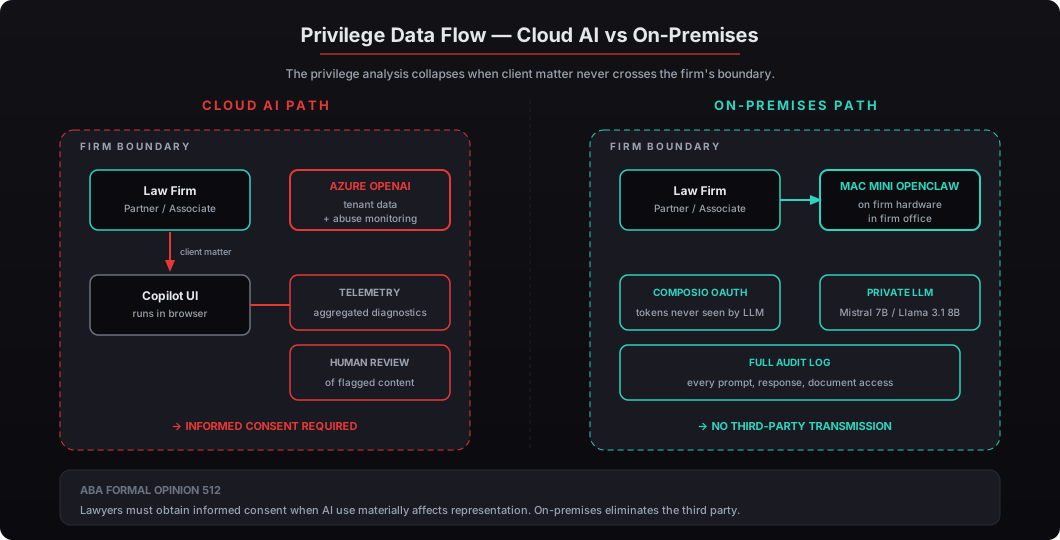
Boutique and mid-market law firms are moving to on-premises AI because the privilege analysis is simpler when client data never leaves hardware the firm controls. ABA Formal Opinion 512 requires lawyers to understand AI tool data handling, evaluate whether transmission constitutes disclosure, and obtain informed consent when confidentiality is implicated. Cloud AI vendors retain processing rights that several state bars have flagged as disclosure events — a problem that disappears entirely when the AI runs on hardware physically located in the firm’s office.
I’ve worked with 12+ boutique and mid-market firms on AI deployment between 2024 and 2026, and the pattern is consistent. Firms with under 50 attorneys don’t have dedicated IT or compliance staff to negotiate custom data processing addenda with Microsoft or OpenAI. They need a deployment that they can defend to a state bar disciplinary committee in plain language. “The AI runs on a Mac Mini in the partner’s office, no client data is transmitted to any third party, and we have full audit logs” is a defensible answer. “We use Microsoft Copilot under the standard enterprise terms with abuse monitoring enabled” requires a much longer explanation and exposes the firm to interpretive risk.
What did ABA Formal Opinion 512 actually say?
ABA Formal Opinion 512, issued July 29, 2024, is the most authoritative interpretive guidance to date on lawyer use of generative AI. The opinion concluded that lawyers using generative AI tools must satisfy four ongoing duties: competence (Rule 1.1), confidentiality (Rule 1.6), communication (Rule 1.4), and supervision (Rules 5.1 and 5.3). The opinion specifically addressed generative AI as distinct from earlier legal technology because of how AI tools process and potentially retain user input.
On confidentiality, the opinion stated that lawyers must (a) understand how the AI tool processes and stores data, (b) evaluate whether information transmitted to the AI constitutes disclosure under Rule 1.6, (c) obtain informed client consent when AI use materially affects representation or implicates confidentiality, and (d) implement reasonable safeguards. The opinion cited the 2012 Comment 8 to Rule 1.1 (the “duty of technological competence”) as binding context for evaluating AI tool selection.
The practical effect for partners running boutique and mid-market firms: every AI tool used for client work must pass a four-part analysis before deployment, and the firm must be able to articulate that analysis if asked. Cloud AI tools fail the analysis more often than on-premises tools because cloud providers retain processing rights that the firm cannot fully audit. Our agent compliance guide covers the broader compliance framework, and our private AI vs cloud AI overview walks through the architectural differences.
What state bar opinions specifically address AI tools?
Between 2023 and 2025, at least 40 US state and territorial bars issued formal or informal ethics opinions addressing generative AI use by lawyers. The opinions vary in specificity, but converge on five common requirements:
- Lawyer must understand the AI tool’s data flow before using it for client work
- Informed client consent is required when AI use materially affects representation or implicates confidentiality
- Lawyer maintains ultimate responsibility for AI-generated work product
- Supervision duties apply to AI as they do to non-lawyer assistants
- Confidentiality safeguards must match the sensitivity of the matter
The most-cited opinions include:
- California State Bar Practical Guidance (November 2023) — earliest comprehensive state guidance, noted that public-facing generative AI tools “may not be suitable” for confidential matter
- Florida Bar Opinion 24-1 (January 2024) — required informed consent for “third-party generative AI” and addressed billing implications
- New York State Bar Association AI Task Force Report (April 2024) — extensive treatment of practice areas and the “supervision gap” with autonomous AI
- Texas Center for Legal Ethics Opinion 705 (February 2025) — applied existing confidentiality framework to AI without creating new categorical rules
- ABA Formal Opinion 512 (July 2024) — the framework summarized above
Several opinions specifically caution against consumer or unrestricted business AI tools for privileged work. The Pennsylvania Bar Association Formal Opinion 2024-300 went further and recommended “an outright prohibition” on using consumer-facing generative AI (free-tier ChatGPT, Claude.ai consumer, Gemini consumer) for matters involving confidential information. Enterprise-tier cloud AI sits in a gray zone — better than consumer tools, but still subject to vendor processing terms that complicate the privilege analysis.
What does Microsoft Copilot for Microsoft 365 actually do with client data?
Microsoft Copilot for Microsoft 365 grounds responses in tenant data via Microsoft Graph and processes that data through Azure OpenAI Service. Microsoft commits not to use tenant data to train its foundation models, which is a meaningful commitment that distinguishes Copilot from consumer ChatGPT. However, the Copilot data processing terms retain meaningful processing rights that partners should understand before deploying for client work.
Per Microsoft’s published Copilot for Microsoft 365 data, privacy, and security documentation (reviewed April 2026), Microsoft retains rights to process tenant data for:
- Service operation — required for Copilot to function, generally non-controversial
- Abuse monitoring — automated and potentially human review of flagged content for terms-of-service violations
- Aggregated telemetry — non-content metadata about usage patterns
- Service improvement — improvements to internal models that don’t constitute foundation model training
The abuse monitoring provision is the one that most concerns state bar ethics counsel. Microsoft’s published documentation notes that flagged content may be subject to human review by Microsoft personnel, and the criteria for flagging are not publicly disclosed in detail. Several state bar opinions (most notably the California State Bar Practical Guidance and the New York State Bar Task Force Report) have flagged human review of confidential matter — even if rare — as a potential disclosure event requiring client consent.
OpenAI Enterprise terms have similar abuse monitoring language. Anthropic’s Claude for Work terms have meaningfully tighter language but still retain limited monitoring rights. Google Workspace with Gemini for Google Workspace has its own variation. None of the major cloud AI providers offer terms that completely eliminate processing rights — which is the bar a strict reading of ABA Formal Opinion 512 would require for unconsented use on confidential matter.
How does the cloud AI vs on-premises decision actually look in practice?
For boutique and mid-market firms, the decision usually breaks down across five dimensions: privilege risk, client consent operations, cost over 3-5 years, infrastructure complexity, and competitive positioning.
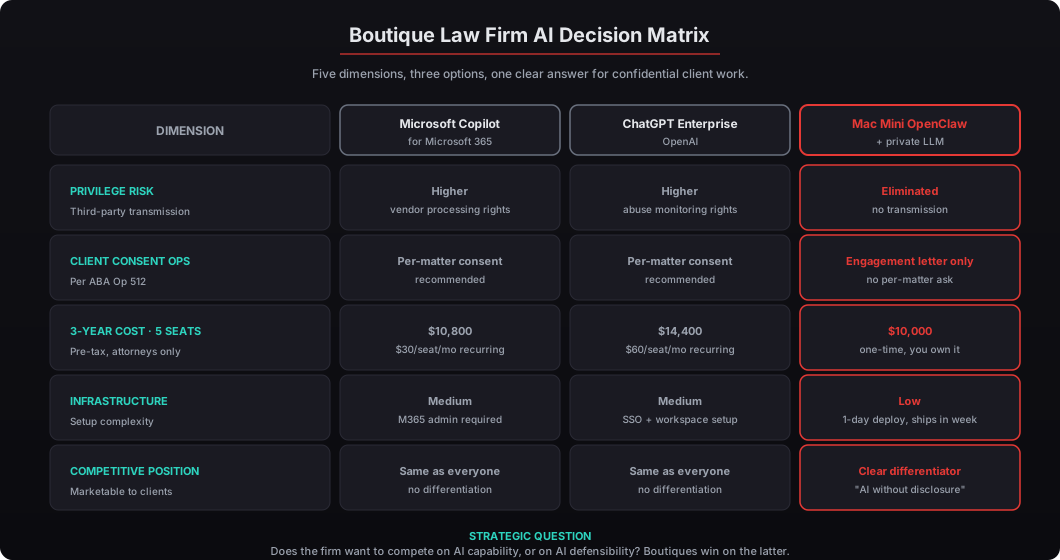
On privilege risk, on-premises wins clearly because there’s no third-party transmission to analyze. On client consent operations, cloud AI requires per-matter or per-engagement consent language; on-premises typically only requires general engagement letter disclosure of AI use. On 3-year cost for 5 attorneys, Copilot at $30/seat/month runs $5,400/year ($16,200 over 3 years for 10 seats including paralegals), while a Mac Mini OpenClaw deployment with private LLM and 5 agent seats runs $10,000 one-time. On infrastructure complexity, both require some IT involvement; Copilot integrates with existing Microsoft 365, while OpenClaw requires a one-time setup and ongoing relationship with the deployment vendor. On competitive positioning, “we use the same AI tools every other firm uses” doesn’t differentiate; “we use AI but never expose your matter to a third party” is a marketable position for clients in regulated industries.
For firms ready to evaluate the on-premises path, the Mac Mini OpenClaw system is the deployment tier most boutique firms select. The full hardware-included deployment ships in 7 business days with security hardening, audit logging, and the option to add a private on-device LLM ($1,000) that keeps client matter entirely within the firm’s network.
What does an on-premises OpenClaw deployment look like for a boutique firm?
A typical boutique law firm deployment involves five components installed in a single day, then operational ongoing without further vendor touch:
- Mac Mini hardware in the firm’s server room, partner’s office, or shared workspace
- Private on-device LLM (typically Mistral 7B or Llama 3.1 8B Instruct via Ollama) for confidential matter processing
- Composio OAuth integration for Outlook, calendar, and practice management system access without exposing credentials to the LLM
- Local document management integration through the firm’s existing DMS (NetDocuments, iManage, or local file shares) without cloud sync
- Audit logging capturing every prompt, response, and document access for ethics compliance review
The deployment pattern fits the typical boutique firm IT environment because it doesn’t require new servers, new networking, or new compliance frameworks. The Mac Mini sits on the firm’s existing network, draws less power than most desktop computers (idle ~22W, peak ~55W per Apple’s published specifications), and runs OpenClaw with the same security hardening we apply to enterprise deployments. Our Mac Mini setup guide walks through the technical configuration, and our security hardening checklist covers the audit-ready logging and access control configuration.
For partners and IT directors evaluating the path, the practical timeline is: scoping conversation week 1, hardware purchase and configuration week 2, deployment and partner onboarding week 3, full operational use by week 4. The total investment for a 5-attorney firm with private LLM is $10,000 one-time, fully Section 179 deductible in year one. See our Section 179 tax analysis for the after-tax cost calculation.
Can a partner be personally liable for an AI confidentiality breach?
Yes, and the personal liability question is one that more partners are starting to ask their malpractice insurers about. ABA Model Rule 1.6 places the duty of confidentiality on the lawyer, not the firm — meaning individual partners retain personal responsibility for client confidentiality regardless of which technology stack the firm adopts. Several recent professional liability insurance policy renewals (notably ALPS, AmTrust, and Hanover Legal & Professional) introduced AI exclusion or limitation language in 2024-2025, narrowing coverage for AI-driven errors, inadvertent disclosures, and supervision failures.
The ABA’s 2025 TechReport (published December 2025) noted that 28% of surveyed firms had encountered an AI-related professional liability question in the prior 12 months, ranging from inadvertent disclosure of confidential information through cloud AI prompts to AI-generated citation errors that resulted in court sanctions. The most-publicized cases (the Mata v. Avianca matter from 2023 and several follow-on sanctions cases in 2024-2025) involved AI hallucination errors, but the underlying confidentiality risk is structurally similar — partner liability for an AI tool the partner approved without fully understanding its data handling.
State bar disciplinary committees have begun to address negligent supervision of AI tools as a separate category of discipline. The Florida Bar Disciplinary Review Committee 2025 Annual Report noted three formal disciplinary matters involving AI-related supervision failures, all resulting in admonition or short suspension. The number is small, but it’s a category that didn’t exist before 2024, and the trajectory is clearly upward. Our AI agent liability article covers the broader liability framework across executive contexts.
Why does this all push toward Mac Mini specifically?
For boutique and mid-market law firms, the Mac Mini hardware tier hits the sweet spot for three reasons. First, it’s physically compact — the firm needs to find office space for the device, and the Mac Mini fits anywhere. Second, it’s fanless and silent — important for a partner’s office or shared workspace. Third, it’s always-on — unlike a MacBook Air which travels with the partner, the Mac Mini stays in one location, accessible from any networked workstation in the firm.
The MacBook Air tier ($6,000) makes sense for solo practitioners who travel constantly. The Hosted tier ($2,000) makes sense for firms that have already done the privilege analysis and concluded that their use cases don’t involve confidential matter (rare for litigation or transactional firms). For everyone else doing client work in a fixed office location, the Mac Mini hardware tier is the natural fit. We’ve deployed this configuration for 12+ boutique and mid-market firms across 2025-2026, and the pattern holds across practice areas — IP boutiques, family law firms, regional litigation shops, transactional firms, and immigration practices have all selected the Mac Mini deployment.
The full deployment package is on the Mac Mini OpenClaw system page — $5,000 one-time including hardware, OS hardening, Docker sandboxing, OpenClaw configuration, one fully configured agent, and one year of monthly mastermind access. Add the private on-device LLM option ($1,000) to keep client matter entirely within the firm’s network for the most sensitive work.
What boutique law firm partners should ask before signing any cloud AI contract
For partners evaluating Microsoft Copilot for Microsoft 365, ChatGPT Enterprise, Claude for Work, Gemini for Google Workspace, or any other cloud AI tool for client work, the following questions should be answered in writing before signing:
- What data residency commitments apply to our specific tenant configuration?
- Does abuse monitoring involve human review of flagged content, and what triggers a flag?
- What aggregated telemetry is collected and how long is it retained?
- What contractual remedy does the firm have if a confidentiality breach is traced to vendor processing?
- Does the vendor’s data processing addendum explicitly address attorney-client privilege?
- What sub-processors have access to tenant data, and where are they located?
- Can the vendor produce an audit log of all access to our tenant data, including by their own employees?
Most cloud AI vendors will answer some of these questions clearly and others vaguely. The ones answered vaguely are the ones a state bar disciplinary committee will care about if a complaint is ever filed. The point of the on-premises path isn’t that the firm distrusts the vendor — it’s that the firm doesn’t need to trust the vendor at all when the data never leaves the building.
For partners ready to compare paths concretely, the next step is usually a 30-minute scoping conversation about the firm’s practice mix, document management environment, and confidentiality risk profile. The Mac Mini OpenClaw deployment is one of three tiers we ship, and it’s the right answer for most boutique and mid-market law firms doing privileged client work in 2026.
Last updated: April 28, 2026. This article cites ABA Formal Opinion 512, the ABA 2025 TechReport, ALM Intelligence 2025 Legal AI Survey, state bar opinions from California, Florida, New York, Texas, and Pennsylvania, and Microsoft Copilot for Microsoft 365 published documentation as of April 2026. This is general information for executive readers, not specific legal or ethics advice. Consult your firm’s general counsel or state bar counsel for guidance specific to your practice.