Private AI vs. Cloud AI: What Executives Need to Know
Private AI runs on hardware you own; cloud AI runs on someone else's. Here's the real cost comparison, the data-flow difference, and the compliance math that executives need to make this decision in 2026.

What Is the Real Difference Between Private AI and Cloud AI?
Answer capsule. Private AI runs on hardware you physically own and control — a Mac Mini on your desk, a MacBook Air in your bag, a VPS you rent and administer yourself. Cloud AI (ChatGPT Enterprise, Microsoft Copilot, Google Gemini for Workspace, Anthropic Claude for Work) processes your data on servers owned by OpenAI, Microsoft, Google, or Anthropic. The technical difference is where the computation happens; the practical difference is who holds the data, who can subpoena it, and who can change the terms of use without asking you first. For executives handling board communications, M&A discussions, investor updates, and financial decisions, those are not philosophical questions.

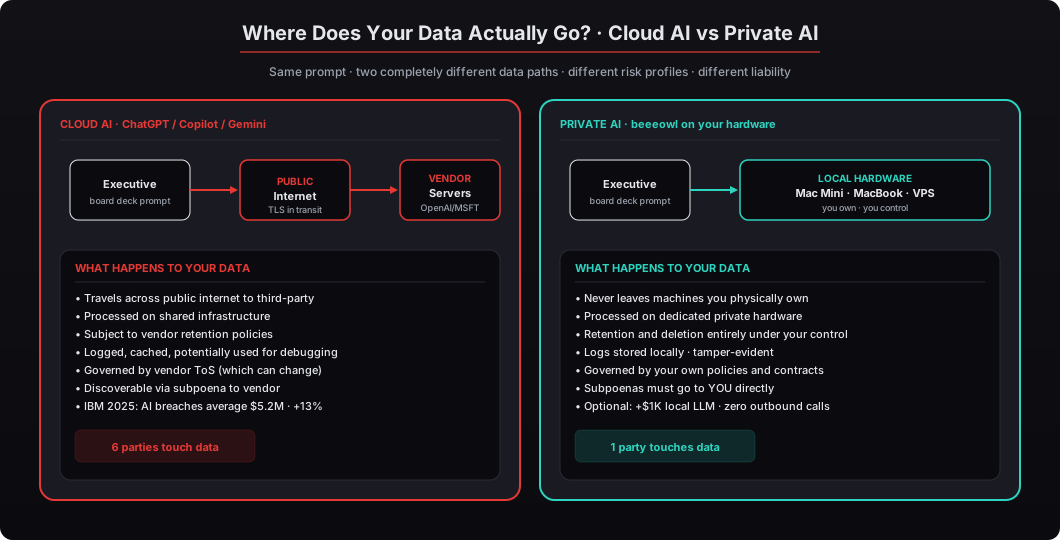
According to Forrester’s 2025 Data Security Survey, 68% of enterprises handling sensitive financial data now require AI processing on infrastructure they directly control — up from 29% in 2023. That’s not a gradual trend. That’s a discontinuous shift driven by three things happening at once: AI-specific breaches that actually made the news, compliance regimes that started enforcing against cloud AI specifically, and a handful of very public vendor terms-of-service updates that retroactively reframed what “your data stays yours” actually meant.
We’ve deployed private AI for executives at companies ranging from 10-person startups to $500M professional services firms, and the question we hear most is never “Is private AI technically better?” It’s “Why did I wait so long?” The answer is almost always a combination of inertia, a vendor promise that sounded reassuring at the time, and nobody in the room willing to ask what happens when the vendor changes their mind.
For the broader business case on when cloud becomes unacceptable, see the case for private AI in 2026. For the structured decision framework that walks through workload-by-workload evaluation, see our cloud AI APIs vs private AI infrastructure decision framework. This post is specifically for the executive in the room who needs the TL;DR in one place.
Why Are Executives Abandoning Cloud AI for Sensitive Work?
Answer capsule. Three forces push C-suite leaders toward private AI: data exposure risk that’s measurable in real breach numbers, vendor lock-in that kills cross-tool workflows, and tightening compliance regimes that make third-party AI processing harder to defend every quarter. Nearly every CEO and CFO we work with cites at least two of these; the ones who move first tend to be in regulated industries or in deals where the other side has raised the question.
Data exposure is the dealbreaker. When you draft an investor update in ChatGPT Enterprise, that text travels to OpenAI’s servers for processing. OpenAI’s policy says they won’t train on it. But a policy is not an architecture — policies change, companies get acquired, legal processes issue subpoenas directly to the vendor rather than to you, and the data has to physically exist somewhere on disk for as long as it’s being processed. IBM’s 2025 Cost of a Data Breach Report found breaches involving AI systems averaged $5.2 million per incident — 13% higher than non-AI breaches and accelerating faster year-over-year than any other category tracked in the report. The gap between “vendor promises not to look” and “the data is not reachable by the vendor in any scenario” is the gap between a policy and an architecture.
Vendor lock-in kills flexibility. Microsoft Copilot only sees data inside Microsoft 365. Google Gemini only sees data inside Google Workspace. Salesforce Einstein only sees Salesforce. According to Okta’s 2025 Business at Work report, the average enterprise uses 130+ SaaS applications, and Gartner’s 2025 Digital Workplace survey found that 78% of executive workflows span four or more platforms daily. A tool that can only see one ecosystem will miss roughly 75% of what you actually do every day. The math doesn’t work no matter how good the tool is inside its own garden.
Compliance is a moving target — and it’s tightening. The EU AI Act entered enforcement in 2025 with articles on risk classification, transparency, and human oversight that practically require the ability to produce audit logs from infrastructure under your direct control. California’s CCPA amendments, Colorado’s AI Act (effective 2026), and US state-level privacy laws now cover 67% of the population per the IAPP 2025 tracker. Canada’s AIDA is advancing through parliament. For public companies, the SEC’s 2024 cybersecurity disclosure rules (Item 1.05 of Form 8-K) require disclosure of material cybersecurity incidents within four business days — a clock that starts running the moment your data lands on a vendor’s server if that vendor later has a breach. Every new regulation makes third-party AI processing a harder compliance story to tell.
Vendor terms of service update on a treadmill. OpenAI’s March 2024 terms update expanded the scope of permitted data use, generating enough backlash that they walked back portions within a week. Google’s 2024 Gemini terms introduced training exclusions that were not backward-compatible. Microsoft’s 2025 Copilot data handling changes required enterprise customers to re-sign a supplementary agreement to maintain existing protections. Each of these generated its own news cycle. None of them changed anything about private AI, because private AI has no vendor to push updates.
How Do Private AI and Cloud AI Costs Actually Compare Over Three Years?
Answer capsule. Cloud AI looks cheaper on day one and gets more expensive every month forever; private AI is a one-time capital expense that breaks even with ChatGPT Enterprise around month 18 for a 10-executive team and saves meaningful money from year two forward. Deloitte’s 2025 AI Cost Benchmarking study found on-premises AI showed 34% lower total cost of ownership over three years compared to cloud-only strategies — and that’s before factoring in the harder-to-price benefits like no vendor risk, no per-seat creep, and no annual renewal uncertainty.
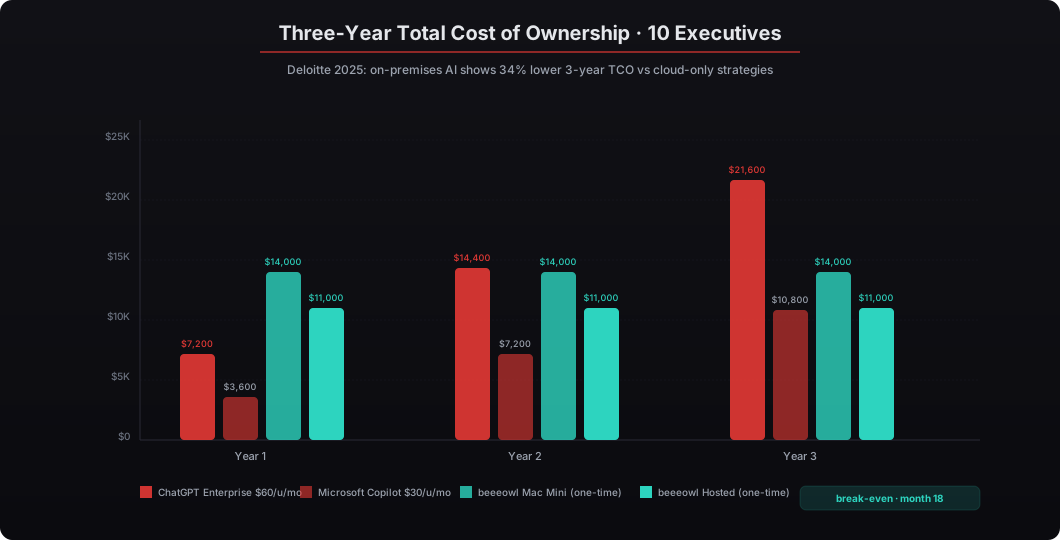
Here’s the real math for a 10-executive deployment:
| Solution | Year 1 | Year 2 cumulative | Year 3 cumulative | Data location |
|---|---|---|---|---|
| ChatGPT Enterprise ($60/user/mo) | $7,200 | $14,400 | $21,600 | OpenAI servers |
| Microsoft Copilot ($30/user/mo) | $3,600 | $7,200 | $10,800 | Microsoft 365 tenant |
| Google Gemini for Workspace ($30/u/mo) | $3,600 | $7,200 | $10,800 | Google infrastructure |
| beeeowl Mac Mini (one-time) | $14,000 | $14,000 | $14,000 | Your hardware |
| beeeowl Hosted (one-time) | $11,000 | $11,000 | $11,000 | Your VPS |
The beeeowl numbers assume the $5,000 Mac Mini setup plus $1,000 for each of the other 9 executives as additional agents (totalling $14,000) or the $2,000 Hosted Setup plus $1,000 each for 9 additional agents ($11,000). No per-seat licensing. No annual renewals. No 15% contract creep every cycle. Hardware included in the Mac Mini tier. One year of monthly mastermind access included in both tiers. See our deployment packages and pricing for the full breakdown.
The subtle cost cloud AI doesn’t print on the invoice. The line items above are what you’ll see in accounting. What you won’t see: the productivity loss when employees self-censor around the AI because they know it’s going to a third party, the compliance consultant you’ll hire to produce audit evidence for regulated workflows, the legal review every time the vendor updates their terms, and the vendor lock-in cost when you decide to switch and discover that “your” data doesn’t export cleanly. McKinsey’s 2025 enterprise AI deployment survey found those unprinted costs add 20 to 40% to the sticker price of cloud AI over three years, depending on the regulatory environment.
For a deeper dive into the return math, see our analysis of ROI on private AI deployment and the cost of not having an agent.
What Can Private AI Actually Do That Cloud AI Cannot?
Answer capsule. Private AI agents built on OpenClaw connect to 40+ tools through Composio — Gmail, Outlook, Salesforce, HubSpot, Google Drive, Notion, Slack, Teams, Jira, Linear, Stripe, QuickBooks, and more — and take autonomous actions across all of them in a single workflow. Cloud AI tools can’t cross vendor boundaries by design: Copilot only sees Microsoft 365, Gemini only sees Google Workspace, Einstein only sees Salesforce. For the executive whose work spans four or more platforms (which is 78% of executives per Gartner 2025), only the cross-boundary architecture actually does the job.
Here’s what private deployment changes in practice:
-
No corporate safety filters on your own data. Cloud AI tools routinely flag M&A terminology, competitive analysis, layoff discussions, and personnel changes as “sensitive content” and either refuse to process them or water down the output. Your private agent processes everything the way your own employees would. If you wouldn’t censor a spreadsheet, your agent doesn’t need to either.
-
Full audit trails you own. Every action logged to storage on your hardware, tamper-evident by design, with retention policies you control. No vendor can access, alter, or delete those records without your cooperation. Subpoenas for your data have to go to you, which means you get to see the request, involve counsel, and push back if appropriate.
-
Optional on-device LLM for maximum privacy. For $1,000 additional, we configure a local language model (typically a quantized Llama 4 or NemoClaw variant) so your data never leaves the machine — not even to the OpenAI or Anthropic APIs. This is the tier most commonly requested by law firms, financial advisors, and family offices. See our guide to on-device AI for legal and financial workflows.
-
Cross-platform workflows that actually work. “Pull the latest three board packets from Google Drive, extract the financial commentary, compare it to this week’s Salesforce pipeline, and draft a Slack message to the finance lead highlighting the three variances that need explanation” is a single private-agent task. In a cloud AI environment, it’s three separate tools and a human doing the coordination.
-
No vendor telemetry. Cloud AI vendors log what you ask, how often you ask, what tools you connect, which prompts work, and which ones fail. They use that telemetry to improve their product — which is fine in principle, less fine when the telemetry is arguably derivative of your confidential data. Private AI has no vendor collecting telemetry.
McKinsey’s 2025 Enterprise AI Deployment Survey found that executives using private AI agents saw 41% higher team adoption rates versus comparable cloud AI deployments. The top reason cited: employees trusted that their work wouldn’t be exposed to third parties, which meant they actually used the tool for real work instead of just the non-sensitive subset.
Why Don’t Microsoft Copilot and Google Gemini Solve This Problem?
Answer capsule. Microsoft Copilot and Google Gemini are genuinely good products trapped inside their own ecosystems. Copilot can summarize Teams meetings, draft Outlook emails, and analyze Excel sheets — but only if those things live inside Microsoft 365. Gemini has the same problem in reverse for Google Workspace. The average executive’s work spans roughly four SaaS platforms per Gartner 2025, meaning a single-vendor tool covers roughly 25% of what the executive actually does. That’s not a product failure; it’s an architectural limit baked into the commercial model.
Copilot summarizes Teams meetings and drafts Outlook emails. But if your deal flow lives in Salesforce, your board communications run through a different portal, your financial models are in Google Sheets, and your M&A discussions happen in Slack — Copilot is blind to all of that. You can ask Copilot to summarize a Word document; you cannot ask it to summarize a Word document, check the figures against your Salesforce opportunity, and send a Slack note to the CFO. That’s not a missing feature; that’s the architecture.
Gemini has the same problem in reverse. Excellent inside Google Workspace. Useless outside of it. If your CRM is HubSpot, your ERP is NetSuite, and your project management is Linear, Gemini cannot see any of it. For companies that standardized on Google Workspace in the early 2010s and never expanded, Gemini might cover most daily work. For anyone else, it covers a fraction.
The cross-platform gap has a name. Gartner calls it “digital workplace fragmentation” in their 2025 Digital Workplace survey, and they measured it directly: 78% of executive workflows span four or more platforms. For those executives, the only product that actually fits the shape of the work is one that can see across platforms — which is the architecture OpenClaw was specifically designed for.
Private AI built on OpenClaw connects to whatever you use — pulling data from Salesforce, drafting summaries in Google Docs, sending updates via Slack, filing Jira tickets, creating Notion pages — in a single autonomous workflow. No vendor boundaries. For a full primer on the framework, see the complete guide to OpenClaw for business leaders.
How Should a CEO or CFO Evaluate This Decision in 2026?
Answer capsule. The decision reduces to three questions you can answer in about five minutes: what data will the AI touch, how many people need access, and how many tools does your team use daily. If the data is sensitive, the team is more than three people, or the tools span more than two platforms, private AI is the better architecture by a wide margin. The only scenarios where cloud AI is the right call are marketing copy for three users all in one ecosystem, or pre-launch experimentation where nothing confidential is in play.
Question one: What data will the AI touch? Marketing copy, blog drafts, job descriptions, vendor research, public company analysis? Cloud AI works fine — the data is either public, low-sensitivity, or genuinely non-material. Board decks, investor updates, M&A terms, financial projections, personnel decisions, legal strategy, client communications that carry privilege, anything subject to HIPAA/SOX/FINRA/GLBA? You need to control where that data lives. Full stop. The liability math is one-sided. See AI agent liability: who pays when it goes wrong and AI insurance exclusions for D&O policies for the specific cases where cloud AI has left executives personally exposed.
Question two: How many people need it? Cloud AI’s per-user pricing compounds fast. At 5 users, the math is roughly even for the first year but tilts toward private AI from year two. At 10 users, beeeowl’s one-time pricing (starting at $11,000 Hosted or $14,000 Mac Mini) breaks even with ChatGPT Enterprise in month 18, and every month after is pure savings. At 20+ users, the three-year savings exceed $40,000 while the data posture gets strictly better.
Question three: How many tools does your team use daily? If everything runs on Microsoft 365 and only Microsoft 365, Copilot covers maybe 80% of your needs — assume the other 20% is either manual or a side tool that the executive handles themselves. If you’re spread across Salesforce, Slack, Google Workspace, Notion, Linear, Stripe, and a custom dashboard — you need an agent that crosses all of them. There is no cloud AI product in 2026 that does cross-vendor orchestration; that’s OpenClaw’s reason for existing.
A fourth question for regulated industries. If you’re a law firm, a family office, a financial advisor, a clinical practice, a defense contractor, or a public company — add: “What compliance regime am I under, and can I produce audit evidence on demand?” The compliance teams at every regulated practice we’ve deployed to arrived at the same conclusion independently: the fastest path to “yes, we can produce evidence” is deploying AI on infrastructure under your direct control. See our executive briefing on GDPR, SOC 2, and EU AI Act compliance for the regulation-by-regulation walkthrough.
We’ve seen this play out dozens of times. The executives who move to private AI don’t go back, not because of ideology but because the math works and the risk profile is strictly better. Request your deployment at beeeowl.com — one-day setup, shipped within a week, every layer of security hardened from day one. See our six-layer security hardening walkthrough for exactly what ships in the box.