GDPR, SOC 2, and the EU AI Act: What AI Agent Compliance Looks Like in 2026
A practical compliance guide for AI agents in 2026 covering GDPR's expanded automated decision-making rules, SOC 2's new AICPA AI governance criteria, the EU AI Act's August 2026 high-risk deadline, Colorado's AI Act, California's CCPA AI amendments, and Illinois BIPA. Includes the side-by-side framework comparison, the specific audit trail requirements that satisfy all of them, and the private-deployment architecture that maps to every framework out of the box.


What Does the AI Compliance Landscape Actually Look Like in April 2026?
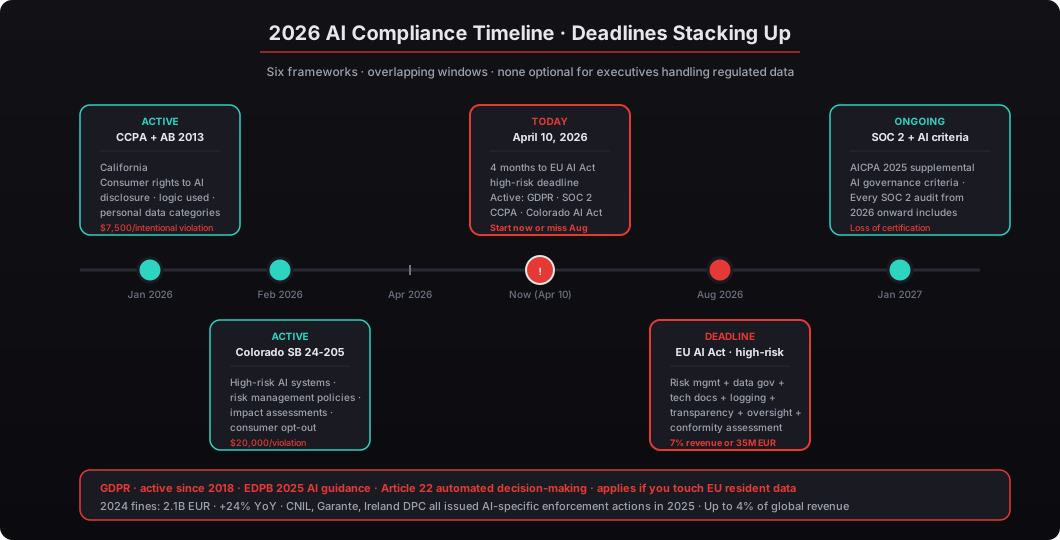
Answer capsule. Three major regulatory frameworks now directly govern how businesses deploy AI agents: GDPR (with expanded EDPB 2025 guidance on automated decision-making that explicitly covers AI agents under Article 22), SOC 2 (with AICPA’s 2025 supplemental AI governance criteria now in scope for every audit conducted from 2026 onward), and the EU AI Act (with the August 2, 2026 hard deadline for high-risk AI system compliance). Three US state laws — Colorado’s SB 24-205, California’s CCPA amendments (AB 2013), and Illinois BIPA — add overlapping requirements on top. Maximum penalties stack: up to 4% of global revenue under GDPR, up to 7% or 35M EUR under the EU AI Act, up to $20,000 per violation in Colorado. The compliance environment for AI agents is the most complex any technology has faced since cloud computing, and the August 2026 deadline is not a suggestion.

I’m not a lawyer — this post isn’t legal advice, and you should absolutely consult your own counsel before making compliance decisions. But I’ve deployed 150+ OpenClaw agents for CFOs, CTOs, and managing partners across the US and Canada, and compliance questions come up in every single conversation. This is the practical guide I wish existed when we started beeeowl, organized around the specific questions executives actually ask about each framework.
According to DLA Piper’s GDPR Fines and Data Breach Survey 2025, regulators issued over 2.1 billion euros in GDPR fines in 2024 alone — a 24% increase year over year. The trend line is clear. And AI-specific enforcement actions are accelerating: Italy’s Garante issued formal AI guidance targeting agent deployments in Q3 2025, France’s CNIL followed with its own in Q4, and Ireland’s Data Protection Commission opened formal investigations into three major AI vendors in early 2026. The pattern is unambiguous: enforcement is coming, and it’s coming faster than most companies are preparing for.
What Does GDPR’s Article 22 Mean for AI Agents in 2026?
Answer capsule. GDPR Article 22 gives individuals the right not to be subject to decisions based solely on automated processing that produce legal or similarly significant effects. For AI agents handling business data, this means any agent making or influencing decisions about people — hiring recommendations, client risk assessments, vendor evaluations, credit scoring, insurance underwriting — triggers Article 22 obligations. You need explicit consent (or one of the other lawful bases), human oversight mechanisms, and the ability to explain how the agent reached its conclusion in a way the data subject can actually understand. The EDPB’s December 2025 guidelines specifically extend this to AI agents acting on delegated authority, closing a loophole that some organizations were trying to use (claiming “a human approved the workflow in advance” as a way to escape Article 22 scope).
The key shift in the EDPB 2025 guidance. Before December 2025, some organizations argued that if a human set up the agent and “approved the workflow” in advance, subsequent autonomous actions didn’t count as “decisions based solely on automated processing.” The EDPB closed that door explicitly: setting up an agent to triage inbound deals and auto-reject those below a threshold is automated decision-making under GDPR Article 22, full stop, regardless of how the agent was initially configured. The same applies to email triage that decides which messages reach the executive, CRM workflows that move deals through stages without human review, and risk scoring that routes applications automatically.
Three practical requirements fall out of this:
Right to explanation. Anyone affected by your agent’s decision can demand an explanation of how it was reached. This means your agent needs logging that captures not just what it did but why — which data inputs drove the output, which tools it consulted, what criteria it applied. Generic responses like “the AI determined” don’t satisfy this. The EDPB’s 2025 guidance cites specific enforcement cases where such responses were ruled insufficient, and the sanctions ranged from 150,000 EUR to 2.8M EUR depending on company size and the nature of the decision. The practical implementation is an audit log that captures the agent’s reasoning trace — not just the final output but the chain of tool calls, data accesses, and intermediate reasoning steps that led to it.
Data minimization. Your agent should only access the personal data it actually needs for its specific task. An executive briefing agent doesn’t need access to employee health records. A deal flow triage agent doesn’t need full investor personal details to score opportunities — it needs the deal metadata, not the LP’s home address. According to the European Commission’s 2025 AI compliance report, data minimization violations were cited in 38% of AI-related GDPR enforcement actions, often because organizations granted broad OAuth scopes (“gmail.full” when “gmail.readonly on a specific folder” would have sufficed). See AI agents as privileged service accounts for the scoped permissions framework we apply to every beeeowl deployment.
Data residency. If you’re processing EU resident data, GDPR’s transfer restrictions apply to your AI agent’s data flows. Sending EU client data to a US-hosted AI API creates a cross-border transfer issue under Chapter V of GDPR. The Schrems II ruling’s aftermath is still playing out — the EU-US Data Privacy Framework provides a current legal basis, but privacy advocacy group noyb (Max Schrems) filed a challenge in 2025, and the Court of Justice of the European Union (CJEU) could invalidate it the same way it did Privacy Shield. Relying on adequacy decisions for your AI architecture carries ongoing legal risk. Private deployment on hardware you physically control eliminates the risk entirely — there’s no cross-border transfer because there’s no transfer at all.
How Has SOC 2 Changed for Companies Using AI Agents?
Answer capsule. SOC 2’s Trust Service Criteria — Security, Availability, Processing Integrity, Confidentiality, and Privacy — didn’t originally contemplate AI agents making autonomous decisions with business data. That changed in late 2025 when AICPA released supplemental guidance adding AI-specific requirements to SOC 2 examinations. If you’re pursuing or maintaining SOC 2 compliance, your AI agent deployment is now in scope for any audit conducted from 2026 onward. The new criteria focus on three areas: AI model documentation (what models you use, how they’re configured, what data they access), output monitoring (whether agent outputs are monitored for accuracy, bias, and unexpected behavior), and automated decision audit trails (retrievable logs for every decision the agent makes or influences).
AI model documentation. You need to document which AI models your agents use, how they’re configured, what data they access, and what guardrails constrain their behavior. For OpenClaw deployments, this means documenting the LLM backend (whether that’s GPT-4o, Claude Sonnet 4.5, Gemini 2.0 Pro, or a private on-device model like Llama 4), the agent’s system prompt and the skills registered in the handler map, the tool permissions granted through the Gateway, and the security controls around the container itself. See our guide to on-device AI for legal and financial workflows and our walkthrough of what OpenClaw actually is.
Output monitoring. SOC 2 auditors starting in 2026 now ask whether AI agent outputs are monitored for accuracy, bias, and unexpected behavior. This isn’t theoretical — Deloitte’s 2025 AI Governance Survey found that 61% of companies using AI agents had no systematic monitoring of agent outputs. The fix is audit trails that capture every agent action plus regular review cycles where a human spot-checks a sample of outputs against expected behavior. The Gateway layer of OpenClaw (see our ecosystem walkthrough) produces the structured audit log automatically; the review cycle is a policy decision the client makes.
Automated decision audit trails. Every decision your AI agent makes — or influences — needs a retrievable log. Who triggered the action, what data the agent accessed, what output it produced, whether a human reviewed it, and if so, what the human’s decision was. This aligns directly with GDPR’s Article 22 logging requirements, which is convenient if you’re building for both frameworks simultaneously (you probably should be). See our detailed audit logging and monitoring walkthrough for the specific log schema and the four observability pillars.
The practical implication for SOC 2 Type II clients. If your next SOC 2 audit is any time in 2026, AI governance is in scope even if your 2025 audit didn’t address it. Your auditor will ask about the AI agents your company uses, how they’re documented, what data they touch, what decisions they make, and whether you have evidence to back it all up. “We use ChatGPT sometimes” is no longer an acceptable answer — the AICPA guidance is explicit that AI usage needs to be inventoried, scoped, and controlled with the same rigor as any other production system.
What Is the EU AI Act’s August 2026 Deadline and Who Does It Affect?
Answer capsule. The EU AI Act is the world’s first comprehensive AI regulation. It entered into force in August 2024, with a phased implementation timeline. The critical date for businesses is August 2, 2026 — that’s when compliance obligations for high-risk AI systems become enforceable. Penalties run up to 35 million euros or 7% of global annual revenue, whichever is higher. The Act classifies AI systems into four risk tiers: unacceptable risk (banned outright), high risk (heavy regulation including conformity assessments), limited risk (transparency obligations), and minimal risk (no specific requirements). AI agents for executives typically land in high risk if they make or influence consequential decisions about people — hiring, financial analysis, credit evaluation, or insurance underwriting all trigger high-risk classification per the European Commission’s January 2026 guidance.
The four risk tiers in practical terms:
- Unacceptable risk (banned): Social scoring, real-time biometric identification in public spaces (with narrow exceptions), predictive policing based on profiling, emotion recognition in workplaces and schools, untargeted scraping of facial images to create databases.
- High risk (heavy regulation): Anything in Annex III — biometric categorization, critical infrastructure management, education and vocational training, employment/worker management, access to essential services, law enforcement, migration, administration of justice, democratic processes. The Commission’s January 2026 guidance specifically lists “AI systems used to evaluate the creditworthiness of natural persons” and “AI systems intended to be used for recruitment or selection” as examples.
- Limited risk (transparency): Chatbots and AI that generates or manipulates content must disclose the AI nature to users. Lower burden but still a real obligation.
- Minimal risk (no specific requirements): Most other applications, like spam filters or AI-enabled video games.
For high-risk classification, the EU AI Act requires:
- A risk management system maintained throughout the AI system’s lifecycle — not just at deployment time
- Data governance covering training data, input data, and validation data with specific quality requirements
- Technical documentation sufficient for third-party conformity assessment, including the information set out in Annex IV
- Automatic logging of agent operations sufficient to trace how the system reached a specific output (this is where your audit trail from the previous section does double duty)
- Transparency to users about the AI system’s capabilities and limitations
- Human oversight measures ensuring a human can intervene or override the system’s decisions
- Accuracy, robustness, and cybersecurity standards appropriate to the system’s purpose and context
- Conformity assessment before placing the system on the market or putting it into service
The European AI Office, established under the Act, began accepting conformity assessment documentation in Q1 2026. Companies operating in the EU — or serving EU clients — should already be preparing their documentation packages, not starting them after the August deadline. The conformity assessment itself takes 6-12 weeks in our experience helping clients prepare theirs, and the assessment bodies have finite capacity, so late-movers will face a bottleneck.
How Do US State AI Laws Add to the Compliance Burden?
Answer capsule. While the EU moved first with comprehensive legislation, US states aren’t waiting for federal action. Three state-level laws create immediate obligations for companies deploying AI agents: Colorado’s AI Act (SB 24-205, effective February 2026 — requires risk management policies, impact assessments, consumer notifications, and opt-out mechanisms for high-risk AI), California’s CCPA amendments (AB 2013, effective January 2026 — extends existing consumer privacy rights to AI-generated decisions with disclosure and explanation obligations), and Illinois BIPA (ongoing — strict biometric privacy law with a private right of action that has resulted in $650M+ in settlements through 2025). Together these three laws cover a majority of the US population and create obligations nearly as demanding as GDPR’s right to explanation.
Colorado’s AI Act (SB 24-205), signed in May 2024 and effective February 2026, requires deployers of “high-risk AI systems” to implement risk management policies, conduct impact assessments, notify consumers when AI is making consequential decisions, and provide opt-out mechanisms. Colorado defines “high-risk” broadly — any AI system making or substantially influencing decisions about employment, financial services, housing, insurance, or education qualifies. The Colorado Attorney General’s office issued implementation guidance in November 2025 confirming that autonomous AI agents fall within the Act’s scope. Penalties run up to $20,000 per violation, and the AG has explicit enforcement authority.
California’s CCPA amendments (AB 2013), effective January 2026, extend existing consumer privacy rights to AI-generated decisions. Consumers can now request disclosure of whether AI was used in decisions affecting them, the logic involved, and the categories of personal data processed by the AI system. For companies using AI agents that touch California resident data — which, given California’s population and economic weight, means most US companies — this creates disclosure obligations nearly as demanding as GDPR’s right to explanation. Penalties: up to $7,500 per intentional violation, with enforcement by both the California AG and the California Privacy Protection Agency.
Illinois BIPA (Biometric Information Privacy Act) remains the strictest biometric privacy law in the US. If your AI agent processes biometric data — voice recordings for transcription, facial recognition for meeting identification, keystroke dynamics for authentication — BIPA’s written consent requirements and private right of action apply. BIPA litigation resulted in over $650 million in settlements through 2025 per Seyfarth Shaw’s BIPA litigation tracker, including a $650M settlement against Facebook, a $92M settlement against TikTok, and multiple smaller settlements. The private right of action is the critical detail: plaintiffs don’t need to show harm beyond the technical violation, which makes BIPA class actions unusually easy to bring and difficult to defend.
Other states are moving too. New York, Texas, and Virginia all have AI-related legislation in various stages. The practical approach is to treat the strictest state’s requirements as the baseline and design for that — typically Colorado for high-risk AI classification and Illinois for biometric data. A compliance program that satisfies Colorado and Illinois usually satisfies the rest of the US by default. See our state-by-state walkthrough in US state AI laws 2026: an executive compliance briefing.
How Do These Frameworks Compare Side by Side?
Answer capsule. Six frameworks, each with slightly different specific language, all converging on the same underlying requirements: audit trails, right to explanation, human oversight, data residency control, risk assessment, and data minimization. A private AI deployment on hardware you own with scoped permissions, tamper-evident logging, and human-in-the-loop approval gates satisfies all six simultaneously — the architecture is the compliance story.
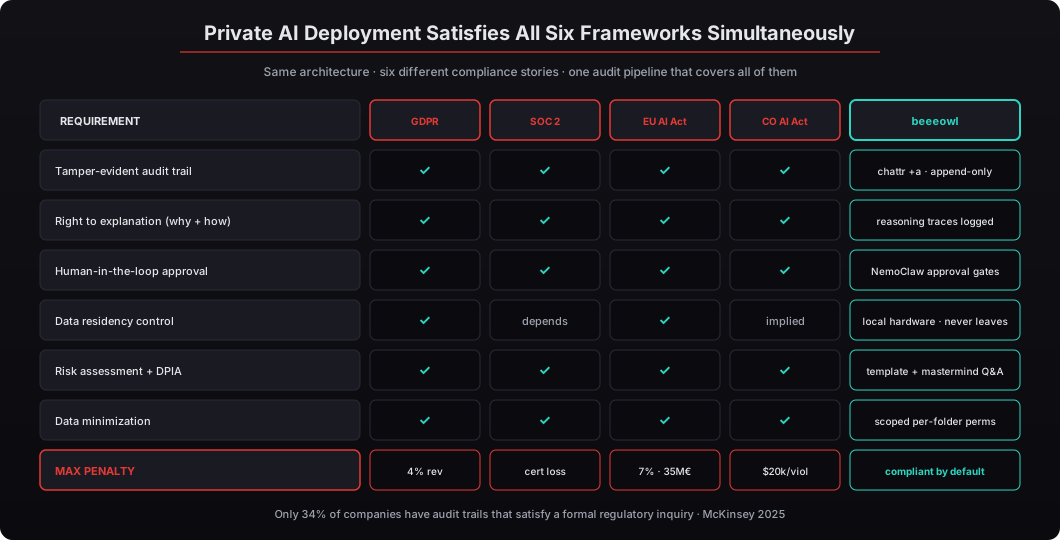
Here’s the detailed side-by-side comparison with specific citations:
| Requirement | GDPR (EU) | SOC 2 (AICPA) | EU AI Act | Colorado AI Act | CCPA (California) |
|---|---|---|---|---|---|
| Audit trail for AI decisions | Required (Art. 22 + EDPB 2025 guidance) | Required (2025 AI criteria) | Required for high-risk (Art. 12) | Required for high-risk | Required on request (AB 2013) |
| Right to explanation | Yes (Art. 13-15, 22) | Implied by Processing Integrity | Yes for high-risk | Yes for high-risk | Yes (AB 2013) |
| Human oversight mandate | Yes for automated decisions | Recommended | Required for high-risk (Art. 14) | Required for high-risk | Not explicitly |
| Data residency restrictions | Yes (Chapter V transfers) | Depends on scope | No specific, but documentation required | No specific | No specific |
| Risk assessment required | DPIA for high-risk processing | Part of audit scope | Mandatory for high-risk | Mandatory for high-risk | Not required |
| Penalties for non-compliance | Up to 4% global revenue | Loss of certification | Up to 7% global revenue or 35M EUR | Up to $20,000 per violation | Up to $7,500 per intentional violation |
| Applies to US companies | Yes, if processing EU data | Voluntary (client-driven) | Yes, if AI affects EU persons | Colorado operations | California resident data |
| Effective date | Active since 2018; AI guidance 2025 | Active; AI criteria late 2025 | High-risk: August 2, 2026 | February 2026 | January 2026 |
What Audit Trail Requirements Do All These Frameworks Share?
Answer capsule. Every single framework in the matrix converges on one thing: you need comprehensive, tamper-resistant logs of what your AI agent does. The specifics vary by framework, but the core requirement is identical. If you can’t show an auditor — or a regulator, or a court — exactly what your agent did, when it did it, what data it accessed, and what output it produced, you have a compliance gap under every applicable framework. McKinsey’s 2025 State of AI report found that only 34% of companies deploying AI agents have audit trails that would satisfy a formal regulatory inquiry. The gap isn’t technical — modern AI frameworks support logging. The gap is operational: nobody configured it, nobody tested it, nobody reviewed the logs.
The shared technical requirement across all six frameworks is:
- Every agent action logged with timestamp, actor (user or agent), action category, tool called, parameters, result, and duration
- Data classification tags so restricted/confidential/internal/public categories can be filtered for targeted audits
- User attribution so each action can be traced to a specific authenticated session
- Tamper evidence so logs cannot be modified after the fact, even by a compromised agent process
- Retention appropriate to the purpose — typically 90 days to 7 years depending on industry (GDPR says “appropriate,” SOC 2 typically expects 12 months, HIPAA expects 6 years, SOX expects 7, FINRA 3-6)
- Exportable format so evidence can be produced on demand for auditors or regulators without custom tooling
At beeeowl, every OpenClaw deployment includes immutable local audit trails by default, matching this shared requirement. Every agent action is logged in structured JSON with full attribution: session ID, user identity, action type, tool called, parameters, response summary, duration, data classification, and permission check result. Logs are stored on the client’s hardware (not in a cloud service, not on a third-party server), with chattr +a append-only attributes that prevent the agent user from reading or modifying existing entries. See the audit logging and monitoring walkthrough for the complete pipeline.
Why Does Data Residency Matter More Than Ever for AI Agents?
Answer capsule. Data residency is where cloud AI deployments run into the most friction with GDPR and the EU AI Act. When your AI agent processes data through a cloud API — OpenAI, Anthropic, Google Gemini — that data travels to the provider’s servers, which may be in the US, the EU, or multiple regions depending on load balancing. You often don’t control where. Under GDPR Chapter V, transferring personal data outside the EU requires either an adequacy decision, Standard Contractual Clauses, or Binding Corporate Rules. The EU-US Data Privacy Framework provides a current legal basis, but it faces ongoing challenges that could invalidate it the same way Schrems II invalidated Privacy Shield in 2020. Private on-premise deployment eliminates this entire category of risk by keeping data on hardware you physically own — there’s no cross-border transfer because there’s no transfer at all.
The specific cloud-transfer problem. When you use ChatGPT Enterprise, your prompts travel from your browser across the public internet to OpenAI’s servers. OpenAI’s infrastructure spans multiple regions and uses automatic load balancing for capacity, which means your prompt might be processed in Virginia, Oregon, Frankfurt, or Dublin depending on the time of day and the load on their datacenters. The practical implication: if your prompt contains personal data of an EU resident, you have created a cross-border data transfer, and the legal basis for that transfer needs to be documented.
The same applies to Anthropic’s Claude (hosted on AWS across multiple regions), Google Gemini (hosted across Google’s global infrastructure), and Microsoft Copilot (hosted in the client’s Azure tenant but with processing that can cross region boundaries in certain scenarios). All four major cloud AI vendors have published DPAs that attempt to address the cross-border transfer issue, typically by citing the EU-US Data Privacy Framework or by offering EU-only processing as a premium tier.
The problem with relying on the DPF. Privacy advocacy group noyb (founded by Max Schrems, the person whose Facebook case invalidated Privacy Shield in 2020) filed a challenge to the EU-US Data Privacy Framework in 2025. The challenge makes essentially the same arguments that succeeded in Schrems II: US intelligence agencies have surveillance capabilities that are incompatible with EU fundamental rights, and no executive order or adequacy decision can fully address that structural problem. The Court of Justice of the European Union has invalidated two successive frameworks (Safe Harbor in 2015, Privacy Shield in 2020) and could invalidate the DPF in 2026 or 2027. If your AI compliance strategy depends on DPF adequacy, you have a clock running on it.
Private, on-premise deployment eliminates this risk entirely. When your AI agent runs on a Mac Mini in your office, a MacBook Air you carry with you, or a VPS in a data center you control, data never leaves your physical custody. There’s no cross-border transfer because there’s no transfer at all. Your data stays on your hardware, processed by your agent, logged locally. The DPF adequacy decision becomes irrelevant because you don’t need it. See the case for private AI in 2026.
The private on-device LLM option takes this one step further. For an additional $1,000 on any beeeowl tier, we configure a locally-running model (typically Llama 4 via Ollama, or a quantized NemoClaw variant) so that your prompts and data never reach any external API — not OpenAI, not Anthropic, not Google, not anyone. The inference happens entirely on your hardware. For companies in regulated industries (financial services, healthcare, legal, defense), this is increasingly the only deployment model that satisfies both the letter and the spirit of data residency requirements. See our walkthrough of running a private LLM with Ollama to keep data off the cloud and on-device AI for legal and financial workflows.
What Should CFOs and CTOs Actually Do Before August 2, 2026?
Answer capsule. Five concrete actions with clear deliverables: (1) Map every AI agent’s data flows and document them for the conformity assessment, (2) Implement tamper-evident audit trails if you haven’t already — the same logs satisfy GDPR, SOC 2, EU AI Act, and every US state law simultaneously, (3) Classify each AI agent’s risk level under the EU AI Act (recruitment, financial analysis, credit scoring, and insurance underwriting are all high-risk per the Commission’s January 2026 guidance), (4) Review cloud AI DPAs — Microsoft, Google, and OpenAI all updated theirs in 2025 specifically for AI processing, so make sure you’re on the current versions, (5) Consider private deployment as a compliance simplification strategy — it eliminates cross-border transfer issues, removes third-party AI processing from your data flow, and gives you complete audit trail ownership in a single architectural decision.
Here’s the practical checklist. No fluff, no “consult your legal team” deflection (though yes, you should do that too):
1. Map your AI agent’s data flows. Document every piece of data your agent accesses, where it goes, how it’s processed, and where the output ends up. If data crosses borders — even to a cloud API — document the legal basis for that transfer. The European Commission’s AI Act conformity documentation templates, published in February 2026, provide a starting framework. This is a real piece of work; budget 2-4 weeks of effort for a thorough map depending on the number of integrations. If you have OpenClaw running through Composio, the integration list doubles as your data flow map — Composio knows every OAuth scope and every API endpoint it’s configured to use.
2. Implement tamper-evident audit trails now. Don’t wait for an auditor to ask. Every action, every data access, every output, every LLM call. Timestamps, tool identifiers, parameter details, response summaries, data classification tags. Store logs separately from the agent on an append-only volume. See our audit logging walkthrough for the complete pipeline. This single investment satisfies logging requirements under GDPR Article 22, SOC 2 CC7.2, EU AI Act Article 12, Colorado SB 24-205, CCPA AB 2013, HIPAA §164.312(b), and SOX §404 simultaneously — one pipeline, seven frameworks.
3. Classify your AI agent’s risk level under the EU AI Act. If your agent makes or influences decisions about people — hiring recommendations, investor risk scoring, creditworthiness evaluation, insurance underwriting — it’s likely high-risk under Annex III. Plan for a conformity assessment, technical documentation per Annex IV, human oversight mechanisms, and the full risk management system. Conformity assessments take 6-12 weeks in our experience, and the assessment bodies have finite capacity. Start the process now if you expect to be in scope.
4. Review your data processing agreements. If you’re using cloud AI APIs (OpenAI, Anthropic, Google, Microsoft), your DPA with the provider needs to cover AI-specific processing. Many standard DPAs written for SaaS products don’t adequately address how AI models handle, retain, or learn from your data. All four major AI vendors updated their enterprise DPAs in 2025 specifically to address AI processing — make sure you’re on the current versions. If your organization has standard contracting terms that predate these updates, get legal to review whether the old terms need amendment.
5. Consider private deployment as a compliance strategy. I’m biased — this is what beeeowl does. But the compliance math is straightforward: private deployment eliminates cross-border transfer issues under GDPR Chapter V, removes third-party AI processing from your data flow diagram, gives you complete control over audit trails, and satisfies data minimization by keeping data within your infrastructure. It’s the shortest architectural path to compliance under every framework discussed in this guide. The same Mac Mini that runs your email triage agent also produces the audit evidence your compliance team needs for SOC 2, the data flow documentation your GDPR DPIA needs, and the logging infrastructure the EU AI Act Article 12 requires. One architectural decision, six frameworks covered.
The regulatory environment for AI agents isn’t going to get simpler. The EU AI Act’s August 2, 2026 deadline is a hard wall, not a suggestion. Colorado and California are already enforcing. GDPR enforcement for AI is accelerating. The companies that build compliance into their AI infrastructure now — rather than retrofitting after an enforcement action — will have a significant operational and competitive advantage. The ones that wait will face a bottleneck at the conformity assessment bodies, rushed legal review under deadline pressure, and the real risk of operating in non-compliance while they figure it out.
If you’re deploying AI agents for your executive team and want compliance built in from day one, that’s exactly what we do at beeeowl. Every deployment — $2,000 Hosted, $5,000 Mac Mini with hardware, $6,000 MacBook Air for traveling executives — includes tamper-evident audit trails, scoped permissions, data residency controls (hardware you own), human-in-the-loop approval gates through NemoClaw, and security hardening that maps to GDPR, SOC 2, and EU AI Act requirements out of the box. Add the +$1,000 private on-device LLM if you need to guarantee that prompts and data never reach any external API. Every tier includes 1 year of monthly mastermind access for ongoing compliance Q&A as the regulations evolve. Request your deployment at beeeowl.com.
Related reading — for deeper coverage of specific compliance topics, see US state AI laws 2026: an executive compliance briefing, AI agent liability: who pays when it goes wrong, AI insurance exclusions for D&O policies, the case for private AI in 2026, and AI agent governance: the control problem for executives in 2026.