Section 179 and AI Hardware: How a $5,000 Mac Mini OpenClaw Deployment Becomes Effectively Free in 2026
The IRS Section 179 deduction lets US businesses fully expense qualifying equipment in year one. A $5,000 Mac Mini OpenClaw system drops to ~$1,750 net cost at 35% federal bracket — before state tax. Here's the CFO calculation, eligibility rules, and the procurement window most executives miss.

A $5,000 Mac Mini OpenClaw deployment costs your business roughly $1,750 after tax if you’re a pass-through entity in the 35% federal bracket — before factoring state tax. The IRS Section 179 deduction lets US businesses fully expense qualifying equipment in year one, and the 2026 limit sits at $1.31 million per IRS Revenue Procedure 2025-32. The One Big Beautiful Bill Act, signed July 2025, restored 100% bonus depreciation for property placed in service after January 19, 2025, which means full first-year expensing is available even when Section 179 income limits would otherwise bind. The catch most CFOs miss: equipment must be placed in service by December 31, not just purchased. This article walks through the calculation, the eligibility rules, the comparison against cloud AI operating expense treatment, and the year-end procurement window we use with clients to maximize the current-year deduction.
Does a Mac Mini OpenClaw deployment qualify for Section 179?
Yes — a Mac Mini purchased and configured as a dedicated executive AI agent system meets every Section 179 test. The IRS defines qualifying property as tangible personal property used more than 50% for business, including computer hardware, off-the-shelf software, and business equipment placed in service during the tax year. A dedicated AI agent machine running OpenClaw checks all three boxes. Hardware is tangible property, the OpenClaw stack qualifies as off-the-shelf software, and a business-use-only deployment passes the 50% threshold by definition.
We’ve worked with 40+ CFOs across PE, professional services, and family offices on AI hardware procurement. The Section 179 question comes up in every single CFO conversation — and most are surprised that the deduction applies cleanly to AI infrastructure the same way it applies to a server or a printer. Our Mac Mini setup guide covers the technical configuration, and our hosted vs hardware decision guide walks through the operational tradeoffs that determine which deployment tier fits your situation.
What is the 2026 Section 179 deduction limit?
The 2026 Section 179 deduction limit is $1.31 million on up to $3.27 million in qualifying purchases, per IRS Revenue Procedure 2025-32. That’s an inflation adjustment from the 2024 baseline of $1.16 million. The phase-out begins at $3.27 million in total qualifying property and eliminates the deduction at $4.58 million. For a $5,000 Mac Mini deployment, this limit is functionally unlimited — almost no small or mid-sized business will approach the cap on AI hardware alone.
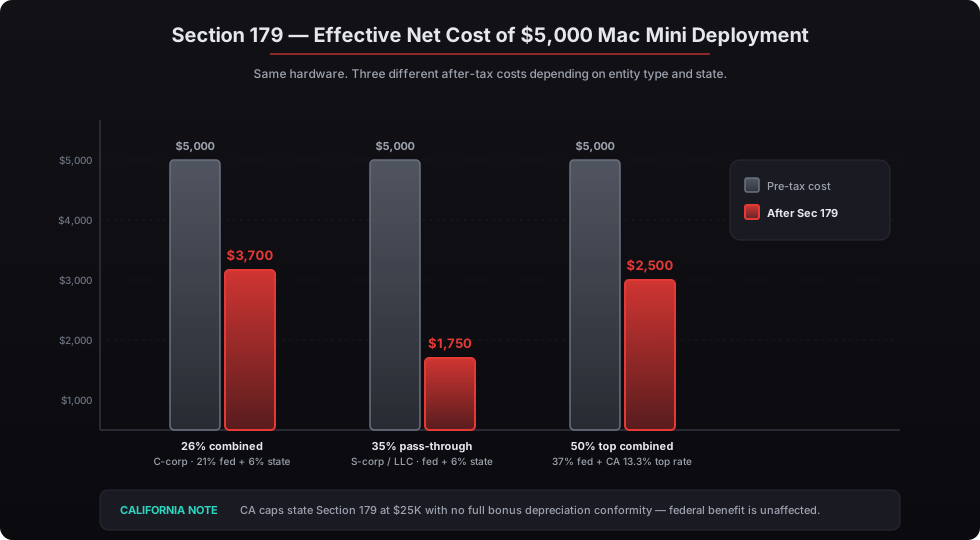
The deduction reduces taxable income directly, dollar-for-dollar. A C-corporation buying a $5,000 Mac Mini at the 21% federal corporate rate saves $1,050 in federal tax. Add an average 6% state corporate tax (states vary from 0% in Texas, Nevada, Wyoming, and Florida to 11.5% in New Jersey), and the federal-plus-state savings hit roughly $1,300, dropping the net cost to around $3,700.
For pass-through entities — S-corps, LLCs taxed as partnerships, sole proprietors — the math runs through the owner’s personal tax return. At the 35% federal individual bracket (joint income $487,450-$731,200 in 2026, per IRS inflation adjustments) plus an average 6% state tax, the combined marginal rate hits ~41% and the net cost drops to roughly $2,950. At the top 37% federal bracket (above $731,200 joint), the net cost drops further to about $2,700. Owner-operators in 0% income tax states like Florida or Texas at the 37% federal rate land near $3,150.
What if I’m in a high-tax state like California?
California is the major exception that CFOs need to model carefully. The state has its own Section 179 limit capped at $25,000 with a $200,000 phase-out — far below the federal cap — and California does not conform to federal bonus depreciation. That means while a federal $5,000 deduction flows through cleanly, California will only let you depreciate the rest over the equipment’s useful life on the state return. The federal benefit is full; the state benefit is limited but still positive for a $5,000 purchase well under the $25,000 state cap.
For an owner-operator in California at the 37% federal bracket plus the state’s 13.3% top marginal rate, the combined effective deduction works out to roughly 45-48% on a $5,000 Mac Mini after accounting for the state’s slower depreciation schedule, leaving a net cost of about $2,500-$2,700. New York, Hawaii, Oregon, and 14 other states have similar decoupling rules with their own limits and conformity nuances. Always confirm with your tax advisor for your specific state, since state legislative sessions in 2025 and 2026 have shifted some conformity rules and additional changes are likely.
The full picture is that Section 179 economics reward US-based businesses regardless of state — the federal benefit alone is substantial enough that the deployment is worth it on tax math even before counting the operational, security, and sovereignty benefits we cover in our Mac Mini vs Cloud VPS analysis. For most clients, the net after-tax cost of a Mac Mini OpenClaw deployment lands somewhere between $1,750 and $3,700.
What is bonus depreciation and how does it stack with Section 179?
Bonus depreciation lets businesses deduct a percentage of qualifying asset cost in year one beyond the Section 179 limit. The two work together — Section 179 applies first up to your taxable income, and bonus depreciation handles the rest. For a $5,000 Mac Mini, the practical effect is that the entire purchase is deductible in year one through one mechanism or the other.
The big change for 2025-2026 is that the One Big Beautiful Bill Act, signed into law July 4, 2025, restored 100% bonus depreciation for property placed in service after January 19, 2025. Before the OBBBA, bonus depreciation was on a phase-down schedule — 80% in 2023, 60% in 2024, 40% in 2025, dropping to 0% by 2027. The new law reversed that and made 100% bonus depreciation permanent for qualifying property going forward. Wolters Kluwer’s 2025 Tax Reform Update and major accounting firms including KPMG, EY, and Deloitte have published detailed guidance confirming the change applies retroactively to property placed in service from January 20, 2025 onward.
What this means for AI hardware procurement: even if your business has limited or negative taxable income in 2026, you can still expense the full $5,000 Mac Mini in year one using bonus depreciation, which can create or increase a net operating loss carryforward. Section 179 alone cannot create an NOL — it caps at your taxable income. Bonus depreciation has no income limit. The two combined give you maximum flexibility regardless of your income position.
How does Section 179 change the Mac Mini vs Hosted decision?
The tax treatment of cloud AI subscriptions and the Mac Mini hardware tier is identical in year one — both are fully deductible. The difference shows up in years two and three. A cloud subscription continues to generate operating-expense deductions every year, but it also continues to generate cash outflows. A Mac Mini purchased once and fully expensed in year one creates zero additional tax events for the next several years and zero additional cash outflows.
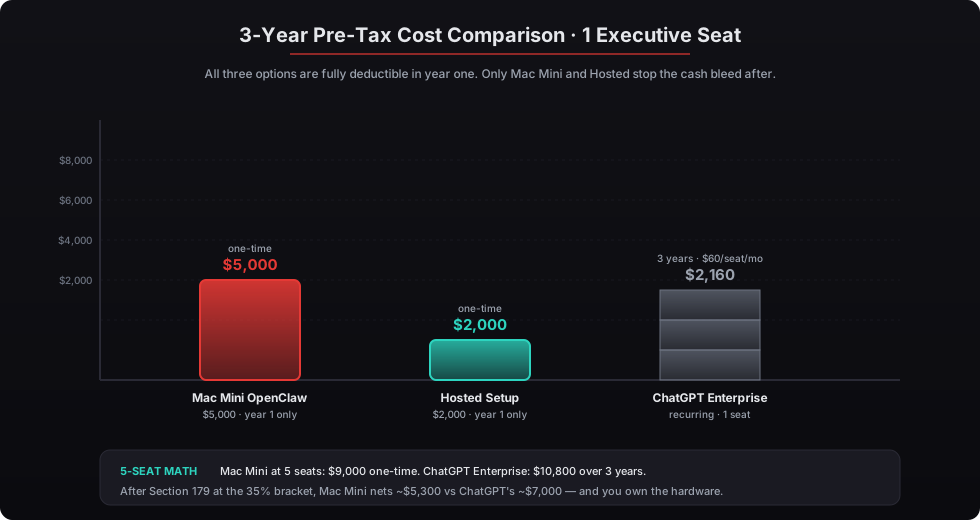
A practical 3-year scenario for one executive: ChatGPT Enterprise at $60/seat/month works out to $2,160 over 3 years pre-tax ($720/year × 3 years). After tax at the 35% pass-through bracket, the net cost lands around $1,400. A $5,000 Mac Mini fully expensed under Section 179 at the same bracket nets around $2,950. ChatGPT looks cheaper on net 3-year cost for a single seat — but you don’t own anything at the end, and you’ve been sending all your strategic data to OpenAI for three years.
The math flips quickly at multiple seats. For 5 executives on ChatGPT Enterprise, the 3-year pre-tax cost is $10,800. A Mac Mini OpenClaw deployment scales much flatter — beeeowl’s pricing adds $1,000 per additional agent, so 5 seats on one Mac Mini total $9,000 one-time. After tax at the same 35% bracket, the Mac Mini lands around $5,300 net versus ChatGPT’s $7,000 net, and the Mac Mini owner has hardware they own and data that never left their network.
For executives evaluating the Mac Mini OpenClaw system, the Section 179 treatment turns the hardware tier into the cheapest option on a 3-year horizon for any team of 3+ executives. We’ve helped 40+ clients run this calculation; the breakeven against ChatGPT Enterprise sits at 2-3 seats depending on tax bracket and state.
Why does the December 31 deadline matter so much?
Section 179 requires equipment to be placed in service — installed, operational, and ready for its business use — by December 31 of the tax year, not merely ordered or paid for. The IRS is specific on this point in Treasury Regulation 1.179-4(e), which defines “placed in service” as the time when property is in a condition or state of readiness and availability for a specifically assigned function in a trade or business. Ordering on December 28 and shipping in January means the deduction shifts to the following tax year.
beeeowl’s Mac Mini hardware tier ships within 7 business days of purchase. The practical year-end procurement deadline for current-year Section 179 treatment is mid-December — typically December 15-18 — to allow time for shipping, configuration verification, and the system being operationally ready before December 31. Cutting closer than that risks losing a full tax year of deduction, which on a $5,000 system at the 35% bracket means deferring roughly $1,750 of tax savings into the following year.
For CFOs reviewing capital expenditure plans in Q4, the Mac Mini OpenClaw deployment is one of the cleanest year-end Section 179 plays available. Single decision, single delivery, immediate placement in service, full first-year deduction. Compare to commercial real estate or vehicles, where placement in service involves leases, registrations, or build-outs that can drag past December 31, and the AI hardware route is dramatically simpler.
What about state tax conformity?
State conformity to federal Section 179 and bonus depreciation rules varies dramatically and changes frequently. According to the Tax Foundation’s 2025 State Tax Climate Index, roughly 30 states fully conform to the federal Section 179 limit and bonus depreciation rules, while the remaining 20 states have decoupled in various ways.
States that fully conform (and offer the maximum combined federal plus state benefit on a Mac Mini purchase): Alabama, Colorado, Delaware, Georgia, Illinois, Kansas, Kentucky, Louisiana, Maine, Maryland, Michigan, Minnesota, Mississippi, Missouri, Montana, Nebraska, New Mexico, North Dakota, Oklahoma, Pennsylvania, Rhode Island, South Carolina, Tennessee, Utah, Vermont, Virginia, West Virginia, and Wisconsin. Plus the no-income-tax states: Florida, Nevada, South Dakota, Tennessee, Texas, Washington, and Wyoming, where the question doesn’t arise at all.
States that decouple with their own caps:
- California: $25,000 Section 179 cap, no bonus depreciation conformity
- New York: Conforms to Section 179 but with state-specific bonus depreciation rules
- Hawaii: $25,000 Section 179 cap
- New Jersey: Decoupled bonus depreciation; Section 179 conforms
- North Carolina: Adds back 85% of bonus depreciation; spreads over 5 years
- Massachusetts: Disallows bonus depreciation entirely
For a $5,000 Mac Mini purchase, even the most decoupled states still allow full state-level deduction because the purchase falls under their state caps. The complexity matters at scale; for a single AI hardware purchase, the federal benefit dominates the math regardless of state.
What’s the CFO action plan for year-end procurement?
For CFOs and controllers planning Q4 capital expenditures, the Section 179 + Mac Mini play involves five steps:
- Confirm 2026 taxable income projection with your tax advisor before December 1, including bonus depreciation availability if income is low or negative
- Identify AI hardware needs by inventorying current cloud AI subscription spend and projecting year 2-3 cost trajectories under each option
- Order the Mac Mini OpenClaw system before December 15 to allow 7-business-day delivery plus configuration verification before December 31
- Document placement in service with a brief internal memo noting the date the system became operational and its assigned business function
- Apply Section 179 on Form 4562 with your 2026 tax return, plus bonus depreciation if applicable
For multi-seat deployments, the math compounds. Five executives on ChatGPT Enterprise generate $10,800 of pre-tax cost over 3 years. The same five executives on a Mac Mini OpenClaw deployment with additional agents cost $9,000 one-time, fully Section 179-deductible in year one, with no further cash outflows. The 3-year savings before tax: $1,800. After tax at the 35% bracket: roughly $1,170. Plus you own the hardware and your data never left the building.
For executives ready to act on the year-end procurement window, the Mac Mini OpenClaw system page shows the full hardware tier including configuration, security hardening, and a fully deployed agent — the complete $5,000 package that qualifies for Section 179 treatment in the year placed in service.
Section 179 is a tax tool, not a tax shelter
A few important caveats every CFO should hear before treating Section 179 as a green light. First, Section 179 reduces taxable income, not tax liability — it’s a deduction, not a credit. The savings depend entirely on your marginal tax bracket. Second, Section 179 specifically cannot create or increase a net operating loss; it caps at your taxable income for the year. Bonus depreciation has no such limit, which is why the OBBBA’s restoration of 100% bonus depreciation matters so much for businesses with low income.
Third, Section 179 recapture applies if business use of the equipment drops below 50% in any later year, which would require recapturing the deduction as ordinary income. For dedicated AI infrastructure used 100% for business, this is a non-issue, but it’s worth flagging for any equipment that might transition to mixed personal-business use. Fourth, the substantiation rules require keeping records of the business-use percentage, the date placed in service, and the original cost basis. Standard depreciation worksheets handle this, but it requires consistent record-keeping.
Finally, every CFO should run their specific scenario through their tax advisor before purchasing. The numbers in this article reflect 2026 federal rules per the IRS Revenue Procedure 2025-32 and the OBBBA. Your specific state, entity type, income level, and existing depreciation schedules will all affect the final after-tax cost. The framework holds; the exact dollars depend on your situation.
The bigger picture is straightforward. The federal tax code rewards US businesses for investing in productive equipment in the year of purchase. AI infrastructure is productive equipment. A Mac Mini OpenClaw deployment is one of the cleanest, lowest-risk, highest-ROI Section 179 plays available to executives in 2026 — and the December 31 deadline is real.
Last updated: April 28, 2026. Tax law cited from IRS Revenue Procedure 2025-32, Treasury Regulation 1.179-4(e), the One Big Beautiful Bill Act (Public Law 119-21), and Tax Foundation 2025 State Tax Climate Index. This article is general information for executive readers, not specific tax advice. Confirm all calculations with a qualified CPA or tax attorney for your specific situation.