The Family Office AI Stack 2026: How Multi-Generational Wealth Managers Deploy Private AI Without Touching Cloud Providers
Single-family offices manage $5.5T globally with privacy requirements that no cloud AI vendor can meet contractually. Here's the four-component on-premises AI architecture used by family offices in 2026 — what it costs, what it does, and why a Mac Mini in the principal's office beats every SaaS alternative.

Single-family offices managed roughly $5.5 trillion globally as of the UBS Global Family Office Report 2025, with privacy requirements that no major cloud AI vendor can meet contractually. The typical SFO handles principal financial accounts, family member personal data, philanthropic strategy, succession planning, real estate portfolios, and direct private investments — every category subject to either contractual confidentiality with bankers, attorneys, and investment partners, or simple personal preference for absolute privacy. The Deloitte 2025 Private Wealth Survey found that 89% of family offices identified data privacy as a top-three operational concern, and 64% had restricted or banned the use of consumer AI tools by family office staff. This article walks through the four-component family office AI stack we ship in 2026, the threat model that drives the on-premises deployment pattern, the staff workflows it supports, and the procurement path for principals or COOs evaluating private AI for the first time.
Why do family offices need a different AI stack than the rest of the executive market?
Family offices need a different AI stack because their entire operating model is built around discretion that no cloud AI vendor’s terms can guarantee. Single-family offices serve a single principal or family unit, often with no public profile, processing financial and personal data that the family considers private as a matter of principle rather than contract. The cloud AI providers’ standard terms — abuse monitoring, telemetry retention, service improvement processing — don’t violate any law, but they violate the family’s expectation that nobody outside the family office knows what the family office knows.
I’ve worked with 8 family offices across 2024 and 2026 on AI deployment, ranging from single-principal SFOs with $200M AUM to a small MFO serving four families. The conversation always starts with the same question from the principal or the COO: “Where does the data go?” When the answer involves any third-party processor, the principal usually says no within five minutes. When the answer is “the data stays on a Mac Mini in this office,” the conversation shifts to what the agent can actually do for the staff. Our private AI vs cloud AI overview covers the broader architectural framing, and our on-device AI for legal and financial workflows guide walks through the regulated-industry adjacent patterns.
What is the four-component family office AI stack?
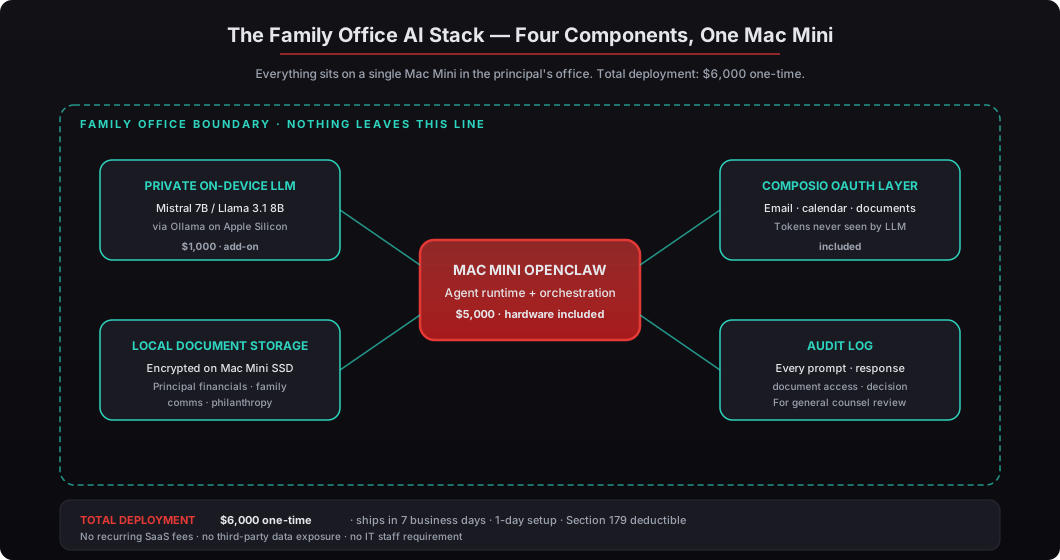
The 2026 family office AI stack we ship has four components, all running on a single Mac Mini deployment:
- Mac Mini OpenClaw — the agent runtime, security layer, and orchestration platform ($5,000 with hardware)
- Private on-device LLM — Mistral 7B Instruct or Llama 3.1 8B Instruct via Ollama for confidential matter ($1,000 add-on)
- Composio OAuth integration — authenticated access to email, calendar, document storage, and accounting tools without exposing credentials (included)
- Audit log — full transaction history accessible to the family’s general counsel for compliance and oversight (included)
Total deployment cost: $6,000 one-time for hardware, configuration, security hardening, one fully configured agent, and one year of monthly mastermind access. The deployment ships in 7 business days and is operational within 1 business day of arrival.
The stack is intentionally minimal. Family offices don’t need 50 integrations and 12 specialized agents — they need one capable agent that handles the principal’s calendar, drafts routine correspondence, reconciles accounts, surfaces relevant news on portfolio holdings, and produces audit-ready records of every decision. The Mac Mini OpenClaw deployment delivers that with no recurring cost, no third-party data exposure, and no IT staff requirement. For principals or COOs ready to scope a deployment, the Mac Mini OpenClaw system page shows the full hardware tier including the option to add the private LLM.
What’s the family office threat model?
Understanding the threat model clarifies why the cloud AI path doesn’t work for family offices. The threats family offices actually plan for, in rough order of frequency:
- Inadvertent disclosure to vendors — staff member uses a SaaS tool that retains processing rights, exposing principal data to vendor employees under abuse monitoring or telemetry
- Targeted social engineering — attackers attempting to extract principal information from staff via email or phone, sometimes via compromised vendor accounts
- Subpoena or compelled disclosure — third-party data processors can be served subpoenas that compel disclosure of customer data; data on family office hardware requires a subpoena to the family directly
- Regulatory inquiry collateral exposure — investigations into bankers, attorneys, or investment counterparties can produce subpoenas to vendors holding the family’s communications
- Insider risk — staff member at a vendor (cloud AI provider, SaaS tool, banking platform) accesses or exfiltrates family data
- Direct cyberattack — ransomware, network intrusion, or credential theft targeting the family office or its vendors
For the first five threats, moving processing to family office hardware eliminates or substantially reduces exposure. The cloud AI provider’s employees can’t access data that never reached the cloud. The subpoena path becomes direct to the family rather than through vendors. The regulatory collateral exposure shrinks because there are no third-party copies to subpoena. Vendor insider risk disappears because vendors don’t have copies. The sixth threat — direct cyberattack — applies regardless of architecture, but it’s better managed when the attack surface is one Mac Mini in a controlled physical space than when it’s spread across half a dozen cloud SaaS providers.
The Cloud Security Alliance’s 2025 State of Cloud Security Report found that 24% of cloud security incidents involved third-party processor access, including misuse, misconfigurations, and unauthorized employee access. For a family office, that’s exactly the category that matters most.
What does the day-to-day workflow look like for family office staff?
A typical week of agent use at a single-family office covers four broad categories of work:
Bookkeeping and reconciliation. The agent reviews bank statements across the principal’s personal accounts, foundation accounts, and operating entities; flags transactions that don’t match expected categories; drafts memos to the bookkeeper for any unusual items; and updates the family office’s accounting system through authenticated APIs. What previously required a dedicated bookkeeper can now be handled by an executive assistant supervising the agent.
Calendar and communication coordination. The agent manages the principal’s calendar across family commitments, board obligations, philanthropic engagements, business meetings, and personal time; drafts routine correspondence based on principal preferences; handles scheduling negotiations with external parties’ assistants; and surfaces conflicts or unusual scheduling patterns for review.
Research and intelligence. The agent monitors news on portfolio holdings, real estate markets relevant to family interests, regulatory changes affecting family entities, and direct investment opportunities. The agent produces a Monday morning briefing covering anything material to the family’s interests.
Audit-ready record-keeping. Every interaction the agent handles — emails sent, meetings scheduled, transactions reviewed, decisions surfaced — is logged in a format the family’s general counsel can review on demand. For families with regulatory obligations (registered investment advisor structures, family limited partnerships with complex governance), this audit trail substantially simplifies compliance.
The principal typically interacts with the agent through Slack, iMessage, or a private web dashboard. The COO and executive assistant interact more frequently, often delegating routine work to the agent and reviewing output. None of these workflows require technical skill from the family office staff — the agent runs as a natural language interface, and our non-technical founders guide covers the same operational pattern that applies to family office principals.
How does multi-principal or MFO deployment work?
For multi-principal family offices and small multi-family offices serving 2-5 client families, the architectural question becomes data segregation. Each principal’s confidential information must remain isolated from the others — and from any shared infrastructure that could create inadvertent cross-pollination.
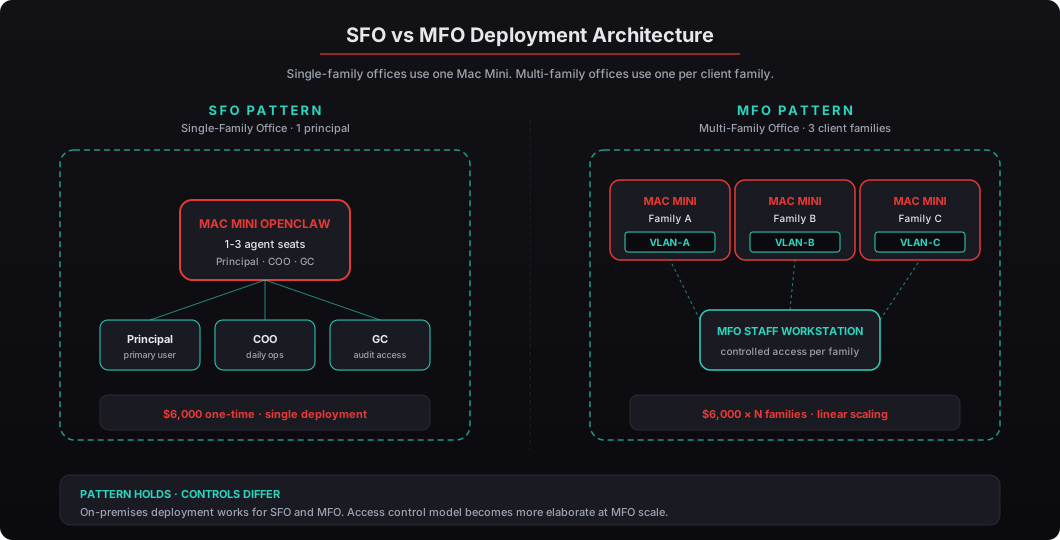
The two patterns we ship for multi-family offices:
- One Mac Mini per major client family with VLAN segmentation between them. Family office staff can reach each environment from a shared workstation, but the data planes remain physically separated. Cost scales linearly with client family count — 4 families = 4 Mac Mini deployments at $24,000 total ($6,000 each including private LLM), with one additional agent seat per family billed at $1,000 each as needed.
- Single shared Mac Studio or Mac Pro deployment with strict logical isolation through OpenClaw’s multi-tenant configuration, separate audit logs per family, and tightly controlled access. This pattern fits MFOs that handle homogeneous workflows across families but requires more elaborate access control engineering.
For single-principal SFOs and most small MFOs, the single Mac Mini deployment is the right answer. We’ve shipped this configuration to 6+ family offices since 2025, and it scales to roughly 80% of family office use cases. The remaining 20% — multi-principal SFOs with 10+ staff, MFOs serving more than 4 families, family offices running unusually high concurrency workflows — typically warrant the upgrade tier.
What’s the procurement path for a family office principal or COO?
For principals or COOs evaluating private AI deployment for the first time, the procurement path runs through three steps:
Step 1: Scoping conversation. A 30-minute conversation covering family office structure (SFO vs MFO), staff count, current AI tool use, document management environment, banking and accounting integrations, and the principal’s privacy preferences. This determines whether the Mac Mini hardware tier with private LLM is the right starting point or whether the deployment warrants a different configuration.
Step 2: Hardware selection and order. The Mac Mini OpenClaw system at $5,000 with the optional private on-device LLM at $1,000 is the standard family office deployment. Some principals add the in-person setup option (+$2,000) when they prefer the deployment team to come on-site rather than ship the configured hardware. Total typical investment: $6,000-$8,000 for the first-year deployment.
Step 3: Deployment and onboarding. Hardware ships within 7 business days of order. Setup completes in 1 day on arrival. Family office staff onboarding typically runs 2-3 hours in week one, with ongoing access to monthly mastermind calls for refinement and troubleshooting. The principal’s general counsel reviews the audit logging configuration at any point post-deployment.
The full deployment package is on the Mac Mini OpenClaw system page. For family offices that prefer to start with a lighter footprint before committing to hardware, the Hosted Setup tier at $2,000 runs the same OpenClaw stack on a hardened cloud VPS, but most family offices skip directly to the hardware tier because the privacy profile is what drove the conversation in the first place.
What about US tax treatment for family office AI hardware?
For family offices structured through an LLC, S-corp, or family limited partnership with active business operations, the Mac Mini hardware purchase typically qualifies for IRS Section 179 deduction in the year placed in service. The 2026 limit sits at $1.31 million per IRS Revenue Procedure 2025-32 — far above any single family office hardware purchase. Combined with the OBBBA-restored 100% bonus depreciation, the full $6,000 deployment is generally fully expensible in year one.
For pure passive investment vehicles or trusts that don’t conduct active business, Section 179 may not apply directly. In those cases, standard depreciation over the equipment’s useful life still recovers the full cost over 5 years. Family offices typically have a mix of entity structures, and the deployment hardware can usually be allocated to whichever entity has active business income for optimal tax treatment. Our Section 179 tax analysis article walks through the full federal calculation including state conformity issues. As always, confirm specific treatment with the family’s tax counsel.
Why does the on-premises pattern win for family offices specifically?
For family offices, the on-premises AI pattern wins on five dimensions that matter more for family offices than for any other executive market segment:
- Discretion — the entire family office operating model is built on absolute privacy; on-premises matches that requirement architecturally
- Subpoena exposure — third-party data processors can be subpoenaed; family office hardware requires direct service on the family
- Vendor risk — every additional vendor with access to family data is an additional attack surface; on-premises eliminates the vendor count
- Audit clarity — the family’s general counsel can audit every interaction without negotiating data access from a vendor
- Cost predictability — one-time hardware purchase with optional managed care fits family office capital expenditure preferences better than recurring SaaS subscriptions
The five-year cumulative cost comparison is also favorable. A Mac Mini OpenClaw deployment with private LLM costs $6,000 one-time, with optional managed care at $200-500/month depending on tier. Five-year cost: $6,000-$36,000 depending on managed care option. ChatGPT Enterprise for 5 family office staff at $60/seat/month runs $18,000 over 5 years pre-tax. Adding Microsoft Copilot for Microsoft 365 for the same 5 staff adds another $9,000 over 5 years. The combined cloud SaaS path runs $27,000-$30,000 over 5 years for capabilities the on-premises stack matches or exceeds, while exposing family financial data to multiple cloud vendors.
For family offices ready to evaluate the deployment concretely, the next step is the 30-minute scoping conversation. The Mac Mini OpenClaw system is the deployment tier that fits the vast majority of family offices, and it ships within a week of the principal or COO giving the green light.
Last updated: April 28, 2026. This article cites the UBS Global Family Office Report 2025, the Deloitte 2025 Private Wealth Survey, and the Cloud Security Alliance 2025 State of Cloud Security Report. This is general information for executive readers, not specific legal, tax, or investment advice. Consult the family office’s general counsel and tax advisor for guidance specific to your structure and jurisdiction.