Building a 24/7 Competitive Intelligence Agent That Actually Works
Crayon 2025: 57% of enterprises have CI programs but most rely on manual spreadsheets. Gartner: real-time CI drives 2.4x faster pricing decisions. McKinsey: a week of competitive response delay costs $50K-$200K. Here's the exact YAML config we ship across 30+ CEO deployments.

Crayon’s 2025 State of Competitive Intelligence report found that 57% of enterprises now have a dedicated CI program — up from 39% in 2022. But here’s the gap: most of those programs rely on manual research teams updating spreadsheets weekly. By the time insights reach the CEO, they’re already stale. Gartner’s 2025 research on strategic decision-making found that organizations with real-time competitive monitoring make pricing and positioning decisions 2.4x faster than those relying on quarterly reviews. McKinsey’s work on strategic decision speed puts a number on it — every week of delay on a competitive response costs mid-market companies between $50K and $200K in lost positioning value. Forrester’s 2025 research on alert fatigue in enterprise intelligence platforms found executives disengage from CI tools after receiving more than 5 low-quality alerts per day. We’ve deployed this agent for 30+ CEOs. This article walks through the exact same YAML configs, data source setup, monitoring schedules, alert rules, and dossier templates we use in production — with target of 1-3 real-time alerts per week and everything else batched into a 90-second morning dossier.
Why does every CEO need a competitive intelligence agent?
Because you’re making decisions with yesterday’s information while your competitors move in real time. A properly configured CI agent monitors 8-12 data sources continuously, detects material changes within hours, and delivers a structured dossier before your first meeting of the day. The gap between “aware of a competitor’s move” and “responded to a competitor’s move” is where most market share shifts quietly happen in mid-market SaaS.
Crayon’s 2025 State of Competitive Intelligence report found that 57% of enterprises now have a dedicated CI program — up from 39% in 2022. But here’s the gap: most of those programs rely on manual research teams updating spreadsheets weekly. By the time insights reach the CEO, they’re already stale. A research analyst who compiled a CI briefing on Monday is summarizing data that’s already 72 hours old by the time it lands in the CEO’s Thursday inbox — and 72 hours is enough time for a competitor to launch a pricing change, close a Series C, or hire a VP of Sales in your top EMEA market before you even know the event happened.
Gartner’s 2025 research on strategic decision-making found that organizations with real-time competitive monitoring make pricing and positioning decisions 2.4x faster than those relying on quarterly reviews. McKinsey’s work on strategic decision speed puts a number to it — every week of delay on a competitive response costs mid-market companies between $50K and $200K in lost positioning value. Compounded across 4-6 competitive events per quarter, that’s $1M+ per year on the floor for companies running CI on manual spreadsheets. We’ve deployed this agent for 30+ CEOs at beeeowl. I’m going to walk through the exact same YAML configs, data source setup, monitoring schedules, and dossier templates we use in production — not simplified examples. You can take this article and ship it.
What data sources should the agent monitor?
Six categories of data give you 90% coverage of what competitors are doing. Here’s how we configure each one and what signal it provides, in priority order by actionable value.
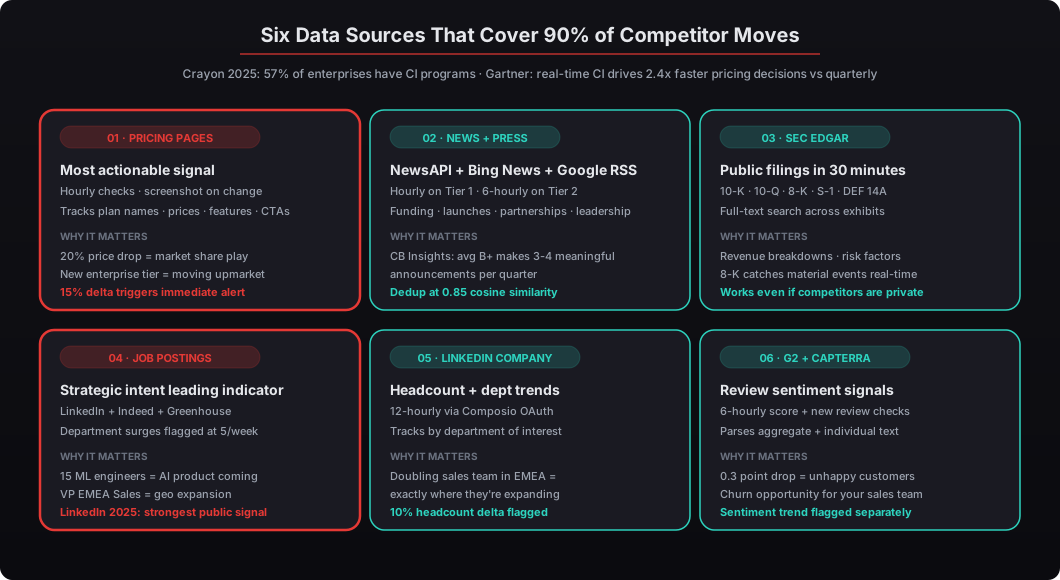
Pricing pages get checked hourly. Pricing changes are the most immediately actionable competitive signal — a competitor dropping prices 20% is making a market share play, a competitor adding an enterprise tier is moving upmarket, a competitor restructuring their seat-based pricing to consumption-based is repositioning for platform customers. Anything strategic that a competitor does eventually shows up on the pricing page, and the pricing page is the single most underused signal because most CI tools check it weekly at best.
News and press releases catch announcements — funding rounds, product launches, partnerships, leadership changes. We use NewsAPI and Bing News Search API as primary sources, with Google News RSS as a fallback. According to CB Insights, the average Series B+ company makes 3-4 public announcements per quarter that are strategically meaningful to direct competitors. The challenge isn’t finding the announcements — it’s filtering the 40 near-duplicates that every announcement generates across tech press, which is why the deduplication threshold matters.
SEC filings matter even if your competitors are private. Their investors, partners, and customers may be public. We pull from SEC EDGAR directly. 10-K filings reveal revenue breakdowns, risk factors, and strategic priorities. 8-K filings catch material events in near real-time — acquisitions, executive changes, material contracts. The 30-minute polling interval on 8-K is the tightest loop in the entire monitoring pipeline because 8-Ks are where the most strategically valuable information lands first.
LinkedIn company pages are goldmines for hiring signals and headcount changes. A competitor that doubles their sales team in EMEA is telling you exactly where they’re expanding next — before they announce it publicly. LinkedIn’s own 2025 Workforce Report showed that hiring velocity is the single strongest public signal of a company’s strategic direction. Engineering hiring patterns are particularly valuable because engineering teams build what the product roadmap says months before the product lands.
G2 and Capterra reviews provide unfiltered customer sentiment. When a competitor’s review score drops 0.3 points in a quarter, their customers are unhappy — and potentially reachable by your sales team. We parse both aggregate scores and individual review text for recurring complaints like “reliability,” “support response,” or “pricing increase surprise.” The agent flags both the aggregate trend and specific themes so your sales team has actual talking points, not just “their G2 score dropped.”
Job postings across LinkedIn, Indeed, and Greenhouse API reveal where competitors are investing before they announce it publicly. Fifteen new ML engineer postings? They’re building an AI product. A VP of APAC Sales opening? Geographic expansion incoming. A Head of Developer Relations hire? They’re building a developer ecosystem. Hiring is the earliest public indicator of strategic direction, typically 3-6 months ahead of launch.
Here’s the full data source configuration we ship in every deployment:
# agent-config/ci-data-sources.yaml
data_sources:
  news_monitoring:
    providers:
      - name: newsapi
        provider: composio
        app: newsapi
        config:
          languages: ["en"]
          sort_by: "publishedAt"
          page_size: 50
      - name: bing_news
        provider: composio
        app: bing_news_search
        config:
          market: "en-US"
          freshness: "Day"
    keywords_per_competitor:
      primary: ["company_name", "CEO_name", "product_name"]
      secondary: ["company_name"]

  sec_filings:
    provider: composio
    app: sec_edgar
    config:
      filing_types: ["10-K", "10-Q", "8-K", "S-1", "DEF 14A"]
      include_exhibits: false
      full_text_search: true

  linkedin_monitoring:
    provider: composio
    app: linkedin
    scopes:
      - r_organization_social
    config:
      track_headcount: true
      track_job_postings: true
      track_company_updates: true
      departments_of_interest:
        - "Engineering"
        - "Sales"
        - "Marketing"
        - "Product"

  review_sites:
    providers:
      - name: g2
        scrape_interval_hours: 6
        track_aggregate_scores: true
        track_new_reviews: true
        min_review_length: 50
      - name: capterra
        scrape_interval_hours: 6
        track_aggregate_scores: true
        track_new_reviews: true

  pricing_pages:
    check_interval_minutes: 60
    screenshot_on_change: true
    track_elements:
      - plan_names
      - plan_prices
      - feature_lists
      - cta_text

  job_postings:
    providers:
      - name: linkedin_jobs
        provider: composio
        app: linkedin
      - name: indeed
        scrape_interval_hours: 6
      - name: greenhouse
        api_check_interval_hours: 6
    categorize_by_department: true
    flag_surge_threshold: 5  # new postings in same dept/week
How should you structure the competitor watchlist?
Not every competitor deserves the same monitoring intensity. We use a three-tier system that keeps signal-to-noise high without missing anything material. The tiering is the single most important configuration decision — get it wrong and you either drown in noise or miss the disruptor that ultimately eats your market.
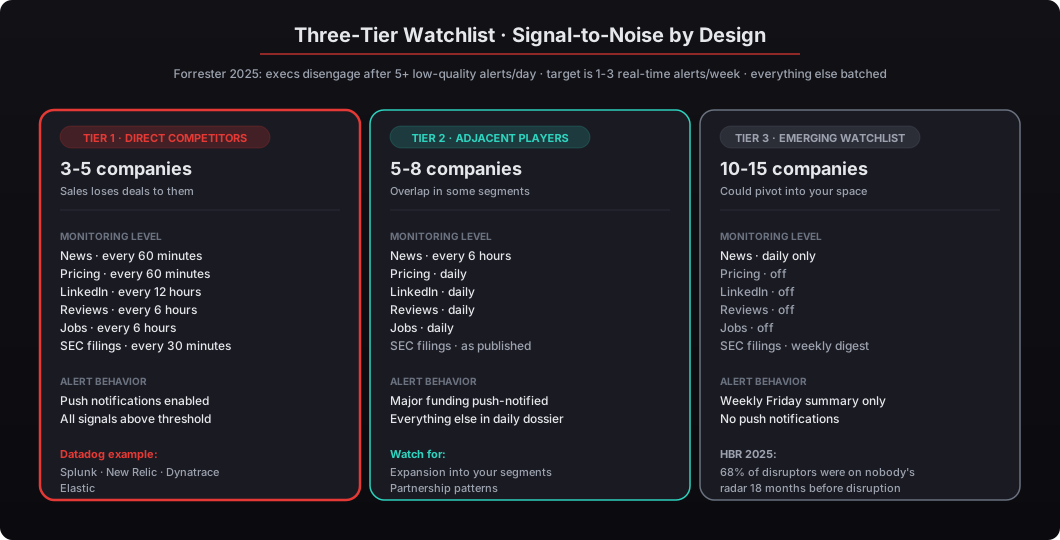
Tier 1 — Direct competitors (3-5 companies). These are the ones your sales team loses deals to. They get hourly news checks, hourly pricing page monitoring, and every data source active. For a company like Datadog, Tier 1 might be Splunk, New Relic, Dynatrace, and Elastic. Crayon’s research shows the most effective CI programs track no more than 5 primary competitors — beyond that, the signal gets drowned by noise and the CEO stops opening the dossier.
Tier 2 — Adjacent competitors (5-8 companies). They compete in some segments but aren’t your primary threat today. News checked every 6 hours, pricing daily, job postings daily. These are the companies where you want awareness of major moves (funding rounds, pricing restructures) but you don’t need hourly monitoring because they’re not immediately taking deals from you. When a Tier 2 company starts showing Tier 1 signals — aggressive pricing, hiring in your verticals, closing your customers — they get promoted to Tier 1 at your next quarterly review.
Tier 3 — Emerging watchlist (10-15 companies). Startups, adjacent players, or companies that could pivot into your space. News only, checked daily. According to Harvard Business Review’s 2025 analysis of competitive disruption, 68% of the companies that ultimately disrupted a market leader were on nobody’s radar 18 months before the disruption. The Tier 3 watchlist is how you catch the disruptor early. The weekly Friday digest keeps you aware without consuming daily attention.
Here’s the watchlist config we ship:
# agent-config/ci-watchlist.yaml
competitors:
  tier_1:
    monitoring_level: "critical"
    news_interval_minutes: 60
    pricing_interval_minutes: 60
    all_sources_active: true
    companies:
      - name: "Competitor Alpha"
        domain: "competitor-alpha.com"
        linkedin_id: "competitor-alpha"
        sec_cik: "0001234567"  # if public
        g2_slug: "competitor-alpha"
        pricing_url: "https://competitor-alpha.com/pricing"
        greenhouse_board: "competitor-alpha"
        keywords: ["Competitor Alpha", "Alpha Platform", "Jane Smith CEO"]

      - name: "Competitor Beta"
        domain: "competitor-beta.com"
        linkedin_id: "competitor-beta"
        g2_slug: "competitor-beta"
        pricing_url: "https://competitor-beta.com/pricing"
        keywords: ["Competitor Beta", "Beta Suite"]

  tier_2:
    monitoring_level: "standard"
    news_interval_hours: 6
    pricing_interval_hours: 24
    sources: ["news", "linkedin", "job_postings", "pricing"]
    companies:
      - name: "Adjacent Player One"
        domain: "adjacent-one.com"
        keywords: ["Adjacent One", "AO Platform"]

  tier_3:
    monitoring_level: "watchlist"
    news_interval_hours: 24
    sources: ["news"]
    companies:
      - name: "Startup to Watch"
        keywords: ["Startup Watch", "SW Labs"]
How do you configure alert thresholds that don’t cry wolf?
This is where most CI setups fail. Too many alerts and you ignore them all. Too few and you miss the pricing change that costs you a quarter’s worth of deals. The goal is 1-3 real-time alerts per week with everything else batched into the daily dossier and weekly digest.
We’ve iterated on alert rules across 30+ deployments. The configuration below reflects what actually works — high-signal triggers that CEOs consistently tell us were worth the interruption. According to Forrester’s 2025 research on alert fatigue in enterprise intelligence platforms, executives disengage from CI tools after receiving more than 5 low-quality alerts per day. Our threshold is 1-3 real-time alerts per week on average, with everything else batched into the daily dossier. The key mechanisms are cooldown periods (preventing duplicate alerts for the same event), deduplication (collapsing news coverage of one event from 40 outlets into one entry), and relevance scoring (dropping low-signal items before they reach the dossier).
{
  "alert_rules": {
    "immediate_alerts": {
      "description": "Push notification via Slack DM within 15 minutes",
      "triggers": [
        {
          "type": "pricing_change",
          "condition": "price_delta_percent > 15 OR new_tier_added",
          "tier": ["tier_1"],
          "cooldown_hours": 24
        },
        {
          "type": "funding_announcement",
          "condition": "amount > 10000000",
          "tier": ["tier_1", "tier_2"],
          "cooldown_hours": 48
        },
        {
          "type": "leadership_change",
          "condition": "role IN ['CEO', 'CTO', 'CRO', 'CPO']",
          "tier": ["tier_1"],
          "cooldown_hours": 48
        },
        {
          "type": "acquisition_or_merger",
          "condition": "any",
          "tier": ["tier_1", "tier_2"],
          "cooldown_hours": 0
        },
        {
          "type": "sec_filing",
          "condition": "filing_type IN ['8-K', 'S-1']",
          "tier": ["tier_1"],
          "cooldown_hours": 0
        }
      ]
    },
    "daily_dossier_items": {
      "description": "Included in morning dossier, no push notification",
      "triggers": [
        {
          "type": "news_mention",
          "condition": "relevance_score > 0.7",
          "tier": ["tier_1", "tier_2"]
        },
        {
          "type": "review_score_change",
          "condition": "delta > 0.2 over 30 days",
          "tier": ["tier_1"]
        },
        {
          "type": "job_posting_surge",
          "condition": "new_postings_in_department > 5 per week",
          "tier": ["tier_1", "tier_2"]
        },
        {
          "type": "headcount_change",
          "condition": "linkedin_headcount_delta_percent > 10 over 90 days",
          "tier": ["tier_1"]
        },
        {
          "type": "new_product_feature",
          "condition": "detected_from_changelog OR pricing_page",
          "tier": ["tier_1"]
        }
      ]
    },
    "weekly_digest_items": {
      "description": "Batched into Friday summary",
      "triggers": [
        {
          "type": "any",
          "tier": ["tier_3"]
        },
        {
          "type": "review_sentiment_trend",
          "condition": "negative_mention_increase > 20 percent",
          "tier": ["tier_1", "tier_2"]
        }
      ]
    }
  }
}
What does the daily intelligence dossier look like?
The dossier is what makes this agent worth the setup. Every morning at 7:00 AM, the CEO gets a structured Slack DM (or WhatsApp, or email) that reads like a personal intelligence briefing — not a firehose of raw alerts. We format it for skimmability: bold competitor names, clear severity labels, and a bottom-line summary the CEO can read in under 90 seconds.
Deloitte’s 2025 research on executive information consumption found that C-suite leaders spend an average of 47 seconds on any single intelligence update — so if your first paragraph doesn’t deliver the headline, nothing else gets read. The dossier is designed to front-load the highest-priority items and push everything else into scan-friendly sections that the executive can absorb in a single pass. Here’s a real example of what the dossier output looks like (anonymized from a beeeowl client deployment):
COMPETITIVE INTELLIGENCE DOSSIER
Thursday, March 27, 2026 | 7:00 AM ET
Monitoring: 7 primary, 12 secondary, 15 watchlist

PRIORITY ALERTS (Action Required)

[HIGH] Competitor Alpha dropped Enterprise pricing 22%
  Source: Pricing page change detected 2:14 AM ET
  Previous: $89/seat/mo | Current: $69/seat/mo
  Analysis: Aggressive mid-market play. Aligns with their
  Q4 earnings call comment about "expanding addressable market."
  Recommendation: Review our Enterprise positioning with CRO
  before Monday pipeline review.

[HIGH] Competitor Beta announced Series D — $185M led by
Andreessen Horowitz
  Source: TechCrunch, 6:47 PM ET yesterday
  Valuation: $2.1B (up from $800M at Series C)
  Analysis: Press release emphasizes "AI-native platform
  rebuild." Expect product acceleration in 6-9 months.
  New board member: Martin Casado (a16z), former VMware
  networking lead.

MARKET MOVEMENTS

  Competitor Gamma: 8 new ML engineer postings this week
  (up from 1/week average). Concentrated in computer vision.
  Likely building visual inspection feature for manufacturing
  vertical.

  Adjacent Player One: G2 score dropped from 4.4 to 4.1
  over past 30 days. Recurring complaints about "reliability"
  and "support response times" in 6 recent reviews.
  Potential churn opportunity — flag for sales team.

  Competitor Alpha: New VP of EMEA Sales hired (announced
  on LinkedIn). Previously at Snowflake where she built
  the DACH region from 0 to $40M ARR.

SEC FILINGS

  Competitor Delta (public): 10-Q filed yesterday.
  Revenue grew 18% YoY but operating loss widened to $45M.
  Customer count up 12% but NRR dropped from 118% to 109%.
  Signal: Growth slowing, retention weakening.

WATCHLIST

  Startup Watch raised $8M seed (PitchBook). Founded by
  former Competitor Alpha VP of Product.
  Stealth mode but job postings reference "workflow
  automation for regulated industries."

WEEKLY TRENDS
  - Competitor Alpha: 3rd pricing change in 6 months.
    Pattern suggests testing price elasticity.
  - Industry hiring: ML/AI roles up 34% across tracked
    competitors vs. same period last year (LinkedIn data).
  - Review sentiment: Your G2 score stable at 4.6. Nearest
    competitor at 4.3 and declining.

---
Sources checked: 127 | Changes detected: 14 | Alerts: 2
Next dossier: Friday, March 28 at 7:00 AM ET
The “Sources checked: 127 | Changes detected: 14 | Alerts: 2” footer matters. It shows the CEO how much noise the agent filtered out to produce the 90-second dossier. A CEO reading this knows the agent looked at 127 things overnight, found 14 that were worth recording, and escalated 2 that required immediate attention. The filtering ratio — 127 → 14 → 2 — is what separates a useful CI dossier from a wall of alerts that nobody reads. See our related build guide in how to build an AI executive briefing agent with OpenClaw for the dossier formatting pattern.
How do you schedule the monitoring pipeline?
The agent doesn’t just wake up at 7 AM and scramble to gather data. It runs a continuous background pipeline that collects, processes, and stages intelligence throughout the day and night. The dossier is just the formatted output of what’s already been processed during the previous 24 hours. Here’s the scheduling config we ship:
# agent-config/ci-schedule.yaml
monitoring_schedule:
  continuous:
    pricing_pages:
      interval_minutes: 60
      retry_on_failure: true
      max_retries: 3
    news_apis:
      interval_minutes: 60
      tier_1_only: true
    sec_edgar:
      interval_minutes: 30
      filing_types: ["8-K", "S-1"]

  periodic:
    linkedin_headcount:
      interval_hours: 12
      run_at: ["06:00", "18:00"]
    job_postings:
      interval_hours: 6
      run_at: ["00:00", "06:00", "12:00", "18:00"]
    review_sites:
      interval_hours: 6
      run_at: ["01:00", "07:00", "13:00", "19:00"]
    news_apis_full:
      interval_hours: 6
      all_tiers: true

  daily:
    dossier_generation:
      time: "06:45"
      timezone: "America/New_York"
    dossier_delivery:
      time: "07:00"
      timezone: "America/New_York"
      channel: "slack_dm"
    weekly_digest:
      day: "friday"
      time: "16:00"
      timezone: "America/New_York"

  processing:
    deduplication:
      window_hours: 72
      similarity_threshold: 0.85
    sentiment_analysis:
      model: "local"  # runs on-device, never hits cloud
      batch_size: 50
    relevance_scoring:
      model: "local"
      min_score: 0.4  # below this, item is dropped
Notice the "model": "local" for sentiment analysis and relevance scoring. That’s critical. Your sentiment analysis prompts contain competitor names and business context. Your relevance scoring prompts contain your strategic priorities and what you consider threatening. Running those through cloud AI means every piece of your CI thinking passes through a third party’s servers. The local Ollama model keeps everything on your machine — see running a private LLM with Ollama for the setup.
Why should competitive intelligence stay on private infrastructure?
This is the part most people don’t think about until it’s too late. Your competitive intelligence configuration — the watchlist, the alert thresholds, the analysis prompts — is itself a strategic asset. It reveals exactly who you consider threats, what signals you care about, and how you think about competitive positioning. That’s sensitive information regardless of how benign the individual data sources look.
According to IBM Security’s 2025 Cost of a Data Breach report, the average breach involving strategic business data costs $5.2M — but competitive intelligence leaks are harder to quantify because the damage is strategic, not operational. A competitor learning that you’re monitoring their EMEA expansion and pricing moves isn’t a compliance event. It’s a strategic exposure that never shows up in an incident report but shifts your competitive position in ways you can’t easily measure.
When you run CI through a cloud AI provider, your prompts, competitor names, and analysis outputs pass through infrastructure you don’t control. OpenAI’s enterprise terms and Anthropic’s commercial terms both include provisions about data handling, but the fundamental architecture means your queries traverse third-party networks. Microsoft Copilot routes through Azure. Google Gemini routes through GCP. Running on private infrastructure — whether that’s a Mac Mini on your desk or a VPS you control — means your intelligence pipeline is air-gapped from third-party AI providers. The LLM runs locally via Ollama. The data sources connect through Composio OAuth directly from your machine. The dossier stays on your Slack workspace or email server. This is exactly what we configure with every beeeowl deployment. The Private On-Device LLM add-on ensures that even the AI model processing your competitive data never phones home.
What are the most common configuration mistakes?
After deploying CI agents for 30+ CEOs, we’ve seen the same mistakes repeatedly. Here’s how to avoid them.
Monitoring too many competitors. Twelve Tier 1 companies means 12x the noise and a dossier that takes 15 minutes to read instead of 90 seconds. Be ruthless about tiering. Crayon’s research shows the most effective CI programs track no more than 5 primary competitors. The instinct is to cast a wide net — fight that instinct.
Ignoring cooldown periods. Without cooldowns, one competitor news story picked up by 40 outlets generates 40 alerts. The cooldown config in our alert rules prevents this — one alert per event per competitor within the specified window (typically 24-48 hours).
Skipping deduplication. The same announcement appears on TechCrunch, VentureBeat, Bloomberg, and Reuters. Without deduplication (we use 0.85 cosine similarity threshold on embeddings), your dossier has four entries for one event and the signal-to-noise ratio collapses.
Not scoring relevance. A competitor’s CEO tweeting about their weekend hike is technically a “LinkedIn activity” signal. The relevance scoring model (running locally via Ollama) filters this noise before it reaches the dossier. Without scoring, every mention becomes a dossier entry.
Setting alert thresholds too low. A 3% pricing change on one SKU isn’t strategic. We set the threshold at 15% price delta for immediate alerts. Anything smaller goes into the daily dossier without a push notification. Gartner’s CI benchmarking data suggests that only 1 in 8 competitive signals is actually actionable at the executive level — your thresholds should reflect that ratio.
How do you get started?
If you’ve got an existing OpenClaw instance with Composio configured, you can take the YAML and JSON configs from this guide and start building today. Budget 6-8 hours for the initial setup — most of that time goes into Composio OAuth connections and tuning the relevance scoring prompts to match what your specific CEO cares about. The configs are production-tested, but the tuning is always company-specific.
If you want it done in a day, that’s what we do. Every beeeowl deployment package includes one fully configured agent, and the CI agent is our second most-requested build after the executive morning briefing. The Hosted Setup starts at $2,000 and includes everything: OpenClaw installation, Composio OAuth for all your data sources, the full monitoring pipeline, alert rules, dossier formatting, and delivery channel configuration. Need it running on hardware you own? The Mac Mini package at $5,000 includes the hardware, shipping, and complete configuration — with the Private On-Device LLM option available for $1,000 more if you want zero cloud AI exposure on your CI pipeline.
Your competitors aren’t waiting for your quarterly strategy review to make their moves. Your intelligence shouldn’t wait either. Request your deployment and we’ll have your CI agent running within a week. Full pricing on our pricing page and the broader executive briefing architecture in how to build an AI executive briefing agent with OpenClaw.