AI-Powered Board Deck Assembly: From Scattered Data to Presentation-Ready in Hours
NACD 2025: 67% of directors say materials are adequate but could be improved. The problem isn't data — it's assembly. Board prep eats 20-40 hours per quarter across 6 systems. Here's how to collapse it to 4-6 hours with a private OpenClaw agent.

Board deck assembly is the single most time-intensive recurring task on a CEO’s calendar. It drains 20-40 hours per quarter because the data lives in six different systems, nobody owns the assembly process end-to-end, and the stakes are too high to delegate blindly. NACD’s 2025 Board Governance Survey found 67% of directors say the materials they receive are “adequate but could be significantly improved” — but the problem isn’t data quality, it’s assembly. McKinsey’s 2024 research on board effectiveness found companies with structured data-driven board reporting make strategic decisions 2.3x faster than those relying on ad-hoc assembly. Diligent’s 2025 Board Reporting Benchmark: 74% of boards now expect product engagement metrics alongside financials (up from 41% in 2022) and 62% of directors want data freshness timestamps. PwC’s 2025 CEO Survey: 71% of CEOs list “time spent on low-value administrative tasks” as their biggest productivity drain. Board materials contain material non-public information — the exact data that can’t touch ChatGPT or Claude because the transmission itself is a Reg FD problem. This article is the full architecture for solving it with a private OpenClaw agent: 6 data sources, 9-section deck template, Composio OAuth setup, MNPI compliance model, and the review workflow that takes 25-35 hours of manual work down to 4-6 hours across 12 production deployments.
Why does board deck prep consume so many CEO hours?
Board deck assembly is the single most time-intensive recurring task on a CEO’s calendar. It drains 20-40 hours per quarter because the data lives in six different systems, nobody owns the assembly process end-to-end, and the stakes are too high to delegate blindly. The quarterly cycle starts three weeks before the board meeting. The CEO pings their VP of Finance for updated P&L numbers. They ask the VP of Sales to pull pipeline snapshots from Salesforce. Someone screenshots Google Analytics dashboards. HR sends a headcount spreadsheet over email. And the CEO or their chief of staff stitches it all together in Google Slides at 11 PM the night before.
I’ve watched this pattern repeat across every CEO client we’ve deployed for at beeeowl. According to the National Association of Corporate Directors (NACD) 2025 Board Governance Survey, 67% of directors say the materials they receive are “adequate but could be significantly improved.” The problem isn’t the data — it’s the assembly. The CEO has accurate data in every source system. The failure mode is that pulling it, reconciling it, and assembling it into a coherent narrative is a manual process that nobody has time to do well.
McKinsey’s 2024 research on board effectiveness found that companies with structured, data-driven board reporting processes make strategic decisions 2.3x faster than those relying on ad-hoc deck assembly. The bottleneck isn’t insight. It’s logistics. And once you remove the logistics tax with an agent, the board conversation moves from “let me walk you through the numbers” to “here are the decisions we need input on” — which is the conversation the board actually wanted in the first place. That’s exactly the problem we built an OpenClaw agent to solve.
What does the board deck agent actually do?
It connects to your live data sources — Salesforce, QuickBooks, Google Analytics, BambooHR — and assembles a structured first draft of your board materials, slide by slide, using real numbers pulled that morning. The entire process takes 2-4 hours instead of 2-4 weeks. The agent doesn’t hallucinate financials or fabricate pipeline numbers — every data point is pulled directly from the source system via Composio’s OAuth integrations with read-only scopes. The agent’s job is retrieval, structuring, and narrative framing — not generation from thin air.
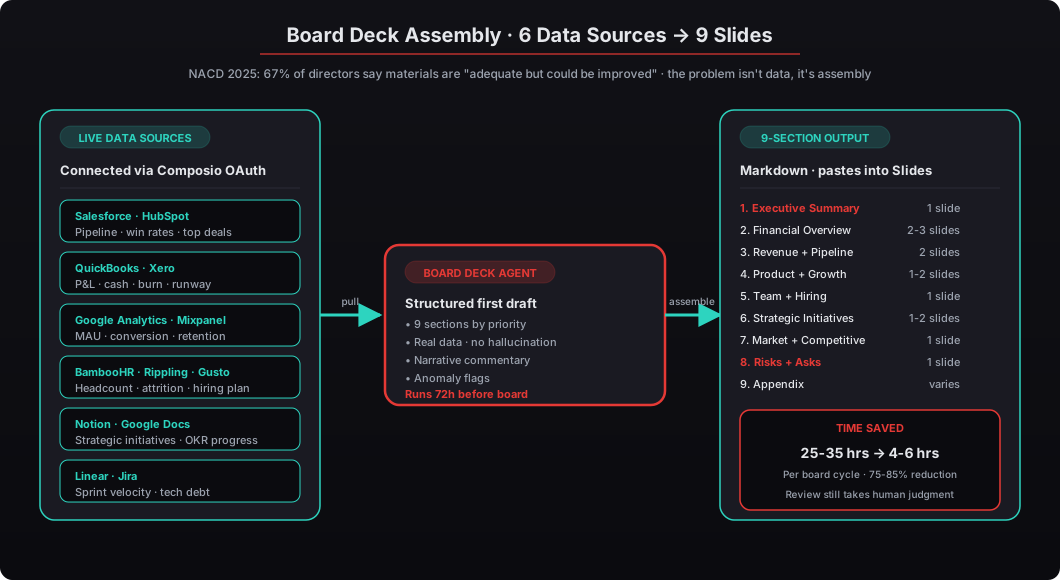
Here’s what a typical run looks like. You trigger the agent (or schedule it for 72 hours before your board meeting). It pulls fresh data from each connected source, runs it through your board deck template, generates commentary for each section, flags anomalies or items that need your attention, and delivers a complete draft to your Slack DM or email. The whole process runs while you’re asleep — the agent wakes up at 6 AM on the pre-board day, pulls fresh data, and has a draft in your inbox by the time you have coffee.
We’ve deployed this configuration for 12 CEOs so far. The fastest adoption was Marcus Chen, a Series B SaaS founder in San Francisco who went from spending 30+ hours per quarter on board prep to under 6 — and his board chair at Sequoia told him the materials actually improved. The improvement came from two places: data freshness (pulled the morning of the meeting instead of three weeks earlier) and consistency (same structure, same metrics, same formatting every quarter, which makes quarter-over-quarter comparison trivial).
Which data sources does the agent pull from?
The standard configuration connects six core systems. Here’s what the agent pulls from each and why. Each connection uses Composio OAuth with read-only scopes — the agent can pull data but can’t modify anything in your source systems. See connecting OpenClaw to tools via Composio for the full credential architecture.
CRM (Salesforce or HubSpot): Pipeline value by stage, quarter-over-quarter movement, win/loss rates, average deal size, top 10 deals by value, and new logos added. For HubSpot users, we also pull marketing-sourced pipeline attribution. Boards care about revenue trajectory — this is the most scrutinized section and the one where data accuracy matters most.
Accounting (QuickBooks or Xero): Revenue, COGS, gross margin, operating expenses by category, net burn, cash position, and runway calculation. The agent pulls the full P&L and formats it into the board’s preferred view. For Xero users in Canada, we configure multi-currency handling automatically.
Web and Product Analytics (Google Analytics or Mixpanel): Monthly active users, traffic by channel, conversion rates, signup-to-activation rates, and retention cohorts. Diligent’s 2025 Board Reporting Benchmark found that 74% of boards now expect product or engagement metrics alongside financials — up from 41% in 2022. The shift reflects that board members are getting more technically literate and expect the CEO to report on product metrics the same way they report on financials.
HRIS (BambooHR, Rippling, or Gusto): Total headcount, new hires by department, open roles, attrition rate, and headcount plan vs actual. Boards track burn rate per head — the agent calculates this automatically by combining HRIS and accounting data so the “efficiency per headcount” metric is always present without manual spreadsheet work.
Strategic docs (Notion, Google Docs): OKR progress, initiative status updates, and any board-level strategic documents you maintain. The agent reads these to populate the “Strategic Update” section rather than making you copy-paste from your OKR tracker.
Engineering tools (Linear, Jira): Sprint velocity, shipped features, tech debt ratio, production incident count. For boards with technical members or for boards at infrastructure companies, these metrics are table stakes. For boards at non-technical companies, we skip this section.
| System | What the Agent Pulls | Board Section |
|---|---|---|
| Salesforce / HubSpot | Pipeline by stage, win rates, top deals, new logos | Revenue and Pipeline |
| QuickBooks / Xero | P&L, cash position, burn rate, runway | Financial Overview |
| Google Analytics / Mixpanel | MAU, conversion rates, retention cohorts | Product and Growth Metrics |
| BambooHR / Rippling | Headcount, attrition, hires vs plan | Team and Hiring |
| Notion / Google Docs | Strategic initiative status, OKR progress | Strategy Update |
| Linear / Jira | Sprint velocity, shipped features, tech debt | Engineering and Product |
What does the agent’s board deck outline look like?
Every CEO’s board has different preferences, but here’s the template we start with. It’s based on the format recommended by First Round Capital’s Board Meeting Guide and refined through our deployments with founders backed by Sequoia, Andreessen Horowitz, and Greylock.
Board Deck Outline (Agent-Generated):
- Executive Summary — 1 slide. Key metrics, headline narrative, items requiring board input.
- Financial Overview — 2-3 slides. P&L summary, cash position, burn rate, runway, budget vs actual variance.
- Revenue and Pipeline — 2 slides. ARR progression, pipeline by stage, win/loss analysis, top deals in flight.
- Product and Growth — 1-2 slides. MAU trend, activation and retention rates, feature launches, NPS or CSAT scores.
- Team and Hiring — 1 slide. Headcount by department, open roles, attrition, notable hires or departures.
- Strategic Initiatives — 1-2 slides. OKR progress, key milestones hit or missed, initiative-level risks.
- Market and Competitive — 1 slide. Competitor moves, market sizing updates, positioning changes.
- Risks and Asks — 1 slide. Top 3 risks, specific asks of the board (introductions, approvals, strategic input).
- Appendix — Supporting data tables, detailed financial schedules, customer logos.
The agent generates each section with real data and a narrative paragraph. Here’s an example of the executive summary output from a recent deployment (company details anonymized but the structure and data density are exactly what the agent produces):
EXECUTIVE SUMMARY — Q1 2026 BOARD MATERIALS
Prepared: March 25, 2026 | Board Meeting: March 28, 2026

HEADLINE: Q1 revenue of $4.2M exceeded plan by 8%, driven by
enterprise deal acceleration. Burn rate decreased to $380K/month
following Q4 hiring slowdown. Runway stands at 19.2 months at
current burn.

KEY METRICS:
- ARR: $16.8M (up 12% QoQ, up 41% YoY)
- Net Revenue Retention: 118%
- Gross Margin: 78.3% (up from 74.1% in Q4)
- Cash Position: $7.3M
- Monthly Burn: $380K (down from $420K in Q4)
- Headcount: 47 (plan was 52 — 5 open roles in engineering)
- Pipeline: $8.9M weighted (up 23% QoQ)

ITEMS REQUIRING BOARD INPUT:
1. Series B timing — pipeline supports Q3 raise at $60-80M
   valuation range. Seeking board guidance on banker selection.
2. VP Engineering hire — two finalists. Board member introductions
   requested for reference checks.
3. European expansion — pilot customer in London signed. Requesting
   approval for UK entity formation ($40K legal budget).

DATA SOURCES: Salesforce (pulled 03/25 08:14 UTC), QuickBooks
(pulled 03/25 08:16 UTC), Google Analytics (pulled 03/25 08:18
UTC), BambooHR (pulled 03/25 08:19 UTC)
Every number in that summary is pulled from a live system — not generated or estimated. The narrative framing (“driven by enterprise deal acceleration”) is based on the agent analyzing stage-movement velocity in Salesforce and identifying which segment drove the overperformance. The timestamp trail at the bottom matters — Diligent’s research shows that 62% of board members want to know when data was last refreshed. The agent logs every pull automatically and includes the timestamps so the board knows the data is fresh.
How do you configure the agent for slide-by-slide assembly?
The configuration uses OpenClaw’s skill system. Each board section is a separate skill with its own data source connections, prompt template, and output format. Here’s the production config we ship:
# agent-config/board-deck-agent.yaml
agent:
  name: board-deck-assembler
  description: Quarterly board deck assembly agent
  schedule:
    trigger: manual  # or cron for auto-scheduling
    advance_days: 3  # days before board meeting

skills:
  - name: executive-summary
    sources: [salesforce, quickbooks, google-analytics, bamboohr]
    template: executive_summary_v2
    output_format: markdown
    priority: 1

  - name: financial-overview
    sources: [quickbooks]
    template: financial_overview_v3
    output_format: markdown_with_tables
    include_variance: true
    comparison_periods: [prior_quarter, prior_year, budget]
    priority: 2

  - name: revenue-pipeline
    sources: [salesforce]
    template: pipeline_analysis_v2
    output_format: markdown_with_tables
    include_top_deals: 10
    priority: 3

  - name: product-growth
    sources: [google-analytics, mixpanel]
    template: growth_metrics_v1
    output_format: markdown
    cohort_periods: [7d, 30d, 90d]
    priority: 4

  - name: team-hiring
    sources: [bamboohr]
    template: headcount_report_v1
    output_format: markdown_with_tables
    include_attrition: true
    plan_comparison: true
    priority: 5

delivery:
  channel: slack_dm
  format: single_document
  include_data_timestamps: true
  include_source_links: true
Each skill runs independently, pulls its own data, and generates its section. The agent then concatenates everything into a single document in priority order and delivers it. We tune the prompt templates per client — a SaaS CEO backed by Bessemer Venture Partners gets different narrative framing than a professional services founder reporting to an independent board. The template controls tone, metric emphasis, and commentary depth.
How does the agent handle sensitivity and MNPI?
Board materials contain material nonpublic information — revenue numbers, pipeline data, strategic plans, M&A considerations. This is exactly why we built this on private infrastructure. The entire agent runs on your own hardware (Mac Mini, MacBook Air) or your private VPS. Data flows directly from Salesforce, QuickBooks, and other sources into your local OpenClaw instance via Composio’s OAuth connections. Nothing passes through beeeowl’s servers. Nothing goes to OpenAI, Anthropic, or any cloud AI provider.
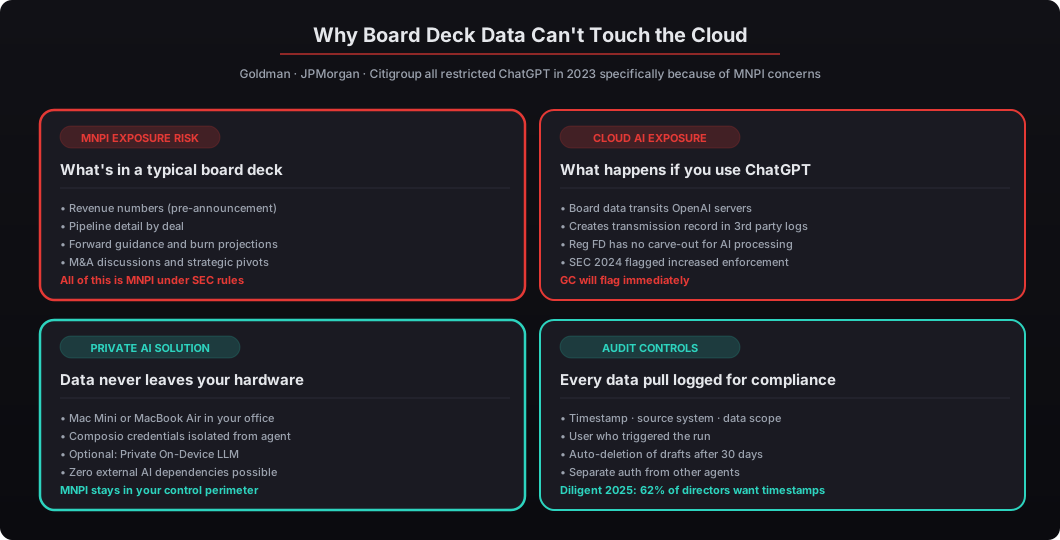
According to the SEC’s 2024 guidance on insider trading controls, companies are increasingly scrutinized for how they handle MNPI in digital workflows. Running board materials through cloud-based AI tools like ChatGPT or Claude creates a data residency risk that most general counsels would flag immediately. The issue isn’t whether the vendor is trustworthy — it’s that the transmission itself creates a record on infrastructure you don’t control, which becomes discoverable during any future enforcement action. Our configuration includes several controls specifically for board-grade sensitivity:
Audit trails. Every data pull is logged with timestamp, source system, scope of data accessed, and the user who triggered the run. If your board or legal team needs to audit how materials were assembled, the trail is there. This maps directly to SOX 404 control documentation requirements for public companies and provides equivalent forensic capability for private companies.
Access controls. The board deck agent is configured with its own authentication — separate from other agents on the same OpenClaw instance. Only the CEO and designated chief of staff can trigger a run or view output. The agent’s audit log shows every access attempt, successful or not.
Output containment. The assembled deck is delivered to a single channel (Slack DM or encrypted email) and isn’t stored in any shared workspace unless you explicitly move it there. We configure auto-deletion of draft outputs after 30 days so old drafts don’t accumulate in the system.
Private LLM option. For CEOs who want zero external AI dependencies, we offer the Private On-Device LLM add-on. The language model itself runs locally via Ollama — your board materials never leave the machine, not even to process the narrative commentary. This is the configuration we recommend for PE-backed companies, public company CEOs, and any company with active M&A discussions on the board agenda. See running a private LLM with Ollama.
Goldman Sachs, JPMorgan Chase, and Citigroup all restricted employee use of ChatGPT in 2023 specifically because of MNPI concerns. The private infrastructure approach eliminates that entire category of risk by design — the data never leaves your control perimeter, so the “did it transit a third party” question never arises.
How does the review process work after assembly?
The agent produces a first draft — not a finished product. The CEO’s review process is where strategy, judgment, and narrative polish happen. We’ve designed the workflow to make that review as efficient as possible through a four-step process:
Step 1: Data verification. The agent flags any data points that seem anomalous — a revenue number that’s more than 20% off from the prior quarter, a headcount figure that doesn’t match the plan, a pipeline value that dropped significantly. These get a warning tag so you check the source directly. In practice, anomalies usually turn out to be real (a deal slipped, an employee unexpectedly resigned, a product metric shifted after a release), but the flag ensures you don’t present unverified anomalies to the board.
Step 2: Narrative review. The commentary paragraphs are where most CEOs spend their editing time. The agent writes functional narrative (“Revenue grew 12% QoQ driven by three enterprise deals closing in March”), but CEOs often want to add strategic context (“This validates our upmarket pivot and we expect this trajectory to accelerate in Q2”). The agent’s job is to deliver the facts; yours is to add the strategic frame.
Step 3: Sensitivity check. Before distributing to the full board, most CEOs review for any information that should be redacted or reframed. The agent doesn’t make judgment calls about what’s too sensitive to share — that’s the CEO’s job. Typical redactions include specific customer names, individual employee names in hiring updates, and any M&A or litigation topics that need in-room discussion rather than written documentation.
Step 4: Formatting. The Markdown output pastes cleanly into Google Slides, Keynote, or PowerPoint. Some clients have their executive assistant or chief of staff handle final formatting. Others use our templating system to match their board’s preferred layout directly.
The whole review cycle typically takes 2-3 hours. Compared to the 20-40 hours of assembly plus review in the old workflow, that’s a 75-85% time reduction. And the data is fresher — pulled the morning of assembly rather than compiled over weeks — which Diligent’s research shows matters to 62% of board members who specifically want recent data.
What results have we seen with CEO deployments?
Across our first 12 board deck agent deployments, the patterns are consistent.
Time savings. CEOs report going from 25-35 hours of quarterly board prep to 4-6 hours. The biggest gains come from eliminating the data-gathering phase entirely. PwC’s 2025 CEO Survey found that 71% of CEOs consider “time spent on low-value administrative tasks” their biggest productivity drain. Board deck assembly sits squarely in that category — high visibility, repetitive, data-heavy, but almost entirely logistics rather than strategic thinking.
Data freshness. Board materials now contain data pulled within hours of delivery rather than data that’s 1-3 weeks stale. One client, a fintech CEO in Toronto reporting to a board that includes partners from OMERS Ventures and BDC Capital, told us the improved data freshness changed the quality of board discussions entirely. “The board used to spend the first 30 minutes asking me to clarify stale numbers. Now we spend it on decisions.”
Consistency. Every quarter follows the same structure, same metrics, same formatting. New board members at firms like Accel, Index Ventures, or Tiger Global can compare across quarters instantly. NACD’s research shows that consistent formatting improves director engagement by 34% — the cognitive load of re-learning the structure each quarter is higher than most CEOs realize.
Reduced coordination overhead. The CEO no longer needs to ping five department heads for data exports. The agent pulls directly from the systems of record. That eliminates a week of back-and-forth emails and Slack messages each quarter — and the frustration that goes with chasing deliverables from people who have other jobs.
How do you get started with a board deck agent?
If you’re running an OpenClaw instance already, you can configure this yourself using the skill architecture outlined above. The key requirements are Composio OAuth connections to your core data sources, a well-structured prompt template for each board section, and the discipline to run it 72 hours before your board meeting so you have time to review. Budget roughly 6-8 hours of DevOps time for initial configuration plus 1-2 weeks of template tuning as you iterate on what your board specifically wants to see.
If you’d rather have it done in a day, that’s what beeeowl’s deployment packages are built for. Every package includes one fully configured agent — the board deck assembler is one of the most popular choices among our CEO clients. We handle the Composio setup, prompt engineering, template customization, security hardening, and delivery configuration. The investment starts at $2,000 for a hosted VPS deployment or $5,000 with a Mac Mini shipped to your door — hardware included. The board deck agent configuration is included as your first agent in any tier. For the deployment walkthrough, see how to get your first OpenClaw agent running in one day and the broader executive productivity context in 7 ways a CEO can use OpenClaw to reclaim 10 hours a week.
Your next board meeting doesn’t have to start with three weeks of data wrangling. Request your deployment and we’ll have it running before your next quarter closes. Full pricing on our pricing page, role-specific workflows on our use cases page, and the broader CEO productivity story in our executive briefing agent guide.