Why Every Executive Needs an AI Agent (Not Just a Chatbot)
ChatGPT and Claude are chatbots you talk to. AI agents built on OpenClaw wake up every 30 minutes to check your inbox, CRM, calendar, and deal flow — then act without being asked. McKinsey 2025 found a 28% reduction in executive admin time within 90 days, roughly 780 hours per year per executive. Here's why the chatbot-to-agent shift matters and how to make it.

What’s the Real Difference Between a Chatbot and an AI Agent?
Answer capsule. A chatbot waits for you to type something, generates a response in 5-10 seconds, and then stops until you type again. An AI agent runs 24/7 on dedicated infrastructure you physically own, monitoring your email, calendar, CRM, Slack, and deal flow on a schedule, and takes action without being asked. ChatGPT, Claude, Gemini, and Copilot are chatbots — you open a window, type a question, get an answer, close the window. OpenClaw is an agent framework — it runs a perception-decision-action loop continuously whether you’re awake, in a meeting, traveling, or asleep. The difference isn’t incremental; it’s the difference between a search engine and an employee.

According to Gartner’s 2025 AI Productivity Survey, 74% of executives who adopted chatbot tools reported using them less than 3 times per week after the first 90 days. The novelty faded because the burden of initiation stayed on the executive: you have to remember to open the tool, remember what you were going to ask, paste in the right context, copy the result back into wherever the work actually lives, and take the next step yourself. Nothing happens until you type. The tool is excellent at what it does but the workflow friction cancels most of the value for recurring work.
AI agents flip that equation. Your OpenClaw agent wakes up every 30 minutes to check your inbox. It drafts responses to routine emails, flags what’s urgent, archives what’s noise. At 8am it delivers a morning briefing — today’s calendar, attendee backgrounds pulled from LinkedIn and your CRM, talking points for each meeting, news about the companies involved. It updates your CRM after every meeting based on the transcript. It does all of this whether you’re awake, traveling, or in back-to-back meetings. You don’t prompt it — it runs its loop on its own schedule and delivers output to wherever you’ve configured it to land (Slack, iMessage, WhatsApp, email, or a local dashboard).
That’s not a better chatbot. That’s a digital employee. For the fuller comparison with ChatGPT and Claude specifically, see our walkthrough of OpenClaw vs ChatGPT vs Claude for executives and our overview of what OpenClaw is in plain English.
How Much Executive Time Goes to Work an Agent Can Handle?
Answer capsule. Twenty-eight percent. That’s the number from McKinsey’s 2025 State of AI report: companies deploying AI agents saw a 28% reduction in executive administrative time within 90 days. For an executive working 55 hours per week, that’s roughly 15 hours reclaimed weekly — 780 hours per year, or 19.5 additional 40-hour work weeks. None of it is strategic work, all of it is necessary, and almost all of it follows predictable patterns an agent handles better than a human. Harvard Business Review 2025 found executives spend 4.1 hours daily on email alone; Deloitte’s 2025 C-Suite Productivity Survey found 62% of executives identify administrative overhead as the single largest barrier to focusing on strategic priorities.
Let’s be specific about what fills those 15 hours today:
- Email processing — reading, categorizing, drafting responses, following up, managing threads across multiple correspondents. Harvard Business Review 2025 found executives spend 4.1 hours daily on email on average. For the typical C-suite calendar, that’s more time than any other single activity, more than meetings themselves.
- Meeting preparation — pulling background on attendees, reviewing previous interactions, gathering relevant documents, formulating talking points. McKinsey 2025 estimates 45-90 minutes per significant external meeting if done properly, which is why most executives do it inadequately or not at all.
- CRM maintenance — logging calls, updating deal stages, entering meeting notes, recording action items. Salesforce’s 2025 State of Sales found the average rep spends 28% of their week on CRM admin, and executives typically spend half that again (14%) on their own CRM hygiene.
- Status reporting — compiling weekly updates, monthly board materials, quarterly investor communications, ad-hoc executive summaries for stakeholders. Deloitte 2025 estimated executives spend 6-9 hours per week on reporting work that produces documents consumed by others.
- Calendar management — scheduling, rescheduling, resolving conflicts, booking rooms, coordinating with assistants across multiple parties. More time-consuming than it looks because every change triggers a cascade of updates to other meetings.
- Follow-up tracking — remembering what was promised in last week’s meeting, chasing the people who owe responses, moving stalled items forward. This is the work that falls through the cracks when executives are busy, which means it gets done in stolen moments at 11pm.
None of this is strategic work. But all of it is necessary. The executive who doesn’t do it falls behind on relationships, loses track of commitments, shows up to meetings unprepared, and eventually produces board materials that are inadequate. The executive who does it all spends 15+ hours a week on tasks that don’t require their judgment.
Deloitte’s 2025 C-Suite Productivity Survey found that 62% of executives said administrative overhead was the single largest barrier to focusing on strategic priorities. Not lack of talent, not lack of vision, not lack of resources — administrative work consuming the hours that should have been spent on strategy. An AI agent doesn’t make the executive faster at administrative tasks. It removes them from the plate entirely, which is a different and more valuable outcome. See our deep dive on 7 ways CEOs use OpenClaw to reclaim 10 hours per week and CFOs using AI agents for variance commentary and cash flow.
What Does an AI Agent Actually Do That a Chatbot Can’t?
Answer capsule. An agent acts proactively, maintains persistent context across your entire tool stack, and executes multi-step workflows end-to-end without you initiating each step. A chatbot does exactly what you ask, exactly when you ask, and nothing more. The practical difference shows up in workflows like board meeting prep: a chatbot requires you to upload the last quarter’s deck, paste in financials, search LinkedIn for attendee backgrounds, prompt for talking points, then copy the output into an email you send yourself. An agent has the deck, pulls financials from your tools, compiles attendee profiles from CRM and email history, drafts talking points based on historical context, and delivers a prep email — all before your meeting, all without you typing anything. Accenture 2025 found that companies using proactive AI agents completed board preparation 67% faster than those using chatbot-assisted workflows.
Here’s a side-by-side comparison with a real workflow — preparing for a Monday morning board meeting that happens every quarter:
| Task | Chatbot (ChatGPT / Claude) | AI Agent (OpenClaw) |
|---|---|---|
| Review last quarter’s board deck | You upload the file, ask for highlights | Agent already has the deck, references it proactively with changes since last quarter |
| Pull financial metrics | You copy-paste from QuickBooks / NetSuite, ask for analysis | Agent pulls directly from accounting tools via Composio |
| Check attendee backgrounds | You search LinkedIn manually, copy into the prompt | Agent compiles profiles from CRM + email history + public sources |
| Draft talking points | You prompt and iterate ~5 times | Agent drafts based on historical context, current metrics, and recent board discussions |
| Check for open action items from last meeting | You remember what was promised and chase people | Agent reads previous meeting notes and surfaces overdue items with nudge drafts |
| Send prep email to attendees | You write it yourself, copy-paste the output | Agent drafts, you approve, it sends |
| Total wall-clock time | 2-3 hours the night before | 15 minutes of review the morning of |
| Executive attention required | Continuous for the full duration | Only at review and approval moments |
According to Accenture’s 2025 Technology Vision report, companies using proactive AI agents completed board preparation 67% faster than those relying on chatbot-assisted workflows. The compound effect across all executive workflows is substantial — it’s not just “faster at the same thing,” it’s “the thing actually exists when you sit down at your desk Monday morning.”
Anthropic’s CEO Dario Amodei described this shift clearly in his 2025 essay “Machines of Loving Grace”: AI is moving from “tool you use” to “colleague that works alongside you.” OpenClaw is built on that exact philosophy. The executive’s job becomes reviewing and approving rather than constructing from scratch. See why every CEO needs an OpenClaw strategy for the broader strategic framing.
Why Is the “Digital Employee” Framing Accurate?
Answer capsule. Because an AI agent does exactly what a dedicated executive assistant does — monitors, prepares, drafts, follows up, flags exceptions — except it works 24 hours a day, 7 days a week, across every tool in your stack simultaneously, with no PTO, no sick days, no context-switching cost, and no turnover. The economic comparison makes the framing even more apt: the median US executive assistant costs $72,400/year in base salary per BLS 2025 data, $95,000+ fully loaded with benefits and workspace, and $475,000 over five years before raises or turnover. A beeeowl Mac Mini deployment is $5,000 one-time with hardware included — 19x cheaper over one year and 94x cheaper over five years. Agents don’t replace the human judgment a great EA contributes; they eliminate the 80% of EA work that is pattern-based, pattern-repeating, and pattern-predictable.
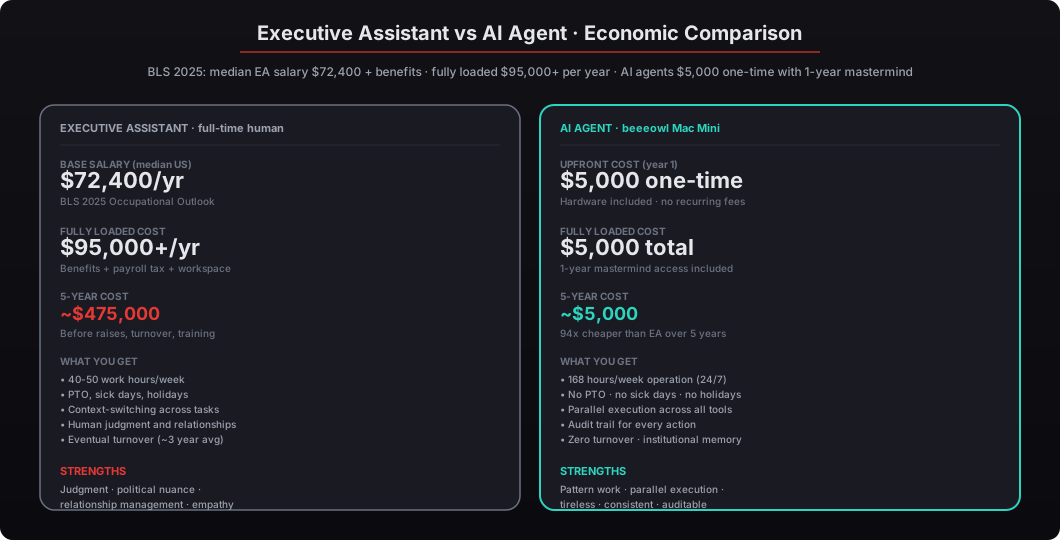
The economics make the framing even more apt. According to the Bureau of Labor Statistics’ 2025 Occupational Outlook data, the median salary for an executive assistant in the US is $72,400 per year. Adding benefits (typically 30-35% of base), payroll taxes, workspace costs, recruiting costs, and training, the fully loaded cost exceeds $95,000 annually per hire. Over five years with modest raises and accounting for eventual turnover (average EA tenure is roughly 3 years), the total cost of one EA position is closer to $500,000.
beeeowl’s Mac Mini deployment — hardware included, fully configured, security-hardened — costs $5,000 one-time. Additional agents for team members cost $1,000 each. No annual salary. No benefits. No workspace. No turnover. No recruiting cycles. The 5-year comparison is roughly 94:1 in favor of the agent, and the agent works 168 hours per week instead of 40. See our deployment packages for the full pricing breakdown.
We’re not saying agents replace the human judgment of a great EA. They don’t handle relationship dynamics, political nuance, sensitive personal communications, or the thousand small judgment calls a skilled human makes in a week of working with an executive. But Stanford’s 2025 AI Index Report found that pattern-based administrative tasks — which represent roughly 80% of an average EA’s daily hours — are the single highest-ROI category for AI agent deployment. The right model for most executives is an agent handling the pattern work at 1% of the cost, with the human focused on the 20% where judgment genuinely matters. Most of our clients who already have EAs don’t fire them; they redeploy them to higher-leverage work while the agent handles email triage, calendar coordination, and CRM hygiene.
What Does the Compound Effect Look Like Over 12 Months?
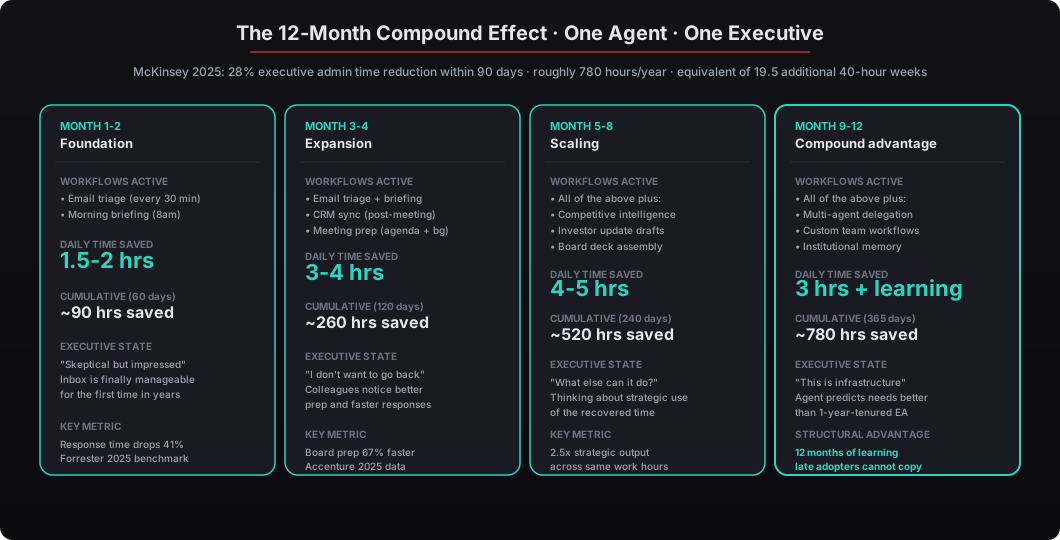
Answer capsule. Small daily gains compound into transformational change. Saving 3 hours per day for a year is 780 hours — the equivalent of 19.5 additional 40-hour work weeks annually. That’s not a productivity hack; it’s a structural advantage that compounds because every week of operation teaches the agent more about the executive’s specific workflows, preferences, and patterns. Harvard Business Review’s 2025 analysis of early adopters found that executives who deployed agents in the first wave built institutional knowledge advantages that late adopters couldn’t replicate with identical technology — the advantage isn’t the tool, it’s the 12 months of accumulated context.
Here’s what we’ve observed across our 150+ client deployments:
Month 1-2 — Foundation. The agent handles email triage and morning briefings. You save 1.5-2 hours daily. You’re skeptical but impressed — mostly because your inbox is finally manageable for the first time in years. By day 60, you’ve saved roughly 90 hours. Response time to critical communications drops by 41% per Forrester’s 2025 Executive Productivity benchmark.
Month 3-4 — Expansion. You add CRM sync and meeting prep. Daily savings jump to 3-4 hours. Colleagues notice that you’re more responsive and better prepared for meetings. Your prep email for the quarterly board meeting shows up Sunday evening with all the financials, attendee backgrounds, and talking points already drafted — Accenture 2025 data says board prep is 67% faster in this phase.
Month 5-8 — Scaling. You’ve added competitive intelligence monitoring (flagging material competitor moves within an hour of publication), investor update drafting (every Friday afternoon), and board deck assembly (Monday morning before the 9am meeting). The agent now handles workflows you didn’t even realize were consuming time. You start thinking about what to do with the recovered time, not just what to automate next.
Month 9-12 — Compound advantage. The compound effect is fully visible. Your agent has 9+ months of context about your communication patterns, meeting cadence, decision-making preferences, writing voice, relationships, and recurring workflows. It’s better at predicting what you need than most human assistants who’ve worked with you for a year. You’ve delegated multi-step workflows the agent runs on your behalf — “prepare the quarterly business review for Tuesday” becomes a single command that triggers a ~40-step workflow spanning six tools.
According to Harvard Business Review’s 2025 analysis of early AI agent adopters, executives who deployed agents in the first wave built institutional knowledge advantages that late adopters couldn’t replicate even with identical technology. The advantage isn’t the tool — it’s the 12 months of compounded learning about the specific executive’s patterns. A new deployment starts from zero; a 12-month-old deployment knows that Tuesday afternoons are focus time, that the CFO prefers bullet-point emails under 200 words, that this specific investor always asks about customer concentration, that the Thursday all-hands needs 30 seconds of off-topic humor to land well. None of that context transfers to a new agent — it lives in the specific deployment. The executive who starts in April 2026 will have 18 months of compound learning before the executive who starts in October 2027 has a single night of data.
Why Is This Shift Happening Right Now?
Answer capsule. Three things converged in 2025 that made agent deployment go from experimental to production-grade: open-source agent frameworks hit production quality (OpenClaw reached 350,000+ GitHub stars, the fastest adoption of any project in GitHub history), enterprise security caught up (NVIDIA’s NemoClaw reference design added the governance layer that regulated industries required), and integration standardization arrived (Anthropic’s MCP created a universal connector protocol that Composio implements for 40+ business tools). The combination of platform maturity, enterprise-grade security, and universal connectivity means AI agents are no longer experimental — they’re deployable infrastructure. Accenture 2025 found that 83% of C-suite executives plan to deploy agents within 18 months but only 12% have started, and the 71-point intention-action gap is where first-mover advantage lives.
OpenClaw reached critical mass. With 350,000+ GitHub stars — the fastest-adopted open source project in GitHub history, surpassing Linux’s 30-year count — OpenClaw created a standardized platform that enterprises could trust. NVIDIA’s Jensen Huang compared it to Linux, HTML, and Kubernetes at CES 2025, calling it “the operating system for agentic computers.” That comparison wasn’t marketing; NVIDIA’s engineers actively contribute to OpenClaw’s security stack, and the CVE-2026-25253 patch in March had NVIDIA code in the commit log. See our full walkthrough of the OpenClaw origin story and personal AI agents eating the enterprise SaaS stack.
NemoClaw made enterprise security real. NVIDIA’s enterprise reference design added policy guardrails, Docker sandboxing, privacy routing, human-in-the-loop approval gates, and full audit logging. Deloitte’s 2025 survey found 71% of AI projects stalled at security review — NemoClaw was built specifically to clear that hurdle. Combined with Composio’s OAuth credential isolation (the agent never sees raw tokens), beeeowl’s seven-layer Docker hardening, and tamper-evident audit logging, the resulting architecture passes SOC 2, EU AI Act, HIPAA, and the other frameworks that regulated industries need. See our security hardening complete checklist and NemoClaw enterprise reference design walkthrough.
MCP standardized integrations. Anthropic’s Model Context Protocol (MCP), released in late 2024, created a universal connector for AI agents — the USB-C of AI tool integrations. Instead of writing custom code for every tool, agents discover and interact with tools through a standardized protocol. Composio implements MCP for 40+ business tools (Gmail, Outlook, Slack, Salesforce, HubSpot, Notion, Linear, Stripe, QuickBooks, and more), handles OAuth credential exchange so the agent never sees raw tokens, and adds new integrations every month. According to GitHub’s 2025 State of Open Source report, MCP adoption grew 340% year-over-year across AI frameworks in 2025 — Claude, GPT, Gemini, Cursor, and OpenClaw all shipped MCP support in their first year of the protocol’s existence. See MCP and how OpenClaw talks to tools.
The convergence of these three forces — platform maturity, enterprise security, and universal connectivity — means AI agents are no longer experimental. They’re deployable infrastructure with production-grade defaults. According to Accenture’s 2025 Technology Vision data, 83% of C-suite executives plan to deploy AI agents within 18 months. Only 12% have started. The 71-percentage-point gap between intention and action is where first-mover advantage lives — the window will close in 2027-2028 when the conversation shifts from “should we deploy” to “how did we fall behind.”
How Do You Start Without Overcomplicating It?
Answer capsule. One agent. One workflow. One week. Don’t commission a committee, don’t run a six-month pilot, don’t schedule a series of evaluation meetings with three vendors. Pick the single workflow that currently consumes the most of your time (usually email triage or CRM hygiene), deploy one agent to handle it, measure the hours saved over the first two weeks, and expand from there. Most of our clients who try to scope “an agent that does everything” on day one end up with analysis paralysis; the ones who pick one workflow see measurable ROI in two weeks and build confidence to expand.
The deployment pattern that works:
-
Day 1: Setup is one day from our side. We configure the agent around your highest-friction workflow (email triage is the most common starting point for CEOs, variance commentary for CFOs, deal flow triage for VCs, conflict checking for managing partners, incident post-mortems for CTOs), connect 3-5 tools through Composio, and walk you through the audit dashboard. Hardware ships within a week.
-
Week 1-2: You review the agent’s outputs daily and adjust. Does it catch the right emails? Are the drafts good? Does the morning briefing include the right information? Small tuning based on actual behavior rather than speculation.
-
Week 3-4: Trust builds because you have concrete evidence that the agent is doing what it’s supposed to do. You start delegating more confidently. The agent’s outputs no longer need line-by-line review.
-
Month 2: Add a second workflow. CRM sync, meeting prep, or investor update drafting depending on where your biggest remaining friction is.
-
Month 3-6: Add more workflows as trust builds and as you notice where your time is still going. Each new workflow is a configuration change, not a new deployment. The same hardware handles 5-8 workflows comfortably.
beeeowl’s deployment packages are designed for this one-agent-first pattern:
- Hosted Setup — $2,000 one-time on your own VPS, fully configured, shipped-ready within a week. The lowest-friction entry point.
- Mac Mini Setup — $5,000 one-time with current-generation Apple Mac Mini hardware included, shipped to your office, configured, and hardened. The most common choice for executives who want dedicated hardware on-site.
- MacBook Air Setup — $6,000 one-time with portable hardware for executives who travel. Same hardening, same configuration, but goes with you.
- In-Person Setup — $2,000 add-on if you want us to come to your office and set it up on-site with your team.
- Additional Agents — $1,000 each for other executives on the team who want their own agent with their own scope.
- Private On-Device LLM — $1,000 add-on for clients who want the model itself to run locally so prompts and data never leave the machine.
Every tier includes one year of monthly mastermind access for ongoing Q&A and best-practice updates as the technology evolves.
Setup takes one day. Hardware ships within one week. The executives who deployed in October 2025 now have 6 months of compounded efficiency gains and institutional context. The ones who deploy in April 2026 will have 6 months of compound by October 2026. The ones who wait another 6 months will start from zero while their competitors have half a year of head start. The technology doesn’t get better by waiting — the advantage gap just widens.
Request your deployment at beeeowl.com.
Related reading — for specific role-based use cases, see 7 ways CEOs use OpenClaw to reclaim 10 hours per week, CFOs using AI agents for variance commentary, VC AI advantage: deal flow, LP updates, portfolio, AI agents for managing partners, and CTOs using OpenClaw for due diligence and incident post-mortems. For the broader strategic framing, see the case for private AI in 2026 and how AI agents are eating the enterprise SaaS stack.