Hosted vs Hardware: Which OpenClaw Deployment Is Right for Your Organization?
beeeowl's Hosted ($2K), Mac Mini ($5K), and MacBook Air ($6K) tiers all include identical security hardening. The right choice depends on data sensitivity, travel, and iMessage integration — here's the 60-second decision framework.

beeeowl ships three OpenClaw deployment tiers with identical security stacks — Hosted VPS at $2,000, Mac Mini at $5,000 (hardware included), MacBook Air at $6,000 (portable hardware included). Every tier includes OS hardening, Docker sandboxing with NIST SP 800-190 controls, Composio OAuth credential isolation, authentication, audit trails, one fully configured agent, and 1 year of monthly mastermind access. The difference isn’t what’s included — it’s where the agent runs and what hardware it runs on. Gartner’s 2025 Data Sovereignty Report found 61% of Fortune 500 CIOs now require physical location control for AI systems handling executive communications, and IDC’s 2025 Edge Infrastructure Survey found 67% of organizations deploying AI at the edge cited data sovereignty as the primary driver. This article is the full comparison across 14 dimensions plus the 60-second decision framework we walk every beeeowl prospect through.
Which OpenClaw deployment tier actually makes sense for your organization?
It depends on three things: how sensitive your data is, whether you travel regularly, and whether you need iMessage or a Private On-Device LLM. The Hosted VPS at $2,000 gets you running fastest — same day, no hardware to ship. The Mac Mini at $5,000 gives you dedicated hardware you physically own, with maximum security and always-on performance. The MacBook Air at $6,000 goes wherever you go and is the only portable private AI deployment on the market. Every tier ships with the exact same security hardening and the exact same one-configured-agent starter bundle.
I’ve deployed all three configurations across the US and Canada over 50+ engagements. There’s no universally correct answer — but there’s almost always a clearly right answer for a specific executive’s situation, and it usually takes under 60 seconds of conversation to land on the right tier once you understand how the three dimensions interact. Gartner’s 2026 Infrastructure Decision Framework emphasizes that deployment topology should follow data sensitivity requirements, not budget alone. I agree, but I’d add that operational context — travel patterns, team distribution, and integration requirements — matters just as much in practice.
Here’s the honest breakdown of what each tier delivers, who it’s for, and when it’s the wrong choice.
What does each tier actually include?
Every beeeowl deployment — regardless of tier — includes the same core package. This isn’t a situation where the cheaper option gets a stripped-down version. OpenClaw installation, OS-level security hardening, Docker sandboxing with all five NIST SP 800-190 controls (read_only, cap_drop: ALL, no-new-privileges, resource limits, localhost binding), firewall configuration with explicit outbound allowlists, Composio OAuth setup (your credentials never get exposed to the bot), built-in authentication, one fully configured agent with integrations to the tools your team uses, audit trails on every action, access controls scoped per integration, and one year of monthly mastermind calls where we share workflow patterns and answer questions as the ecosystem evolves.
The difference between tiers is where that agent runs and what hardware it runs on. Nothing else changes. The security posture, the integration breadth, the authentication flow, the audit logging — all identical across tiers. That’s a deliberate design choice: we don’t want tier selection to be about “which security do I get.” We want it to be about where and how the agent lives relative to your daily work.
Hosted Setup ($2,000): Your agent runs on a hardened cloud VPS provisioned on Hetzner or OVH — dedicated hosts, not hyperscaler multi-tenant. We configure, harden, and lock down the server. You access it remotely via SSH tunnel and a web interface. No physical hardware ships to you. Deployment is same-day because there’s nothing to ship. For the technical trade-offs against owning hardware, see our Mac Mini vs cloud VPS analysis.
Mac Mini Setup ($5,000): A Mac Mini M4 Pro (24GB unified memory, 512GB SSD) ships to your home or office, fully configured. Hardware cost is included in the price — not a rental, not a deposit, not a lease. You plug it in, connect to your network via Ethernet, and your agent is running. See our walkthrough on setting up OpenClaw on a Mac Mini.
MacBook Air Setup ($6,000): Same Apple Silicon performance as the Mac Mini (M4 chip, 24GB unified memory), same security hardening, same agent configuration — but portable. Take it to your office, your home, a board meeting, a flight to Davos, or a client site. No other OpenClaw provider offers a portable deployment option as of this writing.
How do the three tiers compare across every dimension that matters?
I’ve built this comparison table from real deployment experience and client feedback across 14 dimensions that executives actually ask about during the evaluation call.
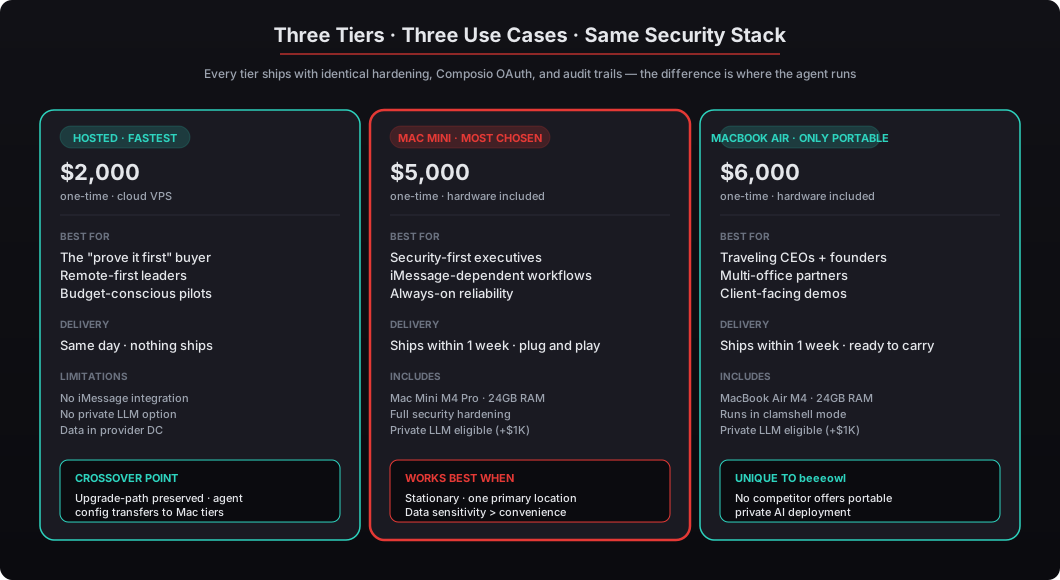
| Dimension | Hosted VPS ($2,000) | Mac Mini ($5,000) | MacBook Air ($6,000) |
|---|---|---|---|
| One-Time Investment | $2,000 | $5,000 (hardware included) | $6,000 (hardware included) |
| Setup Time | 1 day | 1 day (ships within 1 week) | 1 day (ships within 1 week) |
| Physical Hardware Control | None — runs on remote server | Full — sits in your office | Full — goes where you go |
| Data Residency | Hetzner/OVH datacenter | Your premises | Your premises (portable) |
| Security Ceiling | High (hardened VPS) | Highest (air-gappable) | Highest (air-gappable) |
| Portability | Access from anywhere via internet | Stationary | Fully portable |
| Sustained Performance | Depends on VPS tier | Excellent (active cooling) | Good (fanless, thermal limits) |
| iMessage Integration | Not possible (Linux VPS) | Yes (native macOS) | Yes (native macOS) |
| Private On-Device LLM | No | Yes (+$1,000 add-on) | Yes (+$1,000 add-on) |
| In-Person Setup | No | Yes (+$2,000 add-on) | Yes (+$2,000 add-on) |
| Energy Cost | Included in hosting | ~$3-7/month (at 30W) | ~$2-5/month (clamshell) |
| Ongoing Maintenance | Provider handles hardware | You manage hardware | You manage hardware |
| Additional Agents | $1,000 each | $1,000 each | $1,000 each |
| Best For | Speed, budget, remote teams | Maximum security, always-on | Traveling executives |
IDC’s 2025 Edge Infrastructure Survey found that 67% of organizations deploying AI at the edge cited data sovereignty as the primary driver — not performance. That tracks with what I see in our client calls. The executives choosing Mac Mini aren’t doing it because they need more compute than a cloud VPS can deliver. They’re doing it because they want their board decks, deal memos, investor communications, and MNPI running on a machine they can physically see and control. The sovereignty motivation dominates the performance motivation by a wide margin.
When does the hosted VPS tier make the most sense?
The Hosted Setup at $2,000 is the right call when speed and simplicity matter more than physical control. You’re not buying hardware. You’re not waiting for shipping. You’re not coordinating where the Mac Mini will live in your office. We configure a hardened cloud VPS, deploy OpenClaw, set up your agent, verify the security stack, and you’re running — same day.
This works best for three types of executives:
The “prove it first” buyer. You’ve read about OpenClaw. Maybe you saw Jensen Huang’s comparison to Linux and Kubernetes at NVIDIA’s Computex keynote. You want to test the value of an AI agent before committing to dedicated hardware. The $2,000 Hosted tier lets you validate the ROI — McKinsey’s 2025 State of AI report shows executives recover that investment in under a week at a $500/hr loaded rate — before potentially upgrading to the hardware tier later. We’ve had clients take exactly this path: start hosted on Monday, run it for two weeks, see the productivity data, and upgrade to a Mac Mini by the third Monday. The upgrade path preserves your agent configuration, Composio OAuth tokens, integrations, and workflow automations.
Remote-first leaders. If your team is distributed across New York, Toronto, and San Francisco with no primary office, you don’t need a physical box sitting in one location. A cloud VPS is accessible from anywhere via SSH tunnel. Forrester’s 2025 Future of Work survey found that 41% of C-suite executives now work from more than two locations regularly. A hosted agent follows you without packing anything, and you can hand off access to a co-founder or a second executive without worrying about which office the hardware sits in.
Budget-conscious first deployments. Two thousand dollars is the lowest entry point in the OpenClaw deployment space. Competitors like SetupClaw charge $3,000 for their equivalent hosted tier. If you’re deploying across a five-person executive team at $1,000 per additional agent, starting hosted keeps your total investment under $7,000 for the whole team — which is less than the cost of a single Year 1 ChatGPT Enterprise seat deployment at $60/user/month across the same team. We compare deployment services in beeeowl vs SetupClaw vs DIY.
The trade-off is real, and I want to be honest about it. You don’t get iMessage integration (that requires native macOS on Apple Silicon). You can’t add the Private On-Device LLM option (the cloud VPS doesn’t have the GPU acceleration needed for acceptable local inference latency). And your data lives on a cloud server — hardened, encrypted, and access-controlled, but not physically in your possession. For executives handling MNPI, pre-IPO financials, or attorney-client privileged work, those trade-offs usually push them toward a hardware tier instead.
When should you choose the Mac Mini?
The Mac Mini at $5,000 is the workhorse. It’s the tier I personally recommend most often, and it’s what we see the highest adoption on — roughly 70% of our deployments ship on the Mac Mini tier. Apple’s M4 Pro chip delivers exceptional AI orchestration performance with unified memory architecture, and the Mac Mini’s active cooling system means it can sustain heavy workloads without thermal throttling. For the full hardware deep-dive, see our setting up OpenClaw on a Mac Mini guide.
Here’s who this tier is built for:
Security-first executives. If you’re a CFO handling pre-IPO financials, a managing partner at a law firm processing confidential client data, a VC with proprietary deal flow, or a CEO prepping M&A documents, having your AI agent run on hardware you physically own changes the security conversation entirely. Deloitte’s 2025 Cybersecurity Report found that 73% of data breaches involving AI systems originated from cloud-hosted deployments. A Mac Mini sitting in your office behind your firewall eliminates an entire category of attack surface. We made the full case in the case for private AI.
iMessage-dependent workflows. This is bigger than people realize. A significant share of C-suite communication — especially among founders and investors in Silicon Valley, Austin, and Miami — happens over iMessage rather than email or Slack. OpenClaw on a Mac Mini can integrate with iMessage natively because it’s running macOS and has access to the iMessage database. You cannot do this on a Linux-based cloud VPS. Period. If your executive workflow includes summarizing iMessage threads, drafting responses to founder chats, or monitoring investor conversations, you need macOS hardware, which means Mac Mini or MacBook Air.
Private LLM candidates. Adding the Private On-Device LLM option (+$1,000 one-time) means your agent runs models like Llama 3.1 8B, Mistral 7B, or Qwen 2.5 7B locally through Ollama. Your prompts, your data, your responses — none of it ever touches OpenAI, Anthropic, Google, or any external API. For executives operating under NDA-heavy environments, in regulated industries like healthcare (HIPAA) and finance (SOX compliance), or during SEC quiet periods, this is the configuration that legal teams approve without a six-month review. Thomson Reuters’ 2025 Legal AI Report identified on-device inference as the gold standard for privileged information processing.
Always-on reliability. The Mac Mini M4 Pro draws roughly 22 watts at idle and 30-35W under typical load. Leave it plugged in, connected to Ethernet, and it runs 24/7/365. No cloud provider outages. No dependency on AWS us-east-1 going down and taking your agent with it — something that happened twice in 2025 alone, according to Downdetector’s annual infrastructure report. No cloud vendor policy changes affecting your deployment. No shared-tenant noisy neighbors burning your CPU credits.
The trade-off is that the Mac Mini is stationary. If you work from one primary location, that’s fine. If you split time between New York and Aspen, or you spend 60+ days per year traveling, the Mac Mini stays wherever it’s plugged in. That’s where the MacBook Air tier comes in.
Who needs the MacBook Air option?
The MacBook Air at $6,000 exists for one specific type of executive: someone who travels regularly and wants their AI infrastructure physically with them. It’s the only portable private AI deployment on the market. SetupClaw, RoofClaw, and every other OpenClaw deployment service offer cloud or desktop hardware only — not a portable form factor.
Traveling CEOs and founders. If you’re flying between board meetings in San Francisco, investor dinners in New York, and a conference in London, your Mac Mini is sitting empty in your home office doing nothing while you work from a hotel. A MacBook Air with OpenClaw means your agent is in your carry-on. You can run it on hotel Wi-Fi, on a flight with onboard internet, or completely offline if you’ve added the Private On-Device LLM. Your agent follows your actual work pattern instead of being tied to one geography.
Executives splitting time between multiple offices. Boston Consulting Group’s 2025 Executive Mobility Study found that senior executives average 47 travel days per year. That’s nearly 10 weeks where a stationary Mac Mini isn’t helpful — and for managing partners who work across client sites, the travel number is higher still. The MacBook Air covers those gaps at the same security level as the Mac Mini because it’s running the identical hardening, identical Docker config, and identical agent configuration.
Demonstration and client-facing scenarios. Managing partners at consulting firms and advisory practices use the MacBook Air tier to demonstrate their AI capabilities to clients in person. Open the lid, show the agent working on a real workflow, close the lid, take it home. No screen-sharing lag, no “let me connect to the server” delays, no awkward pauses while you dig through two layers of SSH tunnels. The in-person credibility matters when you’re selling professional services.
The performance trade-off is honest: Apple’s MacBook Air uses a fanless design. Under sustained heavy inference loads — think bulk document processing or running a large private LLM for extended periods — it will thermal throttle before a Mac Mini would. For typical executive agent tasks (email triage, CRM updates, calendar management, briefing generation, deal flow screening), you’ll never notice the difference. AnandTech’s benchmarks of the M4 MacBook Air show single-threaded performance within 3% of the M4 Mac Mini for the workloads that matter here. The thermal ceiling only matters if you’re running a 30B-parameter local model for hours, which is not a common executive agent workflow.
What about the add-ons?
Three add-ons apply across tiers, and understanding them matters for total cost planning — especially if you’re building a budget for a larger executive team deployment.
In-Person Setup (+$2,000): Available only for hardware tiers (Mac Mini and MacBook Air). We send a technician to your location to install the hardware on-site, connect it to your network, walk your team through the agent interface, and verify the security hardening in person. This is also the right choice if you want to use your own existing hardware — a Mac Studio, an older Mac Mini, a MacBook Pro, whatever Apple Silicon machine you’ve already got sitting in your office. We configure it on-site rather than shipping new hardware. Gartner’s 2025 Enterprise IT survey found that 58% of executive-level hardware deployments involve on-site configuration for compliance verification. If your organization has strict physical security policies that require a named engineer’s presence during deployment, this is how you satisfy them.
Additional Agents ($1,000 each): Every tier includes one fully configured agent. Need agents for five executives? That’s $4,000 on top of your base tier. Each additional agent gets the same Composio OAuth setup, integrations, authentication, audit trail, and guardrails as the first, but runs in its own isolated Docker container with a separate credential scope. For a five-person C-suite on the Hosted tier, you’re looking at $6,000 total. On Mac Mini, $9,000. Those numbers still undercut most competitors — PwC’s 2025 AI Implementation Costs survey pegs average enterprise AI agent deployment at $15,000-$50,000 per seat, largely because the enterprise platforms bill per-user per-month forever and the total adds up fast.
Private On-Device LLM (+$1,000): Hardware tiers only. This installs and configures Ollama with a production-grade quantized model (typically Llama 3.1 8B, Mistral 7B, or Qwen 2.5 7B depending on workload) running on the Apple Silicon Neural Engine and GPU. Your data never leaves the machine. Not to OpenAI’s servers, not to Anthropic’s servers, not to anyone. For executives handling material non-public information (MNPI) or operating under SEC quiet periods, this isn’t a luxury — it’s a compliance requirement. Thomson Reuters’ 2025 Legal AI Report identified on-device inference as the gold standard for privileged information processing, and it’s the configuration we recommend by default for law firm partners and PE/VC deal teams.
How do you actually decide?
I’ll give you the framework I walk every beeeowl prospect through. It takes about 60 seconds, it has three main questions and two tiebreakers, and it reliably lands on the right tier.
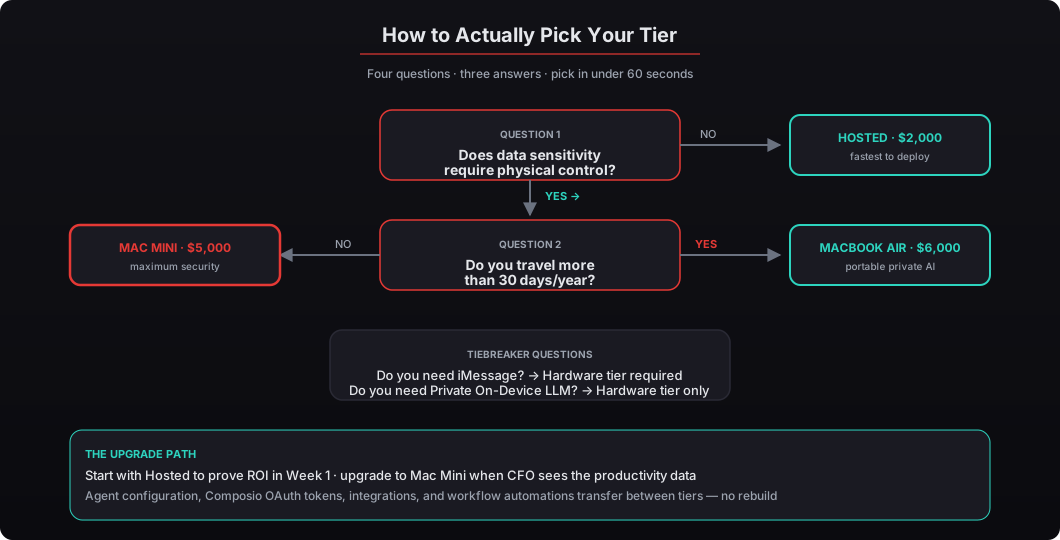
Start with data sensitivity. If your agent will process information that absolutely cannot exist on a cloud server — pre-acquisition financials, legal privilege, healthcare records, MNPI, investor LP data — go hardware. Mac Mini if you’re stationary, MacBook Air if you travel. Add the Private On-Device LLM for maximum isolation. If your data is sensitive but not that sensitive, the Hosted tier with Composio credential isolation and hardened Hetzner hosting is legitimately fine — we run it for plenty of clients whose data is important but doesn’t require physical residency.
Then consider mobility. Work from one place most of the time? Mac Mini. Travel more than 30 days per year? MacBook Air. Don’t care about physical location and work from anywhere? Hosted.
Then consider budget and timeline. Need to prove value before a larger investment? Start with Hosted at $2,000. You can always upgrade to hardware later — we’ve had clients do exactly that after two weeks of seeing the ROI, and the agent configuration transfers cleanly between tiers. For the full ROI math, see our breakdown in the ROI of private AI deployment.
Finally, consider the tiebreakers. If executive communication in your organization runs through iMessage (and in my experience, at least 40% of founder-level communication in North American tech does), you need macOS. That means Mac Mini or MacBook Air. Full stop. If you need a Private On-Device LLM for privileged work, same answer — hardware tier required.
What’s the bottom line for each buyer profile?
The pragmatic CFO who wants lowest risk and fastest payback: Hosted at $2,000. Prove it, measure it, scale it, upgrade later if the physical control premium becomes important.
The security-conscious CTO who answers to compliance and legal: Mac Mini at $5,000 with Private On-Device LLM at $1,000 add-on. Total: $6,000 for air-gapped AI that satisfies SOX, HIPAA, and PCI-DSS conversations in one meeting instead of six months of review.
The mobile CEO running a company from airport lounges and board rooms: MacBook Air at $6,000. The only portable private AI deployment in the market, and the deployment pattern that matches how founders actually work in 2026.
The five-person executive team deploying across the C-suite: Hosted at $2,000 plus four additional agents at $1,000 each. Total: $6,000 for the whole leadership team — less than the cost of a single ChatGPT Enterprise seat over three years for the same team.
The managing partner who needs both office presence and client demos: Mac Mini at $5,000 primary + MacBook Air at $6,000 secondary. Total: $11,000 for complete coverage across the stationary and mobile workflows, with both agents syncing through the same Composio credential vault.
The PE or VC partner reviewing 200+ inbound deals per month: Mac Mini at $5,000 + Private On-Device LLM at $1,000 + one or two additional agents for junior partners at $1,000 each. Total: $7,000-$8,000 for a fully private deal flow triage system that keeps term sheets and LP communications off every cloud AI vendor’s infrastructure.
What if you start with one tier and want to switch?
This comes up constantly, and the answer is: the upgrade path is clean. A CTO starts with the Hosted tier to validate the concept, then moves to a Mac Mini three weeks later when the CFO sees the productivity data. Your agent configuration, Composio OAuth tokens, integration mappings, workflow automations, and audit trail all transfer to the new deployment. You’re paying for the new tier, but you’re not rebuilding from scratch.
We’ve also seen the reverse pattern — an executive starts with a Mac Mini for the primary office deployment, realizes after two months that they travel more than expected, and adds a MacBook Air as a secondary deployment for $6,000. The two agents sync through the same Composio credential vault (Salesforce, Google Workspace, Slack, HubSpot, QuickBooks), so workflow continuity is preserved across locations. When the executive is in the office, the Mac Mini handles the workload. When they’re traveling, the MacBook Air takes over. The cost is $11,000 for complete coverage, which is still less than a two-year ChatGPT Enterprise deployment for the same executive alone.
Every tier gets the same security hardening, the same Composio integration, the same audit trails, and the same year of mastermind access. The question isn’t whether to deploy — Gartner predicts that by 2027, 75% of enterprise executives will have a personal AI agent. The question is which deployment model fits the way you actually work. See our FAQ for more, or review role-specific workflow examples on our use cases page.
We do one-day setups and ship within a week. If you’re ready to figure out which tier fits, request your deployment and we’ll walk through the three-question framework together on the call. Or if you already know which tier you want, order your OpenClaw machine directly.