2026 Year of the AI Agent: What Executives Should Do Now
Gartner predicts 40% of enterprise apps will embed AI agents by 2026 — up from under 5% in 2025. Here's what Microsoft, Google, and IDC are saying, and what to deploy now.

Gartner now projects that 40% of enterprise applications will feature task-specific AI agents by 2026 — up from less than 5% in 2025. Microsoft CEO Satya Nadella calls it a “pivotal year” for AI. IDC expects AI copilots embedded in 80% of workplace applications within the year. Between Q3 2025 and Q1 2026, every major tech CEO shipped a flagship agent product. If you’re still debating an AI strategy in committee, you’re already behind the executives who deployed their first agent this quarter.
What does “2026 is the year of the AI agent” actually mean?
It means AI is shifting from reactive chatbots to autonomous software that runs continuously on dedicated infrastructure, monitors your tools and data, and takes action without being prompted. According to Gartner’s August 2025 forecast, 40% of enterprise apps will embed task-specific AI agents by 2026, up from less than 5% a year earlier.
Nadella framed it directly at Microsoft Ignite in late 2025: models are becoming systems, scaffolded with memory, entitlements, and safe tool use. Google’s 2026 AI Agent Trends report calls the same shift the “agent leap” — AI orchestrating complex end-to-end workflows semi-autonomously. IDC’s 2026 FutureScape predicts AI copilots embedded in 80% of workplace applications, acting “more like teammates than tools.”
That’s not three different trends. That’s the same phase change described by three different analysts.
Why did every major tech CEO pivot to agents at the same time?
Because the underlying infrastructure — agent frameworks, tool connectivity standards, and enterprise security — all reached production readiness between mid-2025 and early 2026. Anthropic shipped computer use. OpenAI launched Operator. Microsoft embedded Copilot Studio across Dynamics 365. Google announced Project Mariner. NVIDIA’s NemoClaw enterprise reference design hit general availability.
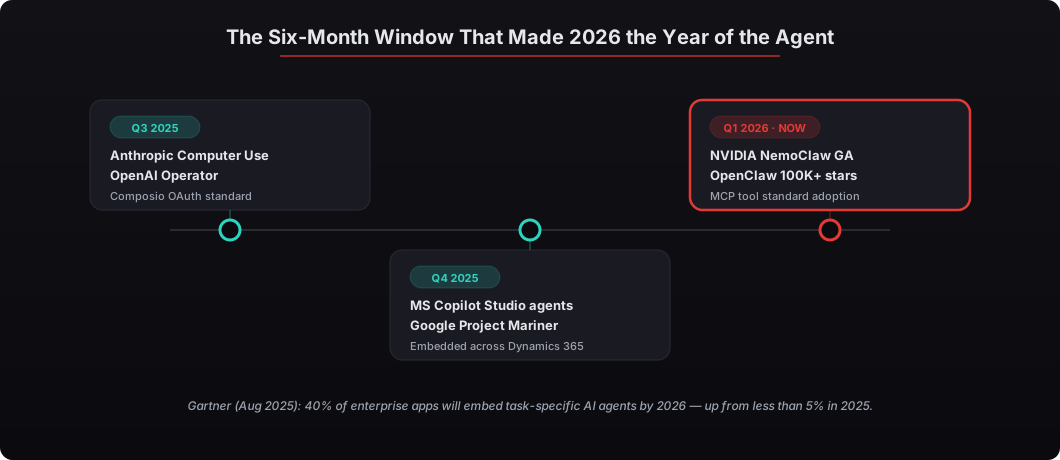
Here’s the six-month window that redefined enterprise AI:
- Q3 2025 — Anthropic released computer use capabilities for Claude. OpenAI launched Operator for web-based task execution. Composio standardized OAuth-backed tool connections for over 250 SaaS apps.
- Q4 2025 — Microsoft shipped Copilot Studio agents across Dynamics 365 and the Microsoft 365 suite. Google DeepMind announced Project Mariner and Gemini-based enterprise agents.
- Q1 2026 — NVIDIA’s NemoClaw security framework reached general availability. OpenClaw crossed 100,000 GitHub stars. The Model Context Protocol (MCP) became the default standard for tool integration.
Gartner’s long-range forecast goes further: agentic AI could drive roughly 30% of enterprise application software revenue — over $450 billion — by 2035, up from 2% in 2025. When analyst projections and CEO announcements converge this cleanly, it isn’t hype. It’s infrastructure being replaced.
What’s the difference between a chatbot, a copilot, and an agent?
A chatbot answers questions you ask it. A copilot assists while you work inside an application. An agent runs continuously on its own infrastructure, monitors your data, and executes multi-step workflows without being prompted. Each wave built on the last, and each needed new infrastructure before it could reach production.
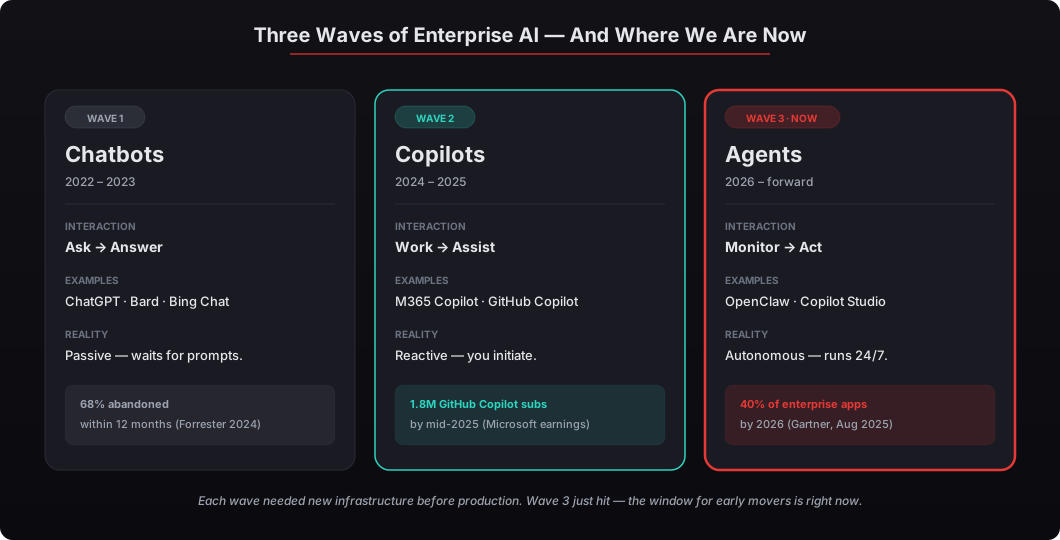
Wave 1: Chatbots (2022–2023). ChatGPT crossed 100 million users in two months, according to Reuters. Every company bolted a chat widget onto their website. The interaction was passive — you ask, it answers. Forrester’s 2024 analysis found that 68% of enterprise chatbot deployments were abandoned within 12 months because they never integrated with the workflows people actually did.
Wave 2: Copilots (2024–2025). Microsoft embedded Copilot across Word, Excel, Outlook, and Teams. GitHub Copilot crossed 1.8 million paid subscribers by mid-2025, per Microsoft’s earnings report. Google added Gemini across Workspace. The interaction improved — you work, it assists in real time — but the AI still waited for you to initiate every task. Accenture’s 2025 Technology Vision found copilot users saved about 1.2 hours per day, but only while they were inside the application.
Wave 3: Autonomous Agents (2026–forward). OpenClaw, Copilot Studio, Vertex AI Agent Builder, and Claude with tool use let you deploy AI that monitors data, recognizes patterns, executes multi-step workflows, and only escalates to you at a threshold you defined. Gartner VP Erick Brethenoux projects that by 2028, 15% of day-to-day work decisions will be made autonomously through agentic AI, up from effectively 0% in 2024.
We’re at the beginning of Wave 3 — not the middle.
What did Gartner, IDC, and McKinsey actually predict about 2026?
The top three analyst firms converged on a single conclusion: AI agents replace chatbots as the primary way enterprises use AI in 2026, with multi-trillion-dollar implications by the end of the decade. Their exact numbers differ. The direction is the same.
- Gartner (August 2025): 40% of enterprise apps will feature task-specific AI agents by 2026, up from less than 5% in 2025. Long-range: roughly 30% of enterprise app software revenue by 2035 (over $450B).
- Gartner (June 2025): Over 40% of agentic AI projects will be canceled by the end of 2027 — a warning, not a contradiction. Single-workflow deployments are the ones that survive.
- IDC FutureScape 2026: AI copilots embedded in 80% of workplace applications, with agents acting “more like teammates than tools.”
- McKinsey 2026 Global AI Survey: Companies that deployed AI agents in 2025 reported a 31% reduction in operational overhead within six months. Companies still experimenting with chatbots reported 4%.
The McKinsey gap is the one worth remembering. The difference between deploying an agent and discussing one is roughly 27 percentage points of operational overhead — per year.
Which workflows should executives automate first?
Start with a high-volume, low-judgment workflow — email triage, meeting prep, weekly financial summaries, deal flow screening, or investor update drafts. These deliver measurable value within 30 days and don’t require complex decision-making. The failure mode is trying to automate strategic judgment before automating repetitive information work.
Deloitte’s 2026 C-Suite AI Readiness Survey found that 71% of successful agent deployments started with email or calendar automation. The unsuccessful ones started with “enterprise-wide AI strategy.” We break down concrete workflow ideas in 7 ways a CEO can use OpenClaw to reclaim 10 hours a week.
Here’s the pattern that works:
- Pick one workflow that’s high-volume and low-judgment for one executive.
- Deploy on private infrastructure — hardware you own or a dedicated VPS, not a shared cloud service.
- Measure for 30 days — hours saved, tasks automated, decisions surfaced.
- Expand only after proof — add a second agent for a second workflow or a second executive.
- Build your constellation over the next quarter, not the next year.
Harvard Business School’s 2025 research on executive technology adoption found that single-user pilots had a 3.4x higher success rate than team-wide launches. The 40% project-cancellation statistic Gartner warned about almost always comes from teams that skipped step 1. For a broader breakdown by role, see our use cases page.
What does a production agent deployment actually look like in 2026?
A production deployment runs on hardware you own or a dedicated private cloud, uses OAuth middleware so the agent never sees raw credentials, and ships with Docker sandboxing, audit logging, and role-based permissions. Setup takes one day with the right team — not the 40 hours of manual configuration it used to.
The reference architecture looks like this: the agent runs inside a hardened Docker container on a Mac Mini, MacBook Air, or private VPS. Composio holds OAuth tokens for 250+ SaaS tools so the agent can call Gmail, Slack, Salesforce, and QuickBooks without ever seeing a password. The Model Context Protocol (MCP) standardizes how the agent talks to internal databases. NVIDIA’s NemoClaw security framework enforces sandboxing and audit trails out of the box. For the plain-English version, read our guide to what OpenClaw is.
Ponemon Institute’s 2025 Cost of a Data Breach report found that breaches involving third-party AI services averaged $5.2 million — 34% higher than breaches without AI exposure. That’s why executives with real data sensitivity shouldn’t run agents on consumer cloud AI. Your email, financials, and deal flow should run on infrastructure you control — the same principle that moved serious workloads off shared hosting in the early 2000s.
What happens to executives who wait until 2027?
They enter 2027 without operational data, competing for booked-up deployment capacity, and playing catch-up to peers who already have agents in production. Gartner’s 2026 IT Services Forecast projects a 200% surge in demand for AI agent deployment services by Q4 2026 — against only a 30% increase in qualified providers. That’s a real supply gap, not a marketing line.
The parallel is cloud adoption in 2012. Companies that migrated early built operational knowledge — what works, which vendors to avoid, which workflows benefit most — that late adopters never fully closed. Bain & Company’s 2026 Technology Report finds that 58% of private equity firms have already deployed or piloted AI agents for deal flow and portfolio monitoring. PwC’s 2026 CEO Survey finds 43% of CEOs plan to deploy AI agents within their executive team by Q3 2026.
Sam Altman said it plainly at OpenAI’s late-2025 developer day: “2026 is when agents go from demo to default.” Dario Amodei, Sundar Pichai, Jensen Huang, and Nadella each made the same prediction in different words during the same three-month window. The consensus is unusual — and it’s already priced into the deployment calendar at every serious infrastructure provider.
We see this at beeeowl every week. Our deployment calendar is booking further out each month. The bottleneck isn’t technology. It’s qualified deployment teams, which is exactly the constraint Gartner’s forecast flagged.
How does beeeowl fit into the 2026 agent shift?
beeeowl is a private AI infrastructure company. We take OpenClaw — the open-source agent framework backed by NVIDIA — deploy it on hardware you own, fully security-hardened, in one day, and ship it within a week. Every deployment includes Docker sandboxing, Composio OAuth setup, authentication, audit trails, and one fully configured agent tailored to your role.
Hosted deployments start at $2,000. Hardware deployments with a Mac Mini or MacBook Air included run $5,000 to $6,000 as one-time costs — no subscriptions, no per-seat licensing, no usage metering. Every client gets a year of monthly mastermind calls where we share workflow patterns and help expand the deployment as the ecosystem evolves. Full details on our pricing page.
The executives moving fastest aren’t building 12-month AI strategies. They’re deploying one agent for one workflow and letting the results justify the next step. If Gartner, Microsoft, Google, and McKinsey are all right about 2026, that head start is the only one that matters.