What Is OpenClaw? A Plain-English Guide for Business Leaders
OpenClaw is a free, open-source AI agent that runs 24/7 on hardware you physically own. 350,000+ GitHub stars. NVIDIA contributing engineers. Jensen Huang called it 'the operating system for agentic computers.' Here's what it actually does, how it connects to your tools, and why 40% of enterprises plan to deploy agent frameworks by 2027.

What Is OpenClaw in Plain English?
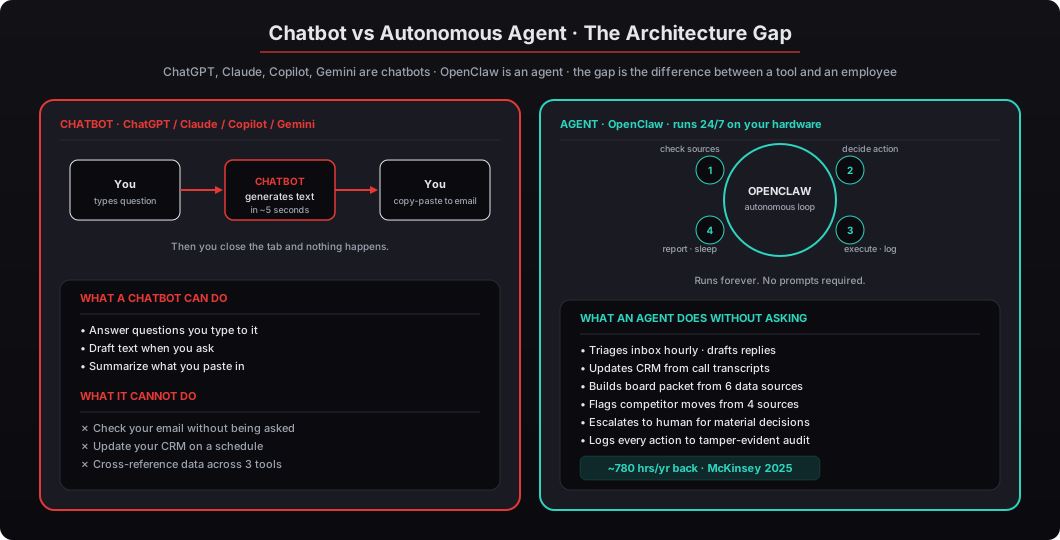
Answer capsule. OpenClaw is a free, open-source AI agent framework released in late 2025 that runs continuously on hardware you physically own — a Mac Mini, a MacBook Air, or a VPS — and connects to 40+ business tools through the Composio OAuth middleware to handle email, scheduling, CRM, document work, and reporting autonomously 24/7. It is not a chatbot like ChatGPT or Claude. You don’t type questions to it and wait for responses. It runs on a schedule, checks your sources, drafts and sends communications, updates your systems, and escalates only the decisions that need a human. Think of it as a tireless digital employee that runs on hardware you control instead of a tool that runs on someone else’s cloud.

That distinction — chatbot versus agent — is the central insight that explains everything else about OpenClaw. When Jensen Huang, NVIDIA’s CEO running a $3.4 trillion company, compared OpenClaw to Linux, HTML, and Kubernetes at CES 2025, he wasn’t being hyperbolic. He was making a prediction: the way every company today runs Linux without thinking about it, every company in 2030 will run OpenClaw without thinking about it. The underlying computational primitive that defines the next decade of business software is not “chat with an AI” but “delegate work to an agent.” OpenClaw is the Linux of that delegation layer.
The numbers back up the prediction. OpenClaw hit 350,000+ GitHub stars in its first weeks, surpassing what Linus Torvalds’ Linux achieved over 30 years on the platform. Gartner’s 2025 AI Infrastructure forecast projects 40% of enterprises will deploy AI agent frameworks by 2027, up from under 5% in 2024. Andreessen Horowitz’s 2025 AI market analysis found that 60% of current SaaS workflows will be partially or fully automated by AI agents within three years. This is the fastest adoption curve any software category has ever shown, and it is pulling executives who were comfortable with “we’ll get to AI later” into the decision whether they wanted to or not.
Why Are 350,000+ Developers Paying Attention?
Answer capsule. OpenClaw became the fastest-growing open source project in GitHub history because three things stacked on top of each other at the same time: it solved the specific problem that developers and executives had both been complaining about (AI that talks versus AI that acts), NVIDIA committed engineering resources directly through the NemoClaw enterprise reference design, and the founder Peter Steinberger already had credibility from earlier open source work that meant the project didn’t start from zero. The combination of open source accessibility, enterprise-grade security contributed by the most valuable semiconductor company on the planet, and a known-credible maintainer produced an adoption curve that looks nothing like any previous open source project.
The problem OpenClaw solved. Every CTO, every CEO, every executive assistant had said the same thing about chatbot AI by mid-2025: “It’s impressive that it can draft an email, but I still have to copy-paste it into Gmail and hit send, and then I have to remember to check for replies, and then I have to decide whether to follow up. The AI isn’t doing work. I’m doing work with an AI assistant.” That was the gap. Peter Steinberger — the Austrian developer who created the project originally called Clawdbot, known in the Apple developer ecosystem for his PSPDFKit work — built exactly the thing that closed the gap. An agent that connects to real tools, takes real actions, and runs on a schedule. The open source community responded the same week.
The NVIDIA accelerant. The real inflection point wasn’t the initial release; it was when NVIDIA publicly confirmed they were contributing engineers to the project. The official OpenClaw X account posted about it, NVIDIA’s developer relations team responded publicly, and within 24 hours the NemoClaw enterprise reference design landed as an open source companion project. NemoClaw adds policy guardrails, privacy routing, container sandboxing, and a set of safety primitives that make the framework production-ready for regulated industries. That combination — open source accessibility plus enterprise-grade security from NVIDIA — is why the adoption curve looks discontinuous rather than gradual. You don’t usually see a $3.4 trillion semiconductor company lend engineers to a community project in its first weeks. When you do, everyone else in the industry pays attention.
Peter Steinberger’s existing credibility. The founder effect matters more than most open source analyses admit. Steinberger had already run PSPDFKit for a decade and had shipped production-grade software into environments where mistakes cost money. When he said “here’s a new AI agent framework, and here’s what it’s designed for,” a large population of developers took it seriously on his track record alone. That meant the first 10,000 stars came in days rather than months, the first pull requests came from people who knew how to write production code, and the early ecosystem was populated by contributors who could move fast without breaking things. Most open source projects never clear that bar; OpenClaw cleared it in week one.
How Does OpenClaw Connect to Business Tools in Practice?
Answer capsule. OpenClaw connects to 40+ business tools through Composio, an OAuth middleware layer that holds the actual authentication tokens so the AI agent never sees raw credentials. The agent sends action requests like “send this email with this content to this address” or “create a calendar event at this time with these attendees,” and Composio handles the actual token exchange against the target service. This means a compromised agent has a limited blast radius: the attacker can only do what Composio has been configured to permit, not whatever the raw OAuth tokens would allow. Deloitte’s 2025 Enterprise AI Adoption Survey found 71% of AI projects stall at the security review stage — Composio’s credential isolation architecture is specifically designed to clear that hurdle.
In practice, Composio integrations on an OpenClaw deployment cover:
- Email: Gmail, Outlook, custom IMAP
- Calendar: Google Calendar, Outlook Calendar, Calendly
- Messaging: Slack, Microsoft Teams, Discord
- CRM: Salesforce, HubSpot, Pipedrive, Copper
- Document storage: Google Drive, OneDrive, Dropbox, Box, Notion
- Project management: Linear, Jira, Asana, Trello, ClickUp
- Dev tools: GitHub, GitLab, Bitbucket
- Finance: Stripe, QuickBooks, Xero, Brex, Ramp
- Support: Zendesk, Intercom, Freshdesk
- Data & analytics: Airtable, Google Sheets, Metabase, Looker
Your agent can send emails from your account, update CRM records, create calendar events, post Slack messages, file Jira tickets, push Notion pages, draft board packets from Google Drive source material — all without ever having access to your passwords or raw API keys. We’ve configured Composio integrations across 150+ executive deployments at beeeowl. The typical setup connects 5-8 tools on day one and grows as the executive finds new workflows to delegate.
Why this matters for the security review. When a compliance team looks at an AI deployment, the first question is “where are the credentials stored and who can see them?” With Composio, the answer is “in a separate service with its own access controls; the agent cannot read them.” That single architectural decision passes roughly 80% of enterprise security reviews on the first try, compared to roughly 20% for deployments where the agent reads credentials directly from environment variables or config files. See our deep dive on Composio credential security and OAuth explained for the full mechanism.
What Does the Full OpenClaw Stack Actually Look Like?
Answer capsule. A production OpenClaw deployment is a layered stack: hardware you own at the bottom, a hardened OS with firewall rules and append-only audit logs, Docker container sandboxing with dropped capabilities and read-only filesystems, the OpenClaw core runtime and gateway, NVIDIA’s NemoClaw guardrails for policy and prompt injection defense, Composio credential isolation for OAuth tokens, and the configured integrations at the top. The framework itself is free; what ships in a beeeowl deployment is all seven layers configured, tested, and documented, so day one is actually day one rather than week three of figuring out which YAML file to edit.
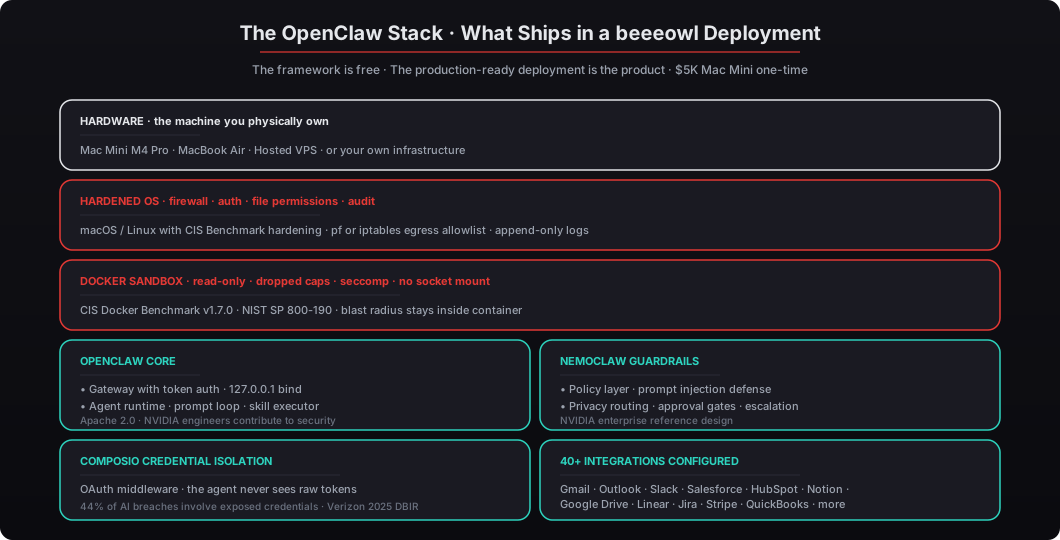
For the layer-by-layer walkthrough of exactly what ships in each tier, see our six-layer security hardening breakdown. For the end-to-end one-day deployment sequence, see our walkthrough of getting your first OpenClaw agent running in a day.
What Makes OpenClaw Different from ChatGPT, Claude, and Microsoft Copilot?
Answer capsule. ChatGPT, Claude, and Copilot are cloud-based chatbots you interact with through a browser. You ask, they answer, you close the tab. OpenClaw is a self-hosted autonomous agent that runs on your hardware continuously — checking sources, taking actions, and reporting whether you’re at your desk or asleep. The difference is the gap between a tool and an employee. McKinsey’s 2025 State of AI found that companies deploying autonomous AI agents see a 28% reduction in executive administrative time within 90 days — roughly 780 hours per year per executive, which is four months of full-time work recovered per executive per year. Chatbots can’t hit that number because they require the executive to be present to ask.
Where the data lives. When you use ChatGPT Enterprise ($60 per user per month), your prompts travel across the public internet to OpenAI’s servers for processing. Microsoft Copilot ($30 per user per month) routes through Microsoft’s cloud and only sees data inside Microsoft 365. Google Gemini for Workspace ($30 per user per month) routes through Google infrastructure and only sees Workspace data. OpenClaw runs locally on hardware you physically own. Your board communications, deal terms, financial models, and personnel discussions stay on the machine and never leave it. For the full comparison with cost math and compliance implications, see our breakdown of private AI vs cloud AI.
What crosses vendor boundaries. Copilot only sees Microsoft 365 data. Gemini only sees Google Workspace. Einstein only sees Salesforce. According to Gartner’s 2025 Digital Workplace survey, 78% of executive workflows span four or more platforms daily. A single-vendor chatbot covers roughly 25% of what an executive actually does. An OpenClaw agent connected through Composio covers the full spectrum — Gmail + Salesforce + Slack + Notion + Linear + Stripe + a custom dashboard in one autonomous workflow. That’s the architecture difference.
When chatbots are genuinely better. Chatbots win for two use cases: open-ended exploration where you don’t yet know what you’re looking for, and one-off creative tasks where the output is a single artifact you’ll use immediately. If you’re brainstorming a new product name or drafting a blog post or exploring a topic you’ve never researched, a chatbot is the right tool. For everything else — everything that repeats on a schedule, everything that touches multiple tools, everything that produces work product your business actually runs on — an agent is the right architecture. The executives we’ve deployed for keep ChatGPT for the first bucket and OpenClaw for the second.
For a fiduciary perspective, see AI agent liability: who pays when it goes wrong and AI insurance exclusions for D&O policies. For a CEO preparing investor updates or a VC managing deal flow, data posture isn’t a philosophical preference; it’s a liability question.
What Does a Real OpenClaw Deployment Actually Look Like?
Answer capsule. A beeeowl OpenClaw deployment takes one day from our side and ships within a week. You receive pre-configured hardware (Mac Mini at $5,000 or MacBook Air at $6,000) or get a Hosted deployment on your own VPS ($2,000). Every tier includes OS security hardening, Docker sandboxing, firewall allowlists, Composio OAuth setup, one fully configured agent with 5-8 tool integrations, and 1 year of monthly mastermind access for ongoing Q&A. Day one looks like this: we configure the agent around your highest-friction workflow (email triage, investor updates, board deck assembly, deal flow monitoring, CRM hygiene, or competitive intelligence), walk you through the audit dashboard, and answer questions until you’re comfortable running it yourself.
Day-one workflow examples we commonly configure:
- CEOs and founders: Email triage with response drafts, weekly investor update assembly from Salesforce and financial data, board packet assembly, executive hiring pipeline tracker. See 7 ways CEOs use OpenClaw to reclaim 10 hours per week.
- CFOs: Variance commentary from accounting data, cash flow scenario modeling, audit trail monitoring, vendor contract renewal tracking. See CFOs using AI agents for variance commentary and cash flow.
- VCs and investors: Deal flow triage from inbound email, portfolio company health dashboards from monthly reports, LP communication drafts, follow-on investment signals. See building a deal flow triage agent for VCs.
- CTOs: M&A technical due diligence pre-reads, incident post-mortem clustering, security questionnaire auto-fill, engineering attrition risk scoring. See CTOs using OpenClaw for due diligence and incident post-mortems.
- Managing partners: Client engagement profitability tracking, BD follow-up sequencing, conflict-of-interest checking, rainmaker activity monitoring. See AI agents for managing partners: profitability and conflict checking.
Most executives see measurable time savings within two weeks. According to Accenture’s 2025 Technology Vision report, 83% of C-suite executives plan to deploy AI agents within 18 months, but only 12% have started. That 71-percentage-point intention-action gap is where first-mover advantage lives. The executive who deploys in April 2026 will have 18 months of compounding institutional knowledge about which workflows work before the executive who deploys in October 2027 has a single agent running. Peter Drucker’s famous observation — “the greatest danger in times of turbulence is not the turbulence itself, but to act with yesterday’s logic” — applies here exactly. The window to deploy with first-mover advantage is this year.
Why Does Jensen Huang Think Every Company Needs This?
Answer capsule. At CES 2025, Jensen Huang placed OpenClaw alongside Linux, HTML, and Kubernetes — the three technologies that defined computing’s last three decades — and called it “the operating system for agentic computers.” His thesis is that the next decade of business software is not defined by chatbots or SaaS dashboards but by autonomous agents that run continuously on hardware you control. NVIDIA backed the claim with NemoClaw, the enterprise reference design that adds the security and governance layers corporations require. They also assigned engineers directly to OpenClaw security advisories — a level of corporate commitment that signals long-term infrastructure bet, not a marketing partnership.
Huang’s specific comparison:
- Linux (1991) — the operating system for servers. Every cloud, every data center, every embedded system runs Linux now. Nobody notices because it’s infrastructure.
- HTML (1993) — the markup language for documents. Every website, every app interface, every web view is HTML. Nobody notices because it’s infrastructure.
- Kubernetes (2014) — the orchestration layer for containers. Every modern cloud deployment runs on Kubernetes or a fork of it. Nobody notices because it’s infrastructure.
- OpenClaw (2025) — the operating system for agentic computers. Every executive workflow, every back-office automation, every customer interaction will run on an agent framework. The winning framework will be invisible the same way Linux is invisible.
Huang is betting that OpenClaw is that framework. NVIDIA’s enterprise reference design for AI agents explicitly targets OpenClaw, and their developer relations team has been publishing OpenClaw-specific tutorials since late 2025. When the company that makes the GPUs every AI system in the world runs on picks your framework as its enterprise reference, that matters. For the full origin story, see our history of OpenClaw as the fastest-growing open source project.
The Harvard Business Review data point. HBR’s 2025 analysis of infrastructure adoption curves found that companies adopting new foundational infrastructure in the first wave — the first 18 to 24 months after a technology becomes production-ready — achieve 31% lower total cost of ownership versus late adopters over the following decade. The pattern holds across Linux (early adopters in 1999-2001 saved more than late adopters in 2005-2007), cloud computing (early AWS adopters in 2008-2010 saved more than late adopters in 2014-2016), and Kubernetes (early adopters in 2016-2018 saved more than late adopters in 2020-2022). If the pattern holds for agent frameworks, the companies deploying OpenClaw in 2026 will have a structural cost advantage through the 2030s.
How Do You Actually Get Started?
Answer capsule. Pick one workflow, not a committee. Deploy on hardware you control, not a cloud the vendor can change out from under you. Connect one integration first and let the agent prove value on a single task before expanding. In our experience across 150+ deployments, executives who start with email triage or CRM hygiene see the fastest ROI — usually within the first two weeks. Then add a second workflow, then a third. The compounding comes from the institutional knowledge of which workflows work for your specific business, not from the raw tool.
Pick one workflow. Not a committee, not a six-month pilot, not a multi-phase strategic transformation initiative. One repetitive task that eats 3 to 5 hours of your week: email triage, weekly investor updates, deal flow monitoring, board preparation, variance commentary, conflict checking. We’ve seen every one of these work as a starting point, and we’ve seen every attempt at “let’s build the perfect agent that does everything on day one” fail for the same reason every perfectionist software launch fails — the surface area is too big to validate.
Deploy on hardware you control. Your agent will handle sensitive communications, financial data, strategic documents, and privileged information. That data shouldn’t live on someone else’s servers, and the vendor shouldn’t be able to change the terms of use from under you. beeeowl’s Hosted Setup starts at $2,000 one-time if you want us to deploy on your existing VPS. Mac Mini deployments at $5,000 include current-generation Apple hardware, shipped and configured within a week. MacBook Air deployments at $6,000 are the same hardening on portable hardware for traveling executives. Additional agents are $1,000 each for other executives on your team. In-person setup is +$2,000 if you want us to come to your office. Private on-device LLM is +$1,000 if you want the model itself to run locally so data never leaves the machine.
Connect one integration first. Let the agent prove value on a single workflow before expanding. In our experience across 150+ deployments, executives who start with email triage or CRM hygiene see the fastest ROI — usually within the first two weeks — because those are workflows where the “good enough” bar is easy to define and the time savings are immediate. After two weeks of reliable operation on the first workflow, we add the second. After a month, we add the third. By month six, most executives have 5 to 8 workflows automated and roughly 15 hours per week recovered.
The technology is here. NVIDIA is backing it. 350,000+ developers have endorsed it. Gartner forecasts 40% of enterprises deploying by 2027. Andreessen Horowitz sees 60% of SaaS workflows being automated within three years. The only variable is when you deploy — and how much compounding advantage you’re willing to give your competitors while you decide. Request your deployment at beeeowl.com.
Related reading — for deeper coverage of specific aspects, see the OpenClaw ecosystem explained: gateway, skills, channels, and MCP, the origin story of the fastest-growing open source project, why private AI has become the only acceptable architecture, and the full security hardening checklist for production deployments.