How CFOs Are Using AI Agents for Automated Variance Commentary and Cash Flow Modeling
Finance teams spend 49% of their time on data gathering (McKinsey 2025). 78% of CFOs rank AI data exposure in their top 5 risks (E&Y 2025). A privately deployed OpenClaw agent automates variance commentary, cash flow scenarios, and vendor renewals without financial data leaving your network.

Finance teams spend 10-15 hours per close cycle writing variance commentary and building cash flow scenarios by hand in 2026 — because the tools that could automate the work require sending P&L data to third-party servers. McKinsey’s 2025 Global Finance Practice report found finance teams spend 49% of their time on data gathering and reconciliation, exactly the work AI agents can eliminate. Ernst & Young’s 2025 Digital Trust Survey found 78% of CFOs rank “unauthorized exposure of financial data through AI tools” in their top 5 risk concerns — above cybersecurity threats, above talent retention. Deloitte’s Q4 2025 CFO Signals Survey reported 73% of CFOs at $1B+ companies are investing in AI-powered financial planning, but 61% cite data security as the primary barrier. SEC enforcement for data handling increased 34% between 2023-2025 according to the SEC’s Division of Enforcement annual report. The tension is clear: CFOs know AI can do this work, tried ChatGPT once with sanitized data, got a taste of what’s possible, and hit the compliance wall. The answer isn’t better cloud AI. It’s AI that never leaves your network. This article is the deployment pattern we ship at beeeowl for CFOs across mid-market and PE portfolio companies.
Why are CFOs still writing variance commentary by hand in 2026?
Because the tools that could automate it require sending your P&L data to someone else’s servers. And no CFO with a SOX obligation is going to pipe quarterly revenue figures through OpenAI’s API — not because the technology can’t do the work, but because the compliance cost is unacceptable. So the FP&A team keeps spending 10-15 hours per close cycle copying numbers into spreadsheets and writing the same explanations they wrote last quarter.
I’ve deployed AI agents for finance teams at mid-market companies and private equity portfolio companies over the past year. The pattern is always the same: the CFO knows AI can do this work, tried ChatGPT once with sanitized data (“I removed the company name and rounded the numbers”), got a taste of what’s possible, and then hit the wall. The compliance team said no. The SOX auditors said no. The deal attorney at Wilson Sonsini or Cooley said no. The answer everyone lands on is the same — “maybe private AI when that’s a real thing.”
Private AI is a real thing now. It’s been a real thing for about 18 months. The reason most CFOs haven’t deployed it isn’t capability — it’s that the deployment pattern for non-technical finance leaders wasn’t obvious until recently. This article walks through what actually works at mid-market and PE portfolio companies, with the four specific workflows we ship in every CFO deployment: variance commentary, cash flow scenarios, vendor renewal tracking, and SOX-compliant audit trails.
What does automated variance commentary actually look like?
A privately deployed OpenClaw agent connects to your ERP — NetSuite, SAP S/4HANA, QuickBooks Enterprise, Sage Intacct, Oracle Cloud ERP — pulls the current period actuals through a Composio OAuth integration, compares them against budget, and generates natural-language explanations for every material variance. The CFO gets a finished first draft within minutes of the books closing, not days.

Here’s what a CFO at a $45M SaaS company actually receives from their agent at 8 AM on close-day + 1:
Revenue — Subscription: Actual $3.82M vs Budget $3.65M (+$170K, +4.7%). Favorable variance driven by Q1 enterprise upsell cohort closing 2 weeks ahead of plan. 14 accounts expanded ARR in March vs 9 budgeted. Net retention rate hit 118% against 112% budget assumption.
COGS — Cloud Infrastructure: Actual $412K vs Budget $380K (+$32K, +8.4%). Unfavorable variance attributable to unplanned AWS us-east-1 capacity scaling following March 12 traffic surge. Engineering confirms temporary — expected to normalize by April as auto-scaling policies are adjusted.
OPEX — Sales & Marketing: Actual $890K vs Budget $920K (-$30K, -3.3%). Favorable variance from delayed Q1 brand campaign launch (now scheduled April 15). Two open SDR headcount positions unfilled — recruiting pipeline active, expect backfill by May.
That’s not a template with numbers plugged in. The agent pulled transaction-level data, identified the causal factors, and wrote commentary that reads like your best FP&A analyst produced it. McKinsey’s 2025 Global Finance Practice report found that finance teams spend 49% of their time on data gathering and reconciliation — exactly the work this agent eliminates. For the specific variance commentary workflow configuration, see our use case breakdown.
How does the agent know what’s driving a variance?
It doesn’t guess. The agent cross-references multiple data sources: your general ledger, CRM pipeline data from Salesforce or HubSpot, HRIS headcount data from Rippling or BambooHR, AWS usage from CloudWatch, and prior-period commentary stored locally. When revenue is up, it checks whether the driver was volume, pricing, or timing. When expenses spike, it looks at new vendors, headcount changes, or one-time charges. When headcount variances appear, it pulls from the HRIS to confirm whether the gap is hiring freeze, unfilled reqs, or delayed starts.
This is where Composio integrations matter. OpenClaw’s agent connects to 250+ tools through OAuth — credentials are never exposed to the agent itself. So when the agent queries your Salesforce instance for closed-won data, it’s using a scoped token that your IT team controls. Revoke it anytime. No shared passwords. No admin account leaks. See our deep-dive on connecting OpenClaw via Composio.
Gartner’s 2025 FP&A Technology Survey predicted that by 2027, 60% of large enterprises will use AI-assisted variance analysis. But their report also noted that adoption in the mid-market is lagging at under 15%, primarily because mid-market CFOs lack the infrastructure to run AI models privately. That’s the gap we fill — the mid-market company with a Senior FP&A Analyst, a monthly close, a SOX auditor who takes their job seriously, and a CEO who wants commentary faster than the current 3-day cycle allows.
The agent also learns your organization’s context over time. After three close cycles, it knows that Q1 always has a seasonal dip in professional services revenue because 30% of your engagements start in Q2. It knows your AWS costs spike every March during annual contract renewals. It stops flagging predictable patterns as variances and focuses commentary on genuine anomalies that deserve explanation. That pattern-learning is what turns a good first-week output into an invaluable long-term tool.
What about cash flow scenario modeling?
This is where CFOs get genuinely excited. The agent takes your current cash position, accounts receivable aging, accounts payable schedule, and revenue forecast — then generates three scenarios with full narrative explanations and probability weightings. This is the workflow that saves CFOs their weekends.
Here’s an example agent output from a real deployment (numbers anonymized):
Base Case (70% probability): Ending cash of $8.2M at Q2 close. Assumes current collection patterns (DSO 42 days), budgeted revenue attainment at 98%, and vendor payments on standard terms. Operating runway: 14 months at current burn.
Upside Case (15% probability): Ending cash of $9.1M. Assumes enterprise pipeline converts at historical Q2 rate (35% vs current 28% base assumption), DSO improves to 38 days with new AR automation, and deferred revenue recognition from two annual contracts signed in Q1.
Downside Case (15% probability): Ending cash of $6.8M. Assumes two largest renewals (combined $1.2M ARR) churn, collection delays push DSO to 52 days, and unbudgeted legal expense from ongoing IP matter ($180K estimated).
The CFO I built this for told me he used to spend an entire Saturday building these models in Excel before every board meeting. Now the agent produces the first draft on Thursday morning, he reviews it Thursday afternoon, and sends it to the board Friday. His exact words: “I got my weekends back.”
Deloitte’s Q4 2025 CFO Signals Survey reported that 73% of CFOs at companies with over $1B in revenue are investing in AI-powered financial planning tools. But the same survey found that 61% cited data security as their primary barrier to adoption. When your cash flow model contains your actual runway, your real churn risk, and your projected headcount — that’s material non-public information under SEC rules. You can’t send it to the cloud. You can’t paste it into ChatGPT “just to see what it suggests.” The transmission itself is the violation.
How does vendor contract renewal tracking work with an AI agent?
The agent monitors your contract database — whether that’s a dedicated CLM tool like Ironclad or DocuSign CLM, or a structured spreadsheet in Airtable — and flags renewals approaching their auto-renew window. But it goes beyond simple date alerts. The agent cross-references contract terms against actual usage data pulled through the Composio integration.
Here’s an example output:
Upcoming Renewal: Snowflake Computing Current annual commitment: $285K. Renewal date: June 15, 2026. Auto-renew clause: Yes (60-day opt-out window closes April 16).
Agent Analysis: Usage has declined 22% since migration of analytics workloads to Databricks in Q4 2025. Current consumption credits suggest a $195K commitment would cover projected usage with 15% buffer. Recommend renegotiation before auto-renew triggers. Estimated savings: $90K annually.
Action Required: CFO approval to initiate vendor discussion by April 10.
That Snowflake example is based on a real deployment — though I’ve changed the numbers. The CFO didn’t even know the contract was about to auto-renew at the old rate because the procurement person who signed the contract had left the company 9 months earlier and the reminder was buried in an abandoned calendar. The agent caught it because it cross-referenced the contract terms against actual Snowflake usage data pulled through the Composio integration.
According to Bain & Company’s 2025 procurement study, enterprises lose an average of 3-5% of total vendor spend to auto-renewed contracts that don’t reflect current usage. For a company spending $5M annually on software vendors, that’s $150K-$250K walking out the door every year — and it’s the exact money the CFO agent recovers in the first quarter of deployment.
Why does financial data privacy actually matter for AI deployments?
It’s not theoretical risk. SEC enforcement actions related to data handling increased 34% between 2023 and 2025, according to the SEC’s own Division of Enforcement annual report. SOX Section 404 requires management to assess internal controls over financial reporting — and sending financial data to a third-party AI provider creates a control gap that auditors from Deloitte, PwC, EY, and KPMG are actively scrutinizing in 2026 engagements.
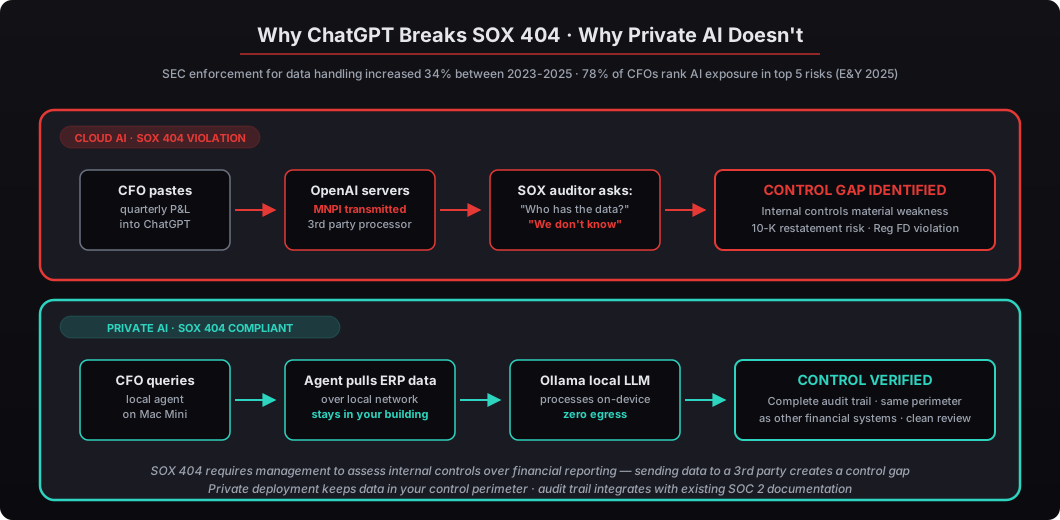
Here’s the specific problem. When you paste your quarterly P&L into ChatGPT, that data transits through OpenAI’s servers. Even if OpenAI doesn’t train on it (their enterprise tier promises this), you’ve still created a transmission record. Your data existed on someone else’s infrastructure, even if briefly. Under SOX, that’s a third-party data processor in your financial reporting chain that needs to be documented, risk-assessed, and audited. Every SOX-listed company has to answer “who has access to your financial data?” and “ChatGPT, sometimes” is not an auditable answer.
MNPI rules make this worse. If your agent is modeling cash flow scenarios that include revenue projections, churn forecasts, or M&A scenarios — that’s material non-public information. Regulation FD doesn’t have a carve-out for “I was just using it for AI processing.” The transmission itself is the violation the moment the data lands on a server outside your control perimeter. Ernst & Young’s 2025 Digital Trust Survey found that 78% of CFOs rank “unauthorized exposure of financial data through AI tools” in their top five risk concerns — above cybersecurity threats, above talent retention, above macroeconomic volatility. The risk isn’t imagined. It’s the top five.
How does beeeowl’s private deployment solve this?
We ship you a Mac Mini (or MacBook Air if you need portability) with OpenClaw pre-configured, security-hardened, and connected to your tools. The agent runs on your hardware, on your network, in your building. Your financial data never leaves the control perimeter your existing SOC 2 and SOX documentation already covers.
The deployment includes Docker sandboxing so the agent can’t access anything outside its isolated container (NIST SP 800-190 compliant). Firewall rules restrict outbound connections to only your approved API endpoints — your ERP, CRM, HRIS, and CLM. Authentication is built in so only authorized users can interact with the agent. And every query, every output, every action gets logged to an audit trail stored on your hardware where it integrates with your existing SOX documentation. See our walkthrough in how to get your first OpenClaw agent running in one day.
For CFOs who want zero cloud exposure — not even to GPT-4 or Claude for the AI reasoning layer — we offer the Private On-Device LLM add-on ($1,000). That installs Ollama locally and routes all inference through models like Llama 3.1 or Qwen 2.5 running directly on the Mac Mini’s hardware. Your prompts don’t leave the machine. Your outputs don’t leave the machine. The audit trail is clean end-to-end. See running a private LLM with Ollama for the full on-device configuration.
One CFO at a PE-backed healthcare company told me the audit trail feature alone justified the investment. Their SOX auditor from KPMG specifically asked how AI-generated financial commentary was being logged during the Q4 2025 audit. Because the entire system ran on-premise with full audit logging, the answer was simple: same as everything else. On our servers, in our logs, under our control. The auditor accepted it with no follow-up questions because the answer matched the model they already use for every other financial control.
What does the audit trail actually capture?
Every interaction with the agent generates a timestamped, immutable log entry that maps directly to SOX Section 404 control documentation requirements. Here’s what gets recorded on every single agent invocation:
- Who initiated the query (authenticated user ID, tied to your existing SSO if applicable)
- What data sources were accessed (ERP tables, CRM objects, contract records)
- When the query ran and when the output was delivered (full timestamps)
- What the agent produced (full output text, stored locally with version history)
- Which model processed the request (GPT-4, Claude, or local Llama/Qwen — documented for provenance)
- What downstream actions were taken (Slack notification sent, email delivered, dashboard updated, CRM record modified)
This maps directly to SOX Section 404 control documentation requirements. Your auditor can trace any AI-generated variance commentary back to the source data, the model that produced it, the user who requested it, and the timestamp of every step. The Association of Certified Fraud Examiners (ACFE) published guidance in 2025 recommending that organizations using AI for financial reporting maintain “complete provenance records” for all AI-generated content. beeeowl’s deployment meets that standard out of the box because we built it to match the ACFE guidance from the first client deployment.
The audit trail also supports forensic investigation. If a variance commentary contains an error six months after delivery, you can reconstruct exactly which data the agent saw, which model produced the output, and what the inputs were at the time — without needing to replay anything through a third-party vendor’s logs. Everything stays on your infrastructure under your retention policy.
How quickly can a CFO get this running?
One day. We configure the agent, connect your integrations through Composio, set up your variance commentary templates, define your cash flow scenario parameters, and import your vendor contract data. The Mac Mini ships within a week — delivery depends on your carrier and physical address. Your first automated close cycle runs within two weeks of the deployment request.
The Hosted Setup at $2,000 gets you the same agent running on a cloud VPS (Hetzner or OVH, not hyperscalers) that only you control. The Mac Mini Setup at $5,000 includes the hardware. Both include one fully configured agent with all the financial automation workflows described in this article, plus one year of monthly mastermind calls where you can ask questions, share workflows, and learn from other finance leaders using the same tools.
Additional agents cost $1,000 each — useful if your VP of Finance and Controller each need their own configured workflows with different data scopes and different approval chains. The Private On-Device LLM is an extra $1,000 if you want zero cloud AI exposure (the default configuration we recommend for PE-backed companies and healthcare CFOs dealing with PHI-adjacent data).
Is this actually better than hiring another FP&A analyst?
Glassdoor data from March 2026 puts the average Senior FP&A Analyst salary in the US at $125K-$155K, plus benefits (typically 30% loading). That analyst spends roughly 40% of their time on variance commentary, close support, and ad-hoc scenario modeling — the work this agent automates. The annualized cost of the automated portion of a Senior FP&A Analyst’s work is $65K-$80K per year, versus a one-time $5,000 beeeowl Mac Mini deployment. The break-even lands at roughly week 4 of the first year.
I’m not suggesting you fire your FP&A team. The agent produces first drafts. Your team reviews, adds judgment, and delivers the final product. But instead of writing commentary from scratch for 200 line items, they’re reviewing and editing 200 line items of pre-written commentary. The time savings let them focus on strategic analysis — the work they were hired to do but never have time for.
The CFO Dive 2025 Finance Transformation Report found that high-performing finance teams spend 35% of their time on strategic analysis versus 12% at average organizations. The difference isn’t talent. It’s that high performers automated the repetitive work so the talented analysts they hired can actually do the job they were hired for. A $5,000 one-time investment that saves your FP&A team 10-15 hours per close cycle, catches $90K vendor contract renewals, and gives your CFO board-ready scenario models before Thursday — that’s not a technology expense. It’s a finance operations upgrade that pays for itself before Q3.
What’s the first step?
Request your deployment. We’ll schedule a 30-minute scoping call to understand your ERP, your close process, your reporting requirements, and which compliance frameworks apply (SOX 404, SOC 2 Type II, HIPAA, GDPR). Then we configure, ship, and you’re running automated variance commentary before your next monthly close. Full pricing on our pricing page and role-specific workflow examples on our use cases page.
Your financial data stays where it belongs — on your hardware, under your control, with a complete audit trail that integrates with your existing SOX documentation. That’s what private AI infrastructure means for finance teams in 2026, and it’s the only deployment pattern that passes both the productivity bar your CEO wants and the compliance bar your auditor requires.