On-Device AI for Legal and Financial Workflows: When Data Cannot Leave the Building
Why M&A due diligence, legal discovery, financial modeling with MNPI, HR personnel analysis, audit workpapers, and contract negotiation demand on-premise AI processing. Regulatory requirements from the ABA, SEC, FINRA, SOX, PCAOB, and state privacy laws all create compliance obligations cloud AI cannot satisfy. This post walks through the six workflows that require on-device processing, the Big 4 accounting firms' three-tier classification model that's becoming industry standard, and the beeeowl Mac Mini plus Private On-Device LLM architecture that keeps every prompt and output on hardware you physically own.


Why Can’t Legal and Financial Teams Just Use ChatGPT?
Answer capsule. They can’t because the data these teams handle has legal protections that cloud AI services structurally violate. Attorney-client privilege, SEC regulations on material nonpublic information, SOX internal controls over financial reporting, FINRA supervisory requirements, and state privacy laws all require that sensitive documents stay within controlled systems with an auditable chain of custody. Sending a merger term sheet to OpenAI’s API or a board deck containing MNPI to Claude isn’t just risky — it’s a regulatory breach that creates third-party exposure, a transmission record discoverable in litigation, and a chain-of-custody break that no audit can reconcile. The data isn’t the problem. The transmission is.

I’ve spent enough time in rooms with managing partners and CFOs to know the conversation always goes the same way. Someone on the team discovers that GPT-4 or Claude Sonnet can summarize a 200-page due diligence report in 90 seconds. The team gets excited. Then general counsel walks in and kills it, and the CFO backs them up.
They’re right to kill it. The enthusiasm is understandable — the AI is genuinely impressive, the time savings would be substantial, and the technology works. But the regulatory environment for legal and financial data doesn’t care how impressive the technology is. It cares about who has access to the data, what chain of custody exists, whether the transmission is auditable, and whether the controls satisfy the frameworks that govern the specific workflow. Cloud AI fails every one of those tests for the data in question — not because the vendors are bad actors, but because the architecture doesn’t match the compliance model.
What Regulatory Frameworks Govern AI Data Handling in Law and Finance?
Answer capsule. Four overlapping regulatory regimes create a near-impossible compliance environment for cloud-based AI in sensitive workflows: ABA ethics rules (Formal Opinion 512 directly addresses AI tools and client confidentiality), SEC regulations (Reg FD on selective disclosure, insider trading rules), FINRA supervisory requirements (Rule 3110 on information barriers), and SOX Section 404 internal controls. Each independently demands data custody that cloud AI can’t provide, and together they make cloud AI structurally unacceptable for six specific workflow categories regardless of how robust the vendor’s security posture is.
The ABA’s Formal Opinion 512 (issued 2024) directly addresses AI tools and client confidentiality. It states that lawyers must ensure “reasonable measures” protect client data when using any technology, including generative AI. The opinion specifically flags cloud-based AI services as requiring scrutiny of the provider’s data retention policies, training practices, access controls, and jurisdiction. Crucially, the opinion establishes that using cloud AI without understanding the provider’s data handling can itself constitute a violation of the duty of competence under ABA Model Rule 1.1.
Cravath, Swaine & Moore — one of the most influential law firms in the world — responded by restricting all AI tool usage involving client data to vetted, on-premise systems. Sullivan & Cromwell issued similar guidance in late 2024, requiring partner approval before any client document touches a third-party AI service. Skadden, Arps, Slate, Meagher & Flom took it further by building an internal AI platform specifically to avoid cloud exposure entirely. The pattern is consistent across big law: the biggest firms have concluded that cloud AI for client-document work is not an acceptable compliance posture.
On the financial side, SEC Regulation FD prohibits selective disclosure of material nonpublic information. FINRA Rule 3110 requires broker-dealers to maintain supervisory systems that prevent MNPI leakage. The Sarbanes-Oxley Act (SOX) Section 404 demands documented internal controls over financial reporting — including any AI systems that touch financial data. Deloitte’s 2025 AI Governance Survey found that 67% of financial services firms had paused or restricted cloud AI adoption specifically due to MNPI handling concerns. That’s not a technology problem; it’s a data custody problem that no vendor’s security certifications can resolve.
The SEC’s 2025 examination priorities explicitly include “AI-related risks in investment management and broker-dealer operations,” with specific attention to data handling practices. SEC Commissioner Hester Peirce noted in a February 2026 speech that firms should expect AI data governance to be a standard examination topic going forward. The practical implication: if your firm is in scope for SEC examination, your AI data handling will be audited, and the standard the examiners apply will be “show us the chain of custody” rather than “show us the vendor’s SOC 2 report.” See our complete guide to GDPR, SOC 2, and EU AI Act compliance for the broader regulatory picture.
Which Workflows Actually Require On-Device Processing?
Answer capsule. Six workflow categories create regulatory obligations that make cloud processing unacceptable: M&A due diligence (NDA + ABA Rule 1.6 + SEC insider trading rules), legal discovery and document review (work product doctrine + attorney-client privilege under Federal Rules of Civil Procedure), financial modeling with material nonpublic information (SEC Reg FD + FINRA Rule 3110 + SOX Section 404), HR personnel analysis (EEOC + state privacy laws + ADA + ADEA), audit and compliance review (SOX Section 404 + PCAOB standards), and contract negotiation (ABA Rule 1.6 + UCC + client NDAs). Not every AI use case needs on-premise infrastructure — drafting a LinkedIn post is fine in the cloud — but for these six categories, cloud AI is structurally unacceptable regardless of vendor assurances.
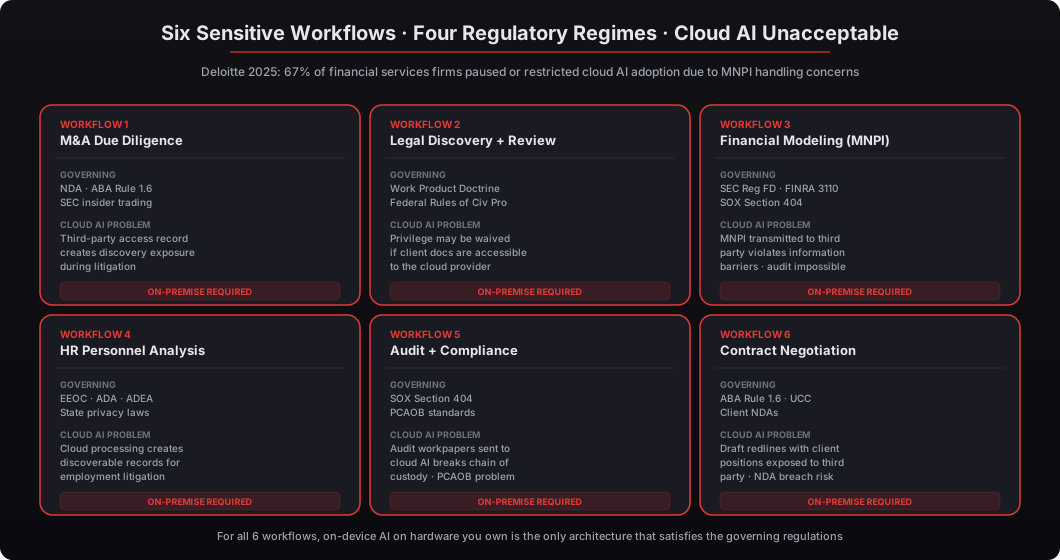
M&A Due Diligence demands confidentiality under NDA obligations, attorney-client privilege (when counsel is involved), and often SEC insider trading rules because the deal information is typically material nonpublic. A managing partner running deal documents through Claude’s API creates a third-party access record that opposing counsel can subpoena during subsequent litigation. On-device processing means the documents, prompts, and AI outputs exist only on hardware within the firm’s physical and legal control, with a clean chain of custody from input to output.
Legal Discovery and Document Review falls squarely under ABA Model Rule 1.6 (confidentiality) and the work product doctrine. According to Thomson Reuters’ 2025 Legal AI Report, 43% of Am Law 200 firms now use AI for document review — but only 18% allow cloud-based tools for matters involving privileged materials. The rest require on-premise or air-gapped deployments specifically because the privilege calculus is structural: the moment a third party can access client documents (even transiently during processing), privilege may be waived under the third-party doctrine.
Financial Modeling with MNPI triggers SEC, FINRA, and potentially CFTC oversight. When a CFO builds revenue projections using nonpublic pipeline data, that model contains information that could move stock prices. PwC’s 2025 AI in Financial Services report notes that 71% of audit committees now specifically ask about AI data handling in their quarterly reviews, and the question is no longer hypothetical. The audit committees want to know exactly where the model ran, what touched the data, and whether the chain of custody is intact — cloud AI answers all three questions wrong.
HR and Personnel Analysis involves PII, compensation data, performance reviews, and potential litigation-sensitive information. Running employee performance data through a cloud AI creates EEOC discovery exposure if any employment action is later challenged — the plaintiff’s counsel subpoenas the AI vendor and obtains a transcript of everything the AI saw. Baker McKenzie’s 2025 Employment AI Guidelines recommend on-premise processing for any AI analysis that informs hiring, promotion, or termination decisions. The risk isn’t bias in the AI output; it’s the discoverability of the input.
Audit and Compliance Review falls under SOX Section 404 (internal controls over financial reporting) and PCAOB standards for auditor independence and documentation. Audit workpapers sent to a cloud AI break the chain of custody that SOX requires — the auditor can no longer document where every piece of evidence went and who had access to it. PCAOB’s 2025 inspection guidance specifically flagged cloud AI as a risk area for audit quality.
Contract Negotiation involves draft redlines, client positions, and negotiation strategy — all of which are subject to attorney-client privilege and often to specific NDA obligations between the negotiating parties. Sending a draft redline containing the client’s fallback position to a cloud AI creates an access record that the opposing counsel could potentially discover in a dispute over the resulting contract. On-device processing keeps the negotiation analysis entirely within the firm’s controlled environment.
McKinsey’s 2025 report on AI adoption in professional services found that regulatory data handling requirements were the number-one barrier to AI deployment in law firms and financial institutions — ahead of cost, technical complexity, and talent shortages. The technical capability exists, but the compliance architecture doesn’t match, which is why on-device processing is the only path forward for these six workflow categories. See our broader analysis of private AI vs cloud AI for executives and the case for private AI in 2026.
How Are the Big 4 Accounting Firms Handling This?
Answer capsule. The Big 4 — Deloitte, PwC, EY, and KPMG — have each published internal AI governance frameworks, and they’re converging on the same conclusion: audit and advisory work involving client financials requires controlled AI environments. KPMG’s three-tier classification model (published Q1 2025) is becoming the de facto industry standard: Tier 1 (public data) can use any AI tool, Tier 2 (confidential) requires enterprise-grade cloud AI with contractual protections, Tier 3 (regulated/privileged) requires on-premise processing with no external data transmission. For legal and financial workflows involving client-privileged or MNPI data, Tier 3 is the only acceptable category — and Tier 3 is exactly what on-device AI delivers.
EY’s 2025 Global AI Policy mandates that any AI tool processing client financial data must operate within EY’s own infrastructure or a client-approved on-premise deployment. They explicitly prohibit the use of public cloud AI services (ChatGPT, Claude, Gemini) for audit workpapers. The rationale from their guidance: chain of custody and independent verification of internal controls. You can’t document internal controls over AI that runs on someone else’s infrastructure.
PwC built an internal AI platform called ChatPwC that runs within their own cloud infrastructure — not public APIs. But for their most sensitive engagements (think IPO audits, merger fairness opinions, contested tax positions), even ChatPwC isn’t enough. PwC’s 2025 guidance recommends client-site deployments where data never leaves the client’s physical environment. The reasoning: even PwC’s own cloud creates a transmission point that auditors can’t fully control in some client engagements.
KPMG’s AI governance framework, published in Q1 2025, introduced the three-tier classification for AI data handling that’s rapidly becoming the industry standard:
- Tier 1 (public data): Can use any AI tool including public cloud APIs. Covers marketing content, general research, publicly available information.
- Tier 2 (confidential): Requires enterprise-grade cloud AI with contractual protections, SOC 2 Type II certification, explicit data retention limits, and vendor DPAs. Covers internal company information, non-sensitive client work.
- Tier 3 (regulated/privileged): Requires on-premise processing with no external data transmission. Covers MNPI, privileged client matters, audit workpapers, regulated customer data, HR personnel records.
This three-tier model is rapidly becoming the industry standard across legal services, financial services, healthcare, and professional services broadly. Deloitte published a similar framework in mid-2025 with different tier names but identical logic. The convergence matters because it means the standard-setting bodies in each industry have independently arrived at the same architectural conclusion: on-premise is required for the sensitive category. See the GDPR, SOC 2, EU AI Act compliance walkthrough for the specific regulatory mapping.
Tier 3 is exactly what on-device AI delivers. When you run Ollama with Llama 3.1 70B on a Mac Mini that sits in your server room, the three conditions that define Tier 3 are all satisfied: processing happens on-premise (the Mac Mini is physically in your building), there is no external data transmission (Ollama runs locally, so inference calls never leave the machine), and the chain of custody is intact (the document goes in, the inference runs, the output comes out, all on the same piece of hardware under your direct control).
What Does a Practical On-Device Legal AI Workflow Look Like?
Answer capsule. The typical workflow is a 50-attorney firm running buy-side due diligence on a $200M acquisition with 4,000+ documents in the deal room. Without on-device AI, 400-600 billable hours at $450-$750/hour rates to manually review everything. With on-device AI on a beeeowl Mac Mini running Llama 3.1 70B through Ollama: documents get loaded into OpenClaw’s local pipeline, the agent classifies and extracts issues with citations, a structured diligence summary is generated with findings organized by risk category, and associates review the AI-generated flags instead of reading cold. At no stage does any document, prompt, or AI output leave the Mac Mini. Privilege is intact. NDA obligations are satisfied. No third-party data processor to disclose.
Let me walk through how a mid-market M&A deal actually works with on-device AI. This is a real workflow pattern we’ve deployed for clients, with the specifics anonymized.
The scenario: A managing partner at a 50-attorney firm is running buy-side due diligence on a $200M acquisition. The deal room contains 4,000+ documents — financial statements, material contracts, IP filings, employment agreements, environmental reports, litigation history, customer contracts, vendor agreements, insurance policies, real estate records, and regulatory filings. The client has signed an NDA. Several documents contain material nonpublic information that could constitute insider trading if it leaked. The deal has to close in 45 days.
Without on-device AI: Associates spend 3-4 weeks manually reviewing documents, flagging issues, and building a diligence memo. Senior associates review the flags. Partners review the memo. Total billable hours: 400-600 at blended rates of $450-$750 per hour. That’s $180,000 to $450,000 in review fees alone for the document-reading phase, and the work product is a partial review because nobody can read 4,000 documents thoroughly in three weeks while handling their other matters.
With on-device AI on a beeeowl Mac Mini deployment:
Step 1 — Document ingestion and classification. Documents are loaded into OpenClaw’s local document processing pipeline from the firm’s secure file share. The AI agent — running Llama 3.1 70B through Ollama on the Mac Mini M4 Pro — performs initial classification and issue spotting. Every document gets categorized (financial, legal, operational, regulatory, environmental, HR), and potential red flags get extracted with citations to specific clauses. See our running a private LLM with Ollama guide.
Step 2 — Structured diligence summary. The agent generates a structured diligence summary organized by risk category: financial red flags (e.g., “revenue recognition accelerated in Q3 2025 per Note 7 of the audited financials, p. 42”), legal issues (e.g., “ongoing trademark dispute with Competitor Corp per litigation summary p. 8”), operational concerns (e.g., “customer concentration — top 3 customers account for 52% of revenue per customer list p. 3”), regulatory matters (e.g., “EPA Notice of Violation dated 2024-06-15 for the Ohio facility per environmental report p. 12”), and HR exposures (e.g., “two former employees filed EEOC complaints in 2025 per employment records summary”). Each finding includes the source document, page number, clause text, and suggested follow-up questions.
Step 3 — Associate review and escalation. Associates review the AI-generated flags instead of reading 4,000 documents cold. They confirm, dismiss, or escalate each finding. The AI has already done the first pass, so the associates focus their time on the flagged items rather than on identifying what to flag. Senior associates review the high-severity findings and add their own analysis. Partners get a polished diligence memo in days instead of weeks.
Step 4 — Final memo assembly. The agent assembles the final memo from the confirmed findings, formatted to the firm’s standard template, with an executive summary for the partner and detailed appendices for the associates. The memo is ready for client delivery after partner review.
The critical compliance point: at no stage during any of the four steps does any document, prompt, or AI output leave the Mac Mini sitting in the firm’s server room. The entire inference chain — document ingestion, analysis, finding extraction, summary generation, and memo assembly — happens on local hardware running the local LLM through Ollama. Attorney-client privilege is intact because no third party ever accessed the client’s documents. The NDA obligations are satisfied because no document was transmitted outside the firm’s controlled systems. There’s no third-party data processor to disclose in the deal’s data flow documentation. The chain of custody from input (documents in the deal room) to output (diligence memo for the partner) is entirely within the firm’s physical and legal control.
According to LegalTech News’ 2025 survey, firms using on-premise AI for document review reported a 60-70% reduction in initial review time while maintaining the same accuracy rates as manual review. A workflow that took 3-4 weeks manually takes 4-6 days with on-device AI, and the partners can finally trust that the review is thorough because the AI actually read every document instead of the associates skim-reading the least important ones at 2am.
How Does beeeowl’s Deployment Actually Work for These Use Cases?
Answer capsule. beeeowl ships a Mac Mini M4 Pro with 24GB unified memory, preconfigured with OpenClaw, Docker sandboxing, and security hardening. The whole stack arrives ready to plug in and run. Every deployment includes one fully configured agent with authentication and Composio OAuth integration. For legal and financial workflows specifically, the $1,000 Private On-Device LLM add-on is what makes the difference: without it, OpenClaw routes reasoning through cloud APIs; with it, every inference call stays on the Mac Mini via Ollama running Llama 3.1 70B or Qwen 2.5 72B locally. The Mac Mini deployment is $5,000 with hardware included, plus $1,000 for the on-device LLM add-on, totaling $6,000 one-time for a fully sovereign AI infrastructure.
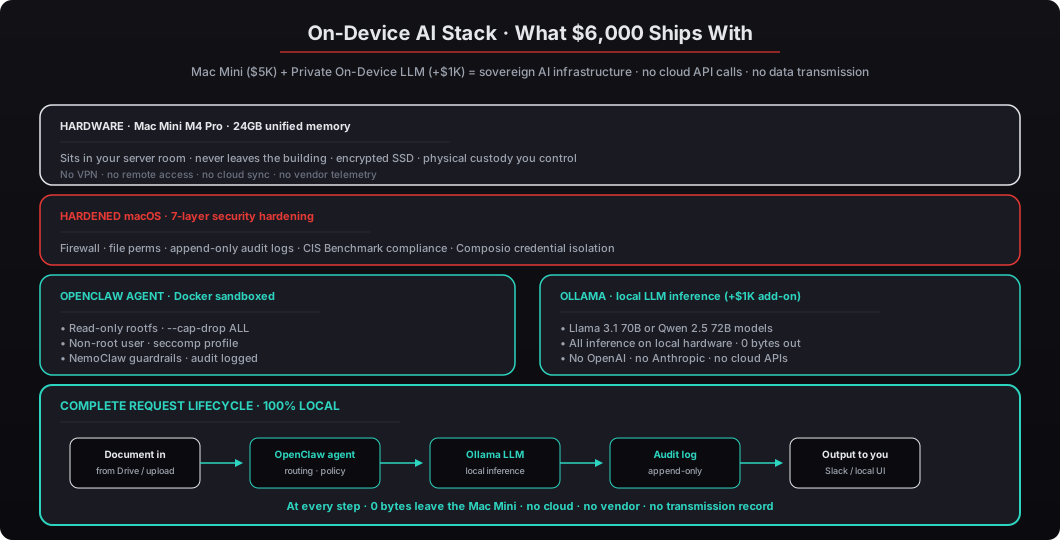
We ship a Mac Mini M4 Pro with 24GB unified memory, preconfigured with OpenClaw, Docker sandboxing, 7-layer security hardening, and (with the add-on) Ollama running your chosen local LLM. The whole stack arrives ready to plug in and run. The client plugs the Mac Mini into power and ethernet, connects through Slack or iMessage (or whatever Channel they chose), and sends the first message. Setup from the client’s perspective is under 15 minutes of plug-and-play.
For legal and financial workflows specifically, the $1,000 Private On-Device LLM add-on is what makes the difference. Without it, OpenClaw routes reasoning through cloud APIs (Claude Sonnet 4.5, GPT-4o, or Gemini) which is fine for non-privileged workflows but fails the Tier 3 compliance standard. With the add-on, we install Ollama, pull models optimized for document analysis (typically Llama 3.1 70B for general work or Qwen 2.5 72B for workflows involving large context windows), and configure OpenClaw to route all inference calls through the local models running on the Mac Mini. Every prompt stays local. Every response stays local. Every intermediate reasoning step stays local. There is no cloud API call at any point in the request lifecycle.
The Mac Mini deployment is $5,000 with hardware included. Add the $1,000 Private On-Device LLM add-on and you have a fully sovereign AI infrastructure for $6,000 total — one-time cost, no subscription, no recurring fees. For firms with multiple partners or executives who each need their own agent, additional agents are $1,000 each. A five-partner firm running on-device AI for deal work comes in at $10,000 total for the whole team. Compare that to a single associate’s monthly billing at a major firm — you’ve paid back the deployment in the first billable hour saved across the team.
The MacBook Air option at $6,000 (plus $1,000 for Private On-Device LLM = $7,000 total) gives traveling partners portable AI infrastructure with the same data sovereignty guarantees. A managing partner reviewing deal terms at a client’s office doesn’t need to VPN back to the firm’s servers; the LLM runs on the MacBook Air sitting in front of them. The documents stay on the laptop’s encrypted SSD. Even on airport WiFi — which should always be assumed compromised — the AI processing happens entirely locally. Gartner’s 2025 report on mobile enterprise AI noted that 29% of professional services firms were evaluating portable on-device AI deployments, up from under 5% the year before. The driver wasn’t convenience; it was the realization that remote work created new data exposure vectors that VPNs alone couldn’t solve.
What’s the Real Risk of Getting This Wrong?
Answer capsule. The consequences aren’t theoretical. In 2024, a Samsung semiconductor division accidentally leaked proprietary chip designs through ChatGPT prompts — the incident led to a company-wide ban on external AI tools. In legal services, the stakes include malpractice liability, ABA Rule 1.1 (competence) violations, client confidentiality breaches, and privilege waiver that opposing counsel can exploit in subsequent litigation. FINRA fined broker-dealers $200K to $1.2M in 2024-2025 for inadequate supervision of AI tools processing customer data. The SEC’s 2025 examination priorities explicitly include AI-related risks, and Commissioner Peirce noted in a February 2026 speech that firms should expect AI data governance to be a standard examination topic going forward. Getting this wrong doesn’t just mean a technology failure — it means regulatory action, fines, litigation exposure, and professional consequences.
The Samsung precedent. In April 2024, a Samsung semiconductor division discovered that engineers had been pasting proprietary chip designs into ChatGPT for debugging help. The code was then available to OpenAI’s systems — not because OpenAI did anything wrong, but because that’s how cloud chatbots work. The prompt is processed on the vendor’s infrastructure. Samsung responded by banning ChatGPT enterprise-wide within two weeks. The incident became a defining moment for how regulated industries think about cloud AI and data sovereignty. JPMorgan Chase, Apple, Goldman Sachs, Citigroup, and Bank of America all restricted employee access to cloud AI tools that same year citing similar concerns.
The ABA’s Standing Committee on Ethics and Professional Responsibility has made it clear: the duty of competence under Rule 1.1 now includes understanding how technology tools handle client data. A partner who approves cloud AI for privileged documents without understanding the data flow isn’t just making a technology mistake — they’re potentially breaching their ethical obligations. State bar associations are beginning to issue disciplinary actions for lawyers who used cloud AI with privileged data without appropriate safeguards, though the exact contours of liability are still developing through case law.
FINRA fined several broker-dealers in 2024-2025 for inadequate supervision of AI tools that processed customer data. The fines ranged from $200,000 to $1.2 million. The common finding across cases: firms lacked documented controls over how AI systems handled regulated information, and couldn’t produce evidence of who had accessed the data during the AI processing workflow. The supervisory failure wasn’t that the AI did something wrong; it was that the firms couldn’t prove the AI had done everything right.
The SEC’s 2025 examination priorities explicitly include “AI-related risks in investment management and broker-dealer operations,” with specific attention to data handling practices. SEC Commissioner Hester Peirce noted in a February 2026 speech that firms should expect AI data governance to be a standard examination topic going forward. The practical implication: within the next 12-18 months, SEC examiners will start asking AI data handling questions during routine examinations, and firms that can’t answer clearly will face enforcement referrals.
The personal professional consequences matter too. For a managing partner or CFO personally approving AI deployments, getting this wrong can mean personal liability, regulatory sanctions against the individual (not just the firm), and professional reputation damage that outlasts the specific incident. See our walkthrough of AI agent liability: who pays when it goes wrong and AI insurance exclusions in D&O policies for the specific liability structures that have left executives personally exposed.
How Do You Start Moving Sensitive Workflows On-Device?
Answer capsule. Start with the workflows that carry the highest regulatory exposure. For most firms, that’s M&A due diligence and financial modeling with MNPI. These workflows have clear regulatory requirements, measurable time savings, and the strongest case for on-premise infrastructure. Don’t try to move everything at once — run a pilot with one deal or one modeling project, measure the time savings, document the compliance posture, and let the results make the case for broader adoption. Every beeeowl deployment includes one year of monthly mastermind access where clients share workflow patterns, integration strategies, and compliance approaches, so you’re not figuring this out alone.
The practical rollout pattern we recommend:
-
Pick one workflow with clear regulatory exposure — usually M&A due diligence for law firms or MNPI-containing financial modeling for CFOs and finance teams. The regulatory clarity gives you an unambiguous answer to “should we use cloud AI here” (no), which simplifies the decision-making process.
-
Deploy the Mac Mini tier with the Private On-Device LLM add-on — $6,000 one-time total. This is the minimum viable configuration for Tier 3 compliance.
-
Run a pilot with one matter — a single M&A deal, a single quarterly model update, a single audit engagement. Measure hours saved, document the compliance posture, and capture the chain-of-custody evidence that makes future audits easy.
-
Expand based on pilot results — after the first pilot succeeds, add a second workflow (contract review, HR analysis, audit support), then a third. Each new workflow reuses the same infrastructure with different Skills configured.
-
Document everything for the compliance audit — keep a running log of which workflows use on-device processing, what data classification they handle, and what evidence you have of the chain of custody. When the SEC examiner or ABA ethics committee asks, you have answers ready.
Every beeeowl deployment includes one year of monthly mastermind access — group Q&A calls where clients share workflow patterns, integration strategies, and compliance approaches. You’re not figuring out Tier 3 compliance alone; you’re part of a community of firms working through the same questions at the same time. The mastermind is where the gnarly questions get answered: “How do I document the chain of custody for the SOX auditor?” “What’s the right way to set up the deal room ingestion pipeline?” “How do I prove to the ABA ethics committee that no third party accessed the privileged documents?”
The firms that move first will set the standard. The firms that wait will spend more time explaining to regulators why they didn’t. IDC’s 2026 AI Governance Forecast projects that 60% of enterprises will face a regulatory audit of their AI systems by end of 2027 — which means the choice between “deploy on-device now” and “wait and see” is really a choice between “be ready when the examiner arrives” and “scramble to build a compliance story after the fact.” Request your deployment at beeeowl.com.
Related reading — for the broader picture, see the case for private AI in 2026, GDPR, SOC 2, and EU AI Act compliance for AI agents in 2026, private AI vs cloud AI for executives, running a private LLM with Ollama to keep data off the cloud, and AI agents for managing partners handling profitability and conflict checking.