OpenClaw vs ChatGPT vs Claude: What Executives Actually Need to Know
ChatGPT and Claude are chatbots you talk to. OpenClaw is a self-hosted agent that works 24/7. Here's the real comparison — data sovereignty, cost, autonomy — for CEOs and CTOs making this decision.
What’s the Fundamental Difference Between OpenClaw, ChatGPT, and Claude?
ChatGPT and Claude are cloud chatbots you interact with in a browser — you ask a question, they respond, and when you close the tab, they stop working. OpenClaw is a self-hosted AI agent that runs 24/7 on hardware you own, autonomously monitoring your email, CRM, calendar, and Slack without waiting for instructions.

That’s not a subtle distinction. It’s the difference between hiring a consultant you call when you have a question and hiring a full-time employee who shows up every day, handles their tasks, and reports back.
According to McKinsey’s 2025 State of AI report, companies deploying autonomous AI agents see 28% reductions in executive administrative time within 90 days. Chatbots don’t deliver that — because they only work when you’re actively using them. OpenClaw works while you sleep, while you’re in meetings, and over the weekend — see why the distinction between agents and chatbots matters.
When Should You Use ChatGPT or Claude Instead?
ChatGPT and Claude are the right tools for ad-hoc thinking — brainstorming, research, drafting, analysis, and one-off questions. If you need to ask “summarize this 50-page report” or “what are the tax implications of this deal structure,” a chatbot is exactly what you want.
OpenAI’s ChatGPT has 800 million weekly active users as of early 2026. Anthropic’s Claude has become the preferred tool for developers and researchers who value precision. Both are excellent at what they do.
But here’s the gap: you have to initiate every interaction. You open the tab, type the prompt, review the output, and take action yourself. Multiply that across email triage, CRM updates, competitive monitoring, and meeting prep — and you’re spending hours per week doing work that an autonomous agent handles without being asked.
The practical answer for most executives we deploy for: use ChatGPT or Claude for thinking. Use OpenClaw for doing.
Where Does Your Data Actually Go?
With ChatGPT Enterprise ($60 per user per month), your prompts travel to OpenAI’s servers in the United States. OpenAI states they don’t train on Enterprise data, but your information is still processed on infrastructure you don’t control. With Claude, data routes through Anthropic’s cloud, subject to their data retention policies.
With OpenClaw deployed privately, your data never leaves hardware you physically own. Your board communications, deal terms, investor updates, and financial models stay on a Mac Mini in your office or a dedicated VPS that only you access. We go deeper in private AI vs cloud AI. We make the business case in the case for private AI.
According to Gartner’s 2025 AI Infrastructure Report, 67% of enterprises with sensitive data now require on-premises AI deployment — up from 34% in 2023. For C-suite executives handling material nonpublic information, this isn’t a preference. It’s a compliance requirement in many industries. See our comparison of OpenClaw vs enterprise AI platforms.
The Samsung incident in 2023 — where engineers accidentally leaked proprietary source code through ChatGPT — demonstrated the risk concretely. JPMorgan Chase, Apple, and Goldman Sachs all restricted employee access to cloud AI tools that same year. Private deployment eliminates that entire category of risk.
How Do the Costs Actually Compare?
ChatGPT Enterprise costs $60 per user per month. Microsoft Copilot runs $30 per user per month. Both are recurring — they never stop billing. For a 5-person executive team on ChatGPT Enterprise, that’s $3,600 per year. Every year. Forever.
OpenClaw itself is free — it’s open-source software. A production-grade deployment through beeeowl costs $2,000 one-time for hosted setup, $5,000 with a Mac Mini included, or $6,000 with a MacBook Air for executives who travel. No per-user monthly fees. No recurring charges.
| Platform | Cost Model | Annual Cost (1 User) | Annual Cost (5 Users) | Data Location |
|---|---|---|---|---|
| ChatGPT Enterprise | $60/user/month | $720 | $3,600 | OpenAI’s cloud |
| Microsoft Copilot | $30/user/month | $360 | $1,800 | Microsoft Azure |
| Claude Team | $30/user/month | $360 | $1,800 | Anthropic’s cloud |
| OpenClaw (beeeowl Hosted) | $2,000 one-time | $2,000 | $2,000 + $1,000/extra agent | Your infrastructure |
| OpenClaw (beeeowl Mac Mini) | $5,000 one-time | $5,000 | $5,000 + $1,000/extra agent | Your hardware |
According to Harvard Business Review’s 2025 analysis, companies adopting infrastructure early achieve 31% lower total cost of ownership versus late adopters. The one-time model compounds that advantage — by year two, OpenClaw’s cost is effectively zero while ChatGPT Enterprise keeps billing.
What Can OpenClaw Do That Chatbots Can’t?
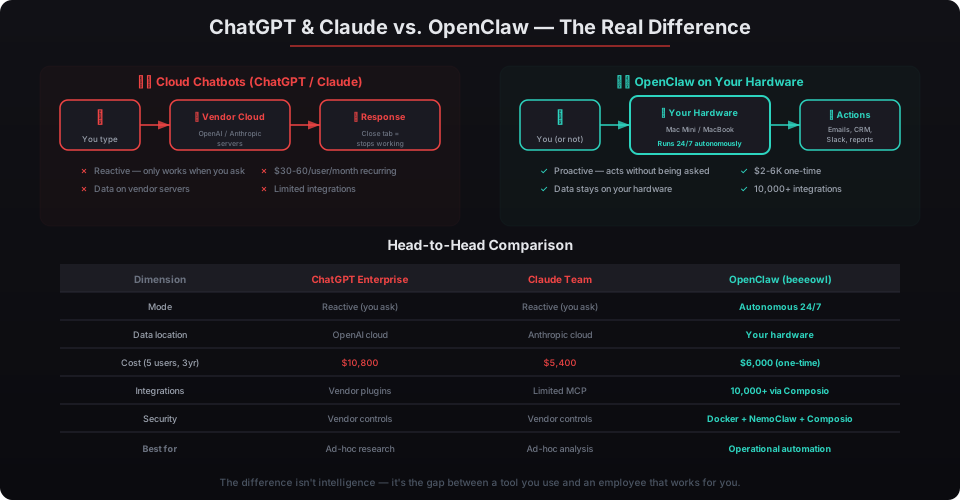
OpenClaw takes autonomous action across your connected tools. It doesn’t wait for you to open a tab and type a prompt. Through Composio integrations, it connects to 10,000+ applications and acts on them continuously.
Here’s what an OpenClaw agent does in a typical day that ChatGPT and Claude cannot:
- Checks email every 30 minutes — drafts responses, flags urgent items, archives noise
- Sends a morning briefing at 9 AM — your schedule, attendee backgrounds, talking points
- Updates CRM after meetings — logs notes, moves deals through pipeline stages
- Monitors Slack — surfaces messages that need your attention, filters the rest
- Tracks competitors — flags press releases, funding announcements, leadership changes
ChatGPT can draft an email if you paste the context and ask. OpenClaw reads your inbox, identifies what needs a response, drafts it, and waits for your approval to send — all before you’ve opened Gmail.
According to Accenture’s 2025 Technology Vision report, 83% of C-suite executives plan to deploy AI agents within 18 months. The shift from chatbots to agents is the shift from “tool I use” to “employee that works for me.”
What About Security and Privacy?
This is where the comparison gets stark. ChatGPT Enterprise and Claude both process your data in their respective clouds. OpenAI and Anthropic are reputable companies with strong security practices. But “reputable” and “you own the server” are different security postures.
OpenClaw deployed privately through beeeowl includes Docker sandboxing, Composio credential isolation, firewall hardening, and full audit trails. NVIDIA’s NemoClaw enterprise reference design — built specifically for corporate OpenClaw deployments — adds policy guardrails and privacy routing. According to NVIDIA’s documentation, NemoClaw addresses 8 of the OWASP Top 10 AI security risks.
Jensen Huang said it directly at Computex 2025: “Agentic systems in the corporate network can have access to sensitive information, execute code, and communicate externally. Obviously, this can’t possibly be allowed” — without proper guardrails. NemoClaw is NVIDIA’s answer to that problem.
For executives handling M&A data, investor communications, or board materials, the calculus is straightforward: private deployment means your data never touches a third party’s infrastructure. Period.
Which Should You Choose?
Don’t choose one. Use the right tool for each job.
Use ChatGPT or Claude for ad-hoc research, brainstorming, document analysis, and one-off questions. They’re excellent at interactive thinking — and they’re getting better every quarter. OpenAI, Anthropic, and Google are all investing billions in making their chatbots smarter.
Use OpenClaw for operational automation — the recurring tasks that eat your calendar every week. Email triage. CRM hygiene. Investor updates. Competitive monitoring. Meeting prep. Board deck assembly. These are workflows that follow patterns, and an autonomous agent handles them better than a chatbot you have to prompt manually.
According to Andreessen Horowitz’s 2025 AI market analysis, 60% of current SaaS workflows will be partially or fully automated by AI agents within three years. The companies deploying OpenClaw now are building institutional knowledge about which workflows work best — knowledge that compounds weekly.
The real question isn’t “OpenClaw or ChatGPT?” It’s: “Which of my recurring tasks should an autonomous agent handle, and which still need a human in the loop?” Start with one workflow. Deploy on hardware you own. Measure hours saved. Expand from there.