OpenClaw vs Enterprise AI Platforms: Why Open Source Wins for Executive AI Agents
Microsoft Copilot, Salesforce Einstein, and Google Gemini cost $5,400-$18,000 over three years per 5-person team. OpenClaw via beeeowl is $2,000-$9,000 one-time. IDC found 72% of enterprises face 6-18 months of migration lock-in. Open source wins on cost, sovereignty, integration breadth, and exit.

Forrester’s 2025 Enterprise AI Adoption Survey found that 58% of organizations now prioritize open-source AI frameworks over proprietary platforms — up from 31% in 2023. IDC’s 2025 Vendor Lock-In Impact Study tracked the flip side: 72% of enterprises face 6-18 months and $500,000 to $2 million to switch between enterprise AI platforms once they’re embedded. Gartner’s 2025 Market Guide for AI Agent Platforms projects the category will reach $47 billion by 2028. That’s $47 billion in recurring fees extracted from companies that chose convenience over control. This article is the head-to-head comparison of OpenClaw against Microsoft Copilot, Salesforce Einstein, Google Gemini for Workspace, and ServiceNow AI Agents — on cost, customization, data sovereignty, integration breadth, and exit cost. The verdict isn’t subtle.
Why are CTOs abandoning enterprise AI platforms for open source?
Because enterprise AI platforms promised turnkey intelligence and delivered per-seat billing, walled gardens, and customization limited to dropdown menus. Open-source AI agents like OpenClaw give executive teams full control over their data, integrations, and costs — without asking permission from a vendor’s product team every time something needs to change. The shift isn’t ideological. It’s economic and strategic, and the evidence is in the deployment numbers.
I’ve evaluated every major enterprise AI platform over the past 18 months. Microsoft Copilot, Salesforce Einstein, Google Duet AI (now Gemini for Google Workspace), ServiceNow AI Agents — we tested all of them before building beeeowl’s deployment practice around OpenClaw. Here’s why open source won on our evaluation, why it’s winning on Forrester’s industry-wide survey data, and why it’ll win for your team too if you’re honest about the three-year total cost of ownership and the exit cost.
According to Forrester’s 2025 Enterprise AI Adoption Survey, 58% of organizations now prioritize open-source AI frameworks over proprietary platforms — up from 31% in 2023. The shift accelerated in 2025 specifically because the vendor-lock-in pattern that defined the 2015-2020 SaaS era became visible in AI platforms over a much shorter timeline. OpenAI revised terms three times in 2025. Anthropic banned consumer OAuth in January 2026. Google hiked Gemini pricing 40-60% in Q1. Microsoft bundled Copilot into E5 tiers. In one year, every major cloud AI vendor demonstrated exactly the lock-in behavior CTOs had been warned about, and the response was a stampede toward open-source alternatives.
What do enterprise AI platforms actually cost over three years?
The sticker price is misleading. Microsoft Copilot looks affordable at $30 per user per month. But that price assumes you’re already paying for Microsoft 365 E3 or E5 licensing — which runs $36 to $57 per user per month depending on tier. Copilot is an add-on to an add-on, and Microsoft has been progressively bundling it into the higher-tier licenses so that escaping the add-on fee increasingly means upgrading to a more expensive base license.
Here’s what the platforms actually cost for a 5-person executive team over three years, based on published pricing at each vendor as of Q1 2026:
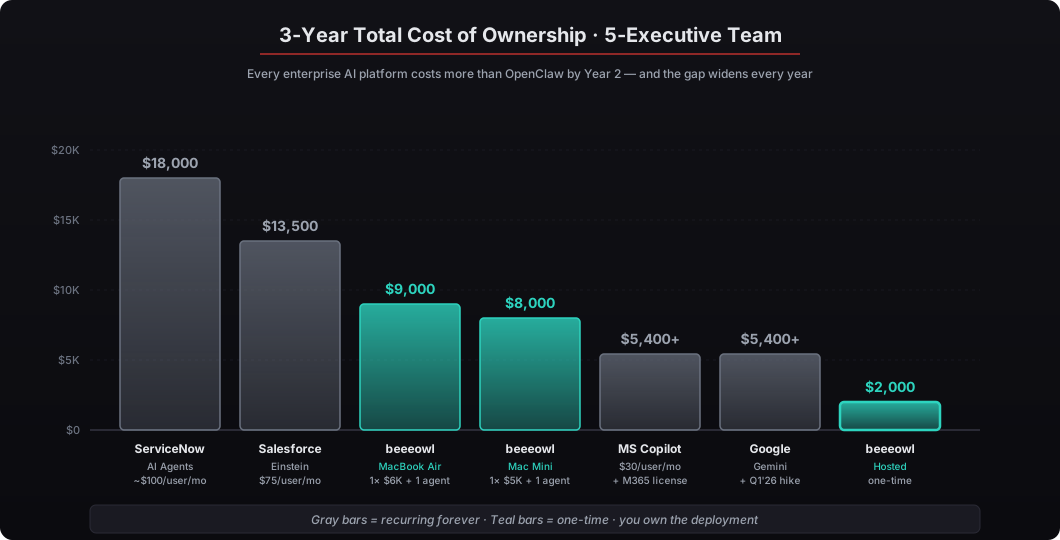
| Platform | Per-User Monthly Cost | Annual Cost (5 Users) | 3-Year Total | Data Location | Open Source |
|---|---|---|---|---|---|
| ServiceNow AI Agents | ~$100/user/month | $6,000 | $18,000 | ServiceNow Cloud | No |
| Salesforce Einstein | $75/user/month | $4,500 | $13,500 | Salesforce Cloud | No |
| beeeowl MacBook Air | One-time + $1K extra agents | $9,000 one-time | $9,000 total | Your hardware | Yes |
| beeeowl Mac Mini | One-time + $1K extra agents | $8,000 one-time | $8,000 total | Your hardware | Yes |
| Microsoft Copilot | $30/user/month (+ M365 base) | $1,800+ | $5,400+ | Microsoft Azure | No |
| Google Gemini for Workspace | $30/user/month (+ Workspace, post-hike) | $1,800+ | $5,400+ | Google Cloud | No |
| beeeowl Hosted | One-time | $2,000 one-time | $2,000 total | Your infrastructure | Yes |
By Year 2, every enterprise platform has already cost more than a full beeeowl deployment — including the most expensive beeeowl tier with hardware included. By Year 3, you’re paying 2-3x what you’d spend on OpenClaw, and you still don’t own anything. You’ve rented access to someone else’s infrastructure and agreed to someone else’s terms, and the vendor holds all the leverage on renewal.
Gartner’s 2025 Market Guide for AI Agent Platforms projects the enterprise AI platform market will reach $47 billion by 2028. That’s $47 billion in recurring fees extracted annually from companies that chose convenience over control. If you’re running the math for a board, those forty-seven billion dollars are the addressable savings for open-source alternatives — and Forrester’s 58% open-source adoption figure suggests a meaningful share of that number is already shifting.
How deep does vendor lock-in actually go?
Vendor lock-in with enterprise AI isn’t just about switching costs. It’s about how deeply these platforms embed into your operations until leaving becomes functionally impossible — and that depth is baked into the product design intentionally. Proprietary AI platforms are built to make your team’s daily workflow unusable without them.
Salesforce is the textbook example. In 2024, Salesforce raised API call pricing by 40% and tightened rate limits across multiple tiers — impacting companies that had built years of workflow automation on the platform. Customers who had customized Einstein extensively faced a choice: absorb the increase or spend months rebuilding on something else. Most absorbed the increase, because the cost of rebuilding exceeded the cost of paying the higher rates. That’s not an accident. That’s pricing power from a vendor who knows the customer can’t leave.
Microsoft followed the identical playbook. When Copilot launched, it was positioned as a $30 add-on. By late 2025, Microsoft had begun bundling Copilot into E5 licensing tiers, effectively making it harder to purchase Microsoft 365 without it. Enterprises already on the Microsoft stack had limited negotiating power because every adjacent product — Teams, SharePoint, OneDrive, Dynamics, Power Platform — reinforces the dependency on the core subscription. Microsoft’s own FY2025 earnings call noted that average revenue per enterprise customer increased 23% year-over-year. That’s not growth from new customers. That’s existing customers paying more because they can’t easily leave.
Anthropic and Google demonstrated the same pattern in 2026. Anthropic revoked consumer OAuth access on January 14, 2026, breaking 15,000-20,000 active installations overnight — we covered the incident in why Anthropic banned consumer OAuth. Google raised Gemini API pricing 40-60% in Q1 2026 and added the “Agent Tier” enrollment requirement in October 2025. Both companies moved the lock-in mechanism earlier in the customer relationship — at the credential layer, not just the pricing layer.
According to IDC’s 2025 Vendor Lock-In Impact Study, 72% of enterprises report that switching AI platforms would take 6 to 18 months and cost between $500,000 and $2 million in migration expenses. That’s not a technology problem. That’s a business model working exactly as designed. The switching cost is the product.
OpenClaw eliminates this entirely. It’s Apache 2.0 licensed. You can fork it, modify it, host it anywhere, and switch LLM providers at will. There’s no contract with renewal leverage. There’s no account manager calling to discuss your “expanded commitment.” There’s no proprietary workflow syntax that locks your automation into one vendor’s runtime. If beeeowl disappeared tomorrow, your OpenClaw deployment would keep running exactly as configured, because the deployment runs on hardware you own and the software is open-source. Try running that thought experiment with Salesforce Einstein.
What does customization look like — enterprise platforms vs OpenClaw?
Enterprise AI platforms give you configuration. OpenClaw gives you code. That distinction sounds abstract until you hit the first workflow the platform doesn’t support, at which point the difference becomes the entire evaluation.
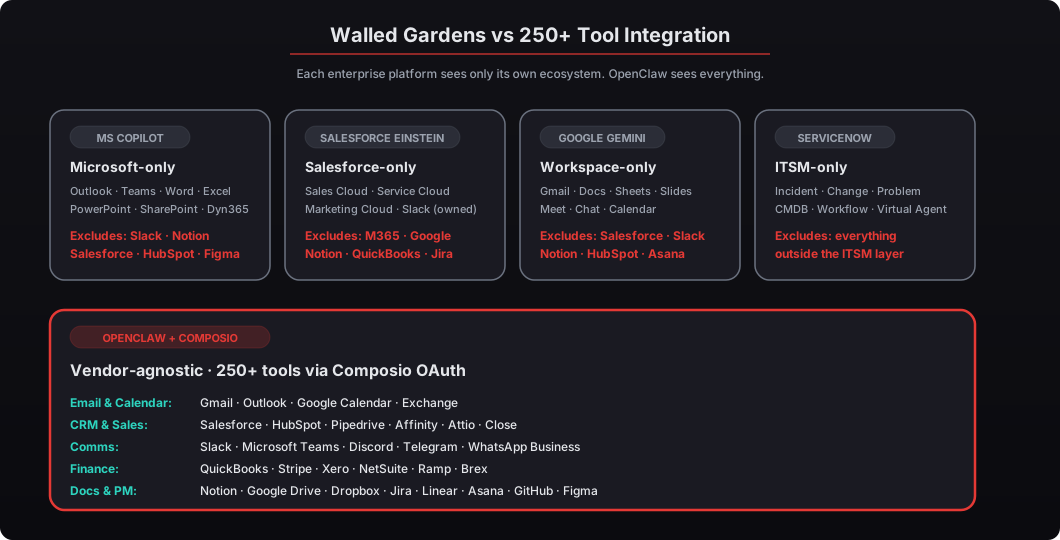
Microsoft Copilot lets you adjust which Microsoft Graph data sources it accesses and create “Copilot agents” through Copilot Studio. But you’re limited to Microsoft’s approved connectors, Microsoft’s prompt framework, and Microsoft’s LLM (GPT-4 variants via Azure OpenAI Service — and only those variants Microsoft has approved for production). You can’t swap in a different model. You can’t build a custom skill that Microsoft hasn’t anticipated. You can’t run it on your own infrastructure. Copilot Studio’s “agent” is a template with configurable knobs, not an actual programmable agent runtime.
Salesforce Einstein operates identically within the Salesforce ecosystem. Einstein Copilot connects to Salesforce objects — Leads, Opportunities, Cases, Accounts — and lets you build “actions” within Salesforce Flow. But if your workflow touches tools outside Salesforce, you’re integrating through MuleSoft (another Salesforce product, starting at $1,250/month), through Apex custom code that still runs on Salesforce’s servers, or through unsupported third-party plugins. Einstein Studio’s customization surface is bounded by what Salesforce’s product team has decided to expose.
Google Gemini for Workspace is even more constrained. It works across Google Workspace — Gmail, Docs, Sheets, Slides, Meet, Chat — and that’s essentially it. Cross-platform automation requires Google Cloud Functions, Vertex AI, or AppSheet, each of which adds engineering investment disproportionate to the value. And the core Gemini agent in Workspace is a fixed feature set you cannot extend. For a structured framework on when to pick cloud vs private, see our cloud AI APIs vs private AI infrastructure decision framework.
ServiceNow AI Agents are powerful within IT Service Management workflows but tightly scoped to ServiceNow’s platform. Extending them beyond ITSM requires the Vancouver release or later and substantial custom development through Flow Designer or IntegrationHub. Every extension reinforces the dependency on ServiceNow’s runtime.
OpenClaw, by contrast, connects to 250+ applications through Composio integrations natively. You can build agents that span Gmail, Salesforce, Slack, HubSpot, Notion, Jira, QuickBooks, Stripe, LinkedIn, GitHub, and dozens more — in a single workflow. You choose the LLM: GPT, Claude, Llama, Mistral, Qwen, DeepSeek, or a fully private on-device model through Ollama. You modify agent behavior at the code level, not through a vendor’s configuration UI. You add custom skills in Python without asking anyone for permission. See our comparison of OpenClaw vs ChatGPT vs Claude.
According to a 2025 O’Reilly Technology Radar report, 64% of AI teams cite customization limitations as their primary frustration with enterprise AI platforms. The platforms solve 80% of the use case out of the box — but it’s the last 20% that matters for executive workflows, because the last 20% is always the part that differentiates one business from another. Dropdown menus don’t differentiate.
Where does your data actually live?
This is the question that should end every enterprise AI platform evaluation for C-suite teams that handle sensitive information. The answers are worth writing out explicitly because the marketing pages make them sound softer than they are.
With Microsoft Copilot, your prompts and responses flow through Azure OpenAI Service. Microsoft’s data processing addendum covers it, but your board communications, deal terms, and financial models are processed on infrastructure shared with millions of other tenants. Microsoft’s trust boundary, not yours. When the Midnight Blizzard breach hit Microsoft’s own corporate email in January 2024, it demonstrated that Microsoft’s security perimeter is a real target for well-resourced adversaries — and your Copilot data shares that perimeter.
With Salesforce Einstein, data processes within Salesforce’s multi-tenant cloud. Your CRM data, pipeline forecasts, and customer intelligence run on Salesforce servers. The Einstein Trust Layer provides some guardrails — data masking, prompt injection defense, PII scanning — but the data still leaves your control and is processed by Salesforce’s infrastructure under Salesforce’s policies.
With Google Gemini for Workspace, data routes through Google Cloud Platform. For companies already deeply invested in Google Workspace, the data is already “in Google.” But for executive-level communications — M&A discussions, investor negotiations, compensation decisions, legal strategy — “it’s already in Google” is not a compelling security argument, especially under the EU AI Act’s Article 10 data governance requirements.
With ServiceNow, data lives in the ServiceNow cloud. Same shared infrastructure story, same trust boundary issues, with the additional wrinkle that ServiceNow’s per-tenant isolation has been the subject of multiple security advisories over the past three years.
With OpenClaw deployed by beeeowl, data stays on hardware you physically control. A Mac Mini sitting in your office. A MacBook Air you carry with you. A dedicated VPS that only your team accesses. No multi-tenant cloud. No third-party processing. No trust boundary beyond your own. Composio handles credential management through a vault that the agent never sees, and NVIDIA’s NemoClaw provides enterprise security reference architecture including Docker sandboxing, audit logging, and role-based access control.
Gartner’s 2025 AI Security and Risk Management Survey found that 71% of organizations handling regulated data now require dedicated infrastructure for AI workloads. For executives dealing with SEC filings, MNPI, or attorney-client privileged information, this isn’t a preference. It’s a governance requirement that cloud AI platforms structurally cannot meet. The Samsung cloud AI leak in 2023 forced JPMorgan Chase, Apple, Goldman Sachs, and Amazon to restrict cloud AI access, and those restrictions have only expanded since. Private deployment isn’t a paranoid choice anymore. It’s the default for organizations that take data governance seriously.
Why did Jensen Huang compare OpenClaw to Linux?
At NVIDIA GTC 2025, Jensen Huang made a statement that reframed how the industry thinks about AI infrastructure. He compared OpenClaw to Linux — an open-source platform that became the foundation everything else runs on. The comparison wasn’t casual. It was a deliberate signal about where NVIDIA sees the AI infrastructure stack heading, and it aligns with exactly the investment NVIDIA is making through NemoClaw and their active contributions to OpenClaw’s security codebase.
That comparison matters because Linux didn’t win by being the easiest option. Solaris was easier in 2002. Windows NT was better-supported. Linux won because it was the most adaptable, the most inspectable, and the most ownable. Red Hat built a billion-dollar business around enterprise Linux support without ever owning the code. Canonical did the same with Ubuntu. SUSE, IBM, Google, Amazon, and dozens of other companies built differentiated value on top of the shared open-source foundation. None of them could have done that with a proprietary operating system.
OpenClaw is following the same trajectory. NVIDIA actively contributes engineers to OpenClaw’s security layer through NemoClaw. The NemoClaw enterprise reference design provides a production-grade deployment blueprint with Docker sandboxing, audit logging, policy guardrails, and credential isolation. Companies like beeeowl build deployment and hardening services on top of the shared open-source foundation. The enterprise AI platforms — Copilot, Einstein, Gemini for Workspace, ServiceNow AI Agents — are the proprietary alternatives. They’re the equivalent of choosing Sun Microsystems’ Solaris over Linux in 2002. Powerful, well-supported, and ultimately a dead end for organizations that needed flexibility.
Forrester’s 2026 Open-Source AI Predictions report estimates that 70% of production AI agents will run on open-source frameworks by 2028. The enterprise platforms will still exist — just like Solaris still exists — but they won’t be where the innovation happens. And they won’t be where the cost savings happen either.
What’s the real risk of choosing an enterprise platform today?
The risk isn’t that Microsoft Copilot or Salesforce Einstein won’t work. They will. Both products solve real problems for their respective ecosystems. The risk is that they’ll work just well enough to make you dependent, and then the economics shift in ways you can’t escape without the 6-18 month migration and $500K-$2M rebuild that IDC documented.
Consider the pattern across the last three years. Salesforce acquired Slack for $27.7 billion in 2021 and has steadily integrated it into the Salesforce platform bundle. If you’re using Einstein and Slack and Service Cloud, separating any one piece becomes a multi-quarter project that your engineering team will dread. That’s by design — every additional integration point increases the cost of leaving.
Microsoft’s approach is identical. Teams, Copilot, Azure OpenAI Service, Dynamics 365, Power Platform, Fabric — each product creates a dependency on the others. According to Microsoft’s own FY2025 earnings call, average revenue per enterprise customer increased 23% year-over-year. That’s not growth from new logos. That’s existing customers spending more because they can’t easily leave. The Copilot E5 bundling in late 2025 was a continuation of this strategy: tie the new AI product to an existing license tier so that customers who want to opt out of the AI have to opt out of their core productivity suite.
Google Workspace’s ecosystem is smaller but follows the same logic. Gemini is deeply embedded in Gmail, Docs, and Sheets. Once your executive team relies on AI-generated email drafts and document summaries, migrating to a different platform means retraining everyone’s workflow — and the training cost often exceeds the licensing cost savings.
ServiceNow’s lock-in is arguably the deepest because ServiceNow sits on top of your ITSM workflows, your CMDB, your change management, your incident response, and (with AI Agents) your IT support tier. Leaving ServiceNow means rebuilding the operational runbook of your entire IT organization.
With OpenClaw, there’s no expanding bundle to absorb. The software is open-source under Apache 2.0. Your deployment runs on infrastructure you control. If beeeowl disappeared tomorrow, your OpenClaw agent would keep running exactly as configured because the code is on your machine and the integrations are in Composio’s OAuth framework. Try that thought experiment with Salesforce Einstein or Microsoft Copilot. The thought experiment won’t compile.
How does integration breadth actually compare?
Enterprise platforms optimize for depth within their ecosystem and treat everything outside as secondary. That’s a rational product decision for the vendor, but it doesn’t map to how modern enterprises actually work — because modern enterprises use 130+ SaaS applications spanning every major ecosystem at once.
Microsoft Copilot integrates deeply with the Microsoft 365 suite — Outlook, Teams, Word, Excel, PowerPoint, SharePoint, OneDrive, OneNote. It also connects to Dynamics 365 and Power Platform. But connecting Copilot to Salesforce, HubSpot, Notion, or Linear requires Microsoft Power Automate (additional cost and complexity), Azure Logic Apps, or third-party middleware that the Microsoft security team has to review individually.
Salesforce Einstein integrates deeply with Salesforce CRM, Service Cloud, Marketing Cloud, and Commerce Cloud. Connecting to non-Salesforce tools requires MuleSoft (starting at $1,250/month for the entry tier), custom Apex development, or third-party AppExchange plugins that add their own security and review burden.
Google Gemini for Workspace covers Gmail, Docs, Sheets, Slides, Meet, and Chat. Extensions to non-Google tools require AppSheet, Google Cloud Functions, or Vertex AI integrations that effectively require a cloud engineer to maintain.
ServiceNow is the same story with a different ecosystem boundary — everything inside ITSM works; everything outside requires IntegrationHub or custom development.
OpenClaw, through Composio, connects to over 250 applications natively — including every platform mentioned above and hundreds more. Gmail, Outlook, Salesforce, HubSpot, Notion, Slack, Microsoft Teams, Jira, GitHub, QuickBooks, Stripe, Xero, NetSuite, LinkedIn, WhatsApp Business, Airtable, Asana, Linear, Figma, Zoom, Calendly, DocuSign, and dozens more. A single OpenClaw agent can monitor your Salesforce pipeline, draft follow-ups in Gmail, update your Notion board, check QuickBooks for the cash position, post a summary to Slack, and schedule a Zoom call — all in one workflow, with no middleware fees and no custom connectors required.
According to Deloitte’s 2025 Enterprise Integration Survey, the average enterprise uses 371 distinct SaaS applications. No single vendor’s ecosystem covers more than 15% of that. An open-source agent that connects to everything outperforms a proprietary agent trapped inside one vendor’s walled garden on the exact dimension that matters most for executive workflows: seeing the whole business.
What should a CTO evaluate before choosing?
If you’re evaluating AI agent platforms right now, here’s the framework I’d use after going through this exact process myself and shipping 50+ deployments at beeeowl. Five questions separate platforms that survive a three-year evaluation from platforms that don’t.
One: data sovereignty. Where does your data physically reside? If the answer is “the vendor’s cloud,” ask whether that’s acceptable for board communications, M&A discussions, attorney-client privileged work, SEC-regulated disclosures, and financial planning. For most C-suite teams, it isn’t — and the EU AI Act, GDPR, and CCPA are making it increasingly indefensible as a fiduciary matter. We made the full case in the case for private AI.
Two: total cost of ownership over 3 years. Calculate the per-seat monthly cost, multiply by your team size, multiply by 36 months, and add middleware costs (MuleSoft, Power Automate), integration costs (custom APIs), and premium tier costs (E5 bundling). Then compare that to a one-time OpenClaw deployment through beeeowl. The comparison is usually decisive by Year 2 and devastating by Year 3.
Three: customization ceiling. Can you modify agent behavior beyond the vendor’s configuration UI? Can you swap LLM providers when a better model ships? Can you build integrations the vendor hasn’t pre-approved? Can you inspect the agent’s code to understand why it made a specific decision? If the answer to any of these is no, you’re renting someone else’s vision of what your AI should do — and when that vision diverges from your actual needs, you have no path forward except filing a feature request.
Four: exit cost. What happens if you need to leave? How long would migration take? What data can you export and in what format? If the vendor controls your agent logic, your prompts, your workflows, and your integration mappings, leaving is a 6-18 month project that IDC costs at $500K-$2M. Open-source platforms have effectively zero exit cost because you own the code and the configurations.
Five: ecosystem independence. Does the platform work with your existing tools across every vendor ecosystem, or does it pressure you to consolidate onto the vendor’s stack? An AI agent should connect your tools — not replace them with one vendor’s alternatives and force migration that benefits the vendor more than you.
OpenClaw, deployed and hardened by beeeowl, scores highest on every one of these criteria. Not because it’s the easiest to set up out of the box — enterprise platforms do win that first-week comparison because someone else did the initial configuration for you. But because the long-term economics, flexibility, sovereignty, integration breadth, and exit cost all favor open source by a decisive margin as soon as you extend the evaluation window past the first year.
The executives we deploy for didn’t choose OpenClaw because they’re open-source enthusiasts. They chose it because they’ve been through enough enterprise platform lock-ins — Oracle, SAP, Salesforce, Adobe, Microsoft — to know what the next three years look like. They wanted off the treadmill, and they wanted to own their AI infrastructure the same way they own their laptops, their buildings, and their corporate trademarks.
If you’re ready to evaluate what a private, open-source AI agent looks like for your executive team, we deploy OpenClaw with full security hardening — shipped to your door in one week, running in one day. See full pricing on our pricing page, and role-specific workflow examples on our use cases page.