The Case for Private AI: Why Sending Internal Data to Cloud AI Tools Is No Longer Acceptable
Samsung banned ChatGPT after engineers leaked source code. Apple, JPMorgan, and Amazon followed. IBM pegs the average breach at $4.88M. PwC found only 14% of cloud AI users can prove EU AI Act compliance. The fiduciary case for private AI is now arithmetic.

In April 2023, Samsung semiconductor engineers pasted proprietary source code into ChatGPT. Three weeks later, Samsung banned all generative AI tools company-wide. Apple, JPMorgan Chase, Goldman Sachs, and Amazon reached independent conclusions and restricted cloud AI access within the following year. IBM’s 2025 Cost of a Data Breach Report pegs the average incident at $4.88 million and AI-related breaches at $5.12 million, 42 days longer to detect. PwC’s February 2026 EU AI Act Readiness Assessment found only 14% of cloud AI users could demonstrate full compliance. Anthropic banned consumer OAuth on January 14, 2026. Google raised Gemini pricing 40-60% in Q1. Microsoft disclosed a Midnight Blizzard breach of their own corporate email. Every one of these events is a data point on the same curve: sending internal executive data to cloud AI vendors has become indefensible as a fiduciary decision. This article is the structured case.
Why should executives stop sending internal data to cloud AI?
Every cloud AI prompt containing board materials, financial projections, or deal terms puts that information on servers you don’t own, operated by companies whose policies you don’t control, under regulations that are tightening in every major jurisdiction simultaneously. The Samsung incident proved this isn’t a theoretical risk. It’s a fiduciary liability, and the window for ignoring it has closed.
I’m writing this as someone who deploys private AI infrastructure for C-suite executives. But honestly, you don’t need to take my word for it. The evidence is overwhelming, the trajectory is clear, and the companies you consider role models have already reached the same conclusion: sending sensitive internal data to cloud AI vendors is becoming indefensible as a governance decision. The question isn’t whether to move to private AI. It’s how fast you can get there and which parts of the existing stack you rebuild first.
Let me make the case the way I’d make it to a board of directors — with specifics, sources, and the math that makes the decision obvious.
What went wrong at Samsung — and why does it keep happening?
In April 2023, Samsung semiconductor engineers at the company’s Device Solutions division pasted proprietary source code directly into ChatGPT as part of debugging and code review tasks. Confidential manufacturing process data and internal meeting minutes followed in separate incidents over the next several weeks. Samsung’s internal investigation identified multiple data leaks before the company implemented a company-wide ban on all generative AI tools in early May 2023. The Economist, Bloomberg, Forbes, and every major business outlet covered the incident as the first high-profile “AI data leak” story.
Samsung wasn’t careless. They’re one of the most sophisticated technology companies on earth, with mature information security, sophisticated data loss prevention, and rigorous employee training. The problem wasn’t user error in the traditional sense. It was architecture. When the tool requires your data to leave your network to do its job, exposure is a feature of the tool, not a bug to be fixed. No amount of employee training makes the architecture private. The architecture is public by design.
Samsung wasn’t alone. The pattern cascaded across the industry in the following quarters:
- Cyberhaven’s 2023 data loss report found that 11% of data employees paste into ChatGPT is confidential — based on analysis of 1.6 million workers across their customer base. Eleven percent is not a small edge case. It’s roughly one in every nine pastes containing material the company would prefer the public cloud didn’t have.
- Apple banned internal use of ChatGPT and GitHub Copilot in 2023 over concerns about data leaking to third-party servers. The ban was reported by The Wall Street Journal in May 2023 and has not been reversed.
- JPMorgan Chase restricted employee access to ChatGPT through network-level blocks in early 2023. Other major banks — Bank of America, Citigroup, Deutsche Bank, and Goldman Sachs — implemented similar restrictions through 2023 and 2024.
- Amazon warned employees after finding ChatGPT responses that closely resembled internal Amazon data, suggesting either training data contamination or prompt exposure. The internal communication was reported by Business Insider in January 2023.
- Verizon, Accenture, Deloitte, and EY all implemented cloud AI restrictions for client-confidential work by mid-2024, per multiple reports in legal and professional services industry publications.
Gartner predicted in 2023 that by 2025, 30% of enterprises would implement restrictions on employee use of cloud AI tools for sensitive work. We’re past that threshold now — Gartner’s 2026 update put the figure closer to 48% in their March 2026 client survey. The question isn’t whether to restrict cloud AI for sensitive work. It’s what you replace it with when the restriction actually lands on the executive who needs the productivity gain.
How exposed is your data when you use cloud AI?
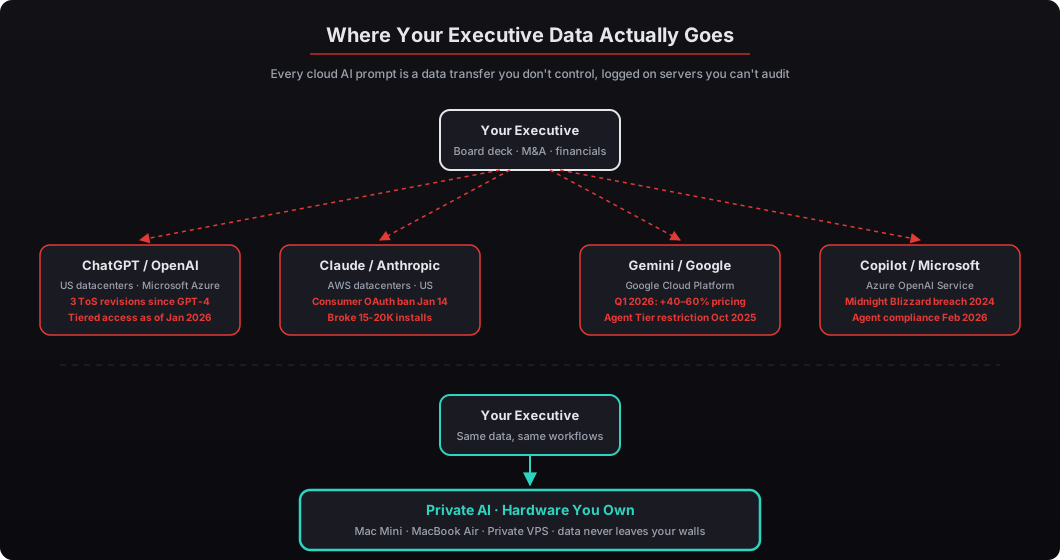
More exposed than vendors want you to believe, and more exposed than the cloud security marketing pages acknowledge. When you type a prompt into ChatGPT, Microsoft Copilot, Google Gemini, or Claude.ai, your data travels to servers operated by OpenAI, Microsoft, Google, or Anthropic. What happens next depends entirely on their policies — policies that change, sometimes with warning and sometimes without.
OpenAI updated its terms of service three times in 2025 alone (March, July, November) and again in January 2026 to introduce tiered access behind annual commitments. Their enterprise tier promises not to train on your data, but your prompts still transit their infrastructure, are processed on their GPUs, and are subject to their security posture. According to IBM’s 2025 Cost of a Data Breach Report, the global average breach cost reached $4.88 million — a 10% increase over the prior year and the highest figure ever recorded in the report’s 20-year history. AI-related breaches involving third-party providers averaged $5.12 million and took 42 days longer to detect than breaches involving on-premise systems.
Anthropic revoked consumer OAuth access on January 14, 2026, breaking an estimated 15,000-20,000 active OpenClaw installations that had been authenticating through personal Claude accounts. The move was legally and contractually defensible under their September 2025 ToS update, but the operational impact was enormous. For enterprises that had built workflows around Claude access, the question wasn’t “is this a good product” — it was “why did I build on infrastructure that could be turned off on 24 hours notice.” We covered the incident in detail in why Anthropic banned consumer OAuth for OpenClaw.
Google processes Gemini for Workspace data on Google Cloud Platform infrastructure. Google’s privacy policy for Workspace has been revised multiple times. In October 2025, Google added the “Agent Tier” enrollment requirement for automated AI access. In Q1 2026, Google raised Gemini API pricing 40-60% for high-volume enterprise users. For executives at companies subject to litigation holds, the idea that a third party retains AI interaction logs on their servers introduces discoverable surface area that didn’t exist five years ago — the kind of thing opposing counsel learns to request in depositions.
Microsoft Copilot operates within the Microsoft 365 ecosystem on Azure OpenAI Service. In January 2024, Microsoft disclosed that a nation-state actor (Midnight Blizzard, linked to Russia’s SVR) had breached Microsoft corporate email accounts. If Microsoft’s own internal systems are targets for well-resourced adversaries, the servers processing your Copilot prompts inherit that threat surface. Microsoft has good security. But “good” is not the same as “my security perimeter.”
The common thread across all four is that you’re trusting someone else’s infrastructure, someone else’s security team, someone else’s policy commitments, and someone else’s incident response. For board communications, M&A discussions, financial modeling, and investor relations, that trust model no longer holds up — not because the vendors are malicious, but because their business model does not align with your fiduciary duty. They’re optimizing for scale across millions of customers. You’re optimizing for the specific board meeting where a data leak would cost your company everything. Those optimizations diverge at exactly the moments that matter most.
What does the regulatory landscape actually require in 2026?
Regulations aren’t coming — they’re here, they’re enforceable, and they’re specifically targeting how organizations handle AI data processing. A CFO reading this in 2024 might have gotten away with “we’ll assess this later.” A CFO reading this in 2026 cannot.
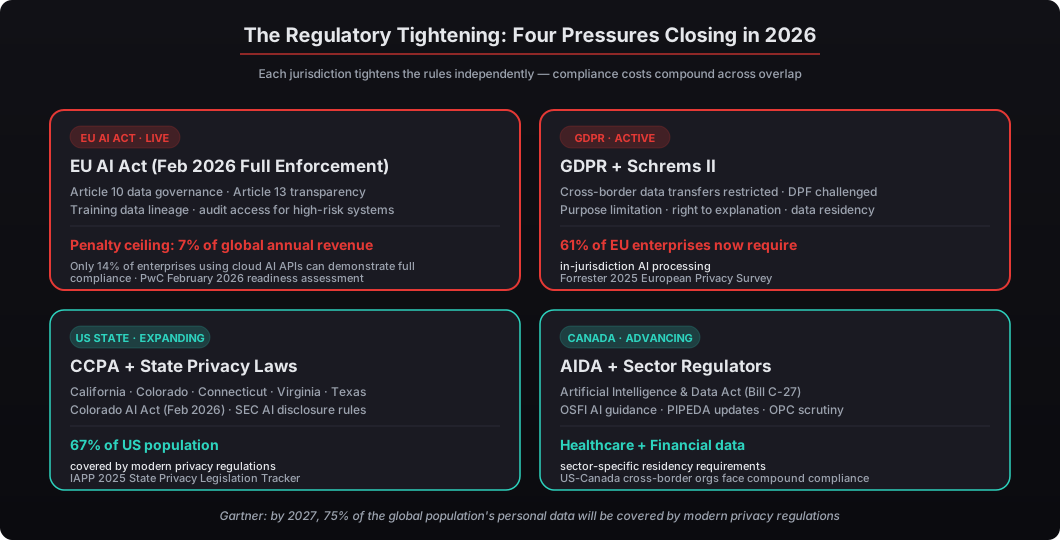
The EU AI Act reached full enforcement in February 2026. Article 10’s data governance requirements and Article 13’s transparency obligations effectively mandate that companies deploying high-risk AI systems know exactly where their AI processes data, how decisions are made, and who has access to the underlying systems. High-risk use cases explicitly include financial decision-making, HR applications, and credit decisions — which covers a large share of the workflows C-suite executives delegate to AI. The penalty structure is real: 7% of global annual revenue for non-compliance with high-risk AI provisions. For a company doing $10 billion in annual revenue, that’s a $700 million exposure — larger than most enterprise IT budgets. PwC’s February 2026 EU AI Act Readiness Assessment found only 14% of enterprises using cloud AI APIs could demonstrate full compliance with the Act’s sovereignty and transparency requirements. Running AI on hardware you own makes that assessment a one-meeting conversation instead of a six-month project.
GDPR already restricts cross-border data transfers, and the legal foundation for transatlantic data flows keeps getting challenged. The Schrems II decision invalidated the EU-US Privacy Shield in 2020. Its replacement — the EU-US Data Privacy Framework — faces ongoing legal challenges, and the outcome is uncertain. Every time a European executive sends data to a US-based cloud AI provider, they’re navigating a legal framework that has been successfully challenged twice and could be again. Forrester’s 2025 Privacy Survey found that 61% of European enterprises now require AI processing within their jurisdictional boundaries — up from 38% in 2023. That’s not a compliance preference. That’s a board-level governance requirement at the majority of large European companies.
CCPA and US state privacy laws now cover over 67% of the US population, according to the IAPP’s 2025 State Privacy Legislation Tracker. California, Colorado, Connecticut, Virginia, Texas, and a growing list of states impose data handling obligations that become significantly simpler when your AI processes data on hardware you own. Colorado’s AI Act took full effect in February 2026, adding specific obligations for AI systems making consequential decisions about consumers. The SEC’s 2025 cybersecurity disclosure rules now require public companies to disclose material AI-related data handling practices. Every one of these regulations makes the compliance story easier when the AI runs on infrastructure you control.
Canada’s AIDA (Artificial Intelligence and Data Act, under Bill C-27) continues advancing through parliament, adding another jurisdiction to the compliance matrix for any executive team operating across the US-Canada border. OSFI’s 2025 AI guidance for Canadian federally regulated financial institutions added residency expectations for AI processing of customer data. PIPEDA updates are tightening the consent framework. For cross-border organizations, the compound compliance cost of running AI on US cloud infrastructure while serving Canadian customers is genuinely large.
Here’s the practical reality: compliance teams at every major law firm — Baker McKenzie, Freshfields Bruckhaus Deringer, Latham and Watkins, Skadden, DLA Piper — are advising clients to assess AI data processing chains. When your AI runs on your hardware, the assessment is straightforward and defensive. When it runs on OpenAI’s or Microsoft’s or Google’s servers, the assessment becomes a multi-quarter project with no guaranteed outcome. The assessment project itself costs more than a beeeowl deployment.
How do the numbers actually compare?
I’ve sat across the table from CFOs who assumed private AI was the expensive option. The math tells a different story, and it tells it quickly.
Cloud AI costs are per-user, per-month, forever:
- ChatGPT Enterprise: $60/user/month ($720/user/year)
- Microsoft Copilot: $30/user/month ($360/user/year), on top of existing Microsoft 365 E3/E5 licensing
- Google Gemini for Workspace: $30/user/month ($360/user/year), on top of Workspace fees
- Claude Team/Enterprise: variable, typically $25-$50/user/month for team plans
For a team of 10 executives, ChatGPT Enterprise alone costs $7,200 per year. Over three years, that’s $21,600 — and you own nothing at the end. You’ve rented access to someone else’s infrastructure and agreed to someone else’s terms, and you’re on the hook for the next renewal at whatever price the vendor sets. Google’s 40-60% price hike in Q1 2026 is a preview of what renewal season looks like when you have no alternative.
beeeowl’s private deployment starts at $2,000 for a hosted setup or $5,000 with a dedicated Mac Mini — hardware included, shipped to your door, fully configured. Additional agents cost $1,000 each. No per-user monthly fees. No recurring charges. No vendor price increases.
Here’s the comparison that matters, side by side:
| Dimension | Cloud AI (ChatGPT, Copilot, Gemini) | Private AI (beeeowl) |
|---|---|---|
| Data location | Vendor’s servers | Hardware you own |
| Monthly cost | $30-60 per user | $0 after deployment |
| Year 1 cost (5 users) | $1,800-3,600 | $2,000-6,000 (one-time) |
| Year 3 cost (5 users) | $5,400-10,800 | $2,000-6,000 (same) |
| Year 5 cost (5 users) | $9,000-18,000 | $2,000-6,000 (same) |
| Vendor policy changes | You’re subject to them | Irrelevant to your deployment |
| Data breach liability | Shared with vendor | Contained to your organization |
| Regulatory compliance | Complex, multi-party | Direct, single-party |
| Integration scope | Vendor ecosystem only | 250+ tools via Composio |
| Hardware ownership | Never | Yours permanently |
| Audit trail control | Vendor-managed | You control everything |
| Price renegotiation | Annual, vendor’s terms | Never |
The crossover point is typically 12 to 18 months. After that, every month with cloud AI is money spent on renting access to infrastructure that exposes your data to risks you could have eliminated with a one-time $2,000-$6,000 investment. Over five years, the cumulative cost advantage to private deployment is decisive and gets wider every year the cloud vendors raise prices.
Why is vendor lock-in a strategic risk — not just an IT problem?
Vendor lock-in isn’t an inconvenience. It’s a strategic constraint that limits how your organization can operate, compete, and respond to change. And it’s a constraint that gets worse over time, not better, because every workflow you build inside a vendor’s ecosystem increases the cost of ever leaving.
Microsoft Copilot only works inside Microsoft 365. If your team uses Slack for messaging, Notion for documents, and Salesforce for CRM, Copilot can’t touch any of it without middleware that doesn’t fully work. Google Gemini for Workspace has the same limitation — it’s confined to the Google ecosystem, and cross-platform automation requires AppSheet or Google Cloud Functions with engineering investment that’s disproportionate to the value.
According to Okta’s 2025 Businesses at Work report, the average enterprise uses over 130 SaaS applications. Your business doesn’t live in one vendor’s ecosystem. Locking your AI into a single vendor’s platform means your most powerful productivity tool can only see a fraction of your actual workflow — and that fraction shrinks every time your team adopts a new tool outside that vendor’s walled garden.
Then there’s the policy risk, which the last 18 months made impossible to ignore:
- Anthropic revoked consumer OAuth on January 14, 2026, breaking 15,000-20,000 active installations
- OpenAI revised ToS three times in 2025 and introduced tiered access in January 2026
- Google raised Gemini API pricing 40-60% in Q1 2026 for enterprise users
- Microsoft restructured Copilot pricing through E5 bundling, effectively making it harder to purchase 365 without it
- Salesforce has raised API fees multiple times over the past three years, including a 40% API call pricing increase in 2024
When Jensen Huang told the audience at NVIDIA GTC that every company needs an OpenClaw strategy, he wasn’t making a product pitch. He was making a structural argument — the same argument Linus Torvalds made about Linux, Tim Berners-Lee made about the open web, and the Kubernetes community made about container orchestration. Infrastructure you depend on should be infrastructure you control. Proprietary ecosystems work as long as the vendor’s incentives align with yours. The moment they don’t, you discover that your “AI strategy” was actually your vendor’s pricing strategy.
Private AI built on OpenClaw connects to over 250 tools through Composio — Gmail, Outlook, Slack, Salesforce, HubSpot, Notion, Google Drive, QuickBooks, Stripe, Jira, LinkedIn, and hundreds more. You’re not locked into any vendor’s ecosystem. When a new tool enters your stack, you add an integration. When a vendor changes terms, your deployment continues working because the vendor doesn’t control your deployment. For a structured decision framework, see our cloud AI APIs vs private AI infrastructure decision framework.
What’s the actual risk of waiting on this?
I’ll be direct: every month you continue routing sensitive executive data through cloud AI tools, you’re accumulating risk that compounds across three dimensions simultaneously — breach exposure, regulatory exposure, and competitive exposure.
The breach exposure curve is moving in one direction. The IBM Cost of a Data Breach Report has shown year-over-year cost increases for a decade straight. AI-related breaches are now the fastest-growing category. Verizon’s 2025 Data Breach Investigations Report noted third-party involvement in breaches increased 28% year-over-year. The more external services touching your data pipeline, the larger your attack surface and the longer your mean time to detection.
The regulatory exposure curve is accelerating. Gartner projects that by 2027, 75% of the global population’s personal data will be covered by modern privacy regulations — up from under 10% in 2020. Every jurisdiction is tightening independently, and the compound compliance cost of running AI on shared cloud infrastructure across multiple jurisdictions is becoming a standalone line item on enterprise IT budgets. The compliance team time alone is measurable and growing.
The competitive exposure is the one executives undersell. Every week your competitor’s private AI agent is learning their business while your executives are still opening Copilot, pasting in documents, and hoping the vendor’s privacy page still says what it said last month. Six months from now, the competitor has a calibrated agent with six months of context on their operations. You have whatever Microsoft or Google happens to have shipped since then, on the same shared infrastructure as everyone else, with zero personalization.
Meanwhile, Cyberhaven’s research showed that sensitive data sharing with AI tools increased 60% in the six months after ChatGPT launched. The volume of confidential data flowing to third-party AI providers is growing, not shrinking. Every one of those additional pastes is a data point that the bad architecture is still the dominant architecture — and a justification for why boards are starting to ask executives what their private AI strategy is.
For CEOs, the question isn’t technical — it’s fiduciary. You have a duty to protect proprietary information, shareholder interests, and organizational risk exposure. Sending board materials, financial models, investor communications, and strategic plans to servers operated by OpenAI, Microsoft, or Google is a risk you’re actively choosing to accept. And it’s a risk you can eliminate in one day with a one-time $2,000-$6,000 deployment. At some point soon, board audit committees are going to ask why the risk wasn’t eliminated sooner.
What does the transition to private AI actually look like?
This is where most executives expect the catch. Surely private AI deployment takes months of IT work, custom development, DevOps engineering, and ongoing maintenance? That used to be true. It hasn’t been for over a year now.
beeeowl deploys fully configured private AI agents in one day. We handle security hardening, Docker sandboxing, firewall configuration, Composio OAuth setup for 250+ services, authentication, and audit trail configuration. The hardware — a Mac Mini or MacBook Air — ships to your door within a week, fully configured and ready to run. Your credentials are never exposed to the bot because Composio brokers every credential request at execution time. Audit trails are built in from day one. Role-based access controls are set up based on your specific workflow.
Every deployment includes one fully configured agent with integrations to the tools your team already uses. Need more? Additional agents are $1,000 each, each scoped to a specific executive’s workflow with its own credential boundary. Want an LLM that runs entirely on-device — where data never leaves your machine, not even to ChatGPT or Claude’s API? That’s the Private On-Device LLM option for an additional $1,000, and it’s the configuration we recommend for executives handling pre-IPO financials, MNPI, or attorney-client privileged information. For a primer on the stack, see our guide to OpenClaw.
NVIDIA actively contributes engineers to OpenClaw’s security architecture through the NemoClaw enterprise reference design. This isn’t experimental technology. It’s production-grade infrastructure backed by the company that makes the GPUs powering every major AI system on the planet. Jensen Huang has publicly compared OpenClaw to Linux, Kubernetes, and the open web — foundational layers that became standard not because they were the easiest option but because they were the most adaptable and the most controllable.
Is this really an opinion — or is it just the math?
I started this piece calling it an opinion. But the more I lay out the evidence, the less it feels like one.
The data exposure risk is documented — Samsung, Apple, JPMorgan Chase, Goldman Sachs, and Amazon all reached the same conclusion independently, at different times, with different threat models, and restricted cloud AI access for the same fundamental reason.
The cost comparison favors private deployment within 18 months for most executive teams — and the gap widens every year the cloud vendors raise prices, which they now do every quarter.
The regulatory trajectory is unambiguous — every major jurisdiction is tightening controls on AI data processing, the EU AI Act is now fully enforceable, Gartner projects 75% of global personal data will be covered by privacy regulations by 2027, and PwC found only 14% of current cloud AI users can demonstrate compliance.
The vendor lock-in risk is materializing in real time — OpenAI, Anthropic, Google, Microsoft, and Salesforce have all tightened or repriced their terms in the last 18 months, and none of them are slowing down.
The competitive advantage of early adopters is compounding — BCG’s 2025 research shows first-mover companies are pulling ahead 6% per quarter in operating efficiency, and Forrester found that late movers need 18-24 months to close a 12-month deployment gap.
If I were presenting this to a board, I’d frame it simply: we can continue paying monthly fees to route our most sensitive data through servers we don’t control, governed by policies that change without our consent, subject to regulations that are tightening quarter by quarter — while our competitors run private agents on infrastructure they own. Or we can own our AI infrastructure outright, keep our data on our hardware, and eliminate the entire category of risk in one day with a one-time $2,000-$6,000 investment.
The case for private AI isn’t theoretical anymore. It’s arithmetic, regulatory reality, fiduciary duty, and common sense — all pointing in the same direction. beeeowl exists because we believe every executive team deserves AI infrastructure they actually own. Not rent. Not borrow. Own.
If you’re ready to stop sending your most sensitive data to someone else’s servers, request your deployment and we’ll have you running in a day.