OpenClaw vs Doing Nothing: The True Cost of Waiting on AI Adoption
Every month you delay AI adoption burns $20K-40K in executive time alone — and BCG says the competitive gap widens 6% per quarter. Here's the compounding math on why waiting is the most expensive strategy.

Accenture’s 2025 Technology Vision surveyed 1,200 C-suite leaders and found the average executive spends 28% of working hours — roughly 14 hours per week — on administrative tasks AI agents can handle autonomously. At Deloitte’s $500-$1,000/hour loaded executive cost, that’s $7,000-$14,000 per week vanishing into calendar management, email triage, and report compilation. BCG’s 2025 AI Adoption Index found that companies deploying agents early grew operating margins 2x faster than those still “evaluating options” — and the gap widens roughly 6% per quarter. McKinsey tracked the compounding: companies using AI for strategic decision support moved 40% faster and captured 15-20% more value from each decision versus manual analysis, compounding to a 31% improvement in strategic initiative success rates over 12 months. Waiting isn’t caution. It’s the most expensive decision on your desk this year.
What does it really cost to wait on AI adoption?
Direct executive time burn plus a compounding competitive gap that widens every quarter. A C-suite executive burning 10-15 hours per week on tasks an AI agent handles autonomously is lighting $20,000-$40,000 per month on fire at standard executive compensation rates. For a five-person leadership team, that’s $100,000-$200,000 per month in burned capacity — and none of that counts the decisions you didn’t make, the deals you didn’t catch, or the intelligence you didn’t synthesize. That’s just the paycheck math.
But the time waste is actually the smallest part of the bill. The real damage is what you’re not doing while you’re stuck in email triage, meeting prep, and manual report monitoring. BCG’s 2025 AI Adoption Index tracked 2,400 enterprises across 18 sectors and found that companies deploying AI agents in the first wave grew operating margins 2x faster than those still in “evaluation” mode. Not 2x larger margins — 2x faster growth of margins. The gap between adopters and waiters isn’t steady. It’s accelerating.
I’ve deployed OpenClaw systems for executives across the US and Canada. The conversation I’m tired of having is the one that starts with “We’re planning to do this next quarter.” Next quarter turns into next half. Next half turns into next year. And meanwhile, your competitors already have agents running, accumulating context about their business, compounding small decision-quality advantages into large operational gaps. By the time the “next quarter” executive gets around to deploying, the catch-up cost is bigger than the deployment cost ever was.
Why does every month of delay cost more than the last?
Because AI advantages compound in three ways simultaneously — accumulated context, improved calibration, and widening competitor efficiency. None of the three is available to a company that hasn’t deployed yet. All three are already working for the company that deployed six months ago. That’s what makes delay non-linear.
Accumulated context. This isn’t like buying new laptops where you get the same productivity boost whether you buy in March or September. An AI agent that’s been running for six months has learned your workflow patterns, accumulated context about your business relationships, and refined its outputs based on your feedback. According to McKinsey’s 2025 analysis of 1,400 enterprise AI deployments, agents used for executive decision support delivered 23% more accurate strategic recommendations by month six compared to month one. Not because the underlying model was different — because the agent had six months of your data to work against. Your competitor who deployed six months ago? Their agent is already better than the one you’d get today on identical software, because theirs has trained on their data and yours hasn’t.
Improved calibration. The feedback loop that makes an agent useful also makes it better-calibrated over time. When an executive tells their agent “don’t surface this type of alert anymore — it’s noise,” that preference persists. When the CFO says “always include the variance against forecast in the weekly summary,” that becomes a standing pattern. Multiply those micro-adjustments across six months and the agent becomes a personalized instrument that does exactly what the executive actually wants — not what the agent framework defaulted to on day one. Calibration is the cumulative result of thousands of small corrections that a brand-new agent simply hasn’t received yet.
Widening competitor efficiency. Forrester’s 2025 AI Maturity Model puts the catch-up math bluntly: organizations that delay AI adoption by 12 months require 18-24 months to reach the same performance level as early movers. The catch-up penalty is real, and it’s not a one-to-one delay — you fall behind faster than you can recover, because your competitors are still moving while you’re trying to reach parity. This is the dynamic that killed late cloud adopters in the 2015-2018 window and killed late mobile adopters in the 2010-2013 window. It’s the same dynamic playing out for AI agents now, compressed into a shorter timeline.
Think about it this way. Jensen Huang told the World Governments Summit in early 2025 that AI is “the new industrial revolution” and compared OpenClaw to what Linux and Kubernetes did for computing infrastructure. The companies that adopted Kubernetes early didn’t just get a head start — they built operational advantages that late adopters are still trying to replicate a decade later. Google, Netflix, and Spotify built container-native architectures while competitors were still debating whether to adopt. The same dynamic is playing out for AI agents now. NVIDIA’s own engineers contribute security patches to OpenClaw’s codebase. Jensen isn’t signaling his company’s roadmap out of politeness. He’s signaling where enterprise infrastructure is going, and companies that move now will build the kind of operational moat that consulting firms bill fortunes to help late adopters replicate in 2028.
How much executive time actually gets wasted without an AI agent?
Accenture’s 2025 Technology Vision report surveyed 1,200 C-suite leaders and found the average executive spends 28% of working hours on administrative tasks. At a 50-hour work week that’s 14 hours. At $500-$1,000/hr loaded executive cost — the range Deloitte’s 2025 Human Capital Trends report uses for enterprise valuation modeling — you’re looking at $7,000-$14,000 per executive per week vanishing into calendar management, email triage, and report compilation. For a 5-person leadership team, multiply by five.
Here’s what that burn looks like by role, based on the engagements we’ve shipped at beeeowl:
- CEO: 3-4 hours/week on meeting prep an agent automates in minutes. 2-3 hours/week on email triage. 1-2 hours/week on dashboard checks.
- CFO: 4-5 hours/week on variance analysis and report monitoring an agent handles continuously. 2-3 hours/week on vendor contract tracking and renewal flags.
- CTO: 3-4 hours/week on incident post-mortem aggregation and security questionnaire reviews. 2-3 hours/week on engineering metrics synthesis.
- Managing Partner: 5-6 hours/week on client engagement tracking and BD follow-up sequencing. 2-3 hours/week on rainmaker activity monitoring.
- VC/Investor: 15-20 hours/week on inbound deal triage. 3-4 hours/week on portfolio company health monitoring.
Multiply those hours by loaded cost. Then multiply by the number of executives. For a five-person leadership team at $500/hr average, that’s $35,000-$50,000 per week in burned executive capacity. Gartner’s 2025 Executive Productivity benchmark confirms these ranges, noting that AI agent deployment reduces executive administrative burden by 60-70% within the first 90 days. That’s not a marketing claim from an AI vendor — that’s Gartner’s measured benchmark across their enterprise client panel.
And none of this accounts for the quality differential. Harvard Business Review’s late-2025 research — “The Executive Attention Audit” from the November/December issue — showed that executives spending over 20% of time on administrative tasks make strategic decisions 34% slower than those who’ve automated the noise away. Slow decisions don’t just delay outcomes. They create a cascade of missed timing windows, because business problems don’t wait politely for your calendar to clear before they compound.
What does the cost of waiting actually look like in hard numbers?
I built this table using deliberately conservative assumptions: $500/hr executive rate (below Deloitte’s enterprise benchmark), 10 hours/week saved per agent (below Accenture’s 12.4-hour average), and a five-person leadership team deploying one agent each. The “competitive gap” column uses BCG’s 2025 finding that AI-adopting firms pull ahead roughly 6% in operating efficiency per quarter.
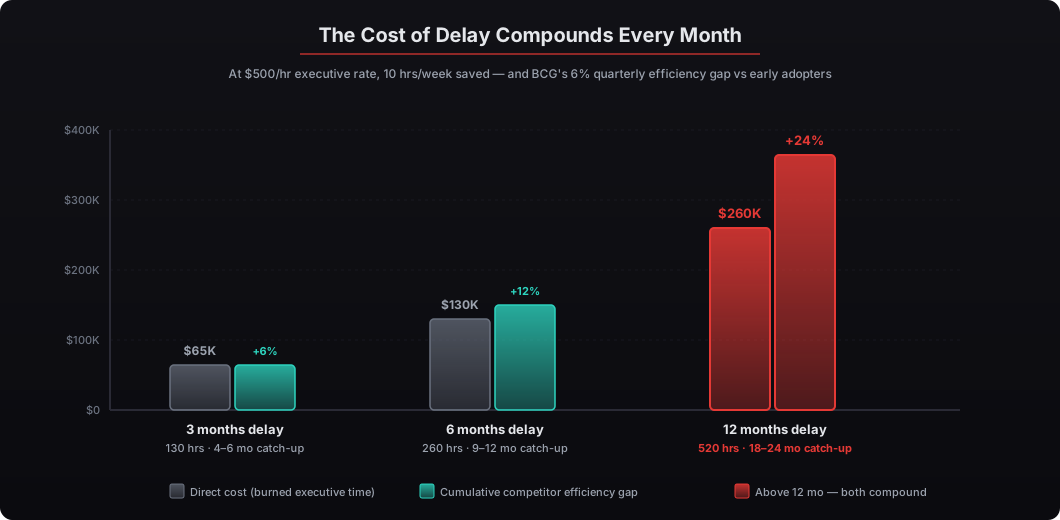
Cost of Delay per Executive (at $500/hr, 10 hrs/week saved)
| Delay Period | Time Wasted (hrs) | Direct Cost Lost | Cumulative Competitor Gap | Catch-Up Penalty |
|---|---|---|---|---|
| 3 months | 130 hours | $65,000 | 6% efficiency gap | 4-6 months to close |
| 6 months | 260 hours | $130,000 | 12% efficiency gap | 9-12 months to close |
| 12 months | 520 hours | $260,000 | 24% efficiency gap | 18-24 months to close |
For a five-person C-suite, multiply those direct costs by five. A 12-month delay burns $1.3 million in executive time alone across the leadership team. And the competitive gap column is where it really hurts — BCG’s research shows these efficiency differentials compound because AI-augmented decisions feed forward into better resource allocation, faster deal execution, and tighter operational loops. It’s not five parallel 24% gaps for five executives. It’s one compounding 24% organizational gap across the whole leadership team.
PwC’s 2025 Global AI Study reinforces this with a broader lens: companies that deployed AI agents for executive workflows in 2024-2025 saw 14% higher revenue growth than industry peers by Q4 2025. Not 14% higher revenue — 14% higher growth rate. Over three years of compounding, that’s the difference between a company that doubles in size and a company that grows 45%. Same starting point, same market, different AI strategy.
What are VCs and investors losing by not having AI deal flow?
This one’s personal. We’ve deployed agents for venture capitalists who were manually triaging 200+ inbound deals per month through email. The math on that workflow is brutal once you actually do it.
According to PitchBook’s 2025 VC Activity Report, the average institutional VC reviews 1,200 deals annually and invests in 8-12. That’s a 99% pass rate — meaning 99% of deal review time produces no direct return. Andreessen Horowitz publicly discussed how their internal AI systems now pre-screen inbound deals in seconds, flagging the 5-10% that match their thesis before a human ever reads the deck. Sequoia, Benchmark, and Founders Fund have all publicly referenced similar AI-augmented deal flow at tech conferences in late 2025.
If you’re a VC without AI deal flow triage, you’re spending 15-20 hours per week on deals you’ll pass on. At partner-level compensation — $600-$1,000/hr at top-tier firms according to Carta’s 2025 VC compensation data — that’s $9,000-$20,000 per week in partner time spent on dead-end reviews. Over a year, that’s $500K-$1M in partner time per investor, spent on work that produced zero deals.
But here’s what actually matters more: the deals you miss because your response time is too slow. DocSend’s 2025 pitch deck data — based on analysis of 35,000 decks — shows that founders sharing pitch decks receive their first substantive response 4.2x faster from AI-equipped firms. The best deals get scooped while you’re still reading last week’s batch. Founders notice the speed differential, and the best founders prefer investors who respond fast because it signals the investor will also move fast post-investment. AI-augmented deal flow isn’t just a productivity story for VCs. It’s a founder-experience story that affects which deals a firm wins, not just which deals a firm reviews.
An OpenClaw agent connected to your email, your CRM (Affinity, Attio, HubSpot, or Salesforce), and your deal tracking tools pre-screens every inbound, cross-references against your portfolio and thesis, surfaces only the deals worth your time, and does it 24/7 while you sleep. Our use cases page breaks out the VC deal flow workflow in more detail along with five other investor-specific agents.
Why is “we’ll wait for better tools” the worst possible strategy?
I hear this constantly. “The AI space moves so fast — won’t today’s tools be obsolete in six months?” This misunderstands where the value actually sits in an AI agent deployment.
The value isn’t in the model. Models improve constantly — OpenAI, Anthropic, Google DeepMind, Meta, and Mistral all ship updates quarterly, and the open-weight ecosystem (Llama, Qwen, DeepSeek) is improving even faster. If your agent deployment was built around a specific model, you’d be right to worry about obsolescence. But that’s not how well-architected agent deployments work.
The value is in the integration layer. Your agent’s OAuth connections to Gmail, Salesforce, Slack, Google Calendar, Notion, QuickBooks, HubSpot, Affinity, and the 40+ other tools your team actually uses every day. That integration — built through Composio’s OAuth framework inside OpenClaw — represents weeks of configuration work that doesn’t become obsolete when GPT-5 or Claude 4 ships. Models are swappable. Integration infrastructure is not.
Gartner’s VP of AI Research, Svetlana Sicular, noted in their 2025 AI Strategy report that “the companies capturing the most AI value are those who invested in integration infrastructure early. Model improvements benefit them automatically because they already have the connective tissue in place.” That’s exactly the right framing. When a better model ships, the companies that already deployed benefit immediately — config change, agent restart, done. The companies still waiting get the same model on a six-month integration timeline.
When we deploy an OpenClaw system through beeeowl, the model layer is modular. Want to move from Claude to GPT-5 when it drops? That’s a configuration change, not a rebuild. But the workflow integrations, the security hardening, the Docker sandboxing, the Composio OAuth vault, the audit trails, the human-in-the-loop triggers — that infrastructure is what takes time to build and what delivers compounding returns. Every day it runs, it gets better at your specific business. Waiting for “better tools” is like refusing to build a factory until better machines exist. The factory itself is the advantage, not whatever marginal improvement the next machine generation will bring.
How do AI-augmented decisions compound over time?
This is the part that most cost analyses miss entirely, and it’s the part that should concern CFOs the most. McKinsey’s 2025 Decision-Making in the Age of AI report studied 800 companies and found that AI-augmented executive decisions have a measurable compounding effect on business outcomes — not just on the individual decisions being made, but on the trajectory of the company over the subsequent 12 months.
Here’s how the compounding chain works in practice. An AI agent surfaces a competitive intelligence alert on Monday. A competitor just raised prices by 8% on a specific product line. You make a pricing adjustment Tuesday to capture the opening — hold your price and win share. That adjustment captures $200K in revenue that quarter that would’ve otherwise gone to the competitor at their old price. That revenue funds a product improvement your engineering team wanted but couldn’t justify. That improvement drives customer retention by 90 basis points. That retention improvement lifts your net dollar retention and drives your next board presentation numbers higher. The board approves a faster hiring plan. Faster hiring drives faster revenue growth. None of that chain starts if the alert arrives two weeks late because you were manually scanning Google Alerts and Bloomberg Terminal.
McKinsey quantified the aggregate effect: companies using AI for strategic decision support made moves 40% faster and captured 15-20% more value from each decision compared to manual analysis. Over 12 months, the cumulative difference was a 31% improvement in strategic initiative success rates. That’s not AI doing your job. That’s AI giving you the context to do your job 31% better, compounded over a year.
Ernst and Young’s 2025 Digital Transformation survey adds another data point: 67% of C-suite executives who deployed AI agents reported that the quality of their board-level decisions improved “significantly” within the first six months. Not faster decisions alone — better ones, because the agent provides context, historical patterns, and cross-referenced data that no human assistant can compile in real time. The executive is still the decision-maker. The agent is the researcher, the analyst, the synthesizer, and the always-on context provider that turns executive intuition into executive judgment.
What does the path from “thinking about it” to “running” actually look like?
Here’s what frustrates me about the AI adoption conversation: executives treat it like a six-month evaluation project. It doesn’t need to be. The beeeowl deployment timeline is designed to compress the “thinking about it” phase into something that fits between a Monday request and a Friday running system.
With beeeowl, the timeline looks like this:
- Day one: You request your deployment. We configure your OpenClaw instance, harden the OS, set up Docker sandboxing, configure firewall rules, build your first agent with Composio OAuth integrations for the tools you actually use, and set up authentication.
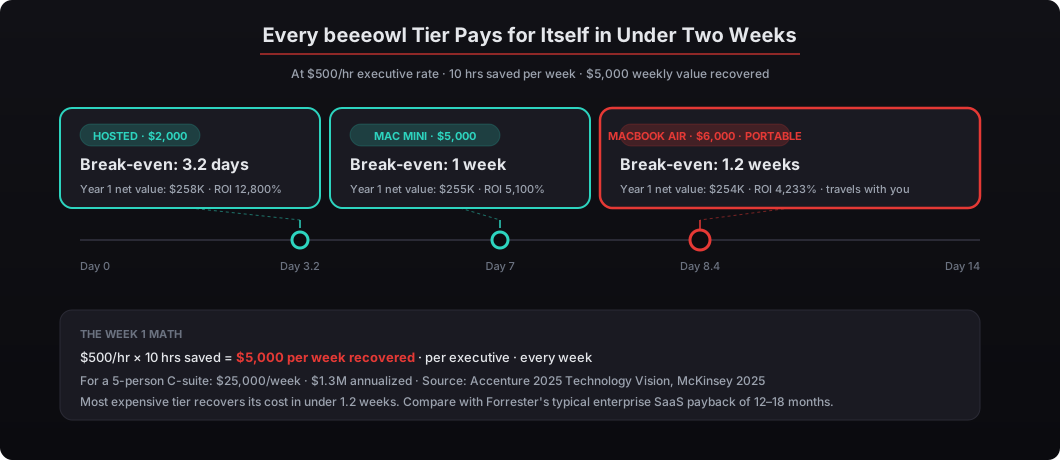
- Day two through five: Hardware ships — Mac Mini at $5,000 or MacBook Air at $6,000 with hardware cost included — or if you chose the hosted tier at $2,000, your agent is already running on a dedicated VPS under your control.
- Week one: Your agent is live — triaging email, prepping meetings, monitoring dashboards, tracking deals. On your infrastructure. With your data never leaving your machine.
That’s it. One week from “yes” to “running.” No six-month pilot. No committee approval for a SaaS vendor. No recurring fees eating into your ROI. See our breakdown of the ROI of private AI for the full break-even analysis by tier.
Every beeeowl deployment includes OpenClaw installation and configuration, OS and system security hardening, Docker sandboxing and firewall configuration, Composio OAuth setup (your credentials never touch the bot), authentication, one fully configured agent with integrations, audit trails and access controls, and one year of monthly mastermind calls where we share workflow patterns and help expand the deployment as your needs evolve. The in-person add-on ($2,000, hardware tiers only) puts our team on-site for white-glove setup on your existing infrastructure.
Why is this an urgency problem, not a priority problem?
The executives who delay aren’t saying AI is unimportant. They’re saying it’s not urgent. And they’re wrong, specifically because of how first-mover advantages are crystallizing into permanent capability differences.
Boston Consulting Group’s 2025 AI-at-Scale study tracked 2,000 companies across industries and found that AI first-mover advantages are crystallizing — becoming permanent. Companies that achieved AI maturity by end of 2025 captured structural advantages (talent, data moats, process optimization) that late entrants can’t replicate by simply deploying the same tools later. The talent advantage alone is enormous: the engineers who know how to deploy, harden, and operate AI agents at enterprise scale are scarce, and they’re being hired by the companies that moved first. Late entrants get what’s left.
Satya Nadella told Microsoft’s 2025 Investor Day audience that AI adoption “has a threshold effect — there’s a window where deployment creates lasting competitive separation, and that window is closing.” Marc Benioff at Salesforce’s Dreamforce 2025 made the same point differently: “The companies that don’t have AI agents running by mid-2026 will spend 2027 and 2028 trying to catch up.” Both CEOs are talking their book to some extent, but the underlying dynamic they’re describing is real and matches the BCG, Forrester, and McKinsey research.
We’re in April 2026. The window they’re talking about? You’re in it. Right now.
Deloitte’s 2025 Global AI Adoption Survey found that 73% of corporate boards now consider AI deployment speed a competitive risk factor — not a technology initiative, not an IT project, but a risk factor alongside cybersecurity and talent retention. If your board isn’t asking why you don’t have AI agents running yet, they will be by next quarter. And the answer “we’re evaluating” will sound in 2026 the way “we’re still evaluating cloud” sounded in 2018 — which is to say, defensive, slow, and about to be overtaken by someone who moved.
What’s the real difference between deploying now and deploying in six months?
Six months is 260 executive hours per person. At $500/hr, that’s $130,000 in burned capacity per executive. For a five-person C-suite, it’s $650,000. But that number, as large as it is, understates the true cost by a factor of three or four because it ignores the compounding competitive effects, the missed decisions, and the catch-up penalty.
The real cost is the 12% competitive efficiency gap that BCG says opens up over six months. It’s the deals your VC firm didn’t see first. It’s the pricing move you made two weeks late while your competitor was already repricing their line. It’s the board presentation that could’ve been assembled in minutes instead of a full day. It’s the CFO spending Thursday afternoons on variance commentary instead of scenario modeling for the next acquisition. It’s the CEO’s 4pm Friday meeting where the weekly summary that should’ve been ready at 9am finally lands.
And it’s the compounding effect: every AI-augmented decision you don’t make is a decision your competitor makes instead. Every week their agent runs is a week it gets better at their business while you’re still scheduling demos. By the time you catch up, their agent has accumulated six more months of context. The race isn’t who reaches parity — it’s who builds the permanent capability lead first.
I’ll be direct: if you’re reading this and you’ve been “thinking about” AI deployment for more than a month, you’ve already paid more in lost productivity than our most expensive tier costs. The arithmetic is not kind to waiting.
The hosted setup is $2,000. The Mac Mini with hardware included is $5,000. The MacBook Air for executives who travel is $6,000. Every option pays for itself in under two weeks at standard executive compensation rates — see our guide to choosing between hosted and hardware for the full comparison.
Stop evaluating. Start running. Request your deployment at beeeowl, and you’ll have an AI agent working for you by next week — same week your competitor’s agent gets its 180th day of accumulated context on their business.