The ROI of Private AI Deployment: Calculating the Real Cost of NOT Having an AI Agent
Executive time costs $500-$1,000/hr. Accenture says agents save 12.4 hrs/week. At $500/hr, every beeeowl tier pays for itself in under 2 weeks — ROI ranges from 4,233% to 12,800% in Year 1. Here's the CFO math.

Accenture’s 2025 Technology Vision surveyed 1,200 C-suite leaders and found the average executive spends 28% of working hours — roughly 14 hours per week — on administrative tasks AI agents handle autonomously. At Deloitte’s $500-$1,000/hour loaded executive cost benchmark, that’s $7,000-$14,000 per executive per week vanishing into calendar management, email triage, and report compilation. Harvard Business Review’s late-2025 research — “The Executive Attention Audit” — found executives spending over 20% of time on admin tasks make strategic decisions 34% slower than those who’ve automated the noise away. A one-time $2,000-$6,000 beeeowl deployment recovers its full cost in 3.2 days to 1.2 weeks at conservative rates, and delivers $254,000-$258,000 in Year 1 net value per executive with ROI ranging from 4,233% to 12,800%. This is the CFO math, built for the skeptical board member who needs hard numbers before signing anything.
What does it actually cost when an executive doesn’t have an AI agent?
More than most CFOs have modeled, and it compounds every single week. A C-suite executive earning $300,000-$500,000 annually has an effective hourly cost of $500-$1,000 when you factor in benefits, equity, bonus, and the opportunity cost of their attention on the right problem at the right time. McKinsey’s 2025 State of AI report found that executives spend 28% of working hours on administrative tasks AI agents can handle autonomously — roughly 11-14 hours per week per executive across industries.
At $500/hr, you’re burning $5,000-$7,000 every week on work a machine should be doing, per executive. For a five-person leadership team at an enterprise-level $1,000/hr loaded cost, that number rises to $50,000-$70,000 per week — $2.5-$3.5 million per year across the C-suite. And none of that includes the indirect cost of slower decisions, missed deal timing, or the cascading operational gaps that result from executives being distracted by noise instead of focused on strategy.
This isn’t about replacing anyone. It’s about redirecting the most expensive resource in your company — leadership attention — from inbox management to actual decision-making. Harvard Business Review published research in late 2025 — “The Executive Attention Audit” from the November/December issue — showing that companies where executives spend more than 20% of time on administrative tasks have 34% slower strategic decision cycles than competitors who’ve automated those workflows. Slow decisions don’t just delay outcomes. They create cascading timing misses because business problems don’t wait politely for your calendar to clear before they compound.
I’m writing this as a founder who’s deployed these systems for 50+ executives across the US and Canada. The ROI conversation isn’t theoretical for us — we’ve watched the numbers play out across multiple client engagements over 18 months. Here’s the business case, built for the skeptical CFO who needs hard math before signing anything. See how CFOs are using AI agents in practice.
How do you calculate executive hourly cost accurately?
Take total compensation — salary, bonus, equity, benefits — and divide by productive hours. For a CEO earning $400,000 in total comp working 2,000 hours annually, that’s $200/hour at the floor. But that floor ignores the real calculus: what’s the enterprise value of a CEO’s attention on the right problem at the right time, versus the cost of her doing manual work that could be automated?
Bain & Company’s 2025 executive productivity research puts it differently. They found that one hour of focused CEO time on strategic decisions generates 5-10x more enterprise value than one hour spent on administrative coordination. When McKinsey’s analysis values a Fortune 500 CEO’s decision-making time at $2,500-$5,000/hr in enterprise value impact, the $500-$1,000 loaded cost I use throughout this article is actually conservative — deliberately so, because conservative numbers are harder for a skeptical CFO to argue with. See the specific workflows in 7 ways a CEO can reclaim 10 hours.
For CFOs running the numbers, here’s the baseline I use across our engagements, benchmarked against Deloitte’s 2025 Human Capital Trends report:
- Mid-market CEO/CFO/CTO: $500/hr loaded cost
- Enterprise CEO/CFO: $800-$1,000/hr loaded cost
- Founder/Managing Partner: $300-$600/hr (with outsized impact on revenue that often justifies the higher end)
- VC Partner at a top-tier firm: $600-$1,000/hr per Carta’s 2025 VC compensation data
These aren’t aspirational or marketing numbers. They’re what enterprise ROI models use as benchmarks for executive time valuation, and they’re what the finance team at a skeptical board will accept without pushback when you present the analysis. If your finance team prefers a lower rate (say, $300/hr for a mid-market CTO), run the same math with their number — the break-even on every beeeowl tier still comes in under three weeks, just at a slower pace.
What tasks does an AI agent actually take off your plate?
The 10+ hours per week number isn’t a guess. Accenture’s 2025 Technology Vision report surveyed 1,200 C-suite executives and found that AI agent deployment eliminates an average of 12.4 hours per week of repetitive executive tasks within the first 90 days. Here’s where those hours actually come from, based on the engagements we’ve shipped and the time-tracking data clients have shared with us.
Email triage and response drafting — 3-4 hours per week. Your agent monitors your inbox continuously, categorizes by urgency and sender importance, drafts responses for your review on anything that needs a reply, and archives the noise automatically. Salesforce’s 2025 Workplace Productivity Index found that executives check email 74 times per day on average. An OpenClaw agent reduces that to one morning briefing, one end-of-day summary, and real-time flags only for the messages that genuinely need attention in the next hour.
Meeting preparation and follow-up — 2-3 hours per week. Before every meeting, your agent pulls attendee backgrounds from LinkedIn, the latest correspondence from your CRM (Salesforce, HubSpot, or Affinity depending on your stack), relevant documents from Google Drive or Notion, recent industry news about the attendee’s company, and creates a one-page briefing. After the meeting, it updates your CRM with notes, drafts the follow-up emails, and files the documents in the right project folder. The 15 minutes per meeting you spent on prep becomes 2 minutes of reviewing an auto-generated briefing.
Scheduling and calendar management — 1-2 hours per week. Not just booking — intelligent scheduling that accounts for travel time, energy management, priority weighting, and your personal rhythms (don’t schedule hard meetings back-to-back; protect deep work blocks; cluster calls to specific days of the week). Calendly and Reclaim.ai handle basic scheduling through rules. An OpenClaw agent handles the judgment calls that rules can’t capture.
Report monitoring and anomaly flagging — 2-3 hours per week. Your agent watches dashboards in Tableau, Looker, QuickBooks, Salesforce, or wherever your data actually lives. When revenue dips, a key metric moves outside normal range, a competitor makes news, a large deal slips, or a customer NPS drops — you get alerted with context and recommended actions, not just a raw notification. Gartner’s 2025 Data Analytics Survey shows that executives who receive AI-curated alerts respond to business anomalies 3.2x faster than those relying on manual dashboard checks.
Deal flow and opportunity tracking — 1-2 hours per week (dramatically more for VCs). For VCs and managing partners, the agent monitors inbound deal flow, cross-references against your portfolio and thesis, pre-screens against your exclusion criteria, and surfaces only the 5-10% worth your time. For CEOs, it tracks competitive moves through news monitoring and public filing alerts, and watches CRM activity patterns for deal slippage signals. For VCs reviewing 200+ inbound deals per month (the PitchBook average is 100 decks per partner per month), this workflow alone can save 15-20 hours per week — not 1-2.
Those are the five most common workflows across our engagements, and they add up to the 12.4-hour Accenture average. Specific executives will weight differently — a CFO spends less time on email and more on variance analysis; a VC spends less time on meeting prep and more on deal triage — but the 10+ hours per week number holds up across every role we’ve deployed for.
What does the break-even analysis look like for each tier?
Here’s where the CFO in the room leans forward. I’ll use the deliberately conservative $500/hour executive rate and 10 hours saved per week — both below what the research supports — so that even the most skeptical board member has nothing to argue with on the assumption side.
Weekly value recovered: $500/hour × 10 hours = $5,000/week per executive. For a five-person C-suite that’s $25,000/week across the leadership team, or $1.3 million per year in recoverable capacity that’s currently being burned on administrative work.
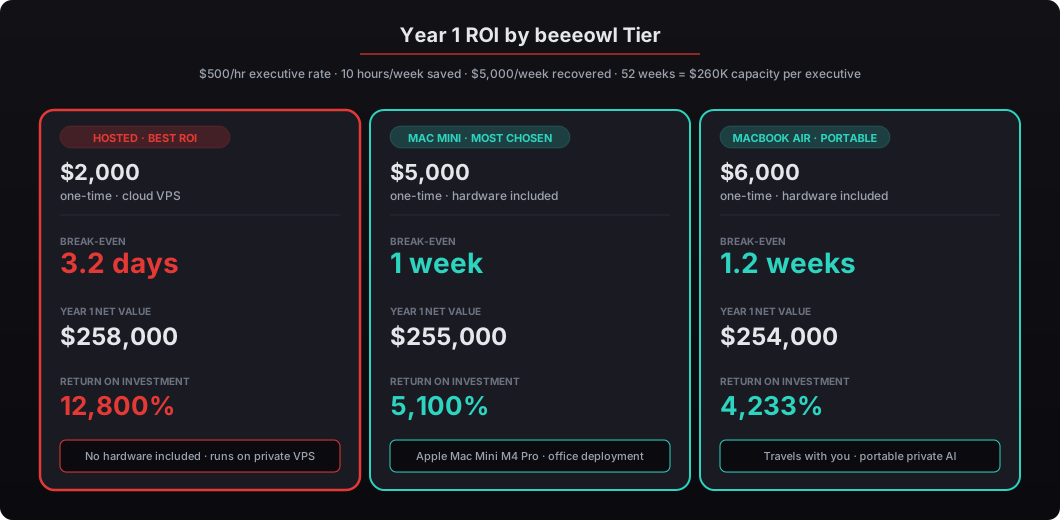
Hosted Setup ($2,000 one-time):
- Break-even: 3.2 working days. By the end of Week 1, you’ve already generated $3,000 in net recovered value.
- Year 1 net recovered value: $258,000 ($260K weekly × 52 − $2K cost)
- Year 1 ROI: 12,800%
- Best choice when: you want the lowest-friction deployment, are comfortable with cloud VPS infrastructure, and don’t need a physical device on your desk.
Mac Mini Setup ($5,000 one-time, hardware included):
- Break-even: 1 week. By Week 2 you’re $5,000 ahead net.
- Year 1 net recovered value: $255,000
- Year 1 ROI: 5,100%
- Best choice when: you want dedicated hardware on your desk for data sovereignty, plan to run a local LLM, or want the tightest possible data boundary. Apple’s Mac Mini with M4 Pro runs a local LLM alongside the OpenClaw agent without breaking a sweat. Hardware cost is included — no ongoing infrastructure bills, no cloud egress fees.
MacBook Air Setup ($6,000 one-time, hardware included):
- Break-even: 1.2 weeks.
- Year 1 net recovered value: $254,000
- Year 1 ROI: 4,233%
- Best choice when: you travel. Portable private AI for executives who work from hotels, client sites, or international offices. The agent runs on the machine that’s already in your briefcase. The portability premium pays for itself the first time you’re working from a conference and your agent is still running on secure hardware instead of requiring you to use a hotel wifi connection to the public cloud.
Compare this to enterprise SaaS platforms. Salesforce Einstein costs $75/user/month ($900/year per seat) and doesn’t run autonomously — it’s a copilot inside Salesforce, not an agent across your tools. Microsoft Copilot for Microsoft 365 runs $30/user/month ($360/year) on top of E3 or E5 licensing — that’s $720-$1,044 per year all-in per seat, and it requires you to prompt it every time. Google Gemini for Workspace is the same story at $30/user/month on top of Workspace fees. None of them deploy on infrastructure you own. None include security hardening. None keep your data completely private.
The break-even on beeeowl’s most expensive tier is under two weeks. Most enterprise software takes 12-18 months to show ROI, according to Forrester’s 2025 Total Economic Impact methodology. beeeowl is 30-50x faster than the typical enterprise software payback. That’s not a marginal productivity gain. That’s a different category of investment.
What is the compounding cost of waiting?
This is the part most ROI analyses miss entirely, and it’s the part that should concern CFOs the most. The cost of NOT deploying isn’t static — it accelerates, because your competitors are deploying while you’re still evaluating, and their agents are accumulating context while yours don’t exist yet.
PwC’s 2025 Global AI Study found that companies deploying AI agents in 2025-2026 are capturing market share 2.3x faster than those still in “evaluation mode.” Accenture’s Technology Vision 2025 puts it more bluntly: AI-adopting firms are growing revenue 2.5x faster than non-adopters, and the gap is widening every quarter as the early movers’ agents accumulate calibration data that late movers will need months or years to replicate.
Here’s what that cost looks like week by week, compounding as the delay extends:
Week 1 without an agent: $5,000 in executive time spent on automatable tasks per person. Your competitor’s agent — the one they deployed six weeks ago — processed 340 emails overnight, flagged 3 time-sensitive opportunities they acted on Monday morning, and drafted follow-ups for 12 warm leads. Your competitor is compounding advantages. You’re breaking even on Sisyphus.
Month 1 without an agent: $20,000 in burned executive time per person. Four weeks of deal flow that wasn’t triaged automatically. Meeting prep that consumed hours instead of minutes. Anomalies in your financial dashboards that went unnoticed for days instead of hours. Your competitor’s agent is four weeks smarter about their business than anyone in your organization is about yours.
Quarter 1 without an agent: $65,000 in executive time costs per person, or $325K for a 5-person C-suite. Meanwhile, Boston Consulting Group’s 2025 AI Advantage report shows early AI adopters are making strategic decisions 40% faster. That speed gap translates directly into deals closed, partnerships formed, pricing moves captured, and market positions established that late movers will spend the following year trying to reach.
Year 1 without an agent: $260,000+ in executive time that could have been redirected per person. For a 5-executive C-suite: $1.3 million. And that’s just the direct time cost — it doesn’t account for missed opportunities, slower response times, and competitive ground lost while your competitors were compounding their agent’s learning over the same 12 months.
Goldman Sachs Research estimated in early 2026 that enterprises delaying AI agent adoption by 12 months face an average competitive disadvantage equivalent to 3-5% of annual revenue. For a $50 million company, that’s $1.5-$2.5 million in lost ground — per year, not cumulative. For a $500M company, that’s $15-$25M per year. A $2,000 beeeowl deployment looks different in that context. We quantify the delay curve in more detail in the true cost of waiting on AI.
Why does one-time pricing change the ROI equation?
Most AI tools are subscriptions. Microsoft Copilot, ChatGPT Enterprise, Google Gemini for Workspace, Jasper, Writer, Anthropic’s Claude Team plan — they all charge monthly or annually, and that recurring cost never stops compounding. For a subscription-based tool, the question “what’s my 5-year cost?” always returns a larger number than “what’s my Year 1 cost?”
ChatGPT Enterprise runs $60/user/month. Over three years, one executive seat costs $2,160. Over five years, $3,600. And at the end of five years, you don’t own any infrastructure, your data has been transiting OpenAI’s servers for five years under whatever policies they happened to have at the time, and you still have to manually prompt the tool every time you want it to do something. Google’s 40-60% Gemini API price hike in Q1 2026 is a preview of what renewal season looks like when you have no alternative to the subscription treadmill.
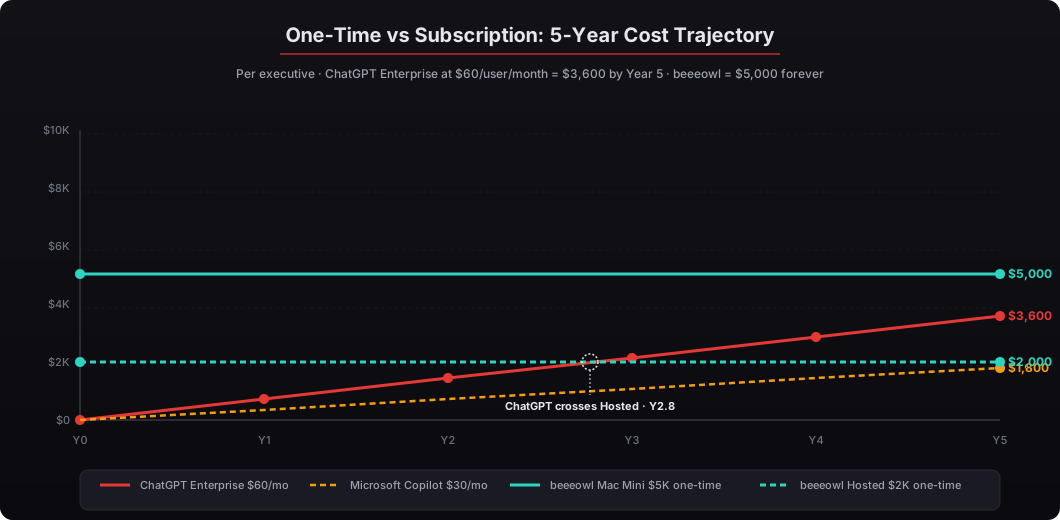
beeeowl’s model is fundamentally different. You pay once. You own the deployment. The agent runs on hardware you control — whether that’s a cloud VPS for the Hosted tier, a Mac Mini on your office desk, or a MacBook Air in your briefcase. The same deployment runs for five years at zero incremental cost. No monthly fees eroding your ROI. No per-seat charges that multiply as you add executives (additional agents are $1,000 each, also one-time). No surprise price increases when your vendor decides to “adjust” their pricing, the way Salesforce did three times between 2023 and 2025 and the way Google did with Gemini in Q1 2026.
For a CFO modeling multi-year total cost of ownership, the math is unambiguous. A beeeowl Mac Mini deployment at $5,000 one-time costs less over three years than a single ChatGPT Enterprise seat, and delivers autonomous 24/7 operation instead of a chat window you have to remember to open. The crossover point for ChatGPT Enterprise versus beeeowl Hosted ($2,000 one-time) lands at roughly Year 2.8 — every year after that, private deployment’s cost advantage widens without bound while cloud AI subscriptions keep billing. By Year 5, ChatGPT Enterprise costs 80% more than beeeowl Hosted for one executive. By Year 10, it costs more than three times as much.
How does private deployment protect against data risk?
There’s an ROI dimension beyond time savings that CFOs often underweight, and it’s the dimension a board audit committee will focus on first if they’re doing their job: data sovereignty risk.
When an executive uses ChatGPT or Microsoft Copilot, every query — every board deck draft, every financial scenario model, every M&A discussion, every investor communication — traverses someone else’s servers, gets logged under someone else’s retention policy, and is subject to someone else’s security posture. IBM’s 2025 Cost of a Data Breach Report pegs the average breach cost at $4.88 million, and that figure has increased 10% year-over-year since 2020. AI-related breaches involving third-party providers averaged $5.12 million and took 42 days longer to detect than breaches involving on-premise systems. Those are published numbers. The actual cost for a specific executive handling MNPI could be substantially higher once you factor in regulatory penalties, investor trust damage, and legal review costs.
A private OpenClaw deployment on a Mac Mini or MacBook Air means your data never leaves your physical hardware. The agent runs in a Docker container on your machine. Composio handles OAuth credential brokering — your raw credentials never touch the agent’s memory. Audit logs are stored locally. The entire data path is within your security perimeter.
Add the Private On-Device LLM option for an additional $1,000 one-time, and even the language model runs locally through Ollama. No data goes to OpenAI, Anthropic, Google, or any third-party API. Every inference happens on the hardware you own. For executives handling pre-IPO financials, board communications, M&A targets, investor LP data, or anything subject to SEC Rule 10b-5, this isn’t a feature — it’s a fiduciary requirement. The SEC’s 2025 cybersecurity disclosure rules (adopted December 2024) now require public companies to disclose material AI-related data handling practices in their 10-K filings. Running your AI agent on infrastructure you own simplifies that compliance conversation dramatically, as PwC’s 2025 AI governance advisory team noted in their client bulletin last fall.
The cost avoidance here is hard to model in a break-even spreadsheet because the catastrophic scenarios are binary — either the leak happens and costs $5M+, or it doesn’t. But risk-adjusted for the probability, the cost avoidance benefit of private deployment is typically in the same order of magnitude as the direct time savings, especially for executives at publicly traded companies or regulated industries. We made the full case in the case for private AI.
What should a CFO tell the board?
Keep it simple. The business case has three numbers and one paragraph of context.
Cost: $2,000-$6,000 one-time (depending on tier and hardware choice)
Weekly return: $5,000+ in executive time redirected to strategic work per executive, at conservative $500/hr and 10 hours/week assumptions
Break-even: Under 2 weeks for every tier
Then add the context: McKinsey projects that 65% of enterprise tasks currently performed by knowledge workers will be augmented or automated by AI agents by 2028. Accenture says AI-adopting firms are growing revenue 2.5x faster than non-adopters. PwC’s 2026 global survey of 4,700 CEOs found that 76% plan to deploy AI agents within 18 months. Goldman Sachs Research estimates 12-month adoption delay equals 3-5% of annual revenue in competitive disadvantage. Deloitte’s 2025 survey found 73% of boards now consider AI deployment speed a competitive risk factor alongside cybersecurity and talent retention — not a technology decision to be delegated to IT.
The question for the board isn’t whether your company will deploy AI agents. Every analyst firm, every consulting firm, every CEO survey, and every technology vendor is converging on the same answer. The question is whether you’ll be the company that deployed early enough to build competitive advantage — or the one that deployed late enough to be playing catch-up. The CFO who presents this case in Q2 2026 will get a quick approval. The CFO who presents the same case in Q2 2027 will be explaining why they waited an extra year.
A $2,000-$6,000 one-time investment that breaks even in under two weeks and returns a quarter-million dollars in recovered executive capacity over 12 months isn’t a technology expense. It’s the highest-ROI infrastructure decision on your desk right now. Compare it to the last infrastructure decision the board approved — almost certainly a longer payback, smaller ROI, and more operational risk. Order your OpenClaw deployment today and we’ll have you running in a week.
Every week without an agent is $5,000 you’re choosing to burn per executive. For a five-person C-suite, that’s $25,000 weekly and $1.3 million annually. The math doesn’t get more favorable by waiting. It gets worse — with every week that passes, your competitors’ agents are compounding advantages and your own break-even math is marking the same delta as “time you could have already been recovering value.” The first week you deploy, the recovered value shows up in the second week. The first week you wait, the burned value shows up that same week and never comes back.
Stop evaluating. Start running.