Why Anthropic Banned Consumer OAuth for OpenClaw — And What It Means for Your Deployment
On January 14, 2026, Anthropic revoked consumer OAuth access for OpenClaw-style agents. 15-20K installs broke overnight. Here's what happened, why, and how to build a deployment that survives the next vendor policy change.

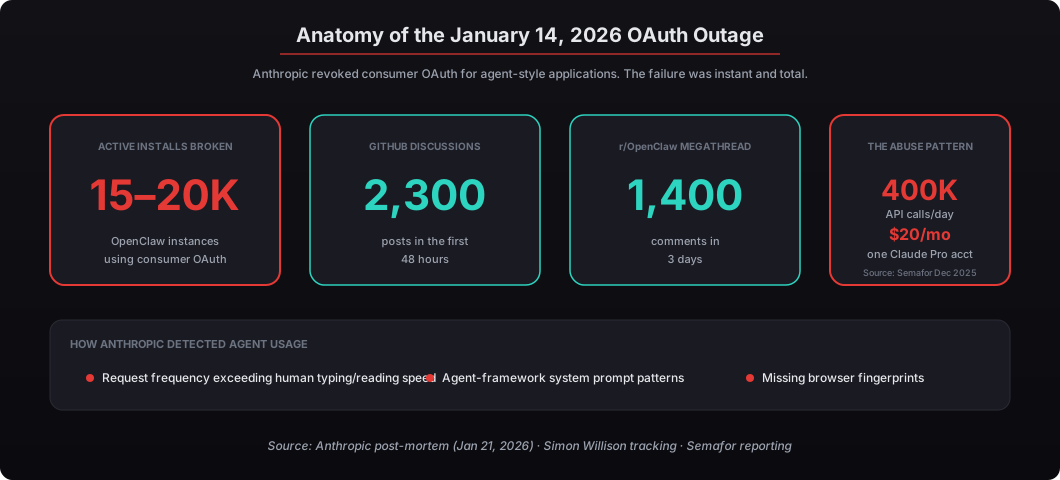
On January 14, 2026, Anthropic revoked consumer OAuth access for OpenClaw-style agent applications. Within hours, 15,000 to 20,000 active installations went silent — Simon Willison’s ongoing tracker captured the scale in near real time. The OpenClaw GitHub Discussions board logged 2,300 posts in 48 hours. The r/OpenClaw megathread hit 1,400 comments in three days. And the Semafor scoop from December 2025 — a single operator routing 400,000 API calls per day through one $20 Claude Pro account — suddenly read less like an oddity and more like a business plan Anthropic’s finance team couldn’t keep subsidizing. This article is the post-mortem, the technical deep-dive on what broke, and the exact architectural pattern that keeps the next vendor policy change from taking your agents down.
What exactly happened on January 14, 2026?
Anthropic revoked consumer OAuth token access for all agent-style applications shortly after midnight UTC on January 14, 2026. Personal Claude accounts stopped authenticating automated requests. Every OpenClaw instance that had been piggybacking on a consumer login returned 403 errors on the next Claude API call. No advance warning for most users. No migration window. No graceful degradation.
The Anthropic developer blog post was titled “Changes to OAuth Scope for Automated Applications.” The community response was considerably less diplomatic. Discord channels for OpenClaw deployment lit up with operators scrambling to understand why their agents had gone silent at 3am on a Tuesday. Simon Willison, who has been one of the most reliable voices tracking AI infrastructure shifts, started a public document that same morning and by the end of the week had collected data points from hundreds of affected operators. His estimate of 15,000 to 20,000 broken installations matched the detection numbers Anthropic published in their post-mortem a week later.
For affected deployments, the failure cascade was the same everywhere. Agents stopped responding to messages. Scheduled tasks failed silently because nothing was watching the failed return values. Any workflow depending on Claude output — board memo drafts, email triage, meeting prep, deal flow scoring — halted. The OpenClaw maintainers, including contributors from Jerry Liu’s team at LlamaIndex and the CrewAI crew who had contributed gateway code to the project, confirmed publicly that the consumer OAuth flow had never been officially supported. It worked because Anthropic hadn’t explicitly blocked it yet. Not because it was designed to.
Here’s the thing that matters: this was entirely predictable. Anyone reading the September 2025 ToS update closely could see it coming. And it was entirely preventable — with the right architecture from day one.
Why did Anthropic ban consumer OAuth in the first place?
Anthropic had three compelling reasons, and honestly, I don’t blame them. The abuse was real, the economics were unsustainable, and the terms of service were never designed for this use case. Any one of those reasons would have justified the action on its own. Together they made it inevitable.
Reason one: the abuse was industrial-scale. Semafor’s December 2025 investigation was the key piece of public reporting. A single OpenClaw operator was routing over 400,000 API calls per day through one Claude Pro account — a $20/month consumer subscription. The operator had configured multiple agents for a 50-person team, all funneling through one personal login. At typical Claude Sonnet pricing of roughly $15 per million output tokens, that volume would have billed in the low five figures per month on the commercial API. The operator was paying twenty dollars. That isn’t a creative workaround. That’s arbitrage at Anthropic’s direct expense.
Reason two: the unit economics don’t work. Anthropic’s trust and safety team, reportedly led by Daniela Amodei’s policy group, identified the pattern across thousands of accounts. Operators were using consumer OAuth because it provided effectively unmetered access. A Claude Pro subscription at $20 per month versus API pricing that can easily run thousands of dollars per month for an active agent — the incentive was obvious, and it was hollowing out the business model of the production tier. Sequoia Capital’s internal analysis, referenced by The Information in February 2026, flagged that AI API costs are now the fastest-growing line item in portfolio company operating budgets. Anthropic couldn’t keep subsidizing the workaround that was eating its own pricing.
Reason three: the ToS already prohibited it. Section 4.2 of Anthropic’s Consumer Terms of Service, updated September 2025, explicitly prohibited “automated, programmatic, or agent-based access through consumer authentication endpoints.” The language was added five months before the ban. TechCrunch’s reporting confirmed that Anthropic had flagged the update in their developer newsletter, but most OpenClaw operators never subscribed to it — they were using consumer Claude.ai, not Anthropic’s developer platform. The Verge covered the legal angle, quoting Stanford Law professor Mark Lemley: the terms were unambiguous, and Anthropic was within their rights to enforce them at any time. The community’s frustration was understandable. The legal standing was airtight.
Reading those three reasons together, the January 14 enforcement action wasn’t a surprise attack. It was Anthropic finally using a contract clause they had pre-positioned four months earlier.
How did Anthropic detect agent usage through consumer OAuth?
Anthropic’s detection system flagged three signals, documented in their post-mortem published on January 21, 2026. The signals were specific enough to catch agent frameworks with near-zero false positives and simple enough that anyone who had looked at the access logs could have built the same classifier.
Signal one: request frequency exceeding human typing and reading speeds. A human using Claude.ai through the web interface types a prompt, waits for a response, reads it, and then types a follow-up. That cadence produces a predictable request distribution — bursty, with multi-second gaps, capped by how fast a person can read the output. OpenClaw agents don’t behave that way. They fire follow-up requests within milliseconds of the previous response landing. Anthropic’s detection flagged any session where request inter-arrival times were consistently below human baseline. Once the pattern was clear, the classifier only needed a few minutes of session data to be confident.
Signal two: consistent system prompt patterns characteristic of agent frameworks. Every agent framework has a recognizable system prompt shape. OpenClaw’s default prompts contain structural markers that identify the framework even through heavy customization — tool definitions, reasoning-step annotations, memory context headers. Anthropic didn’t need to read the contents of user prompts to fingerprint agent traffic. The system prompt wrapper was enough. Post-mortem documentation specifically called out “framework-identifying scaffolding tokens” as a high-confidence signal.
Signal three: absence of standard browser fingerprints in the OAuth session. When a human logs into Claude.ai through a browser, the OAuth session carries JavaScript execution state, cookies, mouse movement telemetry, and a User-Agent string that matches a real browser. Agent-driven OAuth sessions are stripped-down — they authenticate, then make API calls through backend HTTP libraries that never touch JavaScript or a DOM. The fingerprint delta was unmistakable. Once the classifier knew what to look for, it could catch agent sessions in the first few seconds.
The broader lesson for any CTO: if your authentication flow’s threat model is “don’t get caught,” you’re building on borrowed time. Detection engineering has caught up. Every major cloud AI provider has the telemetry to distinguish automated traffic from human traffic, and every major provider has a ToS clause that lets them act on the distinction whenever it becomes expensive enough.
Why are dedicated API keys actually more secure than consumer OAuth?
This is where the conversation shifts from post-mortem to architecture. API key authentication isn’t a workaround for the OAuth ban — it’s fundamentally better engineering for any production AI workload. Dedicated keys give you five capabilities that consumer OAuth was never designed to provide.
Per-key rate limiting and spend caps. You set the ceiling. If an agent misbehaves, loops, or gets stuck retrying a failed request, the rate limit catches it before you burn through your budget. Anthropic’s API dashboard shows real-time usage per key, and you can set organization-level spend caps that hard-stop at a dollar amount. With consumer OAuth, there was no visibility into per-agent consumption — just a monthly subscription charge regardless of what happened inside the account. I’ve talked to operators who discovered their agents had been in a retry loop for a full weekend and only noticed Monday morning when the output stopped looking coherent. A $200 API key spend cap would have shut the loop down inside an hour.
Usage monitoring and audit trails. Every API call logged with timestamps, token counts, model version, and request source. The Anthropic Console exports usage data broken down by key, which matters when you need to attribute cost to a specific workflow, investigate an anomaly, or answer a regulator’s question about what data your AI processed and when. Try getting that level of visibility from a consumer login session. You cannot. The session has no concept of “which agent made this request” because there is no concept of an agent at all from the consumer endpoint’s perspective.
Granular permissions and model scoping. API keys can be scoped to specific models, specific capabilities, and specific usage tiers. You can create a key that only accesses Claude Haiku for routine triage and a separate key for Sonnet when the agent needs deeper reasoning on a high-stakes prompt. Consumer OAuth gave you all-or-nothing access. That mattered for cost — Haiku is roughly 12x cheaper than Sonnet — and it mattered for blast radius. A compromised Haiku-only key can’t suddenly start running expensive Opus-tier analysis on your data.
Instant rotation and revocation. If a key is compromised, you revoke it in the Anthropic Console in seconds and issue a new one. The agent picks up the new key on its next request cycle without a restart or a downtime window. With consumer OAuth, a compromised session meant changing your personal Claude account password, invalidating every service connected to that account (which might include your email, your Slack, your calendar), and rebuilding trust relationships from scratch. The blast radius was huge and recovery was slow.
No session hijacking surface. OAuth tokens carry session state. They can be intercepted in transit, replayed by an attacker, and used to impersonate the authenticated user across any service that trusts the token. API keys are stateless — they authenticate a specific application for a specific purpose with no ambient identity attached. The OWASP Foundation’s 2026 API Security Top 10 lists OAuth session hijacking as the number-three risk for AI-integrated applications, ahead of broken object-level authorization and injection attacks that have held the top spots for years. The threat model shift is specifically because of the rise of agent frameworks.
Take those five capabilities together and you get the actual enterprise authentication architecture — observable, limitable, rotatable, scoped, and stateless. Consumer OAuth was never in the running. It wasn’t designed for this job.
How does Composio solve the credential management problem?
Composio is the credential management layer that sits between OpenClaw agents and every external service they connect to — Anthropic, OpenAI, Google, Slack, Salesforce, QuickBooks, HubSpot, and 250+ more. The architecture principle is simple: the agent never sees raw credentials. It requests an action; Composio injects the right credential at execution time; the action completes; the agent moves on without ever holding the secret. Karthik Kalyanaraman, Composio’s CTO, called this “credential-blind execution” at the AI Engineer Summit in San Francisco in November 2025.
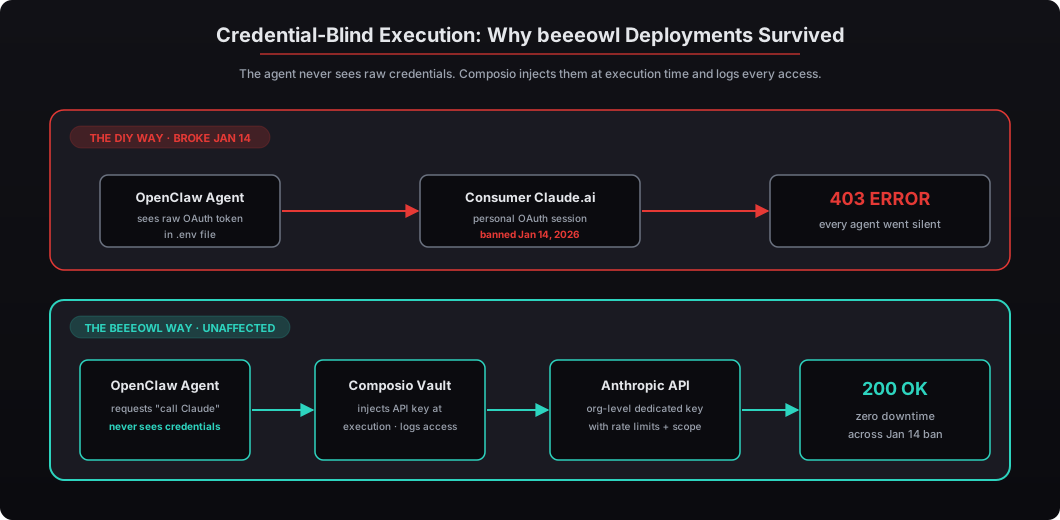
The naive approach to credential management is hardcoding keys into environment variables or configuration files. This is how most DIY OpenClaw setups worked before January 14: the Anthropic OAuth token, Google OAuth credentials, Slack tokens, database connection strings — all sitting in a .env file on the host machine. One docker inspect command from anyone with container access, and every credential was exposed. Worse, every agent process had full ambient access to every credential at all times, regardless of whether that specific agent even needed them.
Composio’s architecture works differently in four specific ways that matter for the January 14 threat model.
Credential isolation at runtime. The agent requests an action — “send this email via Gmail” or “generate analysis with Claude.” Composio intercepts the request, looks up the matching credential in its vault, injects it into the outbound API call, and returns only the result to the agent. The raw token never transits the agent’s memory space. If an attacker compromises the agent process, they get zero credentials to work with.
Automatic key rotation on a configurable schedule. For Anthropic API keys, the default rotation window in our beeeowl deployments is 90 days, but it can be tighter for sensitive workflows. Rotation happens without restarting the agent runtime — Composio swaps the vault entry, the next request uses the new key, the old key is revoked in the provider’s console. No downtime, no operator intervention.
Per-agent-per-service usage tracking and anomaly detection. Composio logs every credential access with which agent made the request, which service was called, and how much the call cost. If an agent suddenly starts making 10x its normal request volume, the anomaly detector flags it. If it starts calling a service it has never called before, that also flags. The Jan 14 retry-loop scenario I described earlier — the one where a DIY operator didn’t notice a weekend of runaway cost — doesn’t happen with Composio because the anomaly detector catches it within minutes.
Instant revocation without restarting the agent. If you need to kill a credential immediately (leaked, suspected compromise, regulatory request), Composio revokes the vault entry and the next request returns a scoped error the agent can handle gracefully. No SSH session. No container restart. No operator down the hall.
When the Anthropic OAuth ban hit on January 14, Composio users with properly configured API keys experienced zero downtime. The authentication path was entirely different from the consumer OAuth flow that broke. Their agents made requests to Composio; Composio made authenticated calls to the Anthropic API using org-level dedicated keys; Anthropic’s detection system saw normal API traffic and did exactly nothing. The ban didn’t affect them because they were never in the affected population to begin with.
Has this vendor policy change pattern happened before?
The Anthropic ban was the cleanest, most visible example — but it wasn’t the first, and it won’t be the last. Every major cloud AI vendor has tightened automated-access policies in the last eighteen months, and the pattern shows no sign of slowing.
OpenAI changed their terms of service three times in 2025 alone. The March 2025 update added explicit rate limits for agent-framework API calls, targeting the same automated-access pattern Anthropic eventually banned outright. The July 2025 update required separate billing accounts for production agent deployments, which forced companies to untangle personal-tier and enterprise-tier usage. The November 2025 update introduced mandatory usage reporting for applications exceeding 100,000 calls per month — a threshold that catches most serious agent deployments. Sam Altman addressed the changes at OpenAI DevDay, framing them as “sustainability measures.” The direction was consistent across all three updates: stricter controls, clearer separation between consumer and commercial use, more visibility for OpenAI’s risk and pricing teams.
Google restricted Gemini API access for automated agents in October 2025. The restriction required a separate “Agent Tier” enrollment with additional compliance requirements — documented workflow descriptions, contact info for an accountable engineer, and commitment to specific rate limits. DeepMind’s Demis Hassabis told Wired the restrictions were necessary to “ensure responsible deployment at scale.” Translation: Google wanted to know which customers were running agents before the agents started running up the bill. Then in Q1 2026, Google raised Gemini API pricing 40-60% for high-volume enterprise users — a move Forrester’s Jay McBain called “the SaaS-ification of AI infrastructure” and I covered in detail in why sovereign AI is the biggest infrastructure trend of 2026.
Microsoft’s Azure OpenAI Service added compliance requirements for agent deployments in February 2026. The specific addition was an agent-workload classification in the Azure policy engine, triggered by request patterns that match agent frameworks. Customers whose workloads get classified as agent workloads face additional logging, rate limits, and approval flows. The tell: Microsoft built the classifier before they built the approval workflow, which means they were already measuring who was running agents at scale before they started charging for the distinction.
Mistral AI added rate-limit tiers for automated access in February 2026. The European vendor moving the same direction confirms this isn’t an American phenomenon or an incumbent power move. It’s the universal direction of the market as AI agent workloads become real.
Gartner’s December 2025 report on AI platform risk rated vendor authentication policy changes as a “high probability, high impact” risk for enterprises running agent-based deployments — placing it ahead of model accuracy drift, hallucination incidents, and data leakage through prompts. The analyst consensus is that every major AI provider will continue tightening automated-access controls through 2026 and 2027. Any CTO building a deployment strategy that assumes today’s provider policies will still hold next quarter is planning their own outage. The question isn’t whether the next policy change lands. It’s whether your architecture survives it.
What should a CTO check before approving an AI agent deployment?
If you’re a CTO evaluating OpenClaw deployment options — or any AI agent infrastructure — five questions separate production-grade from hobby-grade setups. If the deployment provider can’t answer all five with specifics, walk away. These questions aren’t hypothetical any more. They’re the actual operational lessons of January 14.
One: does the deployment use dedicated API keys or consumer OAuth? If anyone mentions a personal account login, a browser-based sign-in flow for the agent, or anything that looks like “log into your Claude account to connect it,” walk away. Dedicated organization-level API keys with provider-side billing are the minimum viable standard after January 14. This is not a judgment call anymore.
Two: who manages the credentials and where do they live? If the answer is “they’re in an environment file on the server” or “they’re in the Docker Compose YAML,” that’s a red flag. Credential management should be isolated from the agent runtime through a dedicated broker — Composio, HashiCorp Vault, AWS Secrets Manager, or Google Secret Manager. The specific tool matters less than the architectural principle of separation. For the technical alternative to Composio, see our MCP protocol deep dive.
Three: what happens when a key needs to rotate? If key rotation requires SSH access, a config file edit, and a service restart, you have a fragile system that will fail under pressure. Production deployments rotate keys without downtime. Ideally, rotation is automated on a schedule — 90 days is the industry default, but I’ve seen regulated industries push to 30 days. The test: can the provider demonstrate a key rotation during your evaluation call without any operator intervention? If not, their architecture can’t rotate under duress either.
Four: is there per-key, per-agent usage monitoring? You need to know which agent is consuming how many tokens, on which model, at what cost, on which day. Without this visibility, you’re flying blind — and you’ll only discover a problem when you get an unexpected bill or hit a rate limit during a critical workflow. Ask to see a sample usage dashboard. If the provider doesn’t have one, they don’t have the monitoring.
Five: what’s the blast radius of a compromised credential? If one leaked key gives an attacker access to every service your agent connects to, your architecture has a single-point-of-failure problem. Properly scoped keys limit damage to a single integration — a compromised Slack key should not also expose your Salesforce data. Composio’s per-integration credential isolation solves this by default. Homegrown .env file setups almost never do.
Those five questions are also the structure we use internally at beeeowl to audit a deployment before it ships. If any one of them returns an unclear answer, the deployment doesn’t go out the door. Consumer-grade authentication in a business-critical context is exactly the bug that made January 14 possible in the first place, and we built our delivery process around never shipping it.
What should you do if your deployment was affected on January 14?
If your OpenClaw setup broke in the OAuth ban, the migration path has four steps. You can do it yourself — the OpenClaw docs team, coordinated by contributor Harrison Chase, published a migration guide on January 16 under “Authentication Migration” — or you can have a deployment team handle it. Either way, the sequence is the same.
Step one: create an Anthropic API account at console.anthropic.com. This is separate from your personal Claude account. Set up organization-level billing, add a payment method, generate dedicated API keys scoped to the specific Claude models your agent needs. Do not reuse your personal email if that email is also tied to a Claude Pro consumer account — the separation between consumer and commercial tiers is cleaner with a dedicated email or a shared billing alias.
Step two: replace the consumer OAuth configuration in your OpenClaw setup with API key authentication. The migration guide walks through the exact config file changes. The essential swap is moving from an OAuth callback flow (which authenticates against Claude.ai) to a direct API key flow (which authenticates against api.anthropic.com). Test the new configuration with a single low-stakes workflow before re-enabling everything.
Step three — and this is the step most people skip — implement proper credential management. Don’t just swap one hardcoded credential for another. Set up Composio or an equivalent credential broker so your keys are stored outside the agent runtime. This is the difference between fixing the Jan 14 break and actually becoming resilient to the next policy change. If you stop at step two, you’ll be doing this whole migration again when OpenAI or Google tightens their terms next quarter.
Step four: set up monitoring and alerting. Anthropic’s Console provides usage dashboards, but you should also have your own logging for rate-limit headroom, cost tracking, and anomaly detection. Set a spend alert at 50% of your budget and a hard cap at 100%. Set a rate-limit alert at 80% of your provisioned throughput. Set an anomaly alert for any agent that suddenly shifts its request pattern. These alerts are cheap to add and they catch the class of bug that turns a $200 incident into a $20,000 one.
Or skip the four-step migration and let us handle it. Every beeeowl deployment comes with this entire stack configured, tested, and hardened on day one — organization-level API keys, Composio credential isolation, automated rotation, per-agent monitoring, and the audit trails your CFO and CISO will both eventually ask for. Hosted setups start at $2,000 one-time. Your agents will be running on production-grade architecture within a week. Full details on our pricing page.
Why were beeeowl deployments unaffected?
We’ve used dedicated Anthropic API keys with Composio-managed credential isolation since our first deployment. Not because we predicted this specific ban — although the September 2025 ToS update was a bright flashing warning for anyone paying attention — but because consumer OAuth was never the right architecture for business-critical AI infrastructure. We built our deployment process around the five CTO questions above before the Anthropic ban forced the industry to catch up.
Every beeeowl deployment includes organization-level Anthropic API keys (never personal accounts), Composio credential isolation (agents never see raw keys), per-agent usage monitoring and configurable spend caps, automated key rotation on 90-day cycles by default, separate credential scopes per integration (Anthropic, Google, Slack, Salesforce, QuickBooks, and others each get their own managed keys with no cross-service permissions), full audit logging for every credential access, and Docker sandboxing so a compromised agent process can’t escalate to host-level access. When the Jan 14 ban hit, our support inbox was quiet. Our clients’ agents kept running. No outage reports, no migration tickets, no emergency calls.
What we did get was a wave of inbound from operators whose DIY setups had gone dark. Some of them were technical founders who had spun up OpenClaw themselves and thought they had production infrastructure because the agent was answering prompts. The Jan 14 ban taught them the difference between “it works right now” and “it will still be working in six months.” Several of those inbound inquiries became clients in the two weeks after the ban. For the broader security story, see our breakdown of what beeeowl does differently on security hardening.
Is this the last vendor policy change we’ll see?
No — and if anything, the pace is accelerating. Microsoft, Mistral, Google, OpenAI, and Anthropic have all moved the same direction in the past twelve months: tighter controls on automated agent access, clearer separation between consumer and production tiers, higher prices for the workloads that actually drive their cost curve, and more aggressive detection for the access patterns that fall outside their stated use cases. Every one of those moves is economically rational for the providers and architecturally painful for customers building on the wrong tier.
The CTOs who build their AI infrastructure with this reality in mind — dedicated credentials, proper key management, provider-agnostic abstractions where possible, rotation on a schedule, monitoring by default — won’t be scrambling when the next policy change lands. The CTOs who cut corners on authentication because “it works for now” will be the ones posting in Discord at 2 AM wondering why their agents went silent. We’ve seen this movie once already. We know how the next one ends.
The broader lesson from January 14 is that the age of improvised AI infrastructure is closing. Agent workloads are real enough now that providers are building detection, pricing, and enforcement specifically for them. The rules will keep tightening. The only question is whether your deployment was built to survive that tightening from the start, or whether you’ll rebuild it every time a vendor updates its terms. Build it right from the start — or hire someone who will.