Why Sovereign AI Is the Biggest Infrastructure Trend of 2026
IBM pegs AI-related breaches at $5.12M. Gartner projects 60% of large enterprises will own their AI infrastructure by 2028. Here's why sovereign AI is 2026's defining shift.


IBM’s 2025 Cost of a Data Breach Report pegs the average incident at $4.88 million. Breaches involving AI and third-party providers average $5.12 million and take 42 days longer to detect. Gartner’s February 2026 forecast projects that by 2028, 60% of large enterprises will run at least one AI workload on infrastructure they directly control — up from under 12% in 2024. Stanford HAI’s 2026 AI Index names sovereign AI the single fastest-growing infrastructure category of the year. The companies still routing confidential data through cloud AI APIs aren’t being cautious. They’re accumulating exposure.
What does sovereign AI actually mean at the infrastructure level?
Sovereign AI means running artificial intelligence on infrastructure you own, in a jurisdiction you choose, under policies you set. It’s the opposite of calling OpenAI’s API and hoping their terms of service don’t change tomorrow. The operational test is simple: if you can’t answer “where is the data, who has the keys, and what runs the model” in one sentence, it isn’t sovereign.
Stanford HAI’s 2026 AI Index Report identifies sovereign AI adoption as the single fastest-growing infrastructure category this year, with investment up 214% year-over-year across G20 nations. This isn’t a niche concern for governments anymore. It’s hitting Fortune 500 boardrooms, private equity partnerships, and the private offices of CEOs who don’t want their M&A pipeline processed through servers they’ll never audit. We covered the geopolitical backdrop in the sovereign AI movement — this article is about the infrastructure mechanics.
Three forces converged to make 2026 the inflection point: regulatory enforcement, breach cost escalation, and vendor lock-in. Each on its own would be enough to move the conversation. All three at once is what turned it into a budget line item.
Why is 2026 the tipping point — not 2025 or 2027?
Because three independent timelines snapped into place in the same quarter. The EU AI Act’s enforcement mechanisms are now fully operational. The open-source AI agent stack reached production maturity. And hardware got cheap enough that a full private deployment costs less than a mid-size enterprise SaaS contract. Any one of these would matter. Together, they close the window on “we’ll figure it out later.”
Deloitte’s Q1 2026 EU Regulatory Survey found that 58% of multinational enterprises have either started or completed AI infrastructure audits — up from 22% six months prior. That’s a near-tripling in a single quarter. The companies that were “monitoring the situation” in 2025 are now filling out compliance questionnaires with actual deadlines.
On the open-source side, OpenClaw crossed 350,000 GitHub stars and counts NVIDIA engineers among its core contributors. Stanford HAI’s 2026 benchmarks show the gap between open and proprietary models narrowed to under 8% on standard enterprise use cases — down from 23% in 2024. Open-weight models from Mistral, Meta’s Llama 3.1, and Alibaba’s Qwen now perform within striking distance of GPT-4o and Claude Sonnet for the tasks most executives actually run.
And the hardware math flipped. Apple’s Mac Mini with M4 Pro starts at $1,399 and runs a local LLM alongside an OpenClaw agent without breaking a sweat. Two years ago, equivalent on-premise AI capability meant a $15,000+ GPU server. IDC’s March 2026 worldwide spending guide forecasts $47.2 billion in sovereign AI infrastructure investment this year — a category that didn’t exist in their 2023 reports.
What does $4.88 million in breach costs have to do with AI infrastructure?
Everything. Because every prompt you send to a cloud AI API is a data transfer you don’t control, logged on a server you can’t audit, under a retention policy you can’t verify. IBM’s 2025 Cost of a Data Breach Report pegs the global average at $4.88 million per incident — the highest in the report’s 20-year history. AI-related breaches involving third-party providers averaged $5.12 million, with detection-to-containment timelines stretching 42 days longer than breaches involving on-premise systems.
Ponemon Institute’s 2025 research found that 67% of enterprises couldn’t confirm whether their AI vendor retained prompt data after processing. Think about that for a CEO prepping acquisition documents, a CFO running scenario models, or a VC analyzing a deal memo. You’re feeding your most sensitive information into a system where you literally cannot verify what happens to it afterward.
Verizon’s 2025 Data Breach Investigations Report added another dimension: third-party involvement in breaches increased 28% year-over-year. The more external services touching your data pipeline, the larger your attack surface. I’ve talked to CISOs at mid-market companies who’ve started treating AI API calls the same way they treat wire transfers — approval and logging on every one. That works at 50 queries a day. It falls apart completely when you deploy an agent that operates autonomously across email, Slack, and your CRM around the clock.
The only architecturally sound answer is to bring the AI onto infrastructure you control. Not because the cloud is inherently insecure — but because you can’t audit what you don’t own.
How did vendor lock-in become an existential risk?
Because every major cloud AI vendor changed the rules on enterprise customers in the last 18 months — and there’s no reason to expect that pattern to stop. OpenAI has revised its terms of service three times since GPT-4’s launch. Anthropic broke production OAuth workflows in late 2025. Google raised Gemini API pricing 40-60% in Q1 2026. Forrester analyst Jay McBain called it “the SaaS-ification of AI infrastructure.”
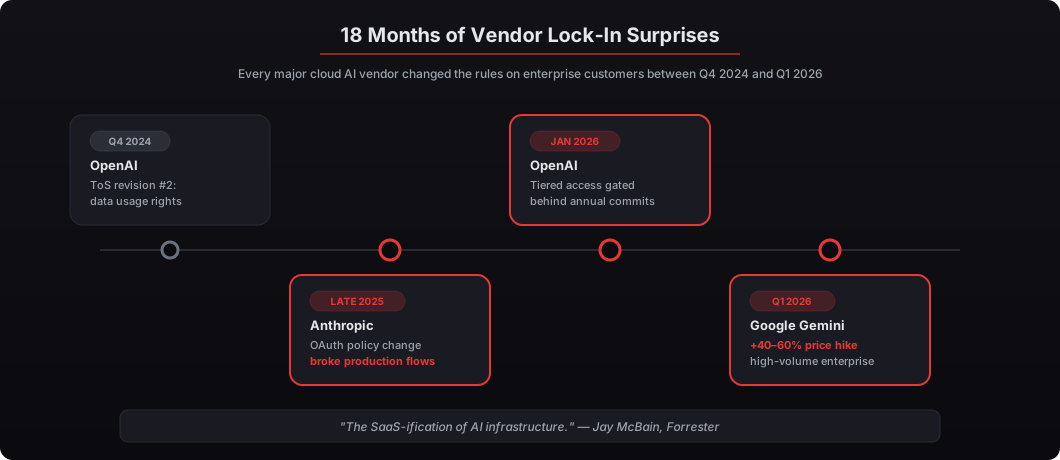
The Anthropic episode is worth understanding in detail. In late 2025, Anthropic changed its OAuth integration policies, and developers on Hacker News documented the fallout in real time — authentication flows that worked on Monday stopped working on Wednesday, with no migration path announced in advance. Companies that had built production systems around Claude’s API spent the following weeks rewriting integration code.
Then in January 2026, OpenAI introduced tiered access that effectively gated certain capabilities behind annual commitments — the move McBain flagged. Sequoia Capital’s internal analysis (referenced by The Information in February 2026) noted that AI API costs now represent the fastest-growing line item in their portfolio companies’ operating budgets.
This is the vendor lock-in playbook enterprise software veterans recognize from the Oracle and SAP era — except it’s happening at compressed timescales. You build workflows around an API, train your team on its quirks, integrate it into operations, and then discover your vendor has repriced, restructured, or restricted the service you depend on. Jensen Huang saw this coming at Computex 2025, when he compared OpenClaw to Linux and Kubernetes — arguing the agent layer needs to be open and ownable the same way operating systems and orchestration became open and ownable. NVIDIA backed the position by assigning engineers directly to OpenClaw’s security stack. When a $3.4 trillion company contributes engineering resources to an open-source project, it isn’t charity. It’s infrastructure investment.
What are the three layers of a sovereign AI stack?
A sovereign AI deployment has three layers: the infrastructure layer, the model layer, and the agent layer. You need to own or control all three for it to count. If any layer is rented from a third party, the stack isn’t sovereign — it’s just cheaper rent on someone else’s building.
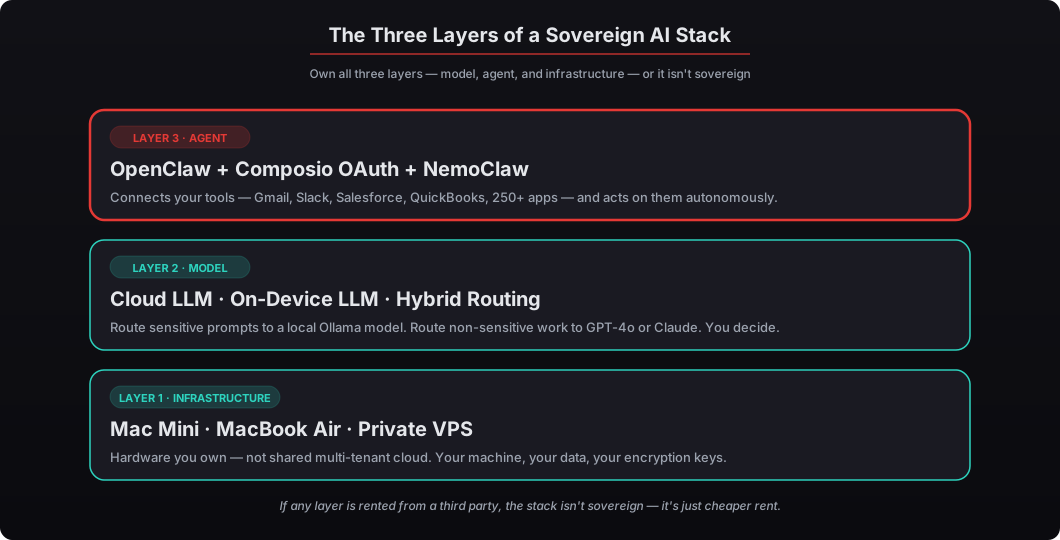
The infrastructure layer is the hardware or server. At beeeowl, we deploy on Mac Minis for office setups, MacBook Airs for traveling executives, or dedicated cloud VPS instances the client controls. The key distinction: this isn’t a shared multi-tenant server. It’s your machine, your data, your encryption keys. Not AWS Bedrock. Not Azure OpenAI Service. Yours.
The model layer is where you choose between a cloud-hosted LLM (GPT-4o, Claude Sonnet) and a private on-device model running through Ollama. For most executives, a hybrid approach works — route confidential work through a local model that never phones home, and use a cloud model for non-sensitive tasks where latency and cost matter more than residency. Dr. Fei-Fei Li of Stanford HAI has argued this hybrid architecture will define enterprise AI for the next decade.
The agent layer is OpenClaw. It connects to your tools — Gmail, Google Calendar, Slack, HubSpot, Salesforce, Notion, QuickBooks, and 250+ others through Composio — and acts on them autonomously. Because it’s open-source, you can inspect every line of code. Because NVIDIA built NemoClaw around it, you get enterprise-grade guardrails: policy controls, privacy routing, Docker sandboxing, and audit trails. For the plain-English breakdown, see our guide to what OpenClaw is.
The entire deployment takes one day. We handle OS hardening, Docker configuration, Composio OAuth setup, firewall rules, and agent configuration. The client gets a fully operational agent connected to their tools and running its first workflows within 24 hours. Not a three-year digital transformation roadmap. Not an 18-month committee review. A production system on your desk by next week.
Which industries are already making the shift?
The early movers aren’t who you’d expect. Private equity, law firms, and healthcare systems are moving faster than defense contractors — because their data sensitivity already mapped to regulations their cloud AI vendors couldn’t satisfy. The Fortune 500 is catching up, not leading.
Bain & Company’s 2026 Technology Report found that 43% of private equity firms with over $5 billion AUM have either deployed or budgeted for sovereign AI infrastructure. The driver is specific: deal flow data is the most sensitive information in finance, and sending it through a third-party API is a liability their LPs are starting to flag. We see this directly — our VC and PE clients deploy first, then expand to portfolio monitoring workflows within a quarter.
Law firms are the second big category. The American Bar Association’s 2026 Legal Technology Survey found that 31% of AmLaw 200 firms have policies restricting AI API usage for client-confidential work. Several have deployed on-premise AI agents specifically to avoid the ethical complications of third-party data processing. Attorney-client privilege and a cloud API call do not share a comfortable legal theory.
Healthcare systems are moving fast, driven by HIPAA’s intersection with AI. Kaiser Permanente, Mayo Clinic, and Cleveland Clinic have all publicly discussed on-premise AI strategies. The HHS Office for Civil Rights issued guidance in January 2026 clarifying that AI systems processing PHI through external APIs may trigger additional HIPAA compliance requirements — which for most hospital general counsels translates to “move it on-premise or stop using it.”
The pattern under all three industries is the same: sensitive data plus strict regulators plus cloud AI equals exposure no CISO can sign off on. Sovereign AI isn’t the cautious choice. It’s the only choice that survives a real audit.
What’s the real cost of waiting?
Two things compound, and both are expensive. First, compliance costs scale on a non-linear curve — PwC’s 2026 compliance cost analysis found that retroactive AI infrastructure changes cost 3.2x more than proactive ones. Second, your competitors don’t wait. Sovereign AI deployment is a capability moat that widens every week it runs.
McKinsey’s March 2026 regulatory impact analysis estimates that 35% of current enterprise AI deployments will require architectural changes to meet 2026-2027 compliance deadlines. That’s not a gentle retrofit. That’s ripping cloud API calls out of production workflows and rebuilding on a stack you can audit. If you do it on your own timeline it’s a planned project. If you do it after a regulator arrives it’s a fire drill with a deadline and a penalty meter running.
The competitive dimension is the one executives undersell. The CEO with an AI agent processing deal flow on private infrastructure can move faster, analyze more, and protect data better than the one still copying and pasting into ChatGPT. That gap compounds weekly. I’ve watched it happen with our clients — by month three, the executive running a sovereign agent has a body of operational data (which workflows work, which prompts break, which integrations matter) that no consultant can replicate. We break the business case down in the case for private AI.
I’m not saying rip out cloud AI tomorrow. I’m saying every company needs a sovereign AI strategy by end of 2026 — a concrete plan for which workloads stay in the cloud, which move to controlled infrastructure, and what the migration timeline looks like. Companies treating this as a 2027 problem are the same ones that treated cloud migration as a 2020 problem in 2016. They caught up eventually. It just cost them a lot more.
How does beeeowl deploy sovereign AI in practice?
We pick one workflow, one executive, one agent — and deploy it on hardware you own in one day. That’s the operating principle. Don’t try to boil the ocean. Pick the workflow where data sensitivity is highest and automation value is most obvious (usually executive email triage, board prep, or deal flow screening) and deploy a sovereign AI agent specifically for that workflow.
Hosted deployments start at $2,000. Hardware tiers with a Mac Mini or MacBook Air included run $5,000 to $6,000 — one-time, not subscription. Every deployment includes Docker sandboxing, Composio OAuth setup, firewall hardening, audit trails, authentication, and one fully configured agent. Full details on our pricing page, and workflow examples by role on our use cases page.
Once the first agent is running, you’ll understand the architecture firsthand. You’ll see what local processing feels like versus cloud roundtrips. You’ll have a concrete data point for your board, your CISO, and your CFO. And you’ll have a production system generating value from day one — not a proof of concept gathering dust in a sandbox.
The sovereign AI shift isn’t coming. It’s here. Stanford said so. Gartner said so. The EU AI Act said so. Forty-plus heads of state at Davos said so. Your competitors’ budgets say so. The only question left is whether you’re building the infrastructure or renting it from someone who can change the terms whenever they want.