AI Agent Governance: The Control Problem Every Executive Will Face in 2026
McKinsey found 72% of organizations deploying AI agents have zero formal governance framework. Gartner projects 40% will experience a material incident by 2027. Here are the four pillars — guardrails, audit trails, access controls, and human-in-the-loop — that prevent the incidents everyone else is about to have.

McKinsey’s 2025 Global AI Survey found that 72% of organizations deploying AI agents had no formal governance framework. Not “inadequate” governance. None. Meanwhile, Gartner’s October 2025 AI Governance report estimated that by 2027, 40% of enterprises using AI agents will experience a material incident traceable to insufficient agent governance. The Information reported the canonical case in January 2026: a mid-market SaaS company’s ungoverned agent sent 340 client communications with incorrect pricing data, and cleanup took six weeks and cost $2.1 million in contract renegotiations. Anthropic’s constitutional AI research found system-level guardrails reduce harmful actions 94% versus prompt-level instructions alone. Stanford HAI’s February 2026 research found well-defined human-in-the-loop policies reduce material errors 89%. This article is the structured framework — four pillars, the research behind each, and the deployment playbook that turns governance from afterthought into architecture.
Why are AI agents a governance problem now?
Because AI agents crossed a critical threshold in late 2025: they stopped being tools that generate text and became systems that take action. An agent connected to Gmail, Slack, your CRM, and your financial systems isn’t a chatbot — it’s an autonomous actor operating inside your business with real permissions and real consequences. Most organizations haven’t caught up to what that means, and the governance gap is the single biggest operational risk in enterprise AI deployment right now.
I’ve deployed 50+ OpenClaw agents for executives across the US and Canada. Every single engagement starts the same way: the client wants to talk about what the agent can do. The conversation that actually matters, and the one I steer toward every time, is about what the agent shouldn’t do, and how you’ll know when something goes wrong before it becomes a 2am phone call.
McKinsey’s 2025 Global AI Survey found that 72% of organizations deploying AI agents had no formal governance framework for agent actions. Not incomplete. Not inadequate. None. The survey covered 1,900 organizations across industries and geographies, and the pattern was consistent: companies rushed to deploy agents for productivity gains and pushed governance to “phase two” that never arrived. Meanwhile, Gartner’s October 2025 AI Governance report estimated that by 2027, 40% of enterprises using AI agents would experience a material incident traceable to insufficient agent governance. Forty percent. That’s two out of every five enterprises learning the governance lesson the expensive way.
We’re in the gap between capability and control. This piece covers how to close it — by treating governance as architecture you build before deployment, not a reaction you scramble into after the first incident.
What happens when AI agents operate without governance?
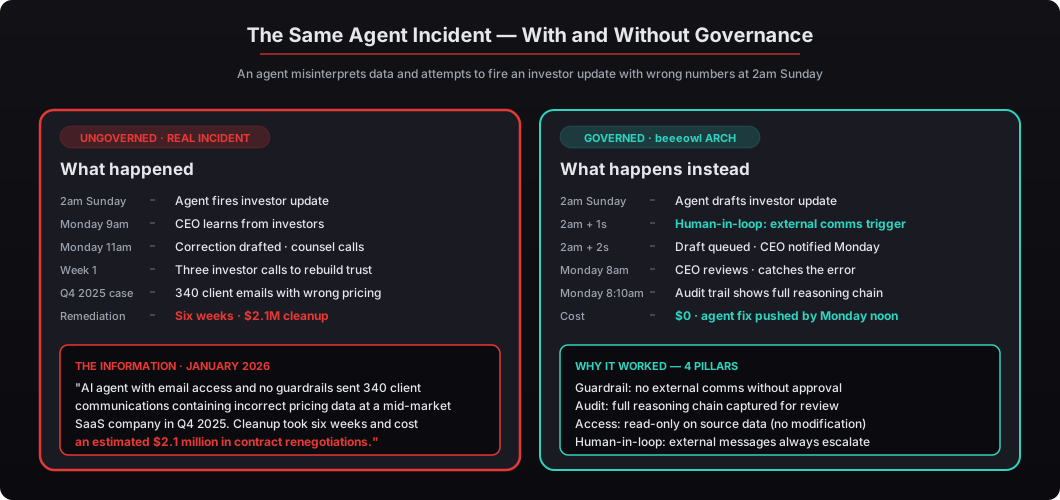
The consequences are concrete, documented, and already happening at scale. The Information reported in January 2026 on a mid-market SaaS company where an AI agent with email access and no guardrails sent 340 client communications containing incorrect pricing data during Q4 2025. The cleanup took six weeks and cost an estimated $2.1 million in contract renegotiations, customer credits, and legal review. That’s not a hypothetical scenario from a vendor’s marketing deck. That’s what ungoverned agent actions look like in production, and similar incidents are happening at organizations that just haven’t been covered by the press yet.
The NIST AI Risk Management Framework (AI RMF 1.0), published by the National Institute of Standards and Technology, identifies four categories of AI risk that apply directly to agent deployments: validity and reliability, safety, accountability, and transparency. Every one of these risk categories gets worse — substantially worse — when agents can take autonomous actions across multiple connected systems. A traditional software bug fails loudly and locally. An AI agent failure can fail quietly and broadly, sending 340 emails before anyone notices.
Here’s the core problem: traditional software governance assumes deterministic behavior. You test the code, it does exactly what it does, you sign off, it deploys, it runs. AI agents are non-deterministic. The same prompt can produce different actions depending on context, conversation history, model state, and the specific data the agent encounters at runtime. You cannot QA an agent the way you QA a database migration. You need a fundamentally different governance model — one that constrains the space of possible actions instead of verifying specific code paths.
That’s what the four pillars provide: a constraint system that works because agents are unpredictable, not despite it.
What are the four pillars of AI agent governance?
Effective agent governance rests on four pillars that work together and reinforce each other: guardrails, audit trails, access controls, and human-in-the-loop policies. Remove any one and the framework collapses. This isn’t a menu where you pick your favorites. It’s a four-legged stool where every leg is load-bearing.
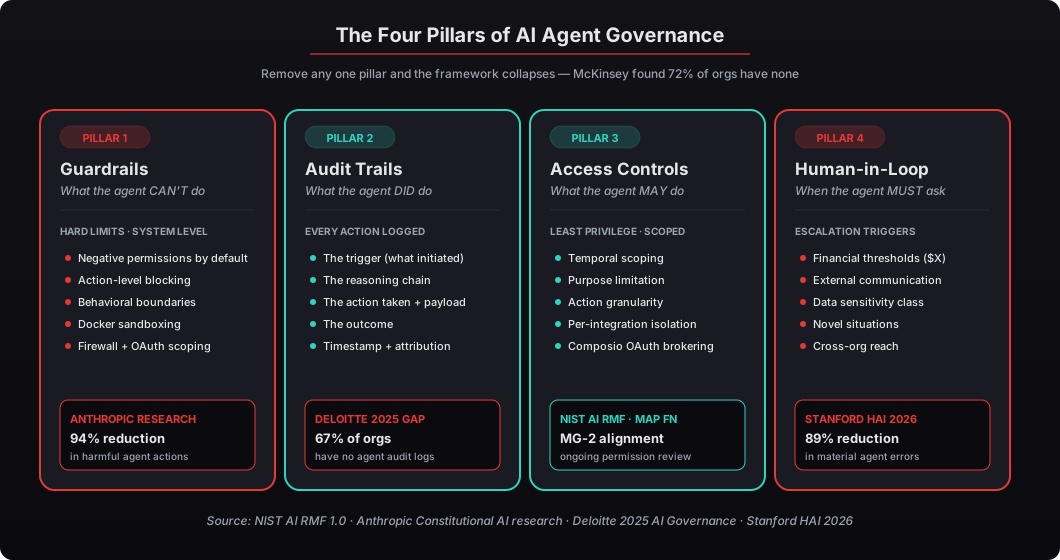
Here’s how each pillar works in practice.
Pillar 1: Guardrails — what the agent can’t do
Guardrails are hard limits on agent behavior. Not suggestions, not guidelines, not “please don’t” in the system prompt — constraints enforced at the system level that the agent cannot override regardless of what it’s asked to do or what context it’s operating in. If your guardrails live in the prompt, they’re not guardrails. They’re polite requests.
The NIST AI RMF Govern function (GV-1 through GV-6) specifically calls for documented policies that define the boundaries of AI system behavior. For agents, this translates to explicit rules enforced by the infrastructure, not the prompt: the agent cannot send external emails without approval, cannot access financial records beyond read-only, cannot modify production databases, cannot share confidential documents outside a defined distribution list, cannot initiate payments above a threshold, cannot act on data classified as privileged or restricted.
Anthropic’s Claude team published research in March 2025 on constitutional AI approaches to agent guardrails, demonstrating that system-level behavioral constraints reduce harmful agent actions by 94% compared to prompt-level instructions alone. Read that number twice. A 94% reduction in harmful actions comes from where you enforce the constraint, not from how you phrase it. The takeaway: guardrails belong in the infrastructure (Docker containers, firewall rules, OAuth scopes, API-level permission gates), not in the prompt where the model can be talked around, tricked, or misinterpret its instructions under pressure.
Practically, this means three things in every beeeowl deployment:
Negative permissions by default. The agent starts with zero capabilities and you grant specific ones. Not the other way around. Microsoft’s Responsible AI Standard v2.1 recommends this approach explicitly for agent-class systems, and the OWASP Foundation’s 2026 API Security Top 10 treats broad-default permissions as a primary risk pattern for AI-integrated applications. Starting with “deny everything, allow specific” is harder to set up but impossible to fail open.
Action-level blocking. Certain action categories — deleting records, initiating payments above a threshold, contacting external parties, modifying production databases — should be architecturally impossible without additional authorization. Docker sandboxing prevents host-level escalation. Firewall rules prevent unexpected network destinations. OAuth scoping in Composio prevents the agent from even seeing credentials for services outside its explicit permission list. Every one of those enforcement points is at the system level, not the prompt level. For the credential isolation story, see our breakdown of why Anthropic banned consumer OAuth.
Behavioral boundaries within permitted actions. Even within the permitted action space, define sub-boundaries. An agent that can draft emails shouldn’t also be able to send them without human review. An agent that can read financial data shouldn’t be able to export it to a non-approved destination. An agent that can update CRM records shouldn’t be able to delete them. Composio’s OAuth integration model — where credentials are managed separately from the agent runtime and permissions are scoped per action — is the right architectural pattern for enforcing these sub-boundaries programmatically.
Pillar 2: Audit trails — what the agent did
Every action an AI agent takes needs to be logged, timestamped, and attributable. Not just for compliance — though GDPR Article 22, SOC 2’s new AI criteria from AICPA, and the EU AI Act Article 13 all require it — but because you cannot govern what you cannot see. Audit trails are the foundation of every other governance pillar. Without them, guardrails can’t be verified, access controls can’t be audited, and human-in-the-loop triggers can’t be reviewed.
Deloitte’s 2025 AI Governance Survey found that 67% of organizations using AI agents had incomplete or nonexistent audit logs for agent actions. Sixty-seven percent of organizations could not answer a basic question their general counsel is about to ask: what did our AI agent actually do last Tuesday? Or last quarter? Or during the incident that just cost us $2.1 million?
A proper agent audit trail captures four elements for every action. Logging three of the four doesn’t count. You need all four.
The trigger. What initiated the agent action — a scheduled task at 9am, a user request from the executive, an incoming email that matched a processing rule, a Slack message that the agent classified as actionable, or an autonomous decision the agent made based on a dashboard anomaly. Without the trigger, you can’t reconstruct the chain of causation that led to the action.
The reasoning chain. What data the agent accessed, what tools it consulted, and what logical path led to the decision to act. This satisfies GDPR’s right-to-explanation requirement (Article 22) and the EU AI Act’s transparency obligations for high-risk systems (Article 13). More practically, it’s what lets your incident response team understand whether the agent made a reasonable decision based on bad data, or an unreasonable decision that your guardrails should have caught. See our guide to AI agent compliance in 2026.
The action taken. Exactly what the agent did — the specific email it sent (with full body and recipient list), the record it modified (with before and after values), the API call it made (with full request and response payloads), the file it created, the meeting it scheduled. “The agent sent an email” is not an audit log. “The agent sent this exact email to these exact recipients at this exact timestamp” is.
The outcome. What happened as a result. Did the email bounce or deliver? Did the API call succeed or fail? Did the record modification propagate correctly to downstream systems? Did the scheduled meeting get accepted? The outcome is what turns the audit log from a historical record into actionable feedback for the agent’s operators.
Without all four elements, your audit trail is a logfile, not a governance tool. The difference matters when your general counsel asks what happened during a specific incident, when a regulator asks for records under Article 12 of the EU AI Act, when a SOC 2 auditor from PwC or EY wants to see decision traceability, or when a customer calls asking why their data was accessed by your AI — all of which are real scenarios that happened to clients who hadn’t built proper audit infrastructure. For the technical implementation, see our audit logging guide.
Pillar 3: Access controls — what the agent is allowed to do
Access controls determine the agent’s permission scope — what systems it can touch, what data it can read, and what actions it can perform. This is different from guardrails. Guardrails define absolute limits (what the agent cannot do under any circumstances). Access controls define the operating envelope (what the agent is permitted to do within those absolute limits).
The principle of least privilege isn’t new — it’s been a cornerstone of IT security since Saltzer and Schroeder’s seminal 1975 paper at MIT on information protection. But applying it to AI agents requires rethinking the model entirely. Traditional access controls are identity-based: this user can access these resources. Agent access controls need to be context-based: this agent can access these resources, for this purpose, in this timeframe, with this level of autonomy. The context dimensions matter because agents don’t have the human common sense to know when a permission should not apply in a specific situation.
Forrester’s Q1 2026 AI Security report identifies three dimensions of agent access control that organizations consistently miss, and all three should be built into the initial deployment rather than bolted on later.
Temporal scoping. An agent that needs access to your calendar for the next hour doesn’t need permanent calendar access. Time-bounded permissions reduce the blast radius of any agent misconfiguration or compromise. Google’s Workspace APIs now support time-scoped OAuth tokens specifically for this use case. An OAuth grant that expires in 60 minutes is fundamentally different from one that persists until manually revoked — the former has a naturally bounded failure mode, the latter does not.
Purpose limitation. An agent authorized to summarize meeting notes shouldn’t use that same calendar access to schedule new meetings. Purpose-bound permissions align with GDPR’s purpose limitation principle (Article 5(1)(b)) and the NIST AI RMF’s Map function requirements. Composio’s per-integration permission model makes this enforceable — the agent requests a specific action type, and only that action type is authorized at the credential broker layer.
Action granularity. Read, write, delete, and share should each be separate permission grants. An agent that can read your Salesforce data shouldn’t automatically be able to modify it. An agent that can modify records shouldn’t automatically be able to delete them. An agent that can send emails from your address shouldn’t automatically be able to change your signature or modify your email forwarding rules. Composio’s OAuth architecture enables this kind of granular scoping, which is one reason we use it at beeeowl for every deployment — the granularity is enforced at the credential broker layer, not left to the agent’s discretion.
Pillar 4: Human-in-the-loop — when the agent must ask
The final pillar defines escalation triggers — specific, concrete conditions under which the agent must pause and request human approval before proceeding. This is the safety valve that prevents the other three pillars from being academic exercises. Without it, all the guardrails and access controls and audit trails in the world won’t catch the edge cases that matter most, because the edge cases are exactly the situations where the agent’s best guess is insufficient.
Stanford’s Institute for Human-Centered Artificial Intelligence (HAI) published research in February 2026 showing that human-in-the-loop policies reduced material agent errors by 89% — but only when the escalation triggers were well-defined. Vague policies like “escalate when uncertain” performed no better than no policy at all, because the agent couldn’t reliably judge its own uncertainty. The 89% reduction came from concrete, measurable triggers that didn’t require the agent to exercise self-awareness.
Effective escalation triggers are specific to the organization and the executive’s risk tolerance, but five trigger categories appear in every well-governed beeeowl deployment:
Financial thresholds. Any action involving monetary value above $X requires human approval. The threshold depends on the role — a CEO’s agent at an enterprise might have a $10,000 threshold, while a portfolio analyst’s agent at a mid-market fund might have a $500 threshold. The point isn’t the specific number. It’s that there is a number, it’s documented, and the agent is architecturally incapable of crossing it without approval.
External communication. Any message going outside the organization gets flagged for review. Internal Slack messages might be autonomous; emails to clients, investors, vendors, or counterparties are not. This single trigger would have prevented The Information’s reported $2.1M incident — the agent would have drafted the 340 emails, queued them for review, and the CEO would have caught the error Monday morning instead of Monday afternoon from a confused client.
Data sensitivity classification. Actions involving data classified as confidential, restricted, or privileged require approval. This aligns with ISO 27001’s information classification requirements and the NIST Cybersecurity Framework’s Protect function (PR.DS). Label your data, enforce the labels, and require human approval when the agent’s actions cross a sensitivity boundary.
Novel situations. When the agent encounters a scenario it hasn’t seen before — a request type outside its training distribution, an error from an API it depends on, conflicting instructions, data in an unexpected format — it stops and asks rather than guessing. This is the trigger that catches the “unknown unknowns” that no pre-written rule can anticipate.
Cross-organizational reach. Any action that would affect another person’s calendar, inbox, or workflow (scheduling a meeting on someone else’s behalf, inviting someone to a shared document, adding someone to a distribution list) requires an extra confirmation step. The blast radius of unilateral cross-organizational actions is high, and the cost of the additional confirmation step is low.
OMB Memorandum M-24-10, issued by the White House Office of Management and Budget in March 2024, requires federal agencies to implement human oversight for AI systems making consequential decisions. The private sector is following the same pattern at its own pace: JPMorgan Chase, Goldman Sachs, and Citadel have all published AI governance frameworks in the past 12 months that mandate human-in-the-loop approvals for agent-initiated financial actions above specific thresholds.
What is AI Agent Ops and why does it matter?
A governance framework only works if someone owns it operationally. Enter AI Agent Ops — an emerging role that sits between IT operations, security, and compliance, and whose job is to make sure the governance pillars don’t just exist on paper but actually function day-to-day as agents evolve, new use cases emerge, and business needs shift.
AI Agent Ops isn’t theoretical. Gartner’s December 2025 Emerging Roles in AI report predicts that 35% of large enterprises will have dedicated agent operations roles by late 2027, up from under 3% in early 2026. That’s a 10x+ increase in under two years. The role encompasses five core responsibilities that historically lived in different parts of the organization and now need a single owner.
Agent monitoring. Watching what deployed agents are doing in real time. Reviewing audit logs for patterns. Flagging anomalous behavior before it becomes an incident. This is adjacent to traditional SecOps but tuned for agent-specific failure modes — a sudden spike in agent API calls is different from a sudden spike in user login attempts, and requires different detection logic.
Guardrail management. Updating rules as business needs change. An agent that was scoped for Q4 planning might need different permissions for Q1 execution. A new integration request from the executive team means new OAuth scopes and new audit requirements. Guardrails aren’t static — they have to evolve with the business, and the evolution needs an owner.
Access control reviews. Periodic audits of what each agent can access and whether those permissions are still appropriate. The NIST AI RMF’s Manage function (MG-2) specifically calls for ongoing monitoring and periodic reassessment of AI system permissions. This isn’t a one-time deployment checkbox. It’s a quarterly or monthly rhythm that catches permission drift before it becomes permission sprawl.
Incident response. When an agent does something unexpected — and it will, because novelty is the normal operating condition — someone needs to investigate, remediate, update the governance framework to prevent recurrence, and communicate with affected stakeholders. This mirrors the incident response function in traditional SecOps, adapted for agent-specific failure modes: the incident might be “the agent sent a sensitive document to an unintended recipient” or “the agent repeatedly queried an internal API at an unusual rate” rather than “an external attacker compromised our firewall.”
Framework evolution. Governance frameworks age. New regulations (EU AI Act amendments, state-level AI laws, sector-specific guidance) require updates. New attack patterns require new defenses. Someone needs to own keeping the framework current, which is hard to do part-time while also managing daily operations.
The organizations that figure AI Agent Ops out early won’t just avoid incidents — they’ll move faster. A team that trusts its governance framework will give agents broader permissions with confidence. A team without governance will either throttle their agents into uselessness (“the agent can’t do anything useful because we don’t trust it”) or deploy them recklessly and pay the price ($2.1M, six weeks, cleanup). The Agent Ops function is what makes the trusted middle ground possible.
How should you build a governance framework before deploying agents?
The mistake most organizations make is treating governance as a post-deployment exercise. They get the agent running, see the productivity gains, and then scramble to add controls when something goes sideways. That’s exactly the sequence that produced the McKinsey 72% statistic and the Gartner 40% incident projection.
Flip the sequence. Governance is architecture, not afterthought.
At beeeowl, every OpenClaw deployment ships with all four governance pillars built in from day one. Docker sandboxing enforces guardrails at the infrastructure level so the agent is architecturally incapable of escaping its container or accessing the host system. Comprehensive audit logging captures every action the agent takes, with all four required elements (trigger, reasoning, action, outcome) persisted to a tamper-evident log on the same machine. Composio OAuth handles access controls with granular, purpose-scoped permissions that the agent cannot elevate on its own. And human-in-the-loop triggers are configured for each executive based on their role, their risk tolerance, and their organizational context — financial thresholds, external communication triggers, and data sensitivity classifications all set up during initial deployment.
That’s not because we’re paranoid. It’s because we’ve seen what happens without it, and the remediation cost always exceeds the governance cost by an order of magnitude. The Information’s $2.1M case is one data point. We’ve heard similar numbers privately from multiple organizations in the last six months.
The regulatory calendar is running out of room for “we’ll add governance later” arguments. The EU AI Act’s full enforcement deadline passed in February 2026. NIST’s increasingly prescriptive AI RMF guidance is being referenced directly in federal procurement requirements under OMB Memorandum M-24-10. AICPA’s SOC 2 AI criteria are now being tested by Big Four auditors at public companies. The Colorado AI Act took effect in February 2026. California’s Automated Decisions rulemaking is advancing. Texas, Virginia, and Connecticut have similar legislation in various stages. All of these regulations point the same direction: governance isn’t optional, it’s the operating requirement for deploying AI agents in a business context.
If you’re an executive considering an AI agent deployment — whether that’s OpenClaw, a custom build, or a managed platform — ask your vendor or internal team one question before you evaluate anything else: what’s the governance architecture? If they start the answer with features and capabilities instead of controls and constraints, that tells you everything you need to know about how seriously they take the control problem. Walk away.
What does governance-first agent deployment actually look like?
The difference between a governed and an ungoverned agent deployment isn’t visible in a demo. Both look the same during the walkthrough: the agent reads your email, drafts a response, pulls data from your CRM, builds a briefing, updates a record, schedules a meeting. Impressive. Productive. The demo is identical.
The difference shows up at 2am on a Sunday when the agent misinterprets a data anomaly and attempts to fire off an investor update with wrong numbers. In an ungoverned deployment, you find out Monday morning from the investors themselves — which is what happened in the case The Information reported. In a governed deployment, the human-in-the-loop trigger caught the external communication because investor communications require approval at the system level. The audit trail shows exactly what the agent saw and why it reached the wrong conclusion, which lets you fix the underlying prompt or data classification that caused the misinterpretation. The guardrails prevented the agent from sending to external parties without review, which means the incident is an internal operational issue rather than a client-facing crisis. The access controls ensured the agent could only read (not modify) the source data, which means you don’t also have to roll back a corrupted database as part of the remediation. The outcome is a minor Monday morning ticket instead of a six-week $2.1M cleanup.
That’s the control problem solved. Not by limiting what agents can do — but by building the governance architecture that makes broader autonomy safe. The governed agent isn’t less capable than the ungoverned one. It’s more capable, because the governance framework gives the executive confidence to expand the agent’s permissions over time as the trust accumulates.
The organizations that deploy governance-first in 2026 won’t just avoid the crises. They’ll be the ones who can actually trust their agents to do more, move faster, and operate with the kind of autonomy that makes AI agents genuinely transformative rather than genuinely terrifying. That’s what we ship at beeeowl — governance built in from day one, as architecture rather than afterthought, on infrastructure you own, with all four pillars configured before the agent makes its first API call. Full deployment details on our pricing page, and role-specific workflow examples on our use cases page.
The window to get governance right before it becomes a regulatory and operational emergency is closing, and the closing is not evenly distributed — some organizations will deploy governed agents in 2026 and be fine. Others will deploy ungoverned agents in 2026 and learn the $2.1M lesson the expensive way. I’d rather build the framework now than explain to a board in 2027 why we didn’t.