AI Agents for Managing Partners: From Client Profitability to Conflict-of-Interest Checking
Am Law 100 realization rate fell to 88.4% (Georgetown 2025). 29% of malpractice claims involve conflict failures (ABA 2025). 51% of firms cite data privacy as the top AI barrier. Here are 6 OpenClaw workflows that solve the managing partner's operational load — all on private infrastructure.

Managing partners at Am Law 200 firms and Big Four consulting practices spend 40-60% of their time on non-billable operational tasks. That’s not a guess — the 2025 Citi-Hildebrandt Client Advisory found that partner productivity at large firms dropped 2.1% year-over-year despite flat headcount, driven primarily by administrative load. Georgetown Law Center’s 2025 Report on the State of the Legal Market showed the average Am Law 100 firm realization rate fell to 88.4% — firms collect less than 89 cents for every dollar billed. Thomson Reuters’ 2025 Law Firm Business Leaders Report found 73% of new client mandates go to the firm that follows up fastest after initial contact, yet the average partner waits 11 days between meaningful BD touches. ABA 2025 TechReport: 29% of malpractice claims involve some form of conflict-of-interest failure. Legal Technology Resource Center: the average manual conflict check takes 4.2 hours of combined staff time. Thomson Reuters: 51% of firms cite data privacy as their top barrier to AI adoption — and that barrier only exists because most firms evaluated cloud AI. ABA 2025 Formal Opinion on AI in Legal Practice: client data must remain under firm control; vendors cannot access, train on, or retain client information. This article is the complete six-workflow playbook for managing partners, all running on a Mac Mini in the firm’s own possession, all compliant with ABA Model Rule 1.6 by construction.
Why are managing partners drowning in operational work?
Because the operational load grew 3x faster than the tools to handle it did. The 2025 Citi-Hildebrandt Client Advisory found that partner productivity at large firms dropped 2.1% year-over-year despite flat headcount, driven primarily by the administrative load of running the business. Client profitability reports, BD follow-up sequences, conflict-of-interest clearances, rainmaker tracking, thought leadership calendars, and contract review queues all used to live in someone’s spreadsheet or the back of a partner’s head. In 2026, they live in systems the firm needs to actually query, and manual query work eats the time partners should spend billing.
I’ve deployed OpenClaw agents for managing partners at three professional services firms over the past year. The pattern is always the same: brilliant practitioners buried under the six workflows this article covers, with no time left for the two things they were elected to do — practice law or consult, and lead the firm. The agents don’t replace the judgment. They replace the manual tracking that drowns the judgment. That’s the distinction that matters for adoption in a profession where every senior person is rightly suspicious of tools that claim to replace their thinking.
Here’s how we built agents for all six workflows — and why every one of them runs on private infrastructure. The six are interconnected (profitability feeds rainmaker tracking, conflict checks gate new intake that feeds BD sequencing) but they deploy independently so you can start with the two highest-ROI workflows and expand from there.
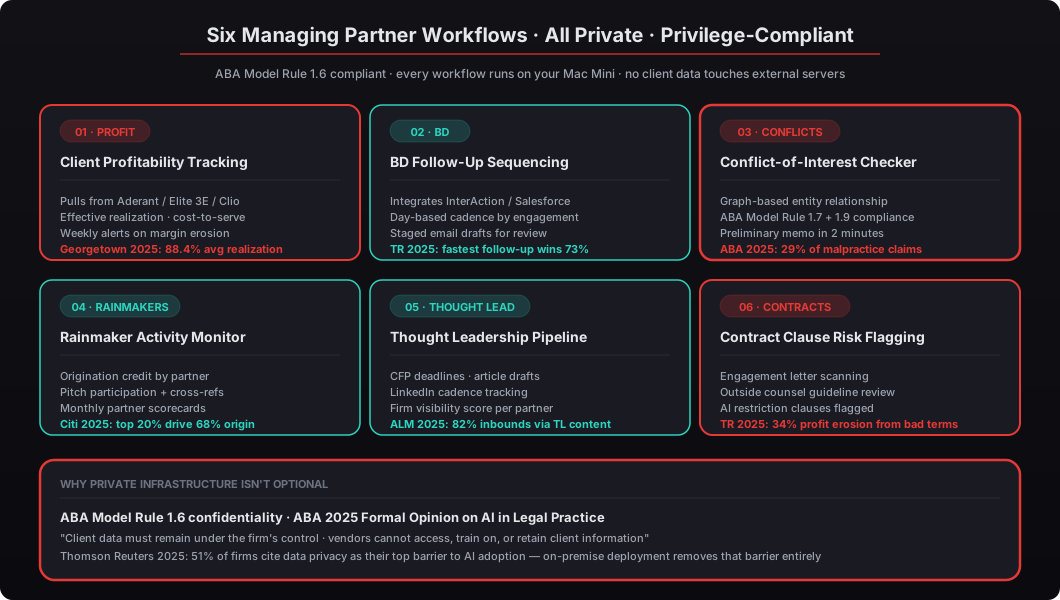
How does client engagement profitability tracking actually work?
An AI agent monitors your billing system in real time, calculates true profitability per engagement, and flags underperforming matters before they drain partner capital. It replaces the quarterly profitability review with a continuous, always-current dashboard pushed to your inbox every Monday morning — which matters because the matters that slip happen within a single billing cycle, not at quarter-end review.
Georgetown Law Center’s 2025 Report on the State of the Legal Market showed that the average Am Law 100 firm’s realization rate fell to 88.4% — meaning firms collect less than 89 cents for every dollar billed. The gap between billed and collected revenue is where profitability dies, and most managing partners don’t see it until quarter-end. Our agent connects to your practice management system — Aderant, Elite 3E, or Clio — through Composio OAuth integrations. It pulls matter-level data: hours billed, rates applied, invoices sent, payments received, write-offs, and aged receivables. Then it calculates three metrics that matter:
- Effective realization rate per client (collected divided by standard value)
- Cost-to-serve ratio (associate and paralegal hours weighted by fully loaded cost, not just billing rate)
- Margin velocity (how fast profit accrues versus time invested — catches slow-bleed matters)
Here’s what a weekly profitability alert looks like:
PROFITABILITY ALERT — Week of March 22, 2026

CLIENT: Meridian Capital Partners
MATTER: Series C Financing (Matter #4892)
STATUS: Margin erosion detected

Billed to date:        $187,400
Collected to date:     $142,200
Realization rate:      75.9% (firm avg: 88.4%)
Write-downs pending:   $18,700
Cost-to-serve:         $124,600

FINDING: 14 associate hours billed at partner rates were
reduced by client during invoice review. Three invoices
(totaling $26,500) are 90+ days outstanding.

RECOMMENDATION: Schedule rate discussion with GC before
next billing cycle. Flag for collections follow-up.
The agent doesn’t just report numbers — it identifies the root cause. ALM Intelligence’s 2025 survey of Am Law 200 managing partners found that 67% of profitability problems trace to rate compression and scope creep, not overstaffing. The agent catches both patterns by cross-referencing billing entries against the engagement letter’s rate schedule and scope definitions, then flagging deviations before they become the quarterly write-off surprise. This is the workflow that delivers the clearest immediate ROI because it shows up on the next billing cycle’s P&L rather than six months later.
How does BD follow-up sequencing prevent revenue leakage?
The agent tracks every business development contact, schedules follow-up sequences based on engagement stage, and alerts you when a prospect goes cold. It turns your haphazard BD pipeline into a structured sequence that actually converts, because the gap between “good pitch” and “retained counsel” is almost always closed by the firm that followed up fastest.
Thomson Reuters’ 2025 Law Firm Business Leaders Report found that 73% of new client mandates go to the firm that follows up fastest after initial contact. Yet the same report showed that the average partner waits 11 days between meaningful BD touches. That gap is where mandates go to competitors like Kirkland & Ellis, Latham & Watkins, or Wachtell Lipton — not because your firm was worse, but because the other firm got back to the GC first while the conversation was still fresh.
The agent integrates with your CRM — typically Salesforce, HubSpot, or InterAction (the legal-specific CRM built on Microsoft Dynamics) — and your email through Composio. It builds a follow-up cadence for each prospect based on engagement type:
- Pitch meeting completed: Follow-up within 24 hours with summary and proposed next steps
- Proposal sent: Check-in at day 3, day 7, and day 14
- RFP response submitted: Weekly status pings until decision date
- Conference connection: Initial follow-up within 48 hours, then monthly nurture
- Cold intro accepted: 3-touch warm-up sequence over 3 weeks
- Dormant client reactivation: Quarterly check-in with practice-specific content
Here’s an example sequence trigger:
BD FOLLOW-UP — Action Required

CONTACT: Sarah Chen, General Counsel
COMPANY: Apex Ventures
LAST TOUCH: March 15, 2026 (pitch meeting)
DAYS SINCE: 13

SEQUENCE STATUS: Overdue
  - Day 1 follow-up: SENT (March 16)
  - Day 7 check-in: SENT (March 22)
  - Day 14 proposal: DUE TOMORROW

CONTEXT: Sarah mentioned Q2 fund formation work during
pitch. Estimated engagement value: $280K-$350K.
Competitor mentioned: Sullivan and Cromwell.

DRAFT AVAILABLE: Proposal email drafted and staged
in your outbox. Review and send, or modify.
The agent doesn’t send emails on your behalf — it stages drafts and alerts you. Professional relationships require a human touch, especially at the partner level where the email tone has to match the specific relationship history. But the tracking and drafting eliminate the 90% of BD work that’s pure administration — and the partner gets to spend their BD time on actual relationship building instead of remembering who to email and what to say.
How does conflict-of-interest checking work with an AI agent?
The agent runs automated conflict checks across all active matters, historical representations, lateral hire disclosures, and known entity relationships. It produces a preliminary conflicts memo in minutes instead of the 3-5 days a manual check requires. This matters more than most partners realize — the American Bar Association’s 2025 TechReport found that 29% of malpractice claims against law firms involve some form of conflict-of-interest failure. ABA Model Rule 1.7 (current client conflicts) and Rule 1.9 (former client conflicts) impose strict obligations that get exponentially harder to manage as firm headcount grows past about 300 attorneys.
We built the conflicts agent with a graph-based relationship model. Every client, matter, opposing party, affiliated entity, and known beneficial owner becomes a node. Relationships between nodes — representation, opposition, investment, board membership, family ties, lateral hire disclosures — become edges. When a new matter intake arrives, the agent traverses the graph and flags any path that could constitute a conflict. See our conflict-of-interest checker use case for the broader workflow context.
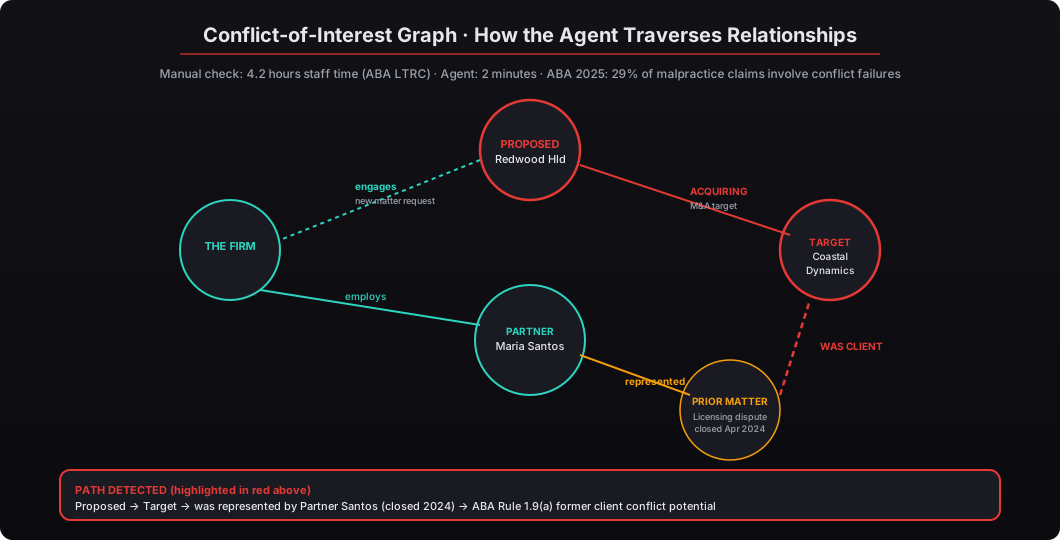
Here’s what a conflicts screening output looks like:
CONFLICT SCREENING — New Matter Intake

PROPOSED CLIENT: Redwood Holdings LLC
PROPOSED MATTER: Acquisition of Coastal Dynamics Inc.
REQUESTING PARTNER: David Park

SCREENING RESULT: POTENTIAL CONFLICT DETECTED

DIRECT CONFLICTS: None found
INDIRECT CONFLICTS: 1 flagged

DETAIL: Partner Maria Santos represented Coastal
Dynamics Inc. in a licensing dispute (Matter #3201,
closed April 2024). Coastal Dynamics is the TARGET
in this proposed acquisition.

RULE IMPLICATED: ABA Model Rule 1.9(a) — duties to
former clients. Substantially related matter test
may apply.

RECOMMENDED ACTION: Escalate to General Counsel for
formal conflicts analysis. Consider whether informed
consent under Rule 1.9(a) is obtainable from both
Redwood Holdings and Coastal Dynamics.

NOTE: This is a preliminary automated screening.
Final conflicts clearance requires attorney review.
The agent runs in under two minutes. A manual conflicts check at a 500-attorney firm involves searching multiple databases, cross-referencing lateral hire disclosures, and chasing down partner recollections. The Legal Technology Resource Center at the ABA estimated that the average manual conflict check takes 4.2 hours of combined staff time. The agent collapses that to 2 minutes and surfaces indirect conflicts (conflicts via prior representations, not the current client list) that manual checks often miss because the researcher doesn’t know to look at closed matters.
One critical point: the agent produces a preliminary screening, not a legal opinion. Final clearance always requires a qualified attorney’s judgment. The agent eliminates the research burden — it doesn’t replace the analysis. This distinction matters for ABA Model Rule 5.3 supervisory obligations and for how the output flows into the firm’s existing intake approval workflow. The general counsel’s office still signs off; they just start from a complete preliminary screening instead of a blank page.
How does rainmaker activity monitoring keep revenue on track?
The agent tracks origination credit, cross-selling activity, pitch participation, and client relationship depth for every partner. It gives you a real-time view of who’s generating business and who’s coasting on legacy client relationships. The 2025 Citi-Hildebrandt Client Advisory reported that at the median Am Law 100 firm, the top 20% of partners generate 68% of origination credit. Managing partners need to know when rainmakers slow down — and when emerging partners are building books that deserve more resources.
The agent pulls data from three sources: your billing system (origination and matter credit), your CRM (pitch activity and prospect engagement), and your calendar (client meeting frequency). It compiles a monthly partner activity scorecard:
RAINMAKER REPORT — March 2026

PARTNER: James Whitfield (Corporate/M&A)
ORIGINATION YTD: $2.4M (target: $3.8M, 63% attainment)
TREND: Down 18% vs. same period 2025

ACTIVITY INDICATORS:
  Pitches participated:    3 (firm avg: 6)
  New prospect meetings:   2 (firm avg: 5)
  Client lunches/dinners:  4 (firm avg: 7)
  Cross-referrals made:    0 (firm avg: 2)
  Conference appearances:  1 (firm avg: 2)

FLAG: Origination pace suggests $3.0M full-year
projection vs. $3.8M target. Activity metrics are
below practice group averages across all categories.

COMPARISON: Partner Rachel Torres in same practice
group is at 87% attainment with rising activity
trend. Consider joint pitch staffing.
This isn’t about surveillance — it’s about resource allocation. McKinsey’s 2025 Professional Services Practice report found that firms with real-time origination tracking grow revenue per partner 23% faster than firms relying on quarterly reviews. You can’t coach what you can’t measure, and the managing partner’s job is making sure coaching happens when partners go through slow periods — not six months after the slowdown has compounded into a book erosion problem. The comparison against peer partners in the same practice group is the most useful part of the output because it makes the coaching conversation concrete: “You’re 63% of target, Rachel is 87% with rising activity, let’s talk about joint pitches” beats “your numbers look low” every time.
How does the thought leadership pipeline agent work?
The agent tracks speaking engagement deadlines, publication submissions, article drafts, social media cadence, and conference CFP timelines. It keeps your firm’s visibility engine running without a full-time marketing coordinator chasing every partner for content commitments they forgot they made.
ALM Intelligence’s 2025 survey of law firm CMOs found that 82% of inbound client inquiries at Am Law 200 firms trace back to some form of thought leadership — articles in Harvard Business Review, speaking slots at the World Economic Forum or Davos, bylines in The American Lawyer, or LinkedIn posts that went beyond surface commentary. Thought leadership isn’t vanity marketing — it’s the top-of-funnel for inbound client acquisition, and the partners who maintain consistent visibility get the inbound that partners with sporadic output don’t.
The agent maintains a content calendar per partner and per practice group. It tracks:
- Conference CFP deadlines (LegalTech New York, ILTACON, ACC Annual Meeting, Thomson Reuters SYNERGY)
- Publication submission windows (Law360, The American Lawyer, Harvard Law Review Forum)
- LinkedIn posting cadence (target: 2-3 posts per week for visibility partners)
- Podcast and webinar invitations (response within 48 hours or the booker moves on)
- Draft article status (outline, first draft, review, submitted, published)
Here’s a sample weekly brief:
THOUGHT LEADERSHIP BRIEF — Week of March 28, 2026

UPCOMING DEADLINES:
  - ACC Annual Meeting CFP: April 5 (8 days)
    Partner assigned: Lisa Nakamura
    Abstract status: DRAFT READY — needs partner review
  - Law360 Guest Column: April 12
    Partner assigned: Robert Kim
    Draft status: OUTLINE ONLY — 1,400 words needed

OVERDUE:
  - LinkedIn post series on ESG compliance
    Partner: James Whitfield
    Last post: February 28 (28 days ago)
    Recommended: Draft queued in content bank. Review
    and approve for publication.

PUBLISHED THIS MONTH: 3 articles, 2 conference panels,
14 LinkedIn posts across 8 partners. Firm visibility
score: 74/100 (up from 68 last month).
The agent drafts content outlines and LinkedIn posts based on each partner’s practice area and recent matter themes — without revealing confidential client details. Everything stays on local infrastructure, which matters because draft articles often reference deal structures and industry trends derived from privileged client work. The “visibility score” metric is a composite of publication frequency, social engagement, and conference presence — not a vanity number but a leading indicator of the 82% inbound funnel that depends on thought leadership.
How does contract clause risk flagging protect the firm?
The agent scans engagement letters, outside counsel guidelines, vendor contracts, and partnership agreements for problematic clauses. It flags liability caps, indemnification requirements, fee arrangement traps, and scope limitations before they become problems — which matters because these clauses are where profitability dies quietly over the life of an engagement.
Thomson Reuters’ 2025 State of the Legal Market report found that 34% of law firm profitability erosion comes from unfavorable engagement terms accepted without adequate review. Outside counsel guidelines from Fortune 500 companies have grown 40% longer since 2020, and many now contain AI usage restrictions, data handling requirements, and staffing mandates buried in appendices that never get read by the partner who signs the engagement. The agent processes documents through OpenClaw’s local language model — no document content leaves your machine. It checks against a clause library you define, which typically includes:
- Liability caps below your standard threshold
- Indemnification clauses that shift risk to the firm (consequential damages without a cap is the single most dangerous construct)
- Fee discount triggers tied to volume or outcome
- AI usage restrictions that may conflict with your operations
- Data handling requirements that impose specific security standards
- Staffing mandates that require named partners or minimum seniority levels
- Audit rights that grant clients access to your internal records
Here’s a flagged clause example:
CONTRACT REVIEW — Outside Counsel Guidelines

CLIENT: Fortuna Group International
DOCUMENT: 2026 Outside Counsel Guidelines (v3.1)
PAGES: 47

FLAGS DETECTED: 4

1. CLAUSE 14.3 — AI USAGE RESTRICTION
   "Outside counsel shall not use any AI system to
   process, analyze, or generate work product related
   to Fortuna Group matters without prior written
   approval from the Legal Department."
   RISK: HIGH — May conflict with current workflows.
   Requires partner review before matter acceptance.

2. CLAUSE 22.1 — INDEMNIFICATION
   "Firm shall indemnify and hold harmless Client
   against all claims arising from Firm's services,
   including consequential damages."
   RISK: HIGH — No cap on consequential damages.
   Firm standard requires mutual cap at 2x fees.

3. CLAUSE 8.7 — BILLING RATE LOCK
   "Rates shall not increase more than 2% annually
   for the duration of the engagement."
   RISK: MEDIUM — Below firm standard 4-5% annual
   increase. Calculate impact over projected 3-year
   engagement.

4. CLAUSE 31.2 — AUDIT RIGHTS
   "Client reserves the right to audit Firm billing
   records, time entries, and staffing decisions."
   RISK: MEDIUM — Scope broader than standard.
   Recommend narrowing to billing records only.

SUMMARY: 2 high-risk, 2 medium-risk clauses detected.
Recommend redline before execution.
Without this agent, these clauses get reviewed by a junior associate — if they get reviewed at all. The 2025 ALM Intelligence survey of managing partners found that 41% of firms do not systematically review outside counsel guidelines before accepting engagements. That’s a profitability and liability time bomb that goes off months or years later when someone tries to enforce a clause the firm didn’t know it had agreed to.
What about ethical obligations and attorney-client privilege?
Every one of these workflows handles data covered by ABA Model Rule 1.6 (confidentiality of information). Client identities, matter details, billing records, conflict relationships, and engagement terms are all protected. Using cloud-based AI tools for these workflows means sending privileged information to third-party servers — which most state bar ethics opinions have flagged as potentially problematic.
The ABA’s 2025 Formal Opinion on AI in Legal Practice recommended that lawyers using AI tools should ensure client data remains under the firm’s control and that vendors cannot access, train on, or retain client information. Our OpenClaw deployments satisfy this by running entirely on firm-owned hardware. This is why we built beeeowl around private infrastructure. A Mac Mini sitting in your server room or a MacBook Air in your briefcase processes everything locally. Composio handles OAuth connections to your billing system, CRM, and email — credentials never touch the AI model. Docker sandboxing ensures the agent can’t access anything outside its configured scope.
The New York City Bar Association, the California State Bar, and the Florida Bar have all issued guidance emphasizing that attorneys must exercise reasonable care when using AI with client data. On-premise deployment is the most straightforward way to satisfy that standard — the compliance answer becomes “the data never left the firm” rather than a 6-month vendor audit. For the broader privacy argument, see the case for private AI and cloud AI APIs vs private AI infrastructure decision framework.
How do professional services firms get started?
We’ve deployed these agents for Am Law 200 firms, mid-market practices, and management consulting firms. The deployment pattern is the same: pick two or three workflows that cause the most pain, deploy those agents first, then expand once partners see results and other practice groups start asking for their own agents. Most managing partners start with profitability tracking and conflict checking — the two workflows with the most immediate ROI and the highest regulatory stakes. BD sequencing and rainmaker monitoring follow once the data integrations are in place. Thought leadership and contract review round out the suite typically by month 3.
Every deployment includes OpenClaw installation, OS and network security hardening, Docker sandboxing (NIST SP 800-190 compliant), Composio OAuth setup, and one fully configured agent. Additional agents run $1,000 each. The Hosted Setup starts at $2,000 for firms that prefer VPS deployment, and hardware packages — Mac Mini at $5,000 or MacBook Air at $6,000 — include the device shipped and configured. We complete the full setup in one day. Hardware ships within a week. Your agents start running immediately with no training period and no ongoing cloud subscription.
Professional services firms have the most to gain from private AI — and the most to lose from getting it wrong. Attorney-client privilege, ABA Model Rule 1.6, side letter confidentiality, and state bar ethics opinions all converge on the same conclusion: client data must stay under firm control. If you’re a managing partner running operations on spreadsheets and quarterly reviews, your competitors using real-time AI agents are already pulling ahead — and they’re doing it on infrastructure that satisfies the compliance bar your general counsel will demand. Full pricing on our pricing page, role-specific workflow examples on our use cases page, and the deployment walkthrough in how to get your first OpenClaw agent running in one day.