Cloud AI APIs vs Private AI Infrastructure: A Decision Framework for Executives
Gartner's 2025 AI Infrastructure Decision Framework found 71% of enterprises picked cloud AI for developer convenience rather than governance. McKinsey's 2026 Global AI Survey found 43% are now migrating sensitive workloads to private infrastructure. Here's the 5-criteria framework we use.

Gartner’s 2025 AI Infrastructure Decision Framework found that 71% of enterprises made their initial AI deployment choice based on developer convenience rather than data governance requirements. McKinsey’s 2026 Global AI Survey confirmed the fallout: 43% of companies that started with cloud-only AI are now migrating sensitive workloads to private infrastructure within 18 months — which means roughly half of all early cloud AI deployments were the wrong architectural choice for the data they ended up processing. IBM’s 2025 Cost of a Data Breach Report puts AI-related breaches at $5.2 million average, and 67% of compliance officers (per Deloitte 2026) now require documented data residency guarantees before approving AI tools for sensitive workflows. This article is the 5-criteria decision framework I walk every beeeowl prospect through — data sensitivity, regulatory exposure, usage volume, customization depth, and cost model preference. Score 3 or more “Private Wins” and cloud APIs are creating risk you don’t need to carry.
Why do executives need a framework for this decision?
Because most AI infrastructure decisions happen backwards and expensively. A team signs up for an API, feeds it sensitive data, and someone in legal notices six months later. By then, the data’s already been processed on third-party servers, the vendor’s terms have changed twice, and nobody can say definitively where those board memos went. The cleanup is always worse than the prevention — and the prevention is just 15 minutes of structured thinking before anyone picks a vendor.
Gartner’s 2025 AI Infrastructure Decision Framework found that 71% of enterprises made their initial AI deployment choice based on developer convenience rather than data governance requirements. McKinsey’s 2026 Global AI Survey confirmed the fallout: 43% of companies that started with cloud-only AI are now migrating sensitive workloads to private infrastructure within 18 months. That’s roughly half of all early cloud AI deployments being re-architected in under two years — which is expensive, disruptive, and avoidable with a structured decision upfront.
I’ve helped dozens of executives navigate this decision at beeeowl. The framework below is what we actually use — not theoretical, but built from real deployment conversations with CEOs, CTOs, and CFOs who needed clarity before writing a check. It takes 10 minutes to run through, and the answer is usually obvious by the end.
What are the five decision criteria that actually matter?
The choice between cloud AI APIs and private AI infrastructure comes down to five factors: data sensitivity, regulatory exposure, usage volume, customization depth, and cost model preference. Every other consideration is a subset of these five, and scoring your situation on all five reveals the right architecture almost automatically.
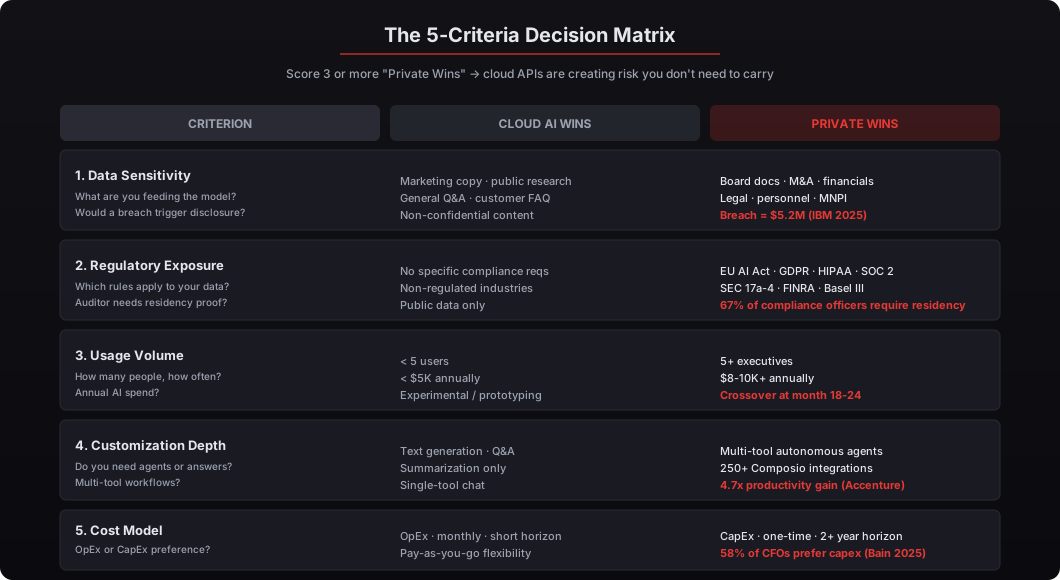
Forrester’s 2025 report on hybrid AI architectures validated this framework, noting that organizations using structured decision criteria deployed AI 2.3x faster than those making ad-hoc choices. The speed isn’t from rushing the decision — it’s from not re-doing the decision 6 months later when the first choice was wrong. Let me break each criterion down with the data and the test question we use.
1. Data sensitivity — what are you actually feeding the model?
This is the single biggest decision driver. If your prompts contain board minutes, M&A term sheets, investor communications, or financial projections, you’re sending your most sensitive information to someone else’s server. OpenAI’s enterprise terms say they won’t train on your data. Anthropic says the same for Claude API. Microsoft makes similar promises for Azure OpenAI. But here’s what those terms don’t change: your data still transits their infrastructure. It’s still processed in their memory. It’s still subject to their jurisdiction, their subpoena exposure, their security posture, and their policy changes.
IBM’s 2025 Cost of a Data Breach Report pegged the average breach involving AI systems at $5.2 million — and took 42 days longer to detect than traditional breaches. That’s not a scare tactic — it’s the actuarial reality that insurers like AIG and Chubb are now pricing into cyber liability policies. A single AI-related breach can undo years of ROI from a deployment.
The test is simple: if a breach of this data would trigger SEC disclosure obligations, board notification, client notification under your engagement letters, or material adverse event reporting, it probably shouldn’t live on a third-party server regardless of how good the vendor’s terms look on paper.
2. Regulatory exposure — which rules apply to your data?
The regulatory environment has tightened dramatically in the last 18 months. The EU AI Act entered full enforcement in February 2026. Canada’s AIDA (Artificial Intelligence and Data Act under Bill C-27) is advancing through parliament. California’s CPRA, Virginia’s CDPA, Colorado’s CPA, Connecticut’s CTDPA, and Texas’s TDPSA collectively cover over 160 million Americans. The IAPP’s 2025 privacy tracker counted 17 US states with comprehensive privacy laws either enacted or in active legislative committee.
Regulated industries face additional layers. HIPAA for healthcare data. SOC 2 Type II for service providers. SEC Rule 17a-4 for broker-dealers and book-keeping requirements. FINRA rules for investment advisors. Basel III operational risk requirements for banks. ISO 27001 for security-certified organizations. Each of these adds specific documentation requirements that cloud APIs struggle to satisfy without provider audit letters that take months to negotiate.
Deloitte’s 2026 regulatory outlook found that 67% of compliance officers now require documented data residency guarantees before approving AI tools for sensitive workflows. A cloud API’s terms of service rarely satisfy that requirement — regulators want to know the physical location of processing, the jurisdiction governing the processor, and the specific legal basis for any cross-border transfers. “It’s processed in the cloud” is no longer an acceptable answer to any of those questions.
The test: if your compliance team needs to certify where data is processed and stored, cloud APIs create audit complexity that private infrastructure eliminates entirely by construction.
3. Usage volume — how many people, how often?
Cloud AI APIs charge per token, per seat, or per month. That’s fine for five people experimenting on a prototype. It’s genuinely expensive for 20 executives using AI daily for production workflows. Here’s the math that matters, with real numbers from current vendor pricing as of Q1 2026:
| Scenario | Cloud AI (ChatGPT Enterprise) | Cloud AI (Claude API) | Private Infrastructure (beeeowl) |
|---|---|---|---|
| 5 executives, Year 1 | $3,600 | $2,000-5,000 (usage-based) | $9,000 one-time |
| 5 executives, Year 3 | $10,800 | $6,000-15,000 | $9,000 total |
| 10 executives, Year 1 | $7,200 | $4,000-10,000 | $14,000 one-time |
| 10 executives, Year 3 | $21,600 | $12,000-30,000 | $14,000 total |
| 20 executives, Year 1 | $14,400 | $8,000-20,000 | $24,000 one-time |
| 20 executives, Year 3 | $43,200 | $24,000-60,000 | $24,000 total |
The crossover point typically lands between month 18 and month 24. After that, every month of cloud usage is pure incremental cost against a private deployment that’s already paid for. McKinsey’s 2025 AI economics analysis found that organizations spending more than $10,000 annually on AI APIs saved 34-47% by migrating high-volume workloads to owned infrastructure. The savings compound because private deployments have zero marginal cost per additional query — once the hardware is paid for, running 100 queries a day costs the same as running 10,000.
The test: calculate your current AI API spend and project three years. If the total exceeds beeeowl’s hardware tier price, private is already cheaper in NPV terms before you count any of the other benefits.
4. Customization depth — do you need agents or just answers?
Cloud AI APIs give you a chat interface or an API endpoint. You send a prompt, you get a response. That’s useful for drafting emails, summarizing documents, and answering questions. It’s not useful for eliminating workflows entirely. Private AI infrastructure gives you agents — autonomous systems that connect to your tools and take action across them without being prompted individually.
An OpenClaw agent on beeeowl’s infrastructure doesn’t just analyze your calendar. It cross-references it against your CRM, pulls relevant documents from Google Drive, drafts a prep brief for each meeting, checks for conflicts with other priorities, and posts a summary to Slack before your meeting starts. We made the full case in the case for private AI.
That distinction matters because the real ROI of AI isn’t in answering questions — it’s in eliminating the check-and-act loops that currently eat 11+ hours of executive time per week. Accenture’s 2025 enterprise AI study found that AI agents delivering autonomous workflow execution produced 4.7x the productivity gain of chat-based AI tools. Through Composio, a private OpenClaw deployment connects to 250+ tools — Gmail, Outlook, Salesforce, HubSpot, Google Drive, Notion, Slack, Microsoft Teams, QuickBooks, Stripe, GitHub, Jira, and hundreds more. OAuth credentials stay on your hardware through Composio’s server-side broker, so the AI agent never sees raw tokens. For the technical deep-dive on the credential architecture, see connecting OpenClaw to Gmail, Calendar, and Slack via Composio.
The test: if you need AI to take action across multiple tools — not just generate text — private infrastructure with agent capabilities is the right architecture. Chat tools don’t reach this ceiling.
5. Cost model preference — OpEx or CapEx?
This isn’t just an accounting question. It reflects how your organization thinks about technology investments and where your CFO prefers to absorb cost. Cloud AI is operating expenditure: monthly bills, per-seat licensing, annual renewals with built-in price escalators. PwC’s 2025 SaaS pricing analysis found that enterprise AI tool renewals averaged 12-18% annual price increases — faster than any other software category — and Google just raised Gemini API pricing 40-60% in Q1 2026 to validate the trend.
Private AI is capital expenditure: one purchase, you own the hardware, you own the deployment. There’s no vendor who can raise your price, change your terms, or sunset your product. NVIDIA’s Jensen Huang called OpenClaw “the Linux of AI” — and just like Linux, once it’s deployed on your hardware, nobody can take it away. Bain’s 2025 enterprise technology survey found that 58% of CFOs now prefer one-time infrastructure purchases over recurring SaaS subscriptions for mission-critical tools, up from 34% in 2022. The shift is driven by CFO frustration at watching SaaS spend grow into a top-five line item over a decade.
The test: if your CFO has complained about SaaS sprawl or written a memo about reducing recurring software costs, private AI aligns with their stated goals. If your organization is committed to pure OpEx for flexibility reasons, cloud APIs stay valid.
How do you use this framework in practice?
Score each criterion for your specific situation, and the infrastructure choice becomes obvious. You’re looking for a clear pattern, not a perfect tie-breaker.
| Decision Criterion | Cloud AI APIs Win | Private Infrastructure Wins |
|---|---|---|
| Data sensitivity | Public-facing content, marketing, general research | Board docs, M&A, financials, legal, personnel, MNPI |
| Regulatory exposure | No specific compliance requirements | HIPAA, SOC 2, SEC, FINRA, GDPR, state privacy laws |
| Usage volume | Fewer than 5 users, under $5K annually | 5+ executives, usage exceeding $8-10K annually |
| Customization needs | Text generation, Q&A, summarization | Multi-tool agents, autonomous workflows, integrations |
| Cost model | Prefer monthly OpEx, short time horizon | Prefer one-time CapEx, 2+ year time horizon |
If you score “Private Infrastructure Wins” on three or more criteria, cloud APIs are creating risk you don’t need to carry. Gartner’s 2025 recommendation aligns: their guidance explicitly states that organizations handling regulated data or executive communications should default to private AI infrastructure unless a specific use case justifies cloud processing. The default is private; cloud is the exception that needs justification, not the other way around.
When is cloud AI the right answer?
I’m not here to tell you cloud AI is bad. For many use cases, it’s genuinely the best option and the faster path to value. Here’s where cloud genuinely wins.
Marketing and content teams should use cloud AI. Claude API and OpenAI’s GPT-4o are excellent for generating blog drafts, social media copy, email campaigns, and product descriptions. The data isn’t sensitive — it’s being published anyway. The volume is high. The per-token cost model works, and the latest models come out faster than private deployments can track. Most marketing teams are fine on Anthropic or OpenAI directly.
Customer support often fits cloud perfectly. Intercom, Zendesk, and Drift all integrate cloud AI for handling tier-1 tickets. The conversations are already semi-public because they’re between the company and the customer. Speed matters more than data residency for most support scenarios, and the support tooling is built around cloud-hosted LLMs anyway.
Internal knowledge bases with non-sensitive documentation — IT procedures, onboarding guides, company policies, engineering runbooks — work well with cloud-based RAG solutions from Pinecone, Weaviate, or OpenAI’s Assistants API. The content is mostly internal but not confidential, and the speed-to-deploy advantage of cloud is meaningful.
Experimentation and prototyping should always start in the cloud. Spinning up a Claude API key takes minutes. Testing a workflow before committing to infrastructure is smart engineering. The cost during the experimentation phase is trivial, and you can always migrate production workflows to private once you’ve proven the ROI.
The point isn’t that cloud AI is wrong. It’s that cloud AI has a boundary, and most executives don’t realize they’ve crossed it until something goes wrong. The framework exists to find that boundary before you cross it, not after.
When does private infrastructure become non-negotiable?
There are scenarios where cloud AI isn’t just suboptimal — it’s a liability that can’t be excused away with “we trust the vendor.”
M&A due diligence. When you’re analyzing a target company’s financials, organizational structure, IP portfolio, and legal exposure, that information is material non-public information under SEC rules. Processing it on OpenAI’s servers creates a data chain that your legal team can’t fully control. Sullivan & Cromwell’s 2025 M&A technology memo specifically flagged cloud AI processing of deal data as a disclosure risk, and several major deal law firms now have internal policies against it.
Board communications. Board memos, strategy documents, and compensation discussions are among the most sensitive documents a company produces. Wachtell, Lipton, Rosen & Katz’s 2025 governance advisory recommended that board-related AI processing occur exclusively on company-controlled infrastructure. When your general counsel reads that recommendation and you’re running board prep through ChatGPT, the conversation gets uncomfortable fast.
Financial reporting and analysis. Variance reports, cash flow projections, revenue forecasts — if your CFO is using AI to speed up financial analysis, that data falls under SOX controls for public companies and fiduciary standards for private ones. EY’s 2025 AI in finance survey found that 73% of finance leaders require on-premises or private cloud processing for any AI touching financial data. For pre-earnings periods or active fundraising, the bar is even higher.
Legal document review. Attorney-client privilege requires that privileged communications remain within the control of the parties. Sending privileged documents to a cloud AI provider arguably waives privilege — a position the American Bar Association’s 2025 ethics opinion addressed directly, recommending private AI infrastructure for any privileged document analysis. Law firms operating under strict ethics rules don’t have the luxury of “probably fine.”
Healthcare workflows. HIPAA’s requirements for protected health information don’t get waived because the processing happens on GPT-4 instead of a local database. BAAs (Business Associate Agreements) can cover some cloud AI providers, but the audit burden is substantial and many hospital CISOs are now defaulting to private deployment for any PHI touching AI.
What does the right hybrid architecture look like?
The smartest approach isn’t all-cloud or all-private. It’s a deliberate split based on data classification, with a clear line between the two tiers and enforcement at the agent layer so prompts get routed correctly without the user having to think about it every time.
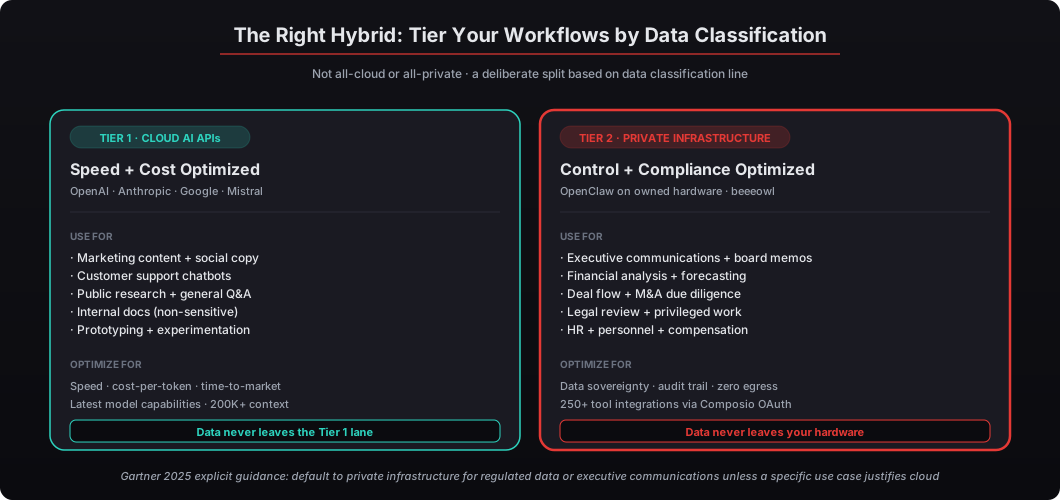
Tier 1 — Cloud AI: Marketing content, customer support, public-facing research, internal documentation, prototyping, general Q&A that doesn’t touch sensitive data. Use OpenAI, Anthropic, Google, or Mistral APIs directly. Optimize for speed, cost-per-token, and access to the latest model capabilities.
Tier 2 — Private Infrastructure: Executive communications, financial analysis, deal flow, legal review, board materials, HR decisions, competitive intelligence, M&A due diligence, HIPAA/SOC2/GDPR-governed data. Deploy on owned hardware with OpenClaw. Optimize for control, compliance, and audit trail.
This is exactly what beeeowl deploys. A Mac Mini or MacBook Air running OpenClaw with full security hardening — Docker sandboxing following NIST SP 800-190, explicit firewall allowlists, audit trails on every action, authentication built in, Composio OAuth credential brokering. One day to deploy. Ships within a week. Starting at $2,000 hosted or $5,000 with Mac Mini hardware included or $6,000 with MacBook Air hardware included. See our guide to choosing between hosted and hardware.
For executives who want the hybrid routing enforced at the agent level (rather than leaving it to user discretion), OpenClaw supports a keyword-based classifier that routes sensitive prompts to a local Ollama instance and general queries to a cloud Claude or GPT API. We cover the configuration pattern in running a private LLM with Ollama.
What should you do next?
Run your current AI usage through the five-criteria matrix above. If you’re scoring “Private Infrastructure Wins” on three or more dimensions — and most executive teams do — the question isn’t whether to deploy private AI. It’s how fast you can get it running before the next “we’ll figure out our AI strategy later” decision produces the 18-month migration McKinsey documented.
We’ve seen executives go from first conversation to fully operational private AI agent in under a week. The technology isn’t the bottleneck anymore — OpenClaw is mature, Composio covers 250+ integrations, Ollama runs production-grade local LLMs, and hardware is cheap. The decision is the bottleneck. Run the framework, score your situation, and either stay on cloud with a clear reason or move to private with a clear plan.
Full pricing on our pricing page, role-specific workflow examples on our use cases page, and deployment FAQ on our FAQ page. If you’re ready to have a conversation about which tier fits your situation, request your deployment and we’ll walk through the 5-criteria framework on the call.