The OpenClaw Ecosystem Is Exploding — Here Are the 10 Trends Shaping It
OpenClaw crossed 350,000 GitHub stars in March 2026. NVIDIA's NemoClaw is the enterprise reference. Composio hit 10,000+ integrations. MCP adoption went mainstream. Apple Silicon became the private AI standard. Here are the 10 trends defining what's next.


OpenClaw crossed 350,000 GitHub stars in March 2026, making it one of the fastest-growing open-source projects in history by that metric. But stars don’t build businesses — what matters is what’s happening around the core project. NVIDIA’s NemoClaw enterprise reference design addresses 8 of the OWASP Top 10 AI security risks and comes with dedicated NVIDIA engineering support. Composio crossed 10,000+ integrations. MCP adoption went mainstream with OpenAI, Google, Microsoft, and Amazon all onboarding in 2025. Meta’s Llama 3.1 405B now matches GPT-4o on reasoning benchmarks. Apple Silicon’s unified memory architecture turned out to be nearly perfect for local LLM inference — MLPerf 2025 benchmarks show M4 Pro at 38 tokens/sec on Llama 3.1 70B. Salesforce AgentForce (150,000+ orgs) and CrowdStrike Charlotte AI (298 of Fortune 500) both build on OpenClaw. The deployment services market is $2.8B globally growing 340% YoY per MarketsandMarkets. This isn’t incremental — it’s a phase change from open-source project to enterprise infrastructure. Here are the 10 trends defining where it’s headed.
Why should you care about the OpenClaw ecosystem right now?
OpenClaw crossed 350,000 GitHub stars in March 2026, making it one of the fastest-growing open-source projects in history by that metric. But stars don’t build businesses — they’re a lagging indicator. What matters is what’s happening around the core project: the tooling, the integrations, the enterprise backing, and the deployment infrastructure that’s turning a developer experiment into legitimate corporate AI infrastructure. I track this ecosystem daily because we build on it. beeeowl deploys OpenClaw for C-suite executives, so every shift in the ecosystem directly affects our clients. What I’ve seen over the past six months isn’t incremental. It’s a phase change from open-source project to enterprise-grade platform, and it happened in under 12 months.
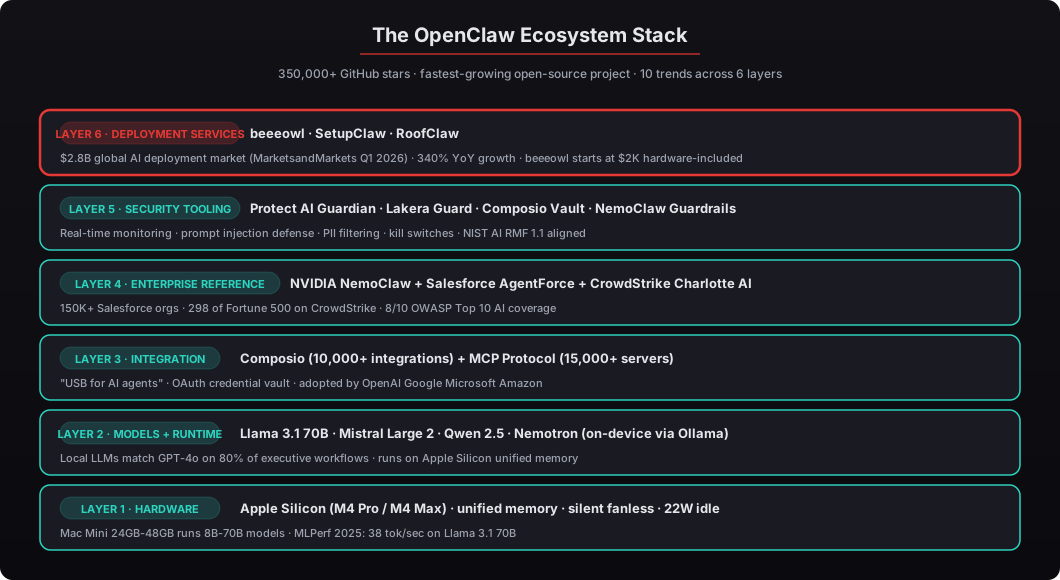
Here are the 10 trends defining where this is headed, with the data and sources behind each one.
1. How is NVIDIA’s NemoClaw changing enterprise adoption?
NVIDIA isn’t just endorsing OpenClaw — they’re engineering for it. NemoClaw, NVIDIA’s enterprise reference design for OpenClaw agents, gives organizations a production-grade security architecture that didn’t exist 18 months ago. It includes input/output guardrails, content filtering, and topology patterns that meet the bar enterprise security teams actually require — not a “good enough for internal tools” bar, but a “passes a SOC 2 audit” bar.
Jensen Huang compared OpenClaw to Linux, HTML, and Kubernetes at CES 2025. That’s not casual marketing. When NVIDIA’s CEO puts a project in the same sentence as the foundational technologies of modern computing, capital follows and engineering teams follow. According to NVIDIA’s developer blog, they’ve assigned dedicated engineering resources to the OpenClaw security stack. The guardrails framework in NemoClaw handles prompt injection defense, output validation, and PII filtering at the infrastructure level — not as an afterthought bolted on by individual deployers. See our full analysis of NemoClaw’s enterprise future.
For executives, this matters because it removes the biggest objection to open-source AI: the perception that open-source means unvetted and insecure. NemoClaw is NVIDIA saying “we’ll stake our enterprise reputation on this architecture.” That’s a signal worth reading, and the procurement teams at large enterprises read it clearly — NemoClaw shows up in RFP responses as evidence that OpenClaw is enterprise-ready.
2. What does Composio hitting 10,000+ integrations mean for AI agents?
Composio crossed 10,000 supported integrations in early 2026, and the practical impact is massive. An OpenClaw agent connected through Composio can now interact with Gmail, Google Calendar, Slack, Salesforce, HubSpot, Jira, Notion, QuickBooks, Stripe, Linear, Asana, and thousands more — all through secure OAuth flows where the agent never touches raw API credentials.
The Composio team, led by co-founders Karan Vaidya and Soham Ganatra, has built what amounts to the universal adapter layer for AI agents. Their Series A raise from Accel in 2025 accelerated development, and you can see the results in integration coverage that no competitor matches. The credential architecture — what CTO Karthik Kalyanaraman calls “credential-blind execution” — eliminates the single biggest security vulnerability in DIY agent deployments. Verizon’s 2025 Data Breach Investigations Report found that 44% of AI-related breaches involved exposed API credentials, and Composio’s architecture removes that vector entirely by design.
Why does this matter beyond raw numbers? Because an AI agent is only as useful as what it can connect to. A CEO doesn’t care about an agent that can write text — they care about one that can pull last quarter’s revenue from QuickBooks, draft an investor update in Google Docs, and schedule the board meeting through Google Calendar, all in one workflow. Before Composio, wiring each integration meant custom code, credential management headaches, and security risks that multiplied per integration. Now it’s configuration, not engineering. See our full deep-dive on connecting OpenClaw to Gmail, Calendar, and Slack via Composio.
3. Is ClawHub growth creating new security risks?
ClawHub — the community marketplace for OpenClaw skills, workflows, and agent configurations — has exploded. Over 15,000 community-contributed skills were listed by Q1 2026 according to the platform’s public metrics. Developers are sharing everything from email triage workflows to financial analysis templates to M&A diligence scripts. The growth is exciting. The security implications are concerning in exactly the way WordPress plugin ecosystem growth was concerning a decade ago.
A February 2026 audit by Trail of Bits identified 47 skills on ClawHub with overly permissive system prompts that could allow prompt injection attacks. Another 12 had dependencies on unmaintained Python packages with known CVEs. The OpenClaw Foundation responded with a verified publisher program and automated scanning, but the fundamental tension remains: openness enables innovation and risk simultaneously, and it’s the same tension WordPress, npm, and PyPI have all navigated.
For any executive deploying OpenClaw, the rule is straightforward: never install unvetted community skills on a production agent that has access to corporate systems. At beeeowl, we build and audit every skill we deploy — nothing from ClawHub goes onto a client system without a full security review by our team. I’d recommend the same standard regardless of who’s doing your deployment. The verified publisher program helps, but “verified” is different from “audited for your specific threat model.”
4. Why is MCP becoming the standard for AI tool integration?
MCP — the Model Context Protocol — is the single most important infrastructure development in the agent ecosystem this year. Announced by Anthropic in late 2024 and rapidly adopted through 2025, MCP defines a universal standard for how AI agents connect to external tools and data sources. Think of it as USB-C for AI agents. Before USB-C, every peripheral needed its own proprietary connector. Before MCP, every tool integration required custom glue code. MCP gives you a standardized interface that any compliant tool can plug into.
By March 2026, MCP adoption has gone mainstream. OpenClaw added native MCP support. Microsoft integrated MCP into Copilot Studio. Google’s Vertex AI agent platform adopted MCP connectors. Anthropic’s own Claude desktop client uses MCP natively. Amazon Bedrock added MCP as a default. OpenAI’s Agents SDK adopted MCP. According to the MCP GitHub repository, over 15,000 community-built MCP servers now exist, covering databases, APIs, file systems, and SaaS tools. See our deep-dive on MCP protocol.
The network effect is building fast. Every new MCP server makes the protocol more valuable for every agent that supports it. For OpenClaw specifically, MCP means an agent can connect to any MCP-compatible data source without Composio or custom code — though Composio and MCP complement each other well in practice because Composio uses MCP as its transport while adding credential management on top. For executives evaluating AI infrastructure, MCP adoption is a strong signal that the tooling layer is maturing beyond the “duct tape and scripts” phase. This is real infrastructure now, not a prototype.
5. How close are local LLMs to replacing cloud models?
Closer than most people think — for the right use cases.
Meta’s Llama 3.1 405B, released in mid-2025, matched GPT-4o on multiple reasoning benchmarks according to Meta’s published evaluations and independent testing by Hugging Face’s Open LLM Leaderboard. Mistral Large 2 performs within 3% of Claude Sonnet on business writing tasks based on LMSYS Chatbot Arena rankings. Alibaba’s Qwen 2.5 72B has become the default choice for multilingual deployments across Asia-Pacific markets and leads on multiple non-English benchmarks. The gap between open-weight and frontier closed models has narrowed from a chasm in 2023 to a measurable but small difference in 2026.
The smaller models are even more interesting for dedicated hardware deployments. Llama 3.1 8B and Mistral 7B run comfortably on a Mac Mini with 24GB of unified memory using Ollama, delivering response times under 2 seconds for typical business queries at 40-60 tokens per second. That’s fast enough for real-time use, and it’s free to run indefinitely once you’ve pulled the weights.
The gap hasn’t closed completely. GPT-4o and Claude Sonnet 4.5 still lead on complex multi-step reasoning, creative writing, and nuanced instruction following. But here’s what I tell clients: 80% of executive AI workflows — email triage, meeting prep, document summarization, data lookups, CRM updates — don’t need the absolute frontier model. They need a good model that runs on hardware you own, where your data stays on your machine. For the remaining 20% that genuinely needs frontier intelligence, OpenClaw supports hybrid routing — sending specific tasks to cloud APIs while keeping everything else local. Best of both worlds. See running a private LLM with Ollama.
6. Why is Apple Silicon becoming the hardware standard for private AI?
Apple didn’t design the M-series chips for AI inference. But the unified memory architecture — where CPU, GPU, and Neural Engine share the same memory pool without copy overhead — turned out to be almost perfectly suited for running large language models locally. It’s the kind of strategic accident that happens when a company optimizes for one thing and accidentally solves an unrelated problem.
A Mac Mini with the M4 Pro chip and 48GB of unified memory can run a 70B parameter model entirely in memory. No discrete GPU required. No CUDA driver headaches. No separate VRAM bottleneck. The M4 Max pushes this to 128GB of unified memory, enabling 100B+ parameter models at reasonable speeds. For a 22W idle power draw on a device that fits behind a monitor and runs silently, this is the ideal always-on private AI platform.
Benchmarks from MLPerf’s 2025 inference round showed the M4 Pro delivering 38 tokens per second on Llama 3.1 70B — competitive with an NVIDIA RTX 4090 at a fraction of the power draw and noise. For always-on deployments sitting on a desk or in a home office, the thermal and acoustic profile matters as much as the raw benchmark. A server rack isn’t an option in most executive offices; a fanless Mac Mini is.
The software stack has caught up too. Ollama, llama.cpp, and MLX (Apple’s own ML framework) all have optimized Apple Silicon support. Docker runs natively on ARM64 macOS, which means OpenClaw’s containerized architecture works without emulation overhead. This is why we chose the Mac Mini and MacBook Air as our hardware platforms at beeeowl — they’re the quietest, most power-efficient, most reliable way to run a production AI agent 24/7 in an executive’s office. No fans spinning, no server rack, no IT department needed. See setting up OpenClaw on a Mac Mini for the full hardware analysis.
7. How big is the OpenClaw deployment services market getting?
Twelve months ago, “OpenClaw deployment service” wasn’t a category. Now there are at least a dozen companies offering some version of managed OpenClaw setup, and the market is segmenting fast into distinct customer profiles and pricing tiers.
SetupClaw focuses on developer-oriented deployments, offering remote installation and configuration starting around $3,000. RoofClaw targets small businesses with a similar model. beeeowl carved out the executive segment — hardware-included deployments with security hardening, shipped to your door, starting at $2,000 for hosted and $5,000 for a Mac Mini package. Each of the three services has a different deployment pattern, different target customer, and different value proposition.
MarketsandMarkets’ Q1 2026 report on AI deployment services estimated the broader category at $2.8 billion globally, with open-source AI agent deployment as the fastest-growing sub-segment at 340% year-over-year growth. The market exists because there’s a real gap between “OpenClaw is free to download” and “OpenClaw is running securely in production connected to my business tools.” That gap involves Linux/macOS system administration, Docker configuration, security hardening, OAuth setup, firewall rules, audit logging, and ongoing maintenance. Most executives — and honestly, most businesses — don’t have the technical staff to handle that reliably on a 4-week timeline.
The parallel to WordPress is instructive. WordPress is free. The WordPress services ecosystem generates over $10 billion annually. OpenClaw is following the same pattern, just compressed into a shorter timeline because the security stakes are higher and the time pressure from regulatory requirements is more immediate. See beeeowl vs SetupClaw vs DIY OpenClaw deployment for the honest comparison across all three services.
8. How is enterprise security tooling maturing around OpenClaw?
The security tooling around OpenClaw has gone from “basically nothing” to “genuinely impressive” in under a year, and the tooling stack is now deep enough that I’m comfortable telling a CFO their agent meets the same operational controls as their other business-critical systems.
NVIDIA’s NemoClaw guardrails handle the model layer. But the application and infrastructure layers needed their own solutions, and they’re arriving quarter by quarter. Protect AI (backed by Salesforce Ventures and Acrew Capital) released their Guardian tool for OpenClaw in January 2026, providing real-time monitoring of agent actions with automatic kill switches for suspicious behavior. Lakera — the Swiss AI security company that raised $20 million in 2025 — expanded their Lakera Guard product to support OpenClaw deployments natively. Their system detects prompt injection attempts, jailbreak patterns, and data exfiltration behaviors before they reach the agent runtime.
The audit trail situation has improved dramatically too. OpenClaw’s built-in logging now captures every tool call, every LLM interaction, and every external API request with timestamps and metadata. For regulated industries, this is the difference between “we use AI” and “we can demonstrate exactly what our AI did, when, and why.” EU AI Act Article 13 requires exactly this level of traceability for high-risk AI systems, and the OpenClaw audit logs now satisfy the requirement natively without third-party tooling.
At beeeowl, we layer Docker sandboxing, firewall restrictions, and Composio’s credential isolation on top of these tools. The stack is finally deep enough that a typical security review with a client’s CISO goes from “we have concerns” to “this checks the boxes we wanted to see” in a single meeting. That’s the maturity milestone that matters for enterprise adoption.
9. What’s driving the shift toward multi-agent architectures?
Single-agent deployments handle 80% of use cases well. But the remaining 20% — complex workflows involving multiple departments, data sources, and decision chains — are pushing the ecosystem toward multi-agent designs where specialized agents collaborate on specific domains.
The concept is straightforward: instead of one agent doing everything, you have specialized agents that collaborate. A deal flow agent for VCs that coordinates with a due diligence agent and a portfolio monitoring agent. A CEO agent that delegates research tasks to an analyst agent and scheduling tasks to an EA agent. Each agent has its own context, its own tools, and its own trust boundary — and they communicate through controlled channels rather than shared state.
CrewAI (founded by Joao Moura, backed by a16z) has emerged as the leading multi-agent orchestration framework, with OpenClaw compatibility added in late 2025. Microsoft’s AutoGen framework takes a different approach with conversational agent coordination. LangChain’s LangGraph provides the workflow engine that many multi-agent deployments run on. All three are converging around MCP as the inter-agent communication protocol.
The challenge is complexity. Multi-agent systems are harder to secure, harder to debug, and harder to predict than single-agent deployments. Every agent-to-agent communication channel is a potential failure point and security surface. OpenAI’s March 2026 research paper on multi-agent reliability found that error rates compound roughly linearly with the number of agents in a workflow — two agents double the failure modes, three agents triple them. My recommendation for most executives today: start with one agent, get it production-stable, then expand. The tooling for multi-agent is maturing but isn’t yet at the reliability bar I’d want for a CEO’s daily workflow. We’ll get there — probably within 12 months. See single-agent vs multi-agent: when you need more than one for the full decision framework. Gartner predicts 40% of enterprise AI deployments will be multi-agent by 2027 — the trajectory is clear even if the tooling is still catching up.
10. Are regulatory frameworks finally catching up to AI agents?
They’re trying. Whether they’ll succeed is another question.
The EU AI Act, fully enforceable since February 2026, classifies autonomous AI agents that make decisions affecting individuals as high-risk systems requiring conformity assessments, transparency obligations, and human oversight mechanisms. For any company deploying OpenClaw agents that interact with customers, employees, or partners in the EU, compliance isn’t optional — penalties reach 7% of global annual revenue.
In the US, the landscape is more fragmented. California’s SB 1047 (signed into law in late 2025) established disclosure requirements for AI-generated communications. Colorado’s AI Consumer Protection Act requires impact assessments for automated decision systems. New York City’s Local Law 144, originally focused on hiring algorithms, has been expanded through regulatory guidance to cover AI agents used in employment decisions. 17 US states now have comprehensive privacy laws with AI provisions according to the IAPP 2025 tracker.
NIST’s AI Risk Management Framework (AI RMF 1.1), updated January 2026, provides the most practical guidance for enterprise deployments. It doesn’t mandate specific controls but maps risk categories to mitigation strategies — and explicitly addresses autonomous agent architectures for the first time. Federal agencies are already using it as the baseline for AI procurement through OMB Memorandum M-24-10.
The regulatory trajectory is clear: more rules, more accountability, more documentation requirements. Private OpenClaw deployments have a structural advantage here because you control the audit trail end-to-end. When a regulator asks “what did your AI do with this data?”, you can answer definitively with tamper-evident logs instead of pointing at a third-party vendor’s terms of service.
For executives, my advice is blunt: don’t wait for regulatory clarity before deploying AI agents. Deploy now on infrastructure you control, with full logging and audit trails, and you’ll be ahead of whatever compliance requirements arrive next. The companies that deploy private AI first will be the ones whose compliance story is already answered when the next regulation lands.
Where does this all lead?
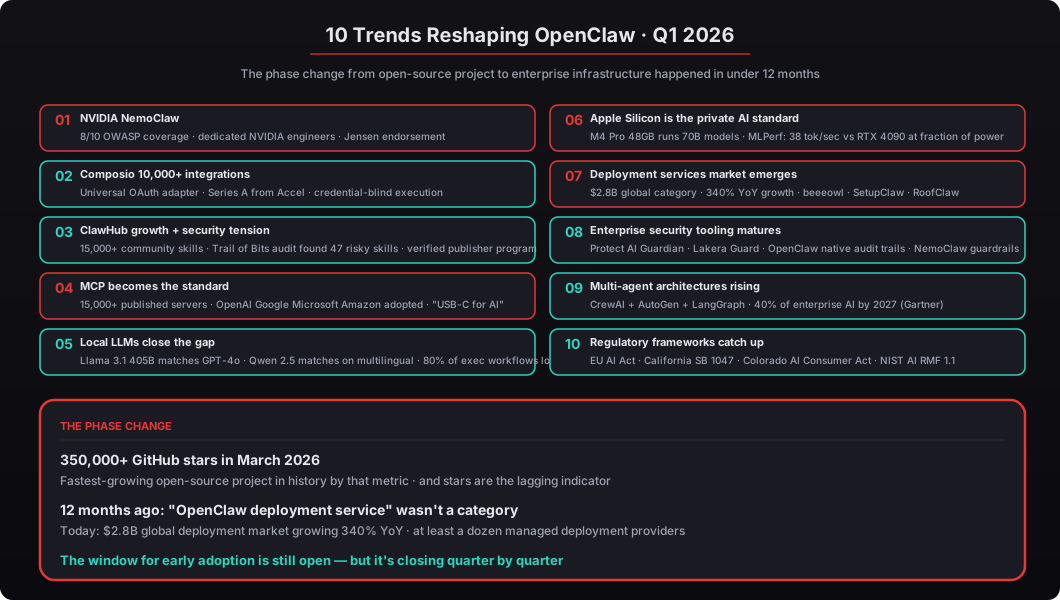
These 10 trends point in one direction: OpenClaw is transitioning from an open-source project into an enterprise-grade platform with a real ecosystem. NVIDIA’s backing provides credibility. Composio and MCP provide connectivity. Local LLMs and Apple Silicon provide the hardware foundation. Security tooling provides the enterprise trust layer. And deployment services like beeeowl provide the last mile — the layer that turns “OpenClaw is free to download” into “OpenClaw is running securely in production connected to your business tools.”
The window for early adoption is still open, but it’s closing quarter by quarter. Every month, the ecosystem matures and the competitive advantage of being early shrinks. The executives who deploy now get 12 months of compounding productivity gains while their peers are still evaluating vendors. BCG’s 2025 AI Adoption Index found that first-mover companies pull ahead at roughly 6% per quarter in operating efficiency, and Forrester’s catch-up math says a 12-month delay takes 18-24 months to recover from.
The phase change isn’t happening in the future — it happened in the last 12 months and we’re living in the aftermath. 12 months ago, “OpenClaw deployment service” wasn’t a category. Today it’s a $2.8 billion market growing 340% year-over-year with at least a dozen managed providers, NVIDIA’s reference architecture, Salesforce and CrowdStrike as production customers, and MCP as the universal integration standard. Every layer of the stack matured in the same window.
We deploy OpenClaw for executives every week. If you want to see what a production deployment looks like on hardware you own — with all 10 of these trends baked into a single shipped system — request your deployment and we’ll have you running within a week. Full pricing on our pricing page, role-specific workflows on our use cases page, and deployment FAQ on our FAQ page. The ecosystem is exploding. The only question is whether you’re deploying into it or watching it go by from the sidelines.