NVIDIA NemoClaw and the Enterprise Future of OpenClaw
NVIDIA's NemoClaw bundles OpenShell security, Nemotron local models, and Salesforce/CrowdStrike partnerships into an enterprise OpenClaw reference design. It addresses 8 of the OWASP Top 10 AI risks. Here's what it signals — and how beeeowl closes the remaining 2.

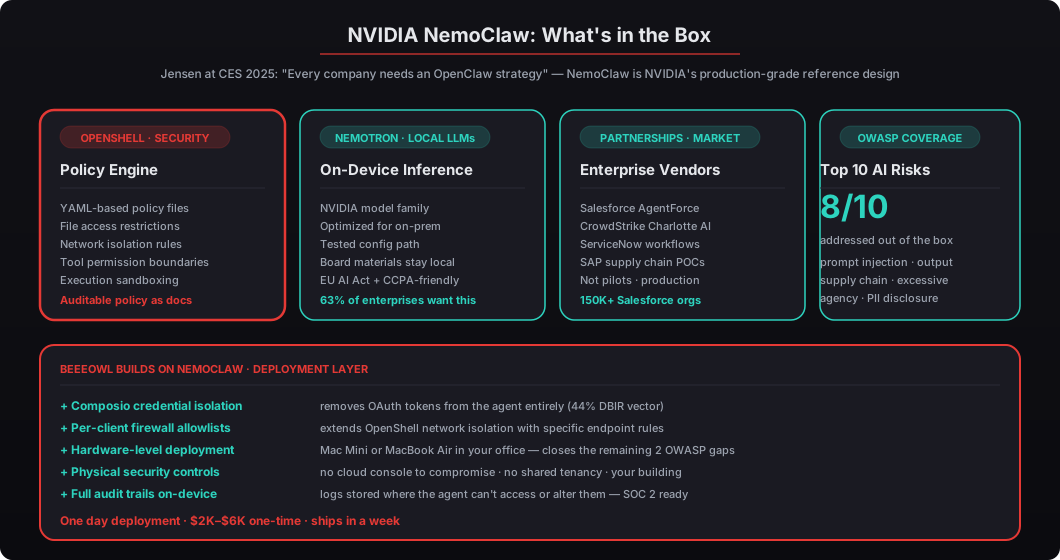
Jensen Huang compared OpenClaw to Linux, HTML, and Kubernetes at CES 2025. That wasn’t casual — Jensen doesn’t make analogies lightly, and he was signaling that OpenClaw would become infrastructure, not just a project. NemoClaw is the production proof. It bundles OpenShell (a YAML-based security runtime), Nemotron (NVIDIA’s local language model family for on-device inference), and pre-built partnerships with Salesforce AgentForce (150,000+ enterprise customers) and CrowdStrike Charlotte AI (298 of the Fortune 500 on Falcon) into a single, opinionated enterprise reference design. It addresses 8 of the OWASP Top 10 AI security risks out of the box. Forrester’s 2025 AI Security Wave found organizations using standardized reference architectures reduced AI security incident rates by 58%. Gartner’s 2025 AI Infrastructure Report found 71% of enterprises cited “lack of standardized security controls” as their top barrier to AI agent adoption — OpenShell’s YAML policy engine addresses exactly that. This article is the full breakdown of what NemoClaw actually delivers, and how beeeowl builds on it to close the remaining infrastructure gaps.
What did NVIDIA actually announce with NemoClaw?
NVIDIA didn’t just release another developer tool. NemoClaw is a full enterprise reference architecture for deploying OpenClaw agents securely at scale — bundling OpenShell security runtime, Nemotron local language models, and pre-built partnerships with Salesforce and CrowdStrike into a single, opinionated design. It’s NVIDIA telling the enterprise world: OpenClaw is ready for production, here’s how to deploy it safely, and here’s who else is already doing it.
I’ve been tracking NVIDIA’s OpenClaw moves since Jensen Huang first compared the framework to Linux, HTML, and Kubernetes at CES 2025. That comparison wasn’t casual — Jensen doesn’t make analogies lightly. He was signaling that OpenClaw would become infrastructure, not just a project. NemoClaw is the proof of that signal. NVIDIA doesn’t build reference architectures for things they think will fade away. They build them for foundational infrastructure they expect to become industry standard over a 10-year horizon, and they assign engineers proportionally.
According to NVIDIA’s official NemoClaw documentation, the reference design addresses 8 of the OWASP Top 10 AI security risks. That’s a massive leap from where OpenClaw stood even six months ago, when security was largely a “bring your own” exercise involving custom Docker configs, firewall rules, and hope. NVIDIA committed dedicated engineers to OpenClaw security advisories — a fact they’ve confirmed publicly on GitHub commit history and in social media posts — and NemoClaw is where that investment materialized as a deployable reference. See how we build on this in our security hardening approach.
What is OpenShell and why should CTOs care?
OpenShell is the security runtime at the heart of NemoClaw. It’s the enforcement layer that turns policy documents into actual runtime constraints on AI agent behavior. If NemoClaw is the blueprint, OpenShell is the building inspector who makes sure nobody cuts corners during construction. This is the single most important piece of the NemoClaw announcement for CTOs evaluating OpenClaw for production use.
Here’s what OpenShell does concretely: it uses YAML-based policy files to define exactly what an agent can and cannot do at the infrastructure level. File access restrictions control which directories the agent can read or write. Network isolation rules specify which external endpoints the agent can reach — and block everything else by default. Tool permission boundaries limit which integrations the agent can invoke and under what conditions. Execution sandboxing prevents the agent from spawning unapproved subprocesses or loading unapproved libraries.
For CTOs evaluating OpenClaw, this is the piece that matters most. Before OpenShell, securing an OpenClaw agent meant stitching together Docker configs, firewall rules, custom middleware, and bespoke audit code. Now there’s a standardized policy language that the entire ecosystem understands. According to Gartner’s 2025 AI Infrastructure Report, 71% of enterprises cited “lack of standardized security controls” as their top barrier to AI agent adoption. OpenShell directly addresses that objection. See our deep-dive on the OpenShell security runtime.
The YAML policy approach is clever for another reason: it’s auditable by humans. When your compliance team asks “what can this AI agent access?”, you hand them a human-readable policy file. No digging through Docker configurations or reverse-engineering firewall rules. The policy is the documentation. SOC 2 auditors and EU AI Act compliance reviewers both prefer this model because it matches how they already think about access control for traditional systems.
How do Nemotron models change the privacy equation?
NemoClaw includes NVIDIA’s Nemotron family of language models — specifically designed for on-device and on-premises inference. This is NVIDIA acknowledging what we’ve been hearing from every C-suite executive we talk to: the data can’t leave the building.
Nemotron models are optimized for NVIDIA hardware (no surprise there), but the strategic move is making local inference a first-class option inside the official reference design. Before NemoClaw, running OpenClaw with a local model meant configuring Ollama, downloading model weights, tuning context windows, setting up Metal Performance Shaders for Apple Silicon, and hoping everything played nicely together. Now it’s a supported, tested configuration path with NVIDIA’s engineering weight behind it. The official support matters because enterprise CTOs don’t adopt DIY configurations — they adopt vendor-backed reference designs.
According to IDC’s 2025 AI Deployment Survey, 63% of enterprises with over 500 employees said they would not deploy AI agents that send data to third-party cloud APIs. That number jumps to 81% for financial services firms. Nemotron gives those companies a path forward without having to write their own local inference stack. For executives handling board materials, M&A documents, investor communications, or client records, local inference isn’t a nice-to-have — it’s a requirement that reference architectures finally acknowledge.
The EU AI Act’s 2025 implementation guidelines explicitly flag data residency as a compliance consideration for AI systems processing personal or sensitive business data. California’s CCPA amendments are moving in the same direction. Canada’s AIDA follows the same pattern. Nemotron fits cleanly into all of those regulatory frameworks because the data never leaves the customer’s infrastructure, which simplifies every compliance conversation from a multi-month vendor audit to a single-meeting data flow diagram.
We’ve been deploying local models on Mac Mini and MacBook Air hardware through beeeowl since day one — see running a private LLM with Ollama. Nemotron validates the approach we’ve taken (private, on-device AI that never phones home), and we’re watching closely for opportunities to offer Nemotron as an alternative to Ollama for clients who prefer NVIDIA’s curated model family over the open-source ecosystem.
What do the Salesforce and CrowdStrike partnerships signal?
This is where NemoClaw stops being a technical announcement and starts being a market signal. Salesforce is building OpenClaw agents into AgentForce — their enterprise AI platform serving over 150,000 companies. CrowdStrike is constructing Charlotte AI, their security operations agent, on the OpenClaw framework. These aren’t pilot programs or “exploring partnerships.” These are production commitments from companies serving hundreds of thousands of enterprises.
Salesforce committed engineering resources to building native OpenClaw integration into AgentForce’s runtime. CrowdStrike is shipping Charlotte AI to their enterprise customer base today. Both companies evaluated every agent framework on the market and chose OpenClaw. That’s the procurement signal that matters most for CTOs deciding whether OpenClaw is safe to bet on — your procurement team can point to two major enterprise vendors as external validation.
According to Salesforce’s Q4 2025 earnings call, AgentForce had over 5,000 enterprise deployments within its first quarter. CrowdStrike’s Falcon platform protects endpoints across 298 of the Fortune 500. When companies of this scale commit to a framework, the ecosystem follows — tooling, integrations, training materials, and third-party vendors all start building on the same foundation. See the full picture in the 10 trends shaping the OpenClaw ecosystem.
For CEOs and CTOs making infrastructure decisions, these partnerships reduce risk dramatically. You’re not betting on an experimental open-source project anymore. You’re adopting the same agent framework that Salesforce and CrowdStrike are building their next-generation products on. The support ecosystem, tooling, and security investment follow the market leaders, and the “is this technology going to exist in 3 years” question becomes trivially answerable.
I’m also watching ServiceNow, which announced OpenClaw integration into its workflow automation platform at their annual conference. And SAP, which disclosed an OpenClaw proof-of-concept for supply chain agents. The pattern is unmistakable: enterprise software vendors are standardizing on OpenClaw the same way they standardized on Kubernetes in 2017-2019.
How does NemoClaw address the OWASP Top 10 for AI?
The OWASP Foundation published its Top 10 security risks for AI applications in 2025, and NemoClaw’s coverage is the most comprehensive of any reference design I’ve reviewed. Eight out of ten risks are addressed with built-in controls.
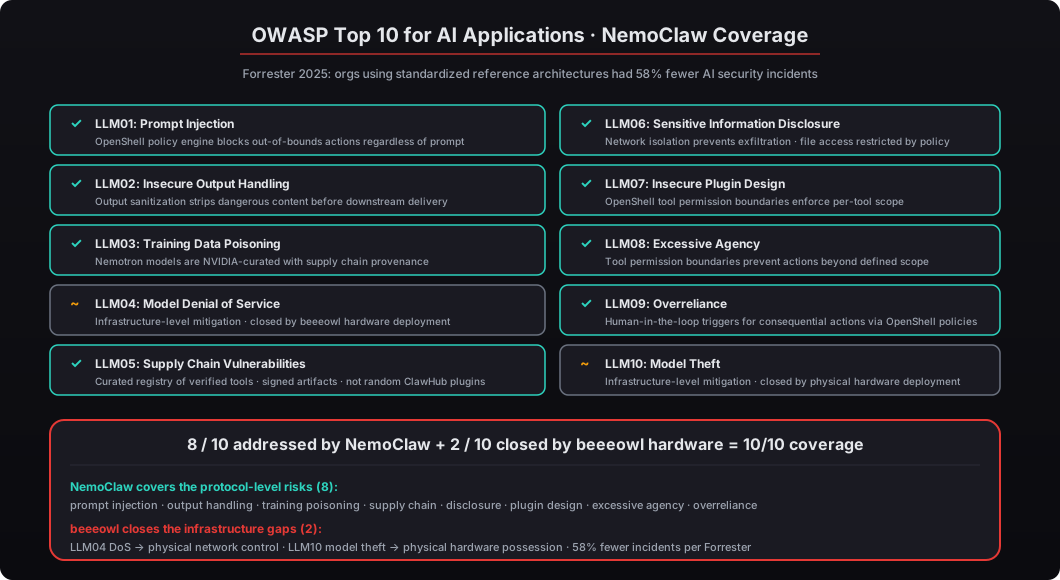
LLM01 Prompt injection — OpenShell’s policy engine restricts what the agent can do even if a malicious prompt gets through. The agent can’t execute actions outside its YAML-defined boundaries, regardless of what a prompt tells it to do. This is the single most important control because prompt injection is the #1 OWASP risk for a reason.
LLM02 Insecure output handling — NemoClaw includes output sanitization that strips potentially dangerous content before it reaches downstream systems. If an agent generates output containing code injection attempts or attempts to render untrusted HTML in a UI, the sanitization layer catches it at the output boundary.
LLM03 Training data poisoning — Nemotron models are NVIDIA-curated with supply chain provenance. You’re not pulling random weights from Hugging Face without review; you’re running models that went through a controlled build pipeline with documented training data.
LLM05 Supply chain vulnerabilities — NemoClaw provides a curated registry of verified tools and integrations. Instead of pulling random plugins from ClawHub, enterprises get a vetted supply chain with signed artifacts and version pinning.
LLM06 Sensitive information disclosure — Network isolation rules prevent the agent from exfiltrating data to unauthorized endpoints. File access restrictions prevent it from reading data outside its designated directories. Both enforced at the OpenShell policy layer.
LLM07 Insecure plugin design — OpenShell’s tool permission boundaries enforce per-tool scope so a plugin can only do what its policy entry allows.
LLM08 Excessive agency — OpenShell’s tool permission boundaries prevent agents from taking actions beyond their defined scope. An agent configured to read email can’t suddenly start sending messages unless the policy explicitly allows it, and the policy is auditable.
LLM09 Overreliance — Human-in-the-loop triggers for consequential actions are configured via OpenShell policies. See our full framework in AI agent governance: the control problem every executive will face in 2026.
According to NVIDIA’s security team (published in their NemoClaw whitepaper), the two OWASP risks not fully covered — LLM04 denial of service and LLM10 model theft — require infrastructure-level mitigations that vary by deployment environment. That’s accurate. Those are operational concerns that depend on whether you’re running on cloud VPS, on-premises hardware, or edge devices, and no protocol-level reference design can cover them fully.
At beeeowl, we close those remaining gaps with hardware-level deployment. When your agent runs on a Mac Mini in your office:
- LLM04 denial of service means someone needs physical access to your network, which is controlled by your office access policies
- LLM10 model theft means someone needs to physically steal the hardware from your office
The threat model is fundamentally different from cloud deployment because physical possession becomes a prerequisite for these attacks. That’s how 10/10 OWASP coverage emerges from combining NemoClaw’s 8 protocol-level controls with beeeowl’s infrastructure-level deployment.
What does this mean for companies evaluating OpenClaw right now?
If you’ve been waiting for a signal that OpenClaw is enterprise-ready, NemoClaw is that signal. NVIDIA doesn’t build reference architectures for hobbyist projects. They build them for infrastructure they expect to become industry standard over a 10-year horizon.
The practical implications for CTOs are straightforward:
First, OpenClaw’s security model is no longer DIY. NemoClaw provides a standardized baseline that your security team can evaluate against known frameworks like OWASP and NIST SP 800-53. According to Forrester’s 2025 AI Security Wave, organizations using standardized reference architectures reduced their AI security incident rate by 58% compared to custom implementations. You’re not inventing controls from scratch anymore — you’re adopting a reference design that’s already been evaluated by people whose job is evaluating reference designs.
Second, the vendor ecosystem is forming. Salesforce, CrowdStrike, ServiceNow, and SAP are building on OpenClaw. That means integrations, support resources, training materials, and tooling will continue improving quarter over quarter. Betting on OpenClaw today is like betting on Kubernetes in 2017 — the outcome is increasingly predictable, and the ecosystem network effects are accelerating.
Third, local model support is now a first-party feature. Nemotron models running on-device mean you don’t need to choose between capable AI and data privacy. You get both, officially supported, with NVIDIA’s engineering weight behind the configuration.
For CEOs, the calculus is simpler. Your competitors are adopting AI agents whether you like it or not. The framework that Salesforce and CrowdStrike chose is the one your enterprise software stack will integrate with natively over the next 18 months. Delaying your OpenClaw strategy means playing catch-up with inferior tooling later. Jensen Huang said it clearly at CES 2025: “Every company needs an OpenClaw strategy.” NemoClaw is NVIDIA putting their engineering resources behind that statement.
How does beeeowl build on the NemoClaw baseline?
NemoClaw is our starting point — not our finish line. Every beeeowl deployment begins with the NemoClaw reference design and adds deployment-specific hardening that the reference architecture intentionally leaves to implementers because it varies by deployment environment.
Composio credential isolation goes beyond NemoClaw’s authentication guidelines. NemoClaw specifies that credentials should be secured but doesn’t prescribe a specific middleware pattern. We use Composio to completely remove OAuth tokens and API keys from the agent’s environment. The agent requests actions through Composio and never sees a credential. Verizon’s 2025 Data Breach Investigations Report found that 44% of AI-related breaches involved exposed API credentials — Composio eliminates that vector entirely by moving credentials out of the agent’s process memory. See connecting OpenClaw to Gmail, Calendar, and Slack via Composio for the full credential architecture.
Per-client firewall allowlists extend OpenShell’s network isolation. NemoClaw provides the policy language and the generic patterns; we write the specific rules for each client’s tool integrations. Only the exact API endpoints your agent needs can receive traffic. No wildcards, no “allow all outbound” shortcuts, no trust-by-default. Every allowed endpoint is documented with a reason in the per-client firewall policy file.
Hardware-level deployment adds a security layer that cloud-based NemoClaw deployments can’t replicate. A Mac Mini ($5,000) or MacBook Air ($6,000) in your office means physical access controls apply. No cloud console to compromise. No remote admin panel to brute-force. No shared infrastructure with other tenants. Your AI runs on your hardware, in your building, under your control. This is what closes the remaining 2 OWASP risks.
Full audit trails exceed NemoClaw’s logging recommendations. Every action — tool access, data reads, data modifications, external API calls, agent decisions — is logged locally with timestamps and stored where the agent itself can’t access or alter them. When compliance asks for records, you have them in the format they need. SOC 2 Type II auditors, EU AI Act reviewers, and internal audit committees all want this level of detail, and we provide it as a default rather than an optional add-on.
NemoClaw made the enterprise case for OpenClaw. beeeowl makes the deployment real — shipped to your door, hardened beyond the baseline, running in one day. If NVIDIA’s reference design is the blueprint, beeeowl is the general contractor who builds it to spec without cutting corners.
Where is OpenClaw headed from here?
NemoClaw is the inflection point. NVIDIA is investing at the infrastructure level — security runtimes, local models, enterprise partnerships — the same way they invested in CUDA for GPU computing starting in 2007. They’re building the foundation for a decade of AI agent infrastructure, and the investment curve looks similar to the CUDA curve: slow for the first few years, then exponential as the ecosystem matures.
I expect three things to happen within the next 12 months:
First, more enterprise vendors will standardize on OpenClaw. Microsoft, Google, and Amazon are all evaluating the framework for their respective agent platforms, and at least one of them will announce production support before the end of 2026. Watch AWS’s re:Invent and Google Cloud Next for the signal.
Second, NemoClaw will evolve into a certification program. Enterprises will want “NemoClaw Certified” deployments the way they want SOC 2 compliance today, because certification provides the auditor-friendly evidence that a deployment follows the reference design. beeeowl is positioning to be among the first certified deployment providers when NVIDIA announces the program.
Third, the local model ecosystem will expand beyond Nemotron to include fine-tuned models for specific industries: legal, financial services, healthcare. Nemotron is the first wave; industry-specific variants are the second, and they’ll arrive through partnerships with firms like Bloomberg, Thomson Reuters, and Epic Systems.
According to McKinsey’s 2025 State of AI Report, enterprise AI agent spending is projected to reach $47 billion by 2027, growing at 34% annually. OpenClaw, with NVIDIA’s backing and enterprise adoption from Salesforce, CrowdStrike, ServiceNow, and SAP, is positioned to capture a significant share of that market. The framework that wins at this inflection point will define enterprise AI infrastructure for the next decade the way Linux defined server infrastructure for the last two decades.
For founders and executives reading this: the window to establish your private AI infrastructure is now. NemoClaw lowered the barrier from “custom security engineering project” to “adopt a reference design.” beeeowl removes the remaining friction entirely by shipping hardened OpenClaw deployments on dedicated hardware, configured in one day, with security that exceeds the reference design baseline and covers all 10 OWASP risks. Full pricing on our pricing page, role-specific workflows on our use cases page, and the broader ecosystem context in OpenClaw ecosystem exploding: 10 trends shaping it.
The enterprise future of OpenClaw isn’t a prediction anymore. It’s happening, and NemoClaw is the announcement that made it undeniable.