The Personal AI Agent Is Eating the Enterprise SaaS Stack
Okta tracks 130+ SaaS apps per enterprise. Andreessen Horowitz projects 60% of SaaS workflows automated by agents within three years. Here's which categories get eaten first — and why the interface layer goes before the data layer.

Okta’s 2025 Businesses at Work report tracks an average of 130+ SaaS applications at the typical large enterprise. Productiv’s SaaS Management Index puts license utilization at 45% — meaning more than half of what companies pay for goes unused. Gartner’s 2025 Digital Workplace Survey found knowledge workers lose 32 minutes per day to app switching alone. And Andreessen Horowitz’s own 2025 AI market analysis projects 60% of SaaS workflows will be partially or fully automated by AI agents within three years. The interface layer of the enterprise stack is the weakest link in the whole architecture, and it’s the part agents eat first. This is the structural argument for why the personal AI agent is eating the enterprise SaaS stack — and the map of which categories get eaten, which survive, and what the new stack looks like by 2028.
Why is a $340 billion market about to get restructured?
Because the interface layer is obsolete. The average enterprise runs 130+ SaaS applications, executives spend their days logging into dashboards, checking notifications, and manually routing information between systems that should already talk to each other. Personal AI agents collapse that entire loop into a single conversation. The SaaS backend survives as headless infrastructure. The dashboard you log into every morning does not.
I’m going to make a specific, falsifiable claim: within three years, most C-suite executives won’t open Salesforce, HubSpot, or Notion directly on a daily basis. They’ll talk to an agent that pulls, synthesizes, and acts on data from all of them simultaneously — pulling a pipeline snapshot out of Salesforce, marketing qualified leads out of HubSpot, meeting notes out of Notion, and deal flow out of Affinity, then delivering one briefing that replaces all four logins. See the specifics in 7 ways a CEO can reclaim 10 hours a week. For a primer, see our guide to what OpenClaw is.
That’s not a prediction about technology. The models are capable enough. The integrations exist. The hardware is cheap. The prediction is about human impatience — specifically, the impatience of executives who are tired of logging into fifteen tools to make a single decision. Once that impatience meets a working agent, the old interface layer becomes vestigial fast. The backends remain. The dashboards go the same way as floppy disks, fax servers, and desktop installers.
What does “software eating software” actually mean?
In 2011, Marc Andreessen wrote his famous essay in The Wall Street Journal arguing that software was eating the world. Every industry — retail, transportation, media, healthcare — was being restructured by software companies. Borders fell to Amazon. Taxis fell to Uber. Blockbuster fell to Netflix. Video rental stores didn’t survive the switch to streaming because the value wasn’t in the store. It was in the content and the delivery mechanism.
Fifteen years later, the eaters are getting eaten. Andreessen Horowitz’s own 2025 AI market analysis projects 60% of current SaaS workflows will be partially or fully automated by AI agents within three years. The companies that ate traditional industries with dashboards are now being eaten by agents that eliminate the need for dashboards entirely. See how executives are using this in practice on our use cases page.
Here’s the structural argument. SaaS was a 10x improvement over on-premise software because it removed installation, maintenance, licensing complexity, and hardware ownership. You could sign up for Salesforce in an afternoon instead of spending six months standing up Siebel on an Oracle database. That 10x gain earned SaaS a decade and a half of market dominance. AI agents are now a 10x improvement over SaaS — they remove the human in the loop for routine tasks. You don’t need a dashboard when the agent already checked the data, identified the anomaly, and drafted the response. You don’t need a CRM login when the agent updated the opportunity record, sent the follow-up, and flagged the deal for your attention only if it’s material. The agent doesn’t replace the CRM. It replaces the interface of the CRM.
McKinsey’s 2025 State of AI report puts numbers on this: companies deploying AI agents see a 28% reduction in executive administrative time within 90 days. That’s not a marginal efficiency gain. That’s the entire value proposition of half the SaaS stack evaporating in a single quarter. The per-seat licensing model for tools whose primary job is “a nicer interface over data that lives elsewhere” has an expiration date, and the countdown is running.
How bad is the SaaS fatigue problem, really?
Worse than most CEOs realize. Okta’s 2025 Businesses at Work report documents the average large enterprise deploying 130+ SaaS apps. Productiv’s 2025 SaaS Management Index puts average per-seat utilization at 45% — meaning more than half the licenses companies pay for are either rarely opened or completely dormant. BetterCloud’s 2025 State of SaaSOps survey found that 56% of SaaS applications at enterprises are not managed by IT at all, meaning nobody has visibility into who has access to what.
Here’s what a typical CEO’s morning looks like right now: open Gmail, check Slack, review the Salesforce dashboard, look at the HubSpot marketing pipeline, check Notion for board prep notes, open Asana for project status, glance at Tableau for the weekly revenue chart, peek at QuickBooks for the cash position, check LinkedIn for the overnight investor comments, and then maybe — maybe — start doing actual strategic work.
That’s nine context switches before making a single decision.
Gartner’s 2025 Digital Workplace Survey found that knowledge workers lose 32 minutes per day to app switching alone. For a 250-person company, that’s over 33,000 hours annually — gone to clicking between tabs and relocating in the mental context of each tool. For a CEO whose time is worth $1,000+ per hour loaded, the daily tab-switching tax is absurd. It’s also invisible on any P&L, which is why it’s been tolerated for so long.
The SaaS industry solved the original problem: “I need access to data from anywhere.” It then created a new problem as a side effect: “I’m drowning in interfaces, each with its own login, its own notifications, its own navigation model, and its own half-implemented search box.” Personal AI agents collapse the new problem back into the original question. Instead of logging into nine tools to find what changed overnight, you ask one agent “what happened overnight?” and get the nine answers in one briefing.
Which SaaS categories get eaten first?
Not all SaaS is equally vulnerable. The categories that get eaten first share a common trait: their primary value proposition is showing you data that lives somewhere else or routing information between systems. If a tool’s moat is its database, it survives as a headless backend. If a tool’s moat is its dashboard or its integration syntax, it does not.
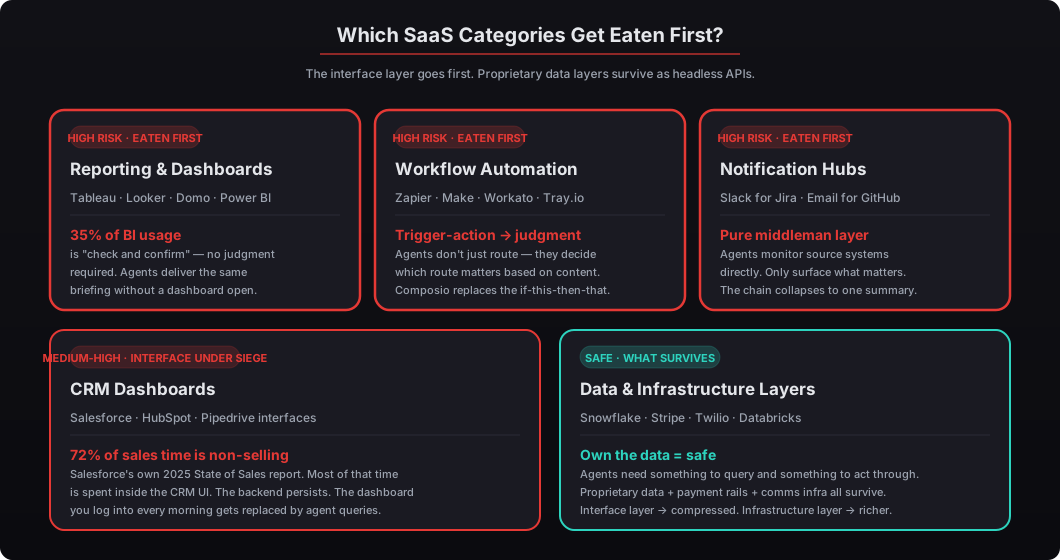
Reporting and dashboard tools face the highest immediate risk. Tableau, Looker, Domo, Power BI — any tool whose job is to pull data from a database and put it in a chart. When your agent can query the same database and deliver a natural-language briefing with anomalies flagged, the dashboard is overhead, not value. Forrester’s 2025 BI Market Forecast found that 35% of BI tool usage is for “check and confirm” tasks that require no human judgment — opening a dashboard to verify a number you already expected. That 35% is pure agent substitution. Even the remaining 65% of dashboard use gets compressed when an agent summarizes “here are the three charts that moved this week” instead of forcing an executive to scroll through twenty.
Workflow automation platforms are the second category. Zapier, Make (formerly Integromat), Workato, Tray.io — tools that connect SaaS apps to each other through trigger-action chains. An AI agent with Composio integration does the same thing but with judgment instead of rules. Instead of “when email arrives, create Slack message,” the agent does “when important email arrives, classify the topic, draft the appropriate response, update the CRM based on content, and notify the relevant team members only if they actually need to know.” That’s not a configuration upgrade. It’s a different category of tool. The Zapier-style workflow builder assumes you can enumerate every trigger and every action in advance. Agents assume you can’t.
Notification aggregators are the third. Tools whose entire job is telling you that something happened in another tool. Slack notifications about Jira tickets about GitHub commits. PagerDuty alerts about Datadog warnings about Kubernetes pods. An agent collapses this chain completely: it monitors the source systems directly and only surfaces what actually matters, with context. No more “you have 47 unread Slack notifications.” The agent reads all 47 and says “three of these need your attention before 9am; the other 44 are routine and I’ve handled them.”
CRM interfaces are the fourth, and this one will be the most controversial. Salesforce is a $35 billion company. Its moat is real. But the dirty secret of CRM is that most of its user-facing value is the data, not the interface. According to Salesforce’s own 2025 State of Sales report, sales reps spend 72% of their time on non-selling activities — much of it inside the CRM itself, updating records, logging calls, navigating the interface. An agent that reads from and writes to Salesforce’s API while the rep focuses on actual selling is a better product than a better dashboard. Salesforce the backend survives. Salesforce the thing-you-log-into-every-morning does not.
What survives: SaaS that owns proprietary data, unique business logic, or mission-critical infrastructure. Snowflake’s data warehouse isn’t going anywhere — agents need something to query. Stripe’s payment processing is safe — agents need infrastructure to transact through. Twilio’s communications APIs survive — agents need delivery rails. The data layer persists. The presentation layer gets compressed into one interface: the agent.
Why should VCs care about this thesis?
Because the SaaS market they’ve built their portfolios around is repricing around a new paradigm. Bessemer Venture Partners’ 2025 State of the Cloud Report valued public SaaS companies at a median 7.2x forward revenue — down from 12x in 2021. Part of that compression is macro. Part of it is structural: the market is starting to price in agent disruption before most founders have even noticed the category exists.
Here’s where the thesis gets specific. If you’re a VC with portfolio companies in reporting, workflow automation, notification aggregation, or CRM interface categories, you need to ask a hard question in your next board meeting: does this company’s moat survive when every executive has a personal AI agent that can query the underlying data directly? For most companies in those categories, the honest answer is no.
Battery Ventures’ 2025 Software Market Analysis identified $87 billion in annual SaaS spend that falls into “interface and routing” categories — tools whose value proposition is primarily showing data from or moving data between other systems. That’s the addressable disruption. Not every one of those dollars disappears, but a meaningful share of them shift from per-seat interface licensing to per-query backend API pricing, and the companies that survive the transition will be different companies than the ones that captured the spending in 2022.
The counter-argument is switching costs, and it’s valid — up to a point. Enterprises don’t rip out Salesforce overnight. True. But they do stop expanding seats when an agent makes the per-seat value proposition questionable. According to Gartner’s 2025 IT Spending Forecast, 28% of enterprises have already frozen SaaS seat expansion in categories where AI agents provide overlapping functionality. That’s not a shutdown. That’s a slow strangulation of growth. SaaS businesses price themselves on net dollar retention above 115%. When NDR flattens to 100% across a category, the multiple compression is brutal — and the market already priced it in for several public SaaS names through 2024 and 2025.
The smart VC play isn’t shorting existing SaaS. It’s investing in the agent infrastructure layer — the picks and shovels of the agentic era. That means agent runtimes (OpenClaw and similar open-source frameworks), integration platforms (Composio, MCP, and the long tail of OAuth brokers), security middleware (credential management, audit logging, governance), and deployment infrastructure (private AI hardware, hardened images, managed private cloud). These are the layers that become richer as the old interface layer collapses.
What does the new stack look like by 2028?
The current enterprise stack has five layers: data storage, business logic, API layer, dashboard interface, and human operator. The agent stack compresses the top two into one and adds an integration broker between the agent and the business logic. Instead of “human → dashboard → API → business logic → data,” the flow becomes “human → agent → integration broker → business logic → data.” Three layers collapse into one agent conversation.
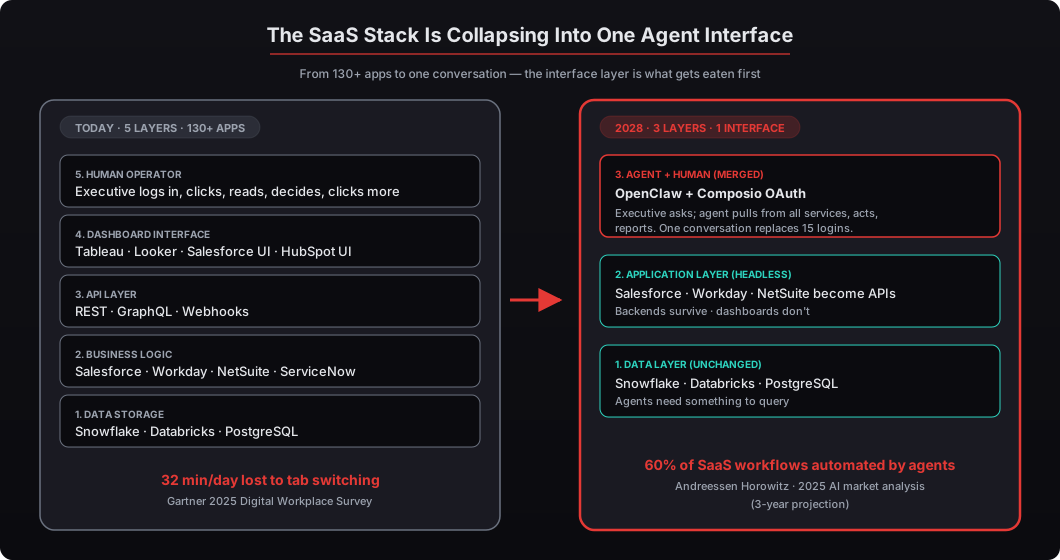
Here’s what I think the stack looks like by 2028, walking from the bottom up.
Data layer — unchanged. Snowflake, Databricks, PostgreSQL, BigQuery. Data has to live somewhere, and the databases that run modern enterprises are not going anywhere. If anything, they’ll get richer — agents query them more aggressively than humans ever did, which drives demand for query optimization, caching layers, and scale-out architecture. Snowflake’s forward multiples are likely safer than Salesforce’s for exactly this reason.
Application layer — SaaS backends that own unique business logic. Salesforce’s opportunity management, Workday’s HR workflows, ServiceNow’s ITSM processes, NetSuite’s GL. These survive as “headless” services — systems that expose their logic through APIs but whose UIs get used less and less. The long tail of SaaS companies that built on top of these backends (the “Salesforce ecosystem” partners, for example) will have a much harder time, because their value was often “a better UI on the same data” and that value just became irrelevant.
Integration layer — this is where OpenClaw + Composio sits, and this is the biggest new category. Composio provides OAuth-secured connections to 10,000+ tools. The agent authenticates through Composio — it never sees raw credentials. The integration broker handles rate limits, retries, permission scoping, and audit logging. This is the critical middleware that makes a single agent useful across dozens of services without becoming a security nightmare. Two years ago this layer didn’t exist as a product category. Today it does. By 2028 it’ll be a billion-dollar category at minimum.
Agent runtime — OpenClaw. The open-source agent that runs 24/7, processes natural language instructions, and executes multi-step workflows across connected services. With NemoClaw’s enterprise security — policy guardrails, Docker sandboxing, audit trails, role-based access control — it’s production-ready for environments where agents handle sensitive data. Jensen Huang compared OpenClaw to Linux at Computex 2025, and the comparison is apt: the runtime becomes commodity infrastructure, and the value creation moves to the deployment, hardening, and integration layers on top of it.
Human layer — the executive. Instead of logging into 15 tools, they have one conversation with their agent. “What happened overnight?” “Prep my board deck.” “Flag any deals that slipped this quarter.” “Draft a response to the investor update.” The agent does the orchestration. The executive does the judgment. That’s the division of labor the new stack enables.
Five layers compressed into three that matter for the end user. The complexity doesn’t disappear — it moves into the integration and runtime layers. That’s exactly why the deployment and security hardening around these layers is where the real value creation happens, and why we built beeeowl around it.
Why does private deployment matter so much for this thesis?
Because the agent has access to everything. When you collapse 130 SaaS dashboards into one agent, that agent holds the keys to your entire operation — email, CRM, financial data, HR records, legal documents, investor communications, board materials, strategic plans. There has never been a single system inside an enterprise that had a more complete picture of the business than a properly integrated AI agent. And that’s the problem.
Running that agent on someone else’s cloud means trusting a third party with the most complete picture of your company that has ever existed in one system. According to IBM’s 2025 Cost of a Data Breach Report, the average breach cost hit $4.88 million — and AI-related breaches involving third-party providers averaged $5.12 million, 42 days longer to detect than breaches involving on-premise systems. That’s the current risk premium on cloud AI, before you factor in agent workloads, and cloud AI agent workloads are a higher risk category than cloud AI chat workloads because the blast radius is larger.
This is why private deployment isn’t a nice-to-have for the SaaS-disruption thesis. It’s structural. If the agent sees everything, the agent must run on infrastructure you control. Period. Any architecture that doesn’t start from that premise is building tomorrow’s data breach.
OpenClaw is open-source. You can run it on a Mac Mini in your office, a MacBook Air in your briefcase, or a dedicated private VPS. Docker sandboxing ensures the agent can’t access the host system. Composio handles OAuth so the agent never touches raw passwords or long-lived tokens. Full audit trails log every action. NVIDIA contributes engineers to the security stack through NemoClaw. This isn’t theoretical — it’s the deployment architecture we ship at beeeowl, and it’s the only architecture that makes the SaaS disruption thesis safe to execute at the C-suite level. We covered the regulatory side in detail in why sovereign AI is the biggest infrastructure trend of 2026.
Deloitte’s 2025 Enterprise AI Adoption Survey found that 71% of AI projects stall at the security review stage. The SaaS disruption thesis only works if your agent deployment passes your CISO’s review, your general counsel’s review, and — increasingly — your auditor’s review. Private infrastructure is how all three reviews become one-meeting conversations instead of six-month stall patterns.
What happens to the workforce inside SaaS companies?
This is the part nobody wants to talk about, so let’s talk about it. If agents eat the interface layer, SaaS companies need fewer people building and maintaining interfaces. Customer success teams shrink because agent users don’t need hand-holding through a dashboard they’re not opening. Sales teams contract because per-seat pricing models give way to usage-based or infrastructure pricing, and there’s no longer a 20-person team to onboard seat by seat. Enablement, training, and implementation services — entire support verticals inside SaaS companies — face headcount pressure.
Bain & Company’s 2025 Technology Workforce Report projects that SaaS companies will reduce customer-facing headcount by 15-25% over the next three years as AI agents handle tier-1 support, routine onboarding, and configuration tasks. That’s not fearmongering from a contrarian analyst. Klarna already cut its workforce by 40% using AI, as CEO Sebastian Siemiatkowski detailed in their 2025 Q1 earnings call. The pattern is replicable inside SaaS — the customer success role of walking users through a new feature dashboard is exactly the kind of work an agent eats first.
The new hiring is in agent infrastructure. Security engineers with AI specialization. Integration specialists who understand OAuth and credential management across 10,000+ services. Deployment experts who can ship hardened private AI to executives without breaking their existing workflows. AI governance roles that combine compliance, security, and operations. The job market for knowledge workers doesn’t shrink in aggregate — it rotates. The rotation is painful for people whose current job is one that gets eaten, and rewarding for people who pick up the skills that scale in the new stack.
What should a CEO do right now?
Three things. None of them require a multi-year budget or a committee review.
First, audit your SaaS stack. Count every tool you log into daily whose primary function is showing you data from another system. Count every tool where your most common action is “check the dashboard” rather than “write original content.” Count every tool where your team files expense reports for licenses that barely get used. That’s your vulnerability surface — and, inverted, it’s your opportunity surface. Every one of those tools is a candidate for agent replacement at the interface level. The backends may stay (you’re not ripping out Salesforce). The logins go.
Second, deploy an agent on private infrastructure. Not as a pilot that a committee debates for six months. Not as an experiment with a vague success criterion. As a daily tool that handles your email triage, your meeting prep, and your data monitoring. You need to feel the shift before you can make strategic decisions about it, and feeling the shift requires having an agent that has been running against your actual data for at least two weeks. OpenClaw on dedicated hardware — a Mac Mini on your desk or a MacBook Air in your briefcase — gives you a working agent in one day. That’s the exact beeeowl deployment model, and it’s the fastest path from “thinking about it” to “running it.”
Third, rethink your SaaS budget. If you’re a CEO, challenge your CTO to identify which SaaS seats can be reduced or eliminated once an agent handles the workflow. Start with the seats that have the lowest utilization — Productiv’s 45% average means half your current SaaS spend is already waste, before any agent deployment. If you’re a VC, stress-test your portfolio companies against this thesis at your next board meeting: what happens to their revenue when the dashboard is no longer how users interact with the data? Which companies in your portfolio own data layers versus interface layers? The answer will tell you which portfolio companies to double down on and which ones to prepare for multiple compression.
How does beeeowl fit the agent-first future?
beeeowl is the deployment layer. We take OpenClaw — the open-source agent runtime backed by NVIDIA — deploy it on hardware you own, security-hardened, in one day, and ship it within a week. Every deployment includes Docker sandboxing, Composio OAuth setup for 250+ services, firewall hardening, audit trails, authentication, and one fully configured agent tailored to your role. You don’t need to hire an agent engineer. You don’t need a governance committee. You need an agent on your desk running workflows that used to eat five SaaS subscriptions. That’s what we ship.
Hosted deployments start at $2,000 one-time. Hardware tiers with a Mac Mini or MacBook Air included run $5,000 to $6,000 — one-time, not subscription. Additional agents run $1,000 each. No per-seat licensing, no usage metering, no recurring fees eating into your ROI. Full details on our pricing page, and workflow examples by role on our use cases page.
The personal AI agent isn’t a future technology story. It’s here. OpenClaw has crossed 350,000 GitHub stars. NVIDIA is committing engineers to its security stack through NemoClaw. Jensen Huang is comparing it to Linux and Kubernetes in keynote speeches. Gartner, McKinsey, Andreessen Horowitz, Battery Ventures, and Bessemer are all tracking the same disruption from slightly different angles. The SaaS stack you built your company on is about to get a new interface — and it doesn’t have a login screen.
The only question is whether you’re running one of those agents by next week or watching your competitors run theirs while you’re still deciding whether to evaluate.