The Sovereign AI Movement: Why Nations and Enterprises Are Building Their Own AI Stacks
40+ heads of state referenced AI sovereignty at Davos 2026. Microsoft pivoted. The EU AI Act went live. Here's what sovereign AI actually means for executives — and what to deploy.


At WEF Davos 2026, more than 40 heads of state referenced AI sovereignty in their addresses — up from just 7 in 2024. Microsoft announced its sovereign cloud at Ignite. The EU AI Act took full effect in February. NVIDIA reported $4.1 billion in sovereign AI orders for Q4 2025 alone. In six months, “sovereign AI” went from think tank language to national budget line item — and the smartest executives are already ahead of it.
What is sovereign AI and why did it become a 2026 flashpoint?
Sovereign AI is the global push by nations, enterprises, and individual executives to own and control their AI infrastructure instead of renting it from a handful of US hyperscalers. The movement became a 2026 flashpoint because regulatory enforcement, hyperscaler pivots, and geopolitical anxiety all hit in the same quarter.
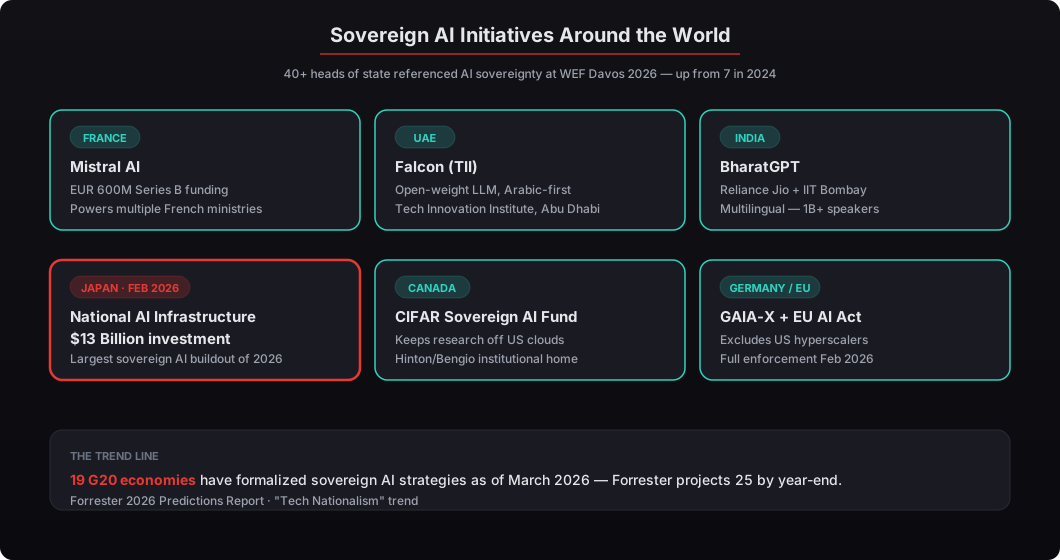
Forrester’s 2026 Predictions Report coined the term “tech nationalism” for the trend, projecting 25 G20 economies will have formalized AI sovereignty strategies by year-end. As of March 2026, the count is already at 19. That’s roughly one new national strategy every six weeks since Davos.
This isn’t protectionism. It’s pragmatism. No government — and increasingly no board — wants its most sensitive data flowing through servers in a jurisdiction it can’t subpoena.
Which countries are actually building their own AI stacks?
Six major economies already have production-grade sovereign AI initiatives, and Japan’s February 2026 $13 billion commitment is the largest single buildout of the year. France, the UAE, India, Canada, and Germany each chose a different path — but the underlying logic is identical: control the model layer, the data layer, and the compute.
France bet heavily on Mistral AI, which raised EUR 600 million in its Series B and now powers operations across multiple French ministries. The UAE’s Technology Innovation Institute continues scaling Falcon, its Arabic-first open-weight LLM. India’s BharatGPT initiative, backed by Reliance Jio and IIT Bombay, is building multilingual models for more than a billion Hindi, Tamil, and Bengali speakers that OpenAI will never prioritize.
Canada’s CIFAR — the research institute Geoffrey Hinton and Yoshua Bengio built modern deep learning inside of — launched a sovereign AI infrastructure fund in late 2025 specifically to keep Canadian research off American clouds. Germany’s GAIA-X initiative explicitly excludes US hyperscalers from its sovereignty requirements, and Brazil’s national AI plan mandates domestic data processing. Japan’s $13B announcement in February 2026 is the largest and most telegraphed bet of the year.
When six of the world’s top-twelve economies all move the same direction within twelve months, it isn’t ideology. It’s policy.
Why is 67% of the Fortune 500 C-suite suddenly on board?
Because the business case stopped being theoretical. McKinsey’s January 2026 Global AI Survey found that 67% of C-suite respondents at companies with revenue exceeding $1 billion now consider AI infrastructure ownership a “board-level strategic priority” — up from 23% in 2024. That’s a near-tripling in 24 months.
Gartner’s 2026 CIO Agenda Survey showed 48% of Fortune 500 CIOs have an active project to move at least one AI workload from cloud APIs to on-premise or private cloud. JPMorgan Chase disclosed in its Q4 2025 earnings call that it runs over 300 AI models internally, with the majority on proprietary infrastructure. Goldman Sachs has built a dedicated AI engineering team of 200-plus focused exclusively on sovereign deployment.
Deloitte’s 2026 AI Enterprise Survey puts hard numbers on it: companies running AI on infrastructure they control report 41% fewer data incidents and 3.2x faster regulatory audit completion compared to those relying entirely on third-party AI APIs. BCG’s 2026 Technology Advantage survey found that 72% of board directors at companies with over 5,000 employees now list “AI infrastructure control” among their top five technology governance priorities — up from 31% in 2024.
These are the same board rooms that spent 2023 asking “what’s our ChatGPT strategy?” They aren’t chasing trends anymore. They’re managing risk.
What did Jensen Huang mean by “the most important infrastructure since electricity”?
NVIDIA CEO Jensen Huang has been the loudest corporate voice on sovereign AI, calling it “the most important infrastructure since electricity” at multiple appearances through 2025 and into 2026. At CES 2026 he dedicated nearly a third of his keynote to sovereign AI buildouts, announcing partnerships with France, Japan, India, and Canada for national AI computing infrastructure.
The electricity analogy isn’t marketing. It’s Huang’s actual argument for why this matters. Nations that built their own power grids thrived in the 20th century. Those that depended on imported electricity stayed economically vulnerable. He’s making the identical case about AI compute — and his order book backs the rhetoric.
NVIDIA reported $4.1 billion in sovereign AI infrastructure orders in Q4 2025 alone, a 340% year-over-year increase. That’s GPUs, networking, and reference architectures for systems that countries and enterprises will actually own. The NemoClaw enterprise reference design, which NVIDIA actively contributes engineering resources to, is one concrete output: a production-grade security and deployment framework for OpenClaw carrying NVIDIA’s stamp.
When I tell prospective clients our deployments use NemoClaw’s security architecture, the NVIDIA association moves the conversation from “interesting startup” to “infrastructure investment.” For the full breakdown, see our analysis of NemoClaw’s enterprise future.
How does the EU AI Act force the sovereignty question?
The EU AI Act, fully enforceable since February 2026, doesn’t just regulate what AI can do — it regulates where AI does it. Article 10’s data governance requirements and Article 13’s transparency obligations effectively mandate that companies know exactly where their AI processes data, how models make decisions, and who has access to the underlying systems.
The penalty structure makes it real: fines up to 7% of global annual revenue for non-compliance with high-risk AI provisions. For a company doing $10 billion in revenue, that’s $700 million in exposure — larger than most enterprise IT budgets. PwC’s EU AI Act Readiness Assessment from February 2026 found that only 14% of enterprises using cloud AI APIs could demonstrate full compliance with the Act’s sovereignty and transparency requirements.
If you’re calling GPT-4 through an API, good luck answering a regulator’s questions in an audit. You don’t know which datacenter processed the request. You can’t prove the model weights weren’t updated mid-session. You can’t produce a complete audit log the vendor didn’t also see.
This is exactly where open platforms like OpenClaw become strategic assets rather than cost savings. When an agent runs on hardware you own with Docker sandboxing and local audit trails, every question a regulator asks has a straight answer. You know where the data lives. You know what the agent did. You control the keys.
What does Microsoft’s sovereign cloud push actually signal?
Microsoft’s sovereign cloud initiative, announced at Ignite 2026 in January, is the clearest signal yet that the hyperscalers see the writing on the wall. The program offers governments and regulated enterprises the ability to run Azure AI services on infrastructure that never leaves their jurisdiction, operated by local partners rather than Microsoft employees.
Read between the lines of Nadella’s announcement and you see strategic accommodation, not innovation. Microsoft is responding to the fact that AWS, Google Cloud, and Azure are losing sovereign AI deals to local alternatives. France chose OVHcloud and Scaleway for government AI workloads over all three US hyperscalers. Germany’s GAIA-X initiative explicitly excludes American cloud infrastructure. Brazil’s national AI plan mandates domestic data processing.
For enterprise executives, the Microsoft move validates a principle: data residency and infrastructure control are now non-negotiable requirements, not nice-to-haves. If the largest cloud provider on earth is restructuring its delivery model around sovereignty, your company can’t afford to treat it as an open question.
The tell is that Microsoft isn’t marketing sovereign cloud as a premium upgrade. They’re positioning it as the default for regulated customers. That only happens when the default without it is losing deals.
Can a single executive actually own their AI the way a nation does?
Yes — and this is the most underreported part of the movement. The sovereign AI narrative gets told as a nation-state story, but the same tooling that lets France run Mistral on French infrastructure lets a CEO run an AI agent on a Mac Mini sitting on her desk. IDC’s February 2026 report on personal AI infrastructure found that executive adoption of privately deployed AI agents grew 890% year-over-year. The market barely existed 18 months ago.
The logic is identical, just at a different scale. If France doesn’t want government data flowing through American servers, why would a CEO want her M&A pipeline, her investor communications, and her competitive intelligence running through OpenAI’s infrastructure? The threat model is the same. The consequences are personal.
What changed is that the tooling caught up. OpenClaw made it possible to run a genuine AI agent — not a chatbot, not a toy — on consumer hardware. Docker sandboxing, OAuth credential management through Composio, audit trails, authentication — all production-grade. Two years ago, self-hosted AI meant a PhD and six months of configuration. Today, it’s a one-day deployment. For the plain-English version, read our guide to what OpenClaw is.
The mental shift in our clients is the interesting part. They stop thinking of AI as a service they subscribe to and start thinking of it as infrastructure they own. Like their laptop. Like their phone. Like their office lease.
Where does the sovereign AI movement go from here?
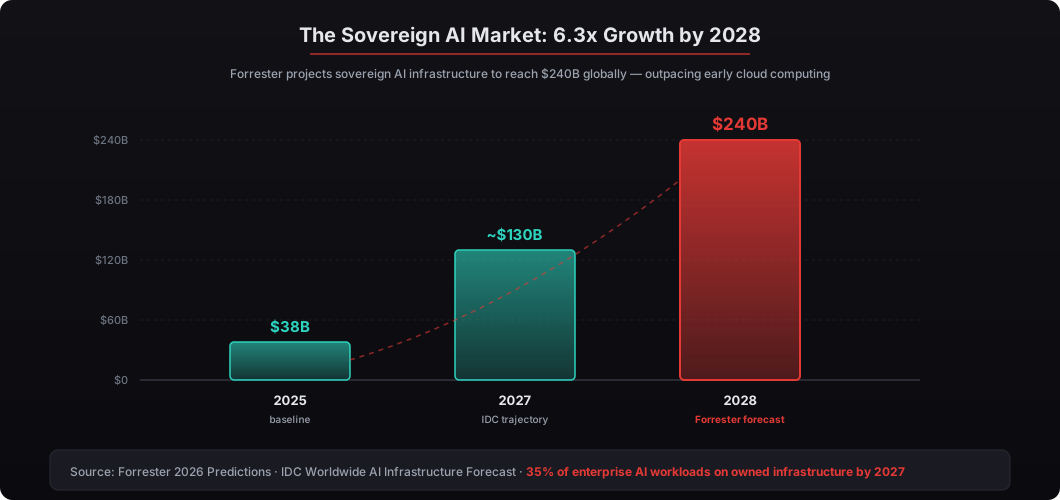
Forrester projects sovereign AI infrastructure will be a $240 billion global market by 2028, up from roughly $38 billion in 2025 — a 6.3x expansion in three years. That outpaces cloud computing’s early growth curve. IDC forecasts that 35% of all enterprise AI workloads will run on owned or controlled infrastructure by 2027.
At the national level, expect every G20 economy to have a formalized sovereign AI strategy within 18 months. Japan’s $13 billion investment was the largest domino in Q1; South Korea and Australia are expected to follow before summer. At the enterprise level, “sovereign stack” is becoming a procurement category — CIOs will evaluate AI vendors on deployment flexibility, not just capability. Vendors that can’t say “yes, on your infrastructure, with your data, under your control” will lose deals.
At the individual level, the concept of personal AI infrastructure is normalizing fast. When I explain to a CEO that she can have an AI agent running on hardware she owns, processing data that never touches a third-party server, the reaction has gone from “that sounds paranoid” in early 2024 to “when can you ship it?” today. The same arc played out with cloud in 2012, with cybersecurity in 2017, and with zero-trust architecture in 2021. Sovereign AI is the 2026 version — see why it’s the biggest infrastructure trend of the year.
The executives moving fastest aren’t waiting for the EU AI Act’s next enforcement wave or the next Microsoft press release. They’re deploying one agent on infrastructure they control and letting the results compound.
How does beeeowl fit into the sovereign AI shift?
beeeowl is a private AI infrastructure company that deploys OpenClaw — the open-source agent framework backed by NVIDIA — on hardware you own, security-hardened, in one day, and ships within a week. Every deployment includes Docker sandboxing, Composio OAuth setup, firewall hardening, audit trails, and one fully configured agent tailored to your role. Not a chatbot. Not a SaaS subscription. Sovereign AI infrastructure for a single executive.
Hosted deployments start at $2,000. Hardware tiers with a Mac Mini or MacBook Air included run $5,000 to $6,000 as one-time costs — no subscriptions, no per-seat licensing, no usage metering. Full details on our pricing page, and role-specific workflows on our use cases page.
The sovereign AI movement stripped of its geopolitical drama comes down to a simple question: do you rent your intelligence infrastructure from a company that can change its terms tomorrow, or do you own it? Nations figured the answer out first. Fortune 500 boards figured it out second. The executives who figure it out now will have the clearest strategic advantage in 2027 — because they won’t just be using AI. They’ll own it.