Google Gemma 4: The Open-Source LLM That Changes Everything for Private AI Agents
Gemma 4 scores 89.2% on AIME, runs locally on a Mac Mini, and ships under Apache 2.0. Here's what it means for executives running private AI infrastructure with OpenClaw.
What Is Gemma 4 and Why Should Executives Care?
Gemma 4 is a family of four open-source AI models released by Google DeepMind on April 2, 2026. The 31B parameter variant scores 89.2% on AIME 2026 (a competition-level math benchmark), 85.2% on MMLU Pro, and 86.4% on agentic tool-use tasks — numbers that put it within striking distance of GPT-4o and Claude while running entirely on hardware you own.
That last part is why this matters for you. According to IBM’s 2025 Cost of a Data Breach Report, breaches involving AI systems cost 13% more than average because AI-processed data tends to be high-value — exactly what executives feed into their agents. Gemma 4 eliminates that attack surface. Your prompts, documents, and outputs never leave your machine.
Sundar Pichai, Google’s CEO, announced the release with a direct statement: Gemma 4 is packing an incredible amount of intelligence per parameter. Demis Hassabis, CEO of Google DeepMind, called them “the best open models in the world for their respective sizes.” Jeff Dean added that these models set a new standard for open intelligence.
The Gemma family has crossed 400 million downloads since its first generation, with over 100,000 community variants. This isn’t an experiment. It’s infrastructure.
What Models Are in the Gemma 4 Family?
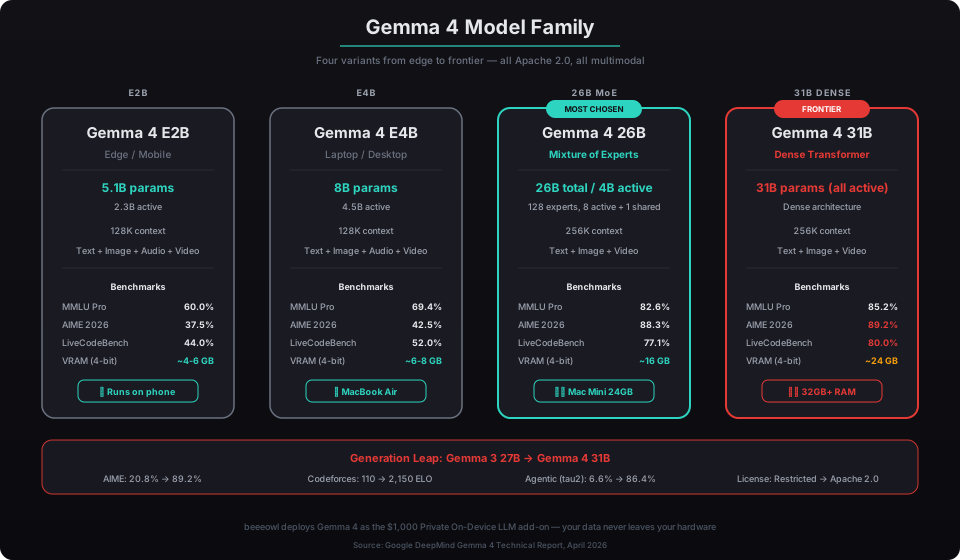
Gemma 4 ships in four variants, each designed for a different deployment scenario. Every model comes in both Base and Instruction-Tuned checkpoints.
- Gemma 4 E2B has 5.1 billion parameters with 2.3 billion active. It handles text, images, audio, and video with a 128K context window. This is the phone and tablet model — it runs on mobile devices and edge hardware with as little as 4-6GB of memory at 4-bit quantization.
- Gemma 4 E4B has 8 billion total parameters, 4.5 billion active. Same modalities as E2B, same 128K context. This is the sweet spot for a MacBook Air — it uses 6-8GB of VRAM at 4-bit and handles everyday executive tasks like email drafting, document summarization, and scheduling.
- Gemma 4 26B A4B is the Mixture of Experts (MoE) model. It has 26 billion total parameters but a router selects only 8 out of 128 experts per token, plus one always-on shared expert. That means only 3.8-4 billion parameters activate per inference step. The result: near-31B quality at roughly 16GB of VRAM. For executives running a Mac Mini with 24GB unified memory, this is the highest-performing model that fits comfortably. It supports a 256K context window — enough to process an entire contract, codebase, or quarterly report in a single pass.
- Gemma 4 31B is the dense frontier model. All 31 billion parameters activate on every token. It scores 89.2% on AIME 2026, 80% on LiveCodeBench v6, and ranks #3 among all open models globally on LMArena. It needs 24GB+ of VRAM at 4-bit quantization — a Mac Mini with 32GB unified memory or a dedicated GPU setup.
How Big Is the Leap from Gemma 3 to Gemma 4?
The generational improvements aren’t incremental — they’re the largest jump between two versions of an open model ever recorded. The numbers speak for themselves.
On AIME 2026 (competition-level math), Gemma 3 27B scored 20.8%. Gemma 4 31B scores 89.2%. That’s a 4.3x improvement on the same benchmark category.
On Codeforces (competitive programming ELO), Gemma 3 27B had an ELO of 110. Gemma 4 31B has an ELO of 2,150. That’s not a percentage increase — it’s a qualitative transformation from a model that couldn’t code competitively to one that competes with expert human programmers.
On tau2-bench (agentic tool use in retail scenarios), Gemma 3 27B scored 6.6%. Gemma 4 31B scores 86.4%. This benchmark measures whether a model can autonomously use tools to complete multi-step tasks — exactly what OpenClaw agents do. A jump from 6.6% to 86.4% means the difference between an agent that fails at tool use and one that reliably completes complex workflows.
According to Google’s technical report, these improvements come from three architectural changes: Mixture of Experts for efficient compute allocation, native function calling trained from the ground up (not bolted on via prompting), and built-in reasoning mode with “thinking tokens” for step-by-step problem solving before answering.
What Are the Key Technical Breakthroughs?
Gemma 4 introduces eleven major features that separate it from everything that came before — not just from Gemma 3, but from the open-source LLM field as a whole.
- Native function calling. Trained from the ground up for tool use across all four model sizes — no prompt engineering hacks. This is what makes the 86.4% tau2-bench score possible, and why it pairs naturally with OpenClaw’s Composio integration stack.
- Built-in reasoning mode. “Thinking tokens” let the model reason step-by-step internally before answering. Similar to OpenAI’s o1-style reasoning, but running locally on your hardware. You control when it activates and how many compute tokens it spends.
- Mixture of Experts architecture. The 26B model uses 128 specialized experts with a router that selects 8 per token plus 1 always-on shared expert. You get 26B-class intelligence while only running 4B parameters of compute per step — frontier-class reasoning in 16GB of VRAM.
- Multimodal by default. All four models handle text and images. E2B and E4B also process audio and video natively — the audio encoder compresses from 681M to 305M parameters, with frame duration reduced from 160ms to 40ms. Feed it a whiteboard photo, financial dashboard screenshot, or voice memo.
- 256K context window. The 26B and 31B models support 256K tokens — doubled from Gemma 3. That’s roughly 500 pages in a single pass. For M&A due diligence, lengthy contracts, or full quarterly reports, no more manual document chunking.
- Apache 2.0 license. Nathan Lambert at Interconnects called this potentially more impactful than the benchmarks. Gemma 3 had restrictive terms with MAU caps. Gemma 4 is fully Apache 2.0 — no commercial restrictions, no redistribution limits, no acceptable-use carve-outs. Fine-tune on proprietary data and deploy without consulting a lawyer.
- Variable aspect ratio vision. Configurable token budgets per image: 70, 140, 280, 560, or 1,120 tokens. Quick thumbnail? 70 tokens. Detailed financial chart? 1,120. Multimodal function calling is also supported — tool responses can include images.
- 140+ language support. 35+ languages out of the box, 140+ total. Board materials, client communications, and compliance documents in non-English languages get processed natively.
- Shared KV cache. Later layers reuse key-value states from earlier layers, eliminating redundant KV projections. According to Google’s benchmarks: up to 4x faster inference and 60% less battery consumption — directly relevant for MacBook Air deployments.
- Structured JSON output. Native well-formed JSON generation, critical for agent workflows that parse structured data. When your OpenClaw agent extracts data from an email for your CRM, the output comes back structured and parseable.
- Per-Layer Embeddings (PLE). E2B and E4B models use a second embedding table feeding residual signals into every decoder layer, squeezing more intelligence out of smaller models — one reason the 8B model punches well above its weight class.
How Does Gemma 4 Compare to Cloud LLMs Like GPT-4 and Claude?
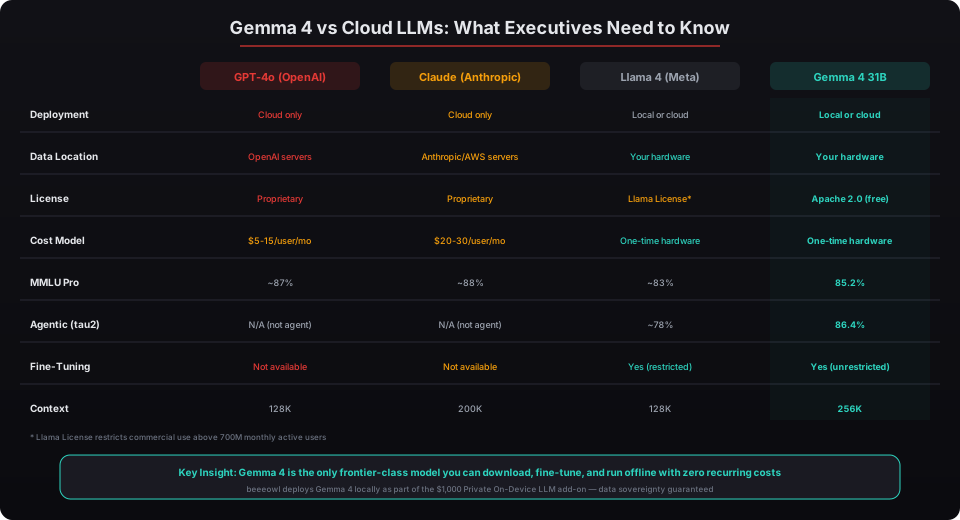
The honest answer: GPT-4o and Claude still lead on some benchmarks. GPT-4o edges ahead on GPQA reasoning. Claude excels at nuanced writing and code generation. But benchmarks don’t capture the full picture.
Gemma 4 31B is the only high-performance model you can download, fine-tune on your proprietary data, and run completely offline. GPT-4o and Claude are cloud-only — your prompts travel to third-party data centers, get processed on shared infrastructure, and create records you don’t control. For executives handling M&A term sheets, board materials, investor updates, or legal documents, that’s a non-starter.
The cost structure is fundamentally different. GPT-4o’s Enterprise tier runs $5-15 per user per month. Claude Teams costs $20-30 per user per month. Scale that across an executive team for three years and you’re looking at $7,200-$43,200 in recurring fees — and that’s before API overage charges. Gemma 4 costs zero in recurring fees. You buy the hardware once, and the model runs forever.
According to VentureBeat’s analysis of the Gemma 4 launch, the license change may matter more than the benchmarks. Apache 2.0 means no vendor lock-in, no usage reporting back to Google, and no telemetry. Meta’s Llama 4 ships under the Llama License, which restricts commercial use above 700 million monthly active users and includes acceptable-use restrictions. For enterprise deployments where legal teams scrutinize every dependency, Apache 2.0 eliminates an entire category of risk.
For many engineers and executives, the ability to fine-tune Gemma 4 on specific internal data — codebases, document styles, domain-specific terminology — makes it effectively smarter for their particular use case than general-purpose proprietary models that can’t be customized.
How Does Gemma 4 Run Locally on Apple Silicon?
Gemma 4 runs on Mac hardware through Ollama, the local model runtime that supports Apple Silicon’s unified memory architecture. Starting with Ollama v0.19, inference automatically uses Apple’s MLX framework for hardware-accelerated performance on M1, M2, M3, and M4 chips.
Here’s what works on each hardware tier:
MacBook Air M4 (16GB): Runs Gemma 4 E4B comfortably at 4-bit quantization. Uses approximately 6-8GB of memory. Handles email drafts, document summarization, scheduling, and conversational tasks. Expect 30-50 tokens per second.
Mac Mini M4 (24GB): Runs Gemma 4 26B MoE — the sweet spot. The model uses roughly 16GB at 4-bit quantization, leaving room for the operating system and OpenClaw processes. Near-31B quality with room to breathe. Community reports from DEV Community confirm stable operation, though the model consumes nearly all available memory under concurrent requests.
Mac Mini M4 (32GB) or Mac Studio: Runs the full Gemma 4 31B Dense model at 4-bit quantization (~24GB). This is the configuration for executives who want maximum reasoning capability without compromises. The larger memory headroom also allows for longer context processing.
Multiple quantization formats are available. GGUF formats (Q4_K_M, Q5, Q8) work through llama.cpp. MLX native formats run on Apple Silicon with TurboQuant at 3.5-bit for KV cache compression. NVIDIA publishes NVFP4 4-bit checkpoints that achieve near-identical accuracy to 8-bit precision.
The setup is straightforward: install Ollama, pull the model (ollama run gemma4), and point OpenClaw to localhost:11434. The entire process takes under 10 minutes.
One critical note from the community: do NOT use Ollama’s /v1 OpenAI-compatible URL endpoint (http://localhost:11434/v1) with OpenClaw. According to multiple setup guides from haimaker.ai and lushbinary.com, this breaks function calling. Use the native Ollama endpoint instead.
What Are the Best Use Cases for Gemma 4 with OpenClaw?
The 86.4% score on tau2-bench (agentic tool use) isn’t just a benchmark number — it translates directly to reliable autonomous workflows. Here’s where Gemma 4 paired with OpenClaw delivers the most value for executives.
Autonomous email management. Gemma 4’s native function calling means your OpenClaw agent can read incoming emails, draft context-aware responses, flag urgent items, and send follow-ups — all running locally. For a CEO handling 200+ emails daily, this reclaims hours. The 256K context window means the agent can reference your entire conversation history with a contact when drafting a reply.
Financial document analysis. Feed quarterly reports, variance analyses, or cash flow projections directly to your local Gemma 4 instance. The multimodal capability means it can also process charts, graphs, and screenshots from financial dashboards. For CFOs running variance commentary workflows, this eliminates the need to send sensitive financial data to cloud APIs.
Deal flow triage for VCs. Gemma 4 processes pitch decks (including images and charts), extracts key metrics, scores deals against your criteria, and routes promising opportunities to your attention. The 256K context lets it analyze an entire 50-page pitch deck in one pass. All evaluation data stays on your hardware — critical when reviewing confidential term sheets.
Board deck assembly. The agent pulls data from Notion, Google Slides, and your CRM, then assembles board-ready materials with Gemma 4 handling the narrative writing and data interpretation. According to Gartner’s 2025 AI Infrastructure forecast, executives spend an average of 15 hours per quarter on board preparation. An OpenClaw agent with Gemma 4 cuts that to under 2 hours.
Competitive intelligence monitoring. Gemma 4’s multilingual support (140+ languages) means your agent can monitor international news sources, translate relevant articles, and compile dossiers — all processed locally. No competitive intelligence data leaks to third-party AI providers.
Contract review and clause flagging. Feed contracts into your local agent, and Gemma 4’s reasoning mode analyzes clauses against your templates. The built-in “thinking tokens” let the model reason through complex legal language before flagging risks. For managing partners tracking contract clause risk, this is a force multiplier.
How Does beeeowl Deploy Gemma 4 for Clients?
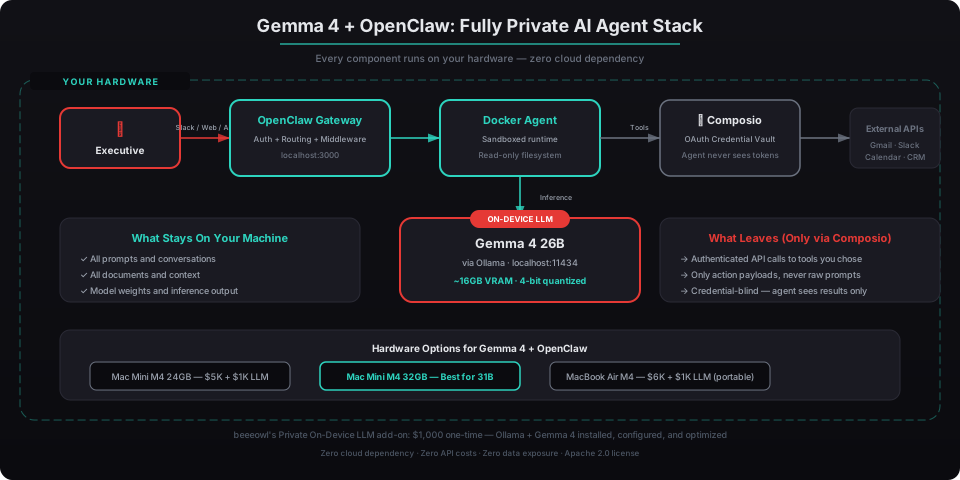
beeeowl offers Gemma 4 as the Private On-Device LLM add-on — a $1,000 one-time addition to any hardware deployment. Here’s what’s included:
Ollama installation and optimization. We install Ollama, configure it for your specific Apple Silicon chip, and pull the optimal Gemma 4 variant for your hardware. Mac Mini 24GB gets the 26B MoE. Mac Mini 32GB gets the 31B Dense. MacBook Air gets E4B. Each model is quantized to the highest quality level your memory allows.
OpenClaw integration. We configure your openclaw.json to route all inference through the local Ollama endpoint. Your agent’s reasoning, drafting, and analysis happen entirely on your machine. No API calls to OpenAI, Anthropic, or Google Cloud.
Model selection and testing. Not every task needs the biggest model. We configure your agent to use the right model for the right job — E4B for quick email triage, 26B MoE for document analysis, 31B for complex reasoning tasks that justify the compute. This maximizes speed without sacrificing quality where it matters.
Performance benchmarking. Before handoff, we run your agent through representative workflows — email processing, document summarization, tool calling — and verify response quality and latency meet production standards.
The add-on works with all three hardware tiers:
| Tier | Hardware | Best Gemma 4 Model | Total Investment |
|---|---|---|---|
| Mac Mini Setup | Mac Mini M4 24GB | 26B MoE | $5,000 + $1,000 |
| Mac Mini Setup | Mac Mini M4 32GB | 31B Dense | $5,000 + $1,000 |
| MacBook Air Setup | MacBook Air M4 | E4B (8B) | $6,000 + $1,000 |
Every deployment also includes OpenClaw installation, Docker sandboxing, Composio OAuth credential isolation, gateway hardening, and 1 year of monthly mastermind calls. The Gemma 4 add-on layers on top of the full security stack — it’s not a shortcut that bypasses hardening.
Why Does the Apache 2.0 License Matter for Enterprises?
Gemma 3 shipped under Google’s custom “Gemma Terms of Use” — a license with acceptable-use restrictions, redistribution limits, and monthly active user caps. Legal teams at enterprises flagged these as risks. You couldn’t fine-tune Gemma 3 for certain use cases without potentially violating the terms.
Gemma 4 is Apache 2.0. That’s the same license used by Kubernetes, TensorFlow, and Apache Kafka. According to the Open Source Initiative, Apache 2.0 explicitly permits:
- Commercial use without restrictions
- Modification and distribution without limits
- Private fine-tuning on proprietary data with no disclosure obligations
- Deployment with no usage reporting or telemetry
- Redistribution under any terms you choose
The Register reported that this license change positions Google directly against Chinese open-weight models like Qwen 3.5, DeepSeek, and GLM 5 — making Gemma 4 the American alternative with a license Western enterprises actually trust. Nathan Lambert at Interconnects wrote that Google’s move creates “cautious optimism” — strong performance, small enough to run locally, the right license, and from a U.S. company.
For regulated industries, this matters enormously. Healthcare organizations can fine-tune Gemma 4 on clinical data without triggering data-sharing clauses. Financial institutions can customize it for compliance workflows without exposing proprietary training data. Government agencies can deploy with strict data residency compliance.
Meta’s Llama 4, the closest competitor, ships under the Llama License — which restricts commercial use above 700 million monthly active users and includes acceptable-use provisions. For 99% of enterprises this restriction won’t trigger, but legal teams still flag it as a future risk. Apache 2.0 eliminates that conversation entirely.
What Does Gemma 4 Mean for the Open-Source AI Industry?
Gemma 4 represents a tipping point. For the first time, an open-source model can credibly handle autonomous agent workflows that previously required GPT-4-class proprietary models. The 86.4% score on tau2-bench — up from 6.6% in the previous generation — means open-source AI agents just became production-viable.
NVIDIA is backing this shift aggressively. Their engineers collaborated with Google on Gemma 4 optimization across the full hardware stack — Blackwell data center GPUs, RTX consumer GPUs, DGX Spark, and Jetson edge modules. NVIDIA published NVFP4 quantized checkpoints that squeeze Gemma 4 into 4-bit precision with near-identical accuracy to 8-bit. Jensen Huang stated the position at GTC: “Proprietary versus open is not a thing. It’s proprietary AND open.”
NVIDIA also announced the Nemotron Coalition — a global collaboration to advance open frontier models. They’re the largest organization on Hugging Face with approximately 4,000 team members contributing to open-source AI infrastructure. This isn’t lip service. NVIDIA’s RTX AI Garage features Gemma 4 as a highlighted local AI model, and their NeMo Automodel framework provides turnkey fine-tuning for Gemma 4 on NVIDIA hardware.
The broader trend is unmistakable. Jensen Huang compared OpenClaw to Linux at Computex 2025 — every company will need an OpenClaw strategy. Gemma 4 is the reasoning engine that makes that strategy work without cloud dependencies. Open-source AI has gone from “interesting experiment” to “enterprise infrastructure.”
According to Latent Space, the leading AI research newsletter, Gemma 4 represents “the best small multimodal open models, dramatically better than Gemma 3 in every way.” The community response confirms this — over 400 million downloads of the Gemma family, with 100,000+ fine-tuned variants in what Google calls the “Gemmaverse.”
What Are the Limitations and Cautions?
Gemma 4 is a breakthrough. It’s not perfect. Executives deploying it should understand the constraints.
- Knowledge cutoff is January 2025. Gemma 4 doesn’t know about events after that date. For time-sensitive workflows like competitive intelligence or market monitoring, your OpenClaw agent should pull current data from external tools via Composio and feed it as context, rather than relying on the model’s training data.
- Audio is limited to edge models. Only E2B and E4B process audio natively. The 26B MoE and 31B Dense models handle text, images, and video — but not speech. If you need voice integration, you’ll need a separate STT layer (like Whisper) feeding text into the larger models.
- VRAM is the constraint at long context. The 31B model at 256K context requires approximately 22GB just for the KV cache, on top of model weights. On a Mac Mini with 24GB, that’s not feasible at full context length. Community benchmarks from ai.rs found that Qwen 3.5 27B fits 190K tokens on the same hardware where Gemma 4 manages roughly 20K tokens. If long-context processing is your primary use case, this is a real limitation.
- Early stability issues. Within the first 24 hours of release, the community reported infinite loops when reading text from images in Google AI Studio, jailbreaks possible with basic system prompts, and hard crashes when loading 31B or 26B models in certain LM Studio configurations. According to DEV Community user reports, QLoRA fine-tuning wasn’t ready at launch — HuggingFace Transformers didn’t recognize the gemma4 architecture, and PEFT couldn’t handle Gemma4ClippableLinear layers. These are expected early-release issues that get patched within weeks, but they matter if you’re deploying immediately.
- It’s not a replacement for safety-critical systems. Gemma 4 processes text, images, and video with impressive reasoning capability. It does not understand physical constraints, torque limits, actuator saturation, or real-time timing guarantees. Application-level safeguards — the kind beeeowl deploys as standard with every OpenClaw installation — remain non-negotiable.
- Multimodal reasoning is not physical grounding. The model can describe what it sees in an image with high accuracy. It cannot reliably reason about physical cause-and-effect in the real world. For workflows involving document analysis, data extraction, and text processing, this isn’t a limitation. For anything involving physical systems, it is.
How Does Gemma 4 Fit Into the Privacy and Data Sovereignty Movement?
Running Gemma 4 locally means your data never leaves your machine. No API calls to Google, OpenAI, or Anthropic. No prompts stored on third-party servers. No data processing agreements required. No cross-border data transfers to worry about.
According to SecurityToday, Gemma 4 represents on-premise AI as a security strategy — not just a technical preference. For organizations subject to GDPR, running inference locally eliminates cross-border data transfer concerns entirely. Healthcare organizations keep patient data fully on-premise. Government agencies deploy with strict data residency compliance.
The $1,000 Private On-Device LLM add-on from beeeowl makes this practical. We don’t just install Ollama and pull a model — we configure the entire stack so that inference, tool calling, and credential management all stay local. The only data that leaves your network is authenticated API calls to the tools you’ve explicitly connected through Composio — and even those calls are credential-blind, meaning the agent never sees your OAuth tokens.
Google also offers Gemma 4 across their Sovereign Cloud deployments, including air-gapped and on-premises options. But for executives who want full control without a Google Cloud relationship, the local deployment path through Ollama is the cleanest option.
According to Open Source For You’s analysis, Gemma 4 under Apache 2.0 means no vendor lock-in of any kind — no usage reporting, no telemetry, no phone-home mechanisms. Your AI infrastructure is yours.
What Should You Do Next?
If you’re already running a beeeowl OpenClaw deployment, adding Gemma 4 is a one-day upgrade. We install Ollama, pull the right model for your hardware, configure OpenClaw to route inference locally, and verify everything works in production. Your existing Docker sandboxing, gateway hardening, and Composio integrations stay untouched.
If you’re evaluating private AI for the first time, Gemma 4 changes the math. A Mac Mini with 24GB unified memory ($599), plus beeeowl’s $5,000 Mac Mini Setup with the $1,000 Private On-Device LLM add-on, gives you a fully autonomous AI agent running frontier-class reasoning with zero recurring costs. Compare that to $20/user/month for ChatGPT Enterprise over three years — $720 per user — with your data on someone else’s servers.
The hardware is included in beeeowl’s price. The model is free. The license is Apache 2.0. The only question is whether your data is sensitive enough to justify keeping it on your own hardware.
For most executives, the answer is obvious.
Request Your Deployment — and get Gemma 4 running on your own hardware within a week.