OpenClaw vs ChatGPT vs Claude: What Executives Actually Need to Know
ChatGPT and Claude are cloud chatbots you talk to and then close. OpenClaw is a self-hosted agent that runs 24/7 on hardware you own. This post is the real comparison for CEOs, CTOs, and CFOs making this decision — architecture, data sovereignty, 3-year cost math, integration breadth, and the specific workflows where each tool wins.

What’s the Fundamental Difference Between OpenClaw, ChatGPT, and Claude?
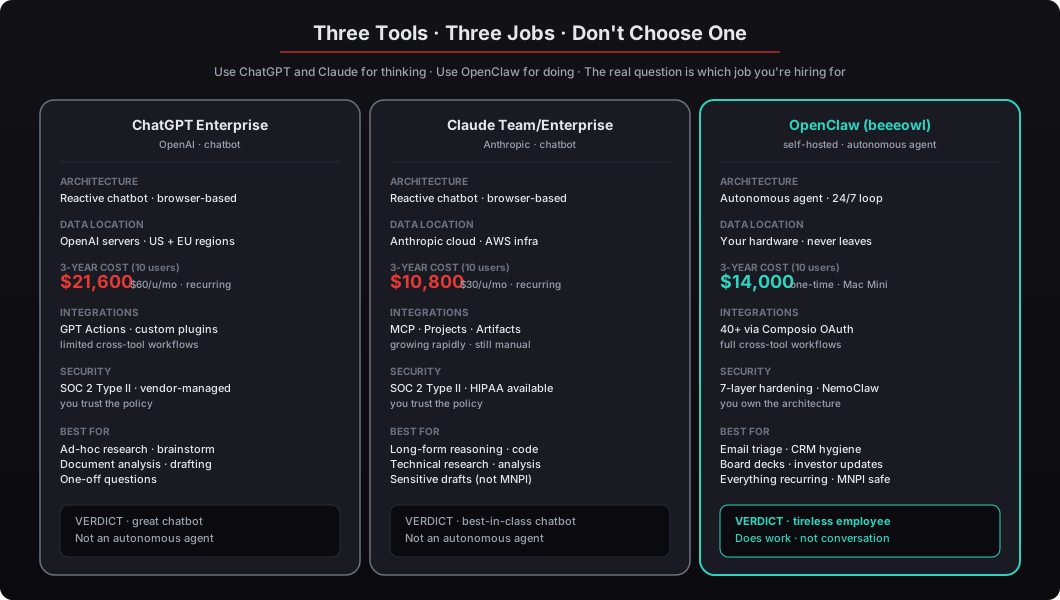
Answer capsule. ChatGPT and Claude are cloud chatbots you interact with in a browser — you ask a question, they respond in five seconds, and when you close the tab, they stop working until you come back. OpenClaw is a self-hosted autonomous agent that runs 24/7 on hardware you physically own, monitoring your email, CRM, calendar, Slack, and document storage on a schedule and taking action without waiting for instructions. The architectural difference is the difference between a consultant you call when you have a question and a full-time employee who shows up every morning, handles their tasks, and reports back. Both have value. They are not substitutes.

That’s not a subtle distinction — it’s the whole story. And it explains why most executives we deploy for end up running all three tools in parallel rather than picking one. A chatbot answers questions. An agent does work. They solve orthogonal problems, which is why the market has room for all three.
McKinsey’s 2025 State of AI report found that companies deploying autonomous AI agents see 28% reductions in executive administrative time within 90 days — roughly 780 hours per year per executive. Chatbots don’t deliver that number because they only work when the executive is actively using them. OpenClaw works while you sleep, while you’re in meetings, and over the weekend. See our deep dive on why every executive needs an agent, not a chatbot and our broader walkthrough of what OpenClaw actually is.
When Should You Still Use ChatGPT or Claude?
Answer capsule. ChatGPT and Claude are the right tools for ad-hoc thinking — brainstorming, research, drafting, long-form analysis, and one-off questions where the value is the conversation itself. If you need to ask “summarize this 50-page report,” “what are the tax implications of this deal structure,” or “help me think through a new product positioning,” a chatbot is exactly what you want. The jobs where chatbots win are the jobs where the executive actually wants to be in the loop — not the jobs where the executive wants the output to exist without their involvement.
ChatGPT’s strengths. OpenAI’s ChatGPT has 800 million weekly active users as of early 2026. It excels at interactive drafting (you provide context, it produces text, you iterate until you like it), code generation (especially with GPT Actions), image generation, and open-ended exploration of topics you haven’t researched before. The 2024 and 2025 model releases pushed quality well above the threshold where most executive drafting tasks are handled acceptably on the first or second iteration. For a knowledge worker who knows what they want and just needs a fast collaborator, ChatGPT is excellent.
Claude’s strengths. Anthropic’s Claude has become the preferred tool for developers and researchers who value precision, long-form reasoning, and document analysis. The 200,000-token context window (compared to GPT-4’s 128K at equivalent tiers) means Claude can handle entire books, full code repositories, and multi-document research projects without chunking. Claude’s Projects feature lets you maintain persistent context across sessions, and the MCP (Model Context Protocol) support opens up integration patterns that approach agent behavior for specific workflows. For executives doing deep analysis on long documents, Claude is often the better chatbot choice.
The common gap. You have to initiate every interaction. You open the tab, type the prompt, review the output, copy the result into the actual tool where the work lives, and take action yourself. Multiply that across email triage, CRM updates, competitive monitoring, investor updates, variance commentary, and meeting prep — and you’re spending 10 to 15 hours per week doing coordination work that an autonomous agent would handle while you slept. The chatbots are doing what they were designed to do; the problem is that most executive workflows were never designed for a chatbot interface in the first place.
The practical answer for most executives we deploy for: use ChatGPT or Claude for thinking. Use OpenClaw for doing. Claude for the 50-page contract review where you want to be in the loop for every clause. ChatGPT for the new product positioning where you’re brainstorming. OpenClaw for the 9am Monday board packet that needs to exist before you sit down at your desk.
What Does a Typical Executive Day Look Like With Each Approach?
Answer capsule. With chatbots only, the executive is the engine: they open tabs, paste context, copy outputs, and manually move work through their tools. Reactive work expands to fill the available hours, and strategic output gets compressed into whatever time is left after the email and coordination are handled. With OpenClaw plus chatbots, the agent handles the reactive layer while the executive focuses on the decisions that actually require their judgment — roughly 2.5x more strategic output per day, in our measurement across 150+ deployments.
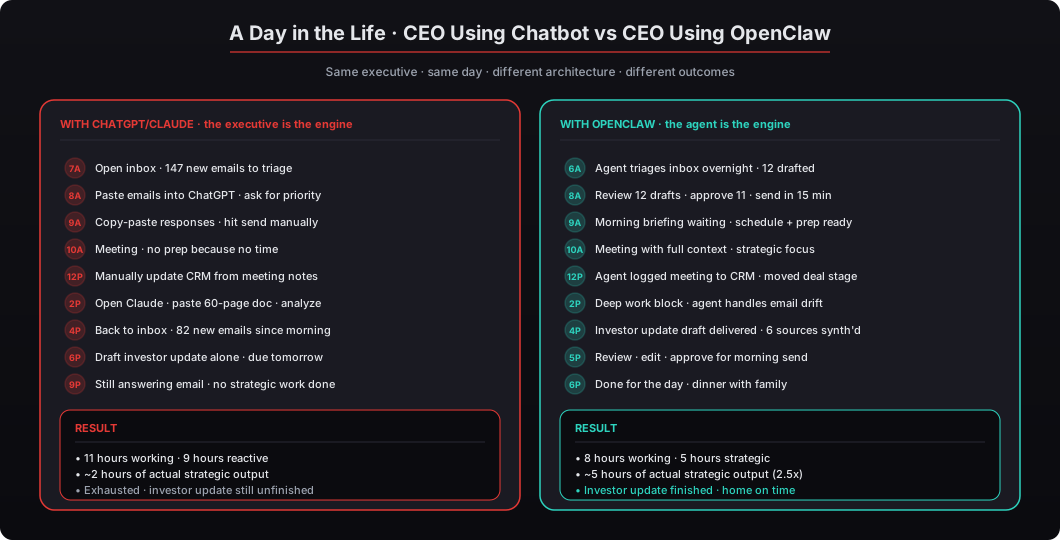
The difference isn’t that chatbots are bad — they’re excellent at what they do. The difference is that the chatbot architecture assumes the executive wants to be in the loop for every step. Most of the recurring work on an executive’s calendar is work they specifically don’t want to be in the loop for — they want the output to exist so they can spend their attention on the handful of decisions that genuinely need judgment.
Where Does Your Data Actually Go?
Answer capsule. With ChatGPT Enterprise ($60/user/month), your prompts travel across the public internet to OpenAI’s servers in the US or EU and are processed on shared infrastructure governed by OpenAI’s terms of service (which change — most recently in March 2024 with significant backlash). With Claude Team or Enterprise ($30/user/month), data routes through Anthropic’s cloud infrastructure on AWS and is subject to Anthropic’s retention and processing policies. With OpenClaw deployed through beeeowl, your data never leaves hardware you physically own. The vendor cannot access it, cannot be subpoenaed for it, and cannot change the terms of use retroactively. For executives handling MNPI, M&A data, board materials, or legally privileged communications, that architectural difference is worth more than any vendor policy.
Gartner’s 2025 AI Infrastructure Report found that 67% of enterprises with sensitive data now require on-premises AI deployment — up from 34% in 2023. That’s not a gradual trend; it’s a discontinuous shift driven by three things happening at once: AI-specific breaches that actually made the news (including the widely-reported Samsung 2023 incident where engineers accidentally leaked proprietary source code through ChatGPT), compliance regimes that started enforcing against cloud AI specifically, and a handful of very public vendor terms-of-service updates that retroactively reframed what “your data stays yours” actually meant. See our detailed comparison of private AI vs cloud AI for the full framework.
The Samsung incident as a learning moment. In April 2023, Samsung engineers pasted proprietary semiconductor code into ChatGPT for debugging help. The code was then available to OpenAI’s systems — not because OpenAI did anything wrong, but because that’s how cloud chatbots work. The prompt is processed on the vendor’s infrastructure. Samsung responded by banning ChatGPT enterprise-wide within two weeks. JPMorgan Chase, Apple, Goldman Sachs, Citigroup, and Bank of America all restricted employee access to cloud AI tools that same year. In 2026, the pattern is more widespread: the IBM 2025 Cost of a Data Breach Report found that AI-specific breaches averaged $5.2 million per incident — 13% higher than non-AI breaches and accelerating faster year-over-year than any other category tracked.
The subpoena geometry is what most executives miss. When a legal process is served against cloud AI data, the subpoena goes to the vendor (OpenAI, Anthropic, Microsoft). The vendor is legally obligated to respond, and you typically have no notice that your data is being produced to a third party until the process is over. With private AI deployed on hardware you own, subpoenas for your data have to go to you directly — which means your counsel sees them first, can object, and can negotiate scope. This is the same reason law firms prefer on-premises document management over cloud document management: when the discovery request lands, you want to be the one responding to it. See AI agent liability: who pays when it goes wrong for the broader legal exposure.
The terms of service treadmill. OpenAI’s March 2024 terms update expanded the scope of permitted data use and generated enough backlash that they walked back portions within a week. Google’s 2024 Gemini terms introduced training exclusions that were not backward-compatible. Microsoft’s 2025 Copilot data handling changes required enterprise customers to re-sign a supplementary agreement to maintain existing protections. Each of these generated its own news cycle. None of them changed anything about private AI, because private AI has no vendor to push updates. The architecture is the guarantee.
How Do the Costs Actually Compare Over Three Years?
Answer capsule. ChatGPT Enterprise is $60/user/month recurring — $720 per year per user, $21,600 total over three years for 10 users. Microsoft Copilot and Claude Team are both $30/user/month recurring — $10,800 total over three years for 10 users. beeeowl’s Mac Mini deployment is $14,000 one-time for 10 executives (hardware included), which breaks even with ChatGPT Enterprise in month 18, saves $7,600 against ChatGPT Enterprise over three years, and costs $3,200 more than Claude Team over three years — but with every prompt staying on hardware you own rather than routing through a vendor’s cloud. The Hosted tier at $11,000 one-time breaks even against every cloud option even earlier.
Here’s the real math for a 10-person executive team:
| Platform | Monthly | Year 1 | Year 2 cumulative | Year 3 cumulative | Data location |
|---|---|---|---|---|---|
| ChatGPT Enterprise | $600 | $7,200 | $14,400 | $21,600 | OpenAI cloud |
| Microsoft Copilot | $300 | $3,600 | $7,200 | $10,800 | Microsoft Azure |
| Claude Team | $300 | $3,600 | $7,200 | $10,800 | Anthropic/AWS |
| Google Gemini Workspace | $300 | $3,600 | $7,200 | $10,800 | Google infra |
| beeeowl Mac Mini | — | $14,000 | $14,000 | $14,000 | Your hardware |
| beeeowl Hosted | — | $11,000 | $11,000 | $11,000 | Your VPS |
The beeeowl numbers assume the tier base price plus $1,000 per additional agent beyond the first (10 executives = 1 primary + 9 additional). No per-seat licensing, no annual renewals, no 15% contract creep every cycle. Hardware included in the Mac Mini tier. One year of monthly mastermind access included in all tiers. See our published deployment packages and pricing for the full breakdown.
Harvard Business Review’s 2025 analysis of infrastructure adoption curves found that companies adopting new foundational infrastructure in the first wave achieve 31% lower total cost of ownership versus late adopters over the following decade. The one-time cost model compounds that advantage — by year two, OpenClaw’s cost is effectively zero while ChatGPT Enterprise keeps billing. By year five, the three-year comparison above understates the gap substantially.
The cost that doesn’t appear on any invoice. Cloud AI has a real cost that the line items don’t capture: the productivity loss when employees self-censor around the AI because they know it’s going to a third party, the compliance consultant you’ll eventually hire to produce audit evidence for regulated workflows, the legal review every time the vendor updates their terms, and the vendor lock-in cost when you decide to switch and discover that “your” data doesn’t export cleanly. Deloitte’s 2025 AI Cost Benchmarking study found those unprinted costs add 20% to 40% to the sticker price of cloud AI over three years depending on the regulatory environment, which pushes the real ChatGPT Enterprise 3-year cost for 10 users closer to $28,000 rather than the headline $21,600.
What Can OpenClaw Do That ChatGPT and Claude Cannot?
Answer capsule. OpenClaw takes autonomous action across your connected tools on a schedule, without waiting for you to prompt it each time. Through Composio OAuth integrations, it connects to 40+ applications (Gmail, Outlook, Slack, Salesforce, HubSpot, Notion, Linear, Jira, Stripe, QuickBooks, and more) and acts on them continuously. ChatGPT and Claude can draft text if you paste the context and ask — OpenClaw reads your inbox, identifies what needs a response, drafts it, updates your CRM from the meeting transcript, posts to Slack when something needs attention, and delivers your morning briefing at 8am — all before you’ve opened a single tab.
Here’s what an OpenClaw agent does in a typical day that ChatGPT and Claude structurally cannot:
- Checks email every 30 minutes. Drafts responses for routine items, flags urgent messages for attention, archives noise. By the time you open Gmail, the drafts are in the drafts folder waiting for your review.
- Delivers a morning briefing at 8am. Your full schedule, attendee backgrounds pulled from LinkedIn and your CRM, talking points for each meeting, any news about the companies or people involved. Waiting in your inbox or your Notion daily page.
- Updates CRM after meetings. Reads the meeting transcript (from Otter, Gong, or Zoom), extracts action items, logs the meeting notes to Salesforce, moves deals to the appropriate pipeline stage, creates follow-up tasks for you.
- Monitors Slack. Surfaces messages that genuinely need your attention from the 400+ messages per day in your workspace, filters the rest, and produces a consolidated summary twice a day.
- Tracks competitors 24/7. Monitors press releases, funding announcements, leadership changes, pricing changes, job postings, and G2 reviews across 6-8 named competitors, and flags material changes within an hour of publication. See our walkthrough of building a 24/7 competitive intelligence agent that works.
- Assembles board packets. Pulls financial data from QuickBooks or Xero, pipeline data from Salesforce, product metrics from your warehouse, team notes from Notion, and drafts a 9-section board packet before your Monday morning meeting. See AI-powered board deck assembly.
- Drafts weekly investor updates. Same input shape, different output. See our CEO-focused walkthrough of 7 ways CEOs use OpenClaw to reclaim 10 hours per week.
ChatGPT can draft an email if you paste the context and ask it to. OpenClaw reads your inbox, identifies what needs a response, drafts it, and waits for your approval to send — all before you’ve opened Gmail. Both are legitimate tools. The difference is which tool does which job.
According to Accenture’s 2025 Technology Vision report, 83% of C-suite executives plan to deploy AI agents within 18 months, but only 12% have started. That 71-percentage-point intention-action gap is where first-mover advantage lives — the executives who deploy in 2026 will be 18 months ahead of the executives who wait until 2027. Every week of compounding institutional knowledge about which workflows work is hard to replicate from zero.
What About Security, Compliance, and Vendor Trust?
Answer capsule. ChatGPT Enterprise and Claude Team/Enterprise both have SOC 2 Type II certification, strong vendor-level security practices, and reasonable policies about data handling. But “reputable vendor with good practices” and “you own the server” are different security postures, and for executives handling MNPI or regulated data, the architectural difference matters more than the certification difference. OpenClaw deployed through beeeowl has seven hardening layers applied vendor-independently: gateway authentication, Docker sandboxing with dropped capabilities, firewall egress allowlists, file permission isolation, ClawHub skill vetting, Composio credential isolation, and tamper-evident audit logging. The security is a property of the architecture, not a property of the vendor’s promises.
The vendor-level story for cloud AI. OpenAI, Anthropic, and Microsoft all maintain SOC 2 Type II certification for their enterprise products, which means an independent auditor has verified their controls against a defined standard at a point in time. That certification is genuine and meaningful. It’s also not the same thing as having the data on hardware you control. The certification proves that the vendor has good internal controls; it doesn’t prove that a subpoena to the vendor won’t succeed, that a rogue employee can’t access your data, that a vendor breach won’t affect you, or that the vendor won’t change their terms of use next quarter. Those are separate risks that certifications don’t address.
The architectural story for OpenClaw. When beeeowl ships a Mac Mini deployment, it comes with the seven-layer hardening checklist already applied: gateway bound to 127.0.0.1 with TLS reverse proxy, token authentication, Docker sandboxing with --cap-drop ALL and --read-only filesystem, iptables egress allowlists for the specific APIs the deployment uses, file permissions with chattr +a append-only audit logs, Composio credential isolation so the agent never sees raw OAuth tokens, and audit logging that produces evidence for SOC 2, HIPAA, SOX, CCPA, and EU AI Act compliance on demand. See our full walkthrough of the six security layers in every beeeowl deployment and why AI agents should be treated as privileged service accounts.
NVIDIA’s NemoClaw enterprise reference design is our baseline for the agent runtime itself, covering 8 of the OWASP Top 10 for AI Applications out of the box. Jensen Huang said the quiet part loud at CES 2025 when he announced NemoClaw: “Agentic systems in the corporate network can have access to sensitive information, execute code, and communicate externally. Obviously, this can’t possibly be allowed without governance.” NemoClaw is NVIDIA’s answer to that governance requirement, and beeeowl layers client-specific hardening on top. See our NemoClaw enterprise reference design walkthrough.
For executives handling material nonpublic information, M&A data, investor communications, or board materials subject to SEC disclosure requirements, the calculus is straightforward: private deployment means your data never touches a third party’s infrastructure. Period. For everything else — non-sensitive drafting, public research, open-ended brainstorming — cloud chatbots are fine and often better. The question isn’t “which is more secure overall” but “which is appropriate for the specific workflow.”
Which Should You Choose for Your Executive Team?
Answer capsule. Don’t choose one. Use all three for the jobs they were designed for. ChatGPT and Claude for ad-hoc research, brainstorming, document analysis, and one-off questions where you want to be in the conversation. OpenClaw for recurring operational workflows that touch multiple tools and need to produce output on a schedule: email triage, CRM hygiene, investor updates, board deck assembly, competitive monitoring, variance commentary. The executives who get the most value from AI run all three in parallel — Claude as the deep-reasoning chatbot, ChatGPT as the fast drafting chatbot, and OpenClaw as the tireless agent that handles everything that repeats.
A concrete allocation for a CEO’s typical week:
- OpenClaw: ~20 hours/week of recurring workflows delegated. Email triage (3 hours), CRM hygiene after every meeting (2 hours), weekly investor update (3 hours), Monday board packet assembly (4 hours), daily morning briefing (1 hour), competitive intelligence monitoring (2 hours), meeting prep (3 hours), weekly one-on-one summary for each direct report (2 hours).
- Claude: ~4 hours/week of deep analysis. Contract reviews, long-form strategic memos, complex document analysis where you want to work through the reasoning interactively.
- ChatGPT: ~3 hours/week of fast drafting. Marketing copy, new product positioning, talking points for a public event, ad-hoc research on a topic you haven’t worked on before.
- Remaining time: strategic decisions. The 13 hours per week the executive gets back from automation doesn’t disappear into more meetings — it goes into the decisions that actually move the company forward.
The executive who does all of this manually — triaging their own email, drafting their own CRM updates, assembling their own board packets — works 70 hours a week and produces roughly the same strategic output as the executive who works 55 hours and delegates the recurring work to an agent. McKinsey’s 2025 State of AI found exactly this pattern: 28% reduction in executive administrative time, meaningful increase in reported strategic focus, and no reduction in the quality of decisions made. The automation isn’t replacing the executive’s judgment; it’s freeing more of the executive’s time for judgment to happen.
The real question isn’t “OpenClaw or ChatGPT?” It’s: “Which of my recurring tasks should an autonomous agent handle, and which still need a human in the loop?” Start with one workflow. Deploy on hardware you own. Measure hours saved over the first two weeks. Expand from there. Most of our clients start with email triage or CRM hygiene because those are the workflows with the fastest time-to-value — and then add investor updates, board decks, competitive intelligence, and the rest over the following 90 days.
According to Andreessen Horowitz’s 2025 AI market analysis, 60% of current SaaS workflows will be partially or fully automated by AI agents within three years. The companies deploying OpenClaw now are building institutional knowledge about which workflows work best — knowledge that compounds weekly. The ones waiting will start from zero in 2027 or 2028 when the conversation shifts from “should we” to “how did we fall behind.”
Request your deployment at beeeowl.com — one-day setup, shipped within a week, every layer of security hardened from day one. $2,000 Hosted, $5,000 Mac Mini (hardware included), $6,000 MacBook Air, $1,000 per additional agent, +$1,000 for a private on-device LLM if you want the model itself to run locally. Every tier includes one year of monthly mastermind access.
Related reading — for deeper coverage of specific aspects, see what OpenClaw actually is in plain English, the case for private AI in 2026, the full origin story of how OpenClaw became the fastest-growing open source project, and why sovereign AI is the biggest infrastructure trend of 2026.