The VC's AI Advantage: Automating Deal Flow, LP Updates, and Portfolio Monitoring
PitchBook tracks 17,000+ VC deals closed per year. Preqin found 73% of LPs demand quarterly reporting. Cambridge Associates: top-quartile funds evaluate 3.2x more opportunities per closed deal. Here are the three OpenClaw workflows that turn VC operations into competitive advantage.

PitchBook’s 2025 Annual US VC Dealmaking Report tracked over 17,000 venture deals closed in 2024 — and behind every closed deal sit hundreds of passed opportunities that still required screening time. Bessemer Venture Partners has publicly stated their team reviews over 4,000 inbound opportunities per year. Andreessen Horowitz reportedly sees 3,000+ annually. Even mid-market firms like Spark Capital field 1,500-2,500 inbound pitches. DocSend’s 2025 Startup Fundraising Research found the average VC spends 2 minutes 24 seconds reviewing a pitch deck on first pass — pattern matching under duress, not analysis. Preqin’s 2025 Investor Outlook found 73% of LPs now expect quarterly reporting (up from 58% in 2021), and 68% include specific reporting requirements in side letters. Cambridge Associates’ 2025 VC Benchmark Report found top-quartile funds consistently source from 3.2x broader funnels per closed deal than bottom-quartile peers. Cambridge Associates’ 2025 Private Equity and VC Operations Survey: fund operations teams spend 12 hours per portfolio company per quarter on data collection (a 25-portfolio fund = 300 hours = nearly 2 FTEs on spreadsheet pulls). Goldman Sachs’ 2025 Technology Outlook: 81% of institutional allocators now ask about AI governance during operational due diligence. This article is the complete architecture for running all three core VC workflows on a Mac Mini in your office — deal flow triage, LP communications, and portfolio monitoring — ILPA-compliant, SEC 206(4)-7 ready, and side letter safe.
Why are the best VC firms betting on private AI agents?
The top-performing venture firms aren’t just investing in AI companies — they’re deploying AI agents internally to run their own operations. Deal flow triage, LP reporting, and portfolio monitoring are the three workflows consuming the most partner and associate hours, and they’re all automatable with the right infrastructure. The math is straightforward: Cambridge Associates 2025 found top-quartile funds evaluate 3.2x more opportunities per closed deal than bottom-quartile peers — and that coverage advantage at the top of the funnel directly correlates with returns. Operations efficiency is the multiplier that separates top-quartile from median performance in a category where the gap between picks and portfolios is razor-thin.
PitchBook’s 2025 Annual US VC Dealmaking Report tracked over 17,000 venture deals closed in 2024. Behind every closed deal sit hundreds of passed opportunities that still required screening time. Preqin’s 2025 Investor Outlook Survey found that 73% of LPs now expect quarterly reporting as a minimum, up from 58% in 2021. The administrative burden on fund operations teams has compounded every year — and it’s compressing the time partners can spend on actual investing work.
I’ve deployed OpenClaw agents for VC firms ranging from solo GPs running first funds to multi-billion-dollar platforms. This is how they’re using them — and why private infrastructure isn’t optional for fund managers handling LP confidentiality obligations. See our guide to OpenClaw for the baseline architecture, and our private AI vs cloud AI analysis for the compliance rationale.
How does automated deal flow triage actually work?
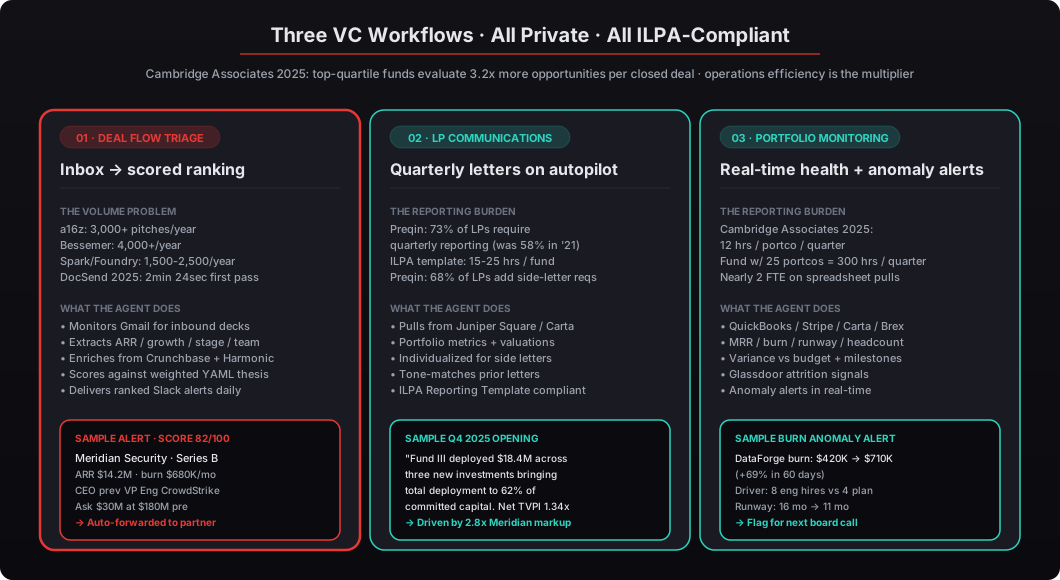
An OpenClaw deal flow agent monitors your inbox for inbound pitches, extracts key data from attachments, scores each opportunity against your investment thesis, and delivers ranked summaries to Slack or email. It compresses a 6-hour daily screening cycle into a 15-minute partner review. For the full pipeline architecture, see our deal flow triage deep-dive which covers the 5-step pipeline from inbox monitoring through scored Slack delivery.
The volume problem is real. According to DocSend’s 2025 Startup Fundraising Research, the average VC spends 2 minutes and 24 seconds reviewing a pitch deck on first pass. Bessemer Venture Partners has publicly stated their team reviews over 4,000 inbound opportunities per year. Andreessen Horowitz reportedly sees north of 3,000 annually. Even a disciplined mid-market firm like Spark Capital or Foundry Group is fielding 1,500 to 2,500 inbound pitches per year. Most of those pitches don’t match the fund’s thesis — wrong stage, wrong sector, wrong geography. An associate catches this in 90 seconds — but multiply that by 20 decks a day, five days a week, and you’ve burned an entire headcount on pattern matching that a weighted YAML thesis can do consistently.
What does the scoring engine look like?
The agent uses a weighted thesis configuration. Here’s a simplified example for a Series B enterprise infrastructure fund (this is the exact YAML schema we ship to clients):
thesis:
  name: "Enterprise Infrastructure Series B"
  criteria:
    sector:
      targets: [cloud-infrastructure, cybersecurity, data-platforms, devtools]
      weight: 0.30
    stage:
      targets: [series-b, series-a-late]
      weight: 0.20
    revenue:
      minimum_arr: 5000000
      preferred_arr: 10000000
      weight: 0.25
    geography:
      targets: [us, canada, uk]
      weight: 0.10
    team:
      founder_repeat: true
      technical_ceo: preferred
      weight: 0.15
Every inbound pitch gets scored against these criteria. The agent extracts revenue figures, headcount, founding team backgrounds, and sector classification directly from the deck and enrichment sources like Crunchbase, Harmonic, and LinkedIn. The thesis is a living document — partners adjust weights based on quarter-over-quarter learning, and the agent applies the updated weights on the next cycle without any engineering work.
What does the agent output look like?
Here’s a sample Slack alert the agent generates (anonymized from a real deployment):
DEAL SCORE: 82/100 — High Priority

Company: Meridian Security (Series B)
Sector: Cloud Infrastructure / Cybersecurity
ARR: $14.2M (up from $6.8M, 12 months prior)
Burn: $680K/mo | Runway: 22 months
Team: CEO prev. VP Eng at CrowdStrike, CTO ex-Datadog
Ask: $30M at $180M pre

Thesis Match:
  Sector: 0.30/0.30
  Stage: 0.20/0.20
  Revenue: 0.22/0.25
  Geography: 0.10/0.10
  Team: 0.12/0.15 (no prior founder exit)

Deck: [attached] | Crunchbase: [link] | LinkedIn: [link]
Action: Auto-forwarded to @sarah for deep dive
The partner sees scored, ranked deals every morning. No inbox digging. No missed opportunities buried under 40 cold emails. Cambridge Associates’ 2025 VC Benchmark Report found that top-quartile funds consistently source from a broader funnel than bottom-quartile peers — 3.2x more evaluated opportunities per closed deal. Speed and coverage at the top of the funnel directly correlate with returns. This agent is how you achieve that 3.2x multiplier without proportional headcount growth, which is the operational reality of running a fund efficiently.
How do AI agents draft LP communications?
LP reporting is the workflow every GP dreads and every LP demands. Quarterly letters, capital call notices, distribution memos, annual meeting decks — the cadence never stops. An OpenClaw agent drafts all of it from structured fund data, in your voice, ready for partner review.
Preqin’s 2025 Global Fund Terms Advisor Report shows that 68% of institutional LPs now include specific reporting requirements in side letters. The Institutional Limited Partners Association (ILPA) Reporting Template has become the de facto standard, and it’s detailed — cash flow waterfalls, portfolio company summaries, valuation methodology disclosures, ESG metrics, fee and expense breakdowns. Generating a compliant quarterly letter takes 15 to 25 hours of CFO and operations time per fund — and that’s if your ops team is efficient.
What does the agent draft?
The LP communication agent pulls from three data sources: your fund admin platform (Juniper Square, Carta Fund Admin, or Allvue), your portfolio monitoring data, and your previous communications for tone matching. Here’s a sample quarterly letter opening the agent generates from real fund data:
Dear [LP Name],

We're pleased to share our Q4 2025 update for Fund III.
The fund deployed $18.4M across three new investments during
the quarter, bringing total deployment to 62% of committed
capital. Net TVPI stands at 1.34x, up from 1.21x at Q3
close, driven primarily by Meridian Security's Series C
markup and NovaBio's revenue acceleration.

Portfolio highlights this quarter:

- Meridian Security: ARR reached $22M (54% YoY growth).
  Completed Series C led by Insight Partners at $320M
  valuation, representing a 2.8x markup from our entry.

- DataForge: Signed enterprise contracts with JPMorgan
  and Deloitte. Q4 revenue of $4.1M, first cash-flow
  positive quarter.

- NovaBio: FDA fast-track designation received for lead
  compound. Runway extended to 18 months following $8M
  bridge round.
Every name, figure, and metric is pulled from live fund data. The agent generates individualized letters when side letter terms require customized reporting — some LPs get ESG addendums, others get co-investment pipeline updates, others get detailed fee calculations with customized waterfall treatment. The individualization used to take another 10 hours of ops work per quarter. Now it’s a templating exercise the agent handles at draft time.
Why does confidentiality matter for LP communications?
This is where private infrastructure becomes non-negotiable. ILPA’s Principles 3.0, published in 2023 and now adopted by over 600 institutional investors including CalPERS, Ontario Teachers’ Pension Plan, and Yale’s endowment office, explicitly address data handling obligations. Side letters routinely include clauses prohibiting GPs from sharing LP identity, commitment amounts, and customized terms with third parties — and OpenAI’s API counts as a third party regardless of their “we don’t train on your data” promises.
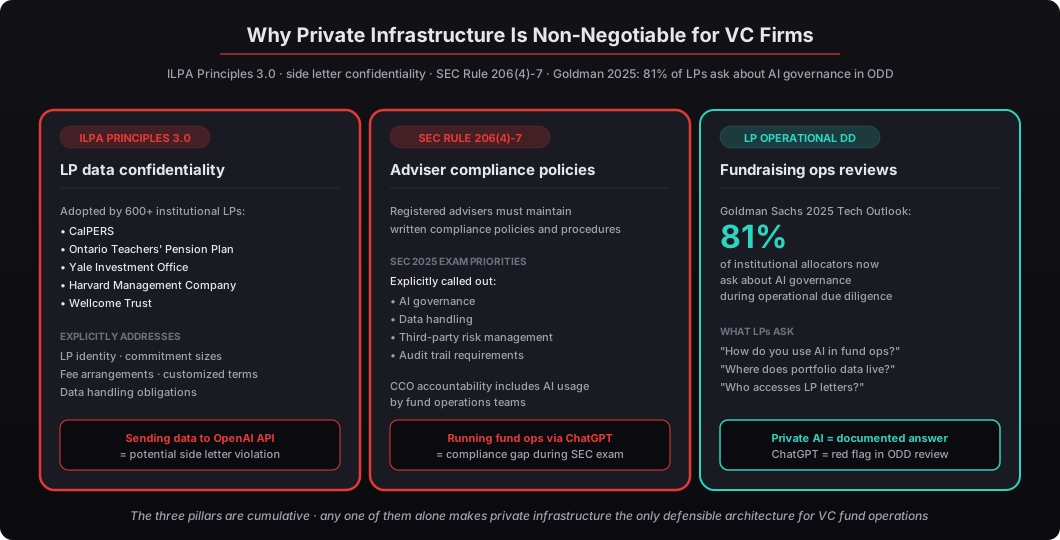
Sending your LP letters through ChatGPT’s API means OpenAI’s servers process your LP names, commitment sizes, fee arrangements, and portfolio valuations. That’s a side letter violation waiting to happen. OpenClaw agents running on a Mac Mini in your office keep everything local. The LLM processes fund data on your hardware. No API calls to external providers. No data leaving your network. Full compliance with ILPA guidelines and every side letter we’ve seen across 50+ deployments. For firms requiring the highest level of data isolation, we offer a Private On-Device LLM add-on — your fund data never touches even ChatGPT or Claude APIs. The model runs entirely on your machine using Ollama with models like Llama 3, Qwen 2.5, or Nemotron-Mini. See running a private LLM with Ollama for the full on-device configuration.
How does portfolio company health monitoring work?
The third workflow is ongoing portfolio monitoring. An OpenClaw agent connects to your portfolio companies’ reporting tools, aggregates key metrics, flags anomalies, and builds a live dashboard your partners access anytime. This is the workflow that replaces the “portfolio company health review” slide in every monthly partner meeting with a live dashboard that updates continuously.
According to Cambridge Associates’ 2025 Private Equity and VC Operations Survey, fund operations teams spend an average of 12 hours per portfolio company per quarter on data collection and reporting. For a fund with 25 active companies, that’s 300 hours per quarter — nearly two full-time headcounts dedicated to pulling numbers from spreadsheets. Those headcounts are the operational tax on having a portfolio, and the agent is how you eliminate it without sacrificing visibility.
What metrics does the dashboard track?
The portfolio monitoring agent tracks five categories across every active portfolio company:
Revenue and Growth: Monthly and annual recurring revenue (MRR/ARR), revenue growth rate (month-over-month, quarter-over-quarter), net revenue retention and churn.
Cash and Runway: Monthly burn rate, cash balance and projected runway, variance from budget.
Hiring and Team: Headcount by department, key hire completions vs plan, Glassdoor and LinkedIn attrition signals.
Product and Customers: Active customer count, logo churn and expansion revenue, NPS or CSAT scores where available.
Milestones: Board-approved milestones vs actual completion, fundraise timeline tracking, regulatory or clinical milestones for biotech and healthtech portfolios.
The agent connects to portfolio company data via Composio OAuth integrations — QuickBooks, Stripe, Carta, Brex, Gusto, Google Sheets, Notion, AWS Cost Explorer are the most common. Credentials are configured once during deployment and never exposed to the agent’s LLM layer.
What do anomaly alerts look like?
Here’s a sample burn rate alert from a real deployment:
ALERT: Burn Rate Anomaly — DataForge

Monthly burn increased from $420K to $710K (69% increase)
over the past 60 days.

Primary driver: 8 new engineering hires (Q4 hiring plan
was 4). AWS spend up 34% ($82K to $110K).

Runway impact: Projected runway dropped from 16 months
to 11 months at current burn.

Recommended action: Flag for next board call. Review
hiring plan adherence and infrastructure spend.

Data sources: Brex (expenses), Gusto (payroll),
AWS Cost Explorer (infra)
Partners see this in Slack the moment the anomaly crosses a threshold. No waiting for the quarterly board deck to discover a portfolio company is burning faster than planned. Bain & Company’s 2025 Global Private Equity Report emphasizes that early intervention in portfolio company operations is the single strongest predictor of fund-level outperformance. The firms that catch problems at month 2 instead of month 6 preserve significantly more value. The agent is the monitoring layer that makes “month 2 intervention” operationally possible across 25+ portfolio companies simultaneously.
What does the full deployment look like?
At beeeowl, we deploy all three workflows as separate OpenClaw agents on the same infrastructure. Each agent has its own skills, channels, Composio credential scope, and audit trail, but they share the same secure hardware. The deployment takes one structured day:
Morning: OpenClaw installation, OS hardening, Docker sandboxing (NIST SP 800-190 compliant), firewall configuration with explicit outbound allowlists. We lock down the system before any fund data touches it.
Midday: Agent configuration. Deal flow thesis setup with weighted YAML, LP template creation from your historical letters, portfolio company data source connections via Composio. For the technical setup, see our guide to building a deal flow triage agent.
Afternoon: Integration testing. We run sample pitches through the triage agent, generate test LP letters, and verify portfolio data pulls. Partners and associates get Slack notifications confirming everything works end-to-end.
Shipped: Hardware arrives within one week. A Mac Mini for the office, or a MacBook Air for partners who travel between New York, San Francisco, London, and international fund events. Everything is pre-configured — plug in, connect to WiFi, and the agents resume automatically from the configured state. See our deployment walkthrough in how to get your first OpenClaw agent running in one day.
Every deployment includes authentication, audit trails, and access controls. Partners see everything. Associates see deal flow. Operations sees LP reporting. Nobody sees data outside their role. For the multi-agent architecture that supports this role separation, see single-agent vs multi-agent: when you need more than one.
Why can’t VC firms just use ChatGPT or Claude directly?
Three reasons: confidentiality, consistency, and compliance.
Confidentiality. Pitch decks contain revenue figures, cap tables, customer lists, and founder compensation — all under NDA. LP letters contain commitment amounts, fee arrangements, and co-investment allocations — all under side letter confidentiality clauses. Portfolio data includes real-time financials of private companies. None of this should transit external servers. The side letter clauses are specific — “GP shall not share LP information with third-party processors without LP consent” is a standard construct, and OpenAI’s API counts as a third-party processor regardless of their enterprise terms.
Consistency. ChatGPT gives you a different output format every time you prompt it. An OpenClaw agent runs the same scoring rubric on every pitch, generates LP letters in the same structure every quarter, and flags anomalies against the same thresholds every week. Consistency is what makes fund operations scalable and what lets LPs get familiar with how your firm reports. Inconsistent reporting formats are a red flag in ODD reviews because they suggest process weakness.
Compliance. SEC Rule 206(4)-7 requires registered advisers to maintain compliance policies and procedures. The SEC’s 2025 Examination Priorities explicitly called out AI governance and data handling. Running fund operations through a cloud chatbot with no audit trail is a compliance gap your CCO should be worried about — and increasingly, SEC examiners are. OpenClaw agents maintain full audit logs on your infrastructure, which maps directly to the documentation your CCO needs for the next SEC exam cycle.
Goldman Sachs’ 2025 Technology Outlook for Asset Management noted that 81% of institutional allocators now ask about AI usage and data governance during operational due diligence. Having a documented, private AI infrastructure positions your fund ahead of that conversation — and the LPs who ask the question are often the ones with the biggest commitments, so being able to answer cleanly matters for fundraising, not just ops.
What’s the investment for a VC firm?
Our Hosted Setup starts at $2,000 for a cloud VPS deployment — suitable for emerging managers running a single fund and looking for the lowest-friction entry point. The Mac Mini Setup at $5,000 is where most VC firms land, giving you dedicated hardware in your office with all three agents configured. For partners splitting time between coasts or traveling to international fund events, the MacBook Air Setup at $6,000 gives you portable private AI infrastructure.
Additional agents beyond the first are $1,000 each — one per partner or one per workflow, depending on your access control requirements. If you have three partners who each want their own deal flow dashboard filtered by their sector focus, that’s three agents on the same physical machine. If you separate deal flow, LP, and portfolio monitoring into three isolated containers, same pricing — three agents, $3,000 incremental.
The Private On-Device LLM add-on is $1,000 for firms that need absolute data isolation. This is the configuration we recommend by default for larger VC firms managing institutional capital from pension funds and sovereign wealth funds, where the operational due diligence bar is highest.
Every deployment includes one year of monthly mastermind access — group calls where fund operators share workflow configurations, integration tips, and operational best practices with other beeeowl VC clients. The peer group is one of the underrated parts of the deployment because it means you’re not inventing operational patterns from scratch.
How do you get started?
We’ve deployed these exact workflows for VC firms managing between $50M and $2B in AUM. The pattern is the same regardless of fund size — the volume just scales. A $50M emerging manager fielding 500 inbound pitches per year gets the same three-workflow architecture as a $2B platform fund fielding 5,000 inbound pitches. The agent config changes; the infrastructure pattern doesn’t.
If your associates are spending half their day on inbox triage, your CFO is drowning in quarterly letter cycles, or your partners are surprised by portfolio company burn rates at board meetings, these are solvable problems — and they’re solvable in one week with one physical Mac Mini sitting in your office. Request your deployment and we’ll have your agents running within a week. Full pricing on our pricing page, role-specific workflow examples on our use cases page, and the deal flow deep-dive at building a deal flow triage agent for VCs with OpenClaw.