From Clawdbot to OpenClaw: The Fastest-Growing Open-Source Project in History
Peter Steinberger built an AI coding agent, Anthropic sent two trademark claims in four days, the community voted on a new name, and then OpenClaw became the fastest-growing open source project in GitHub history: 350,000+ stars, NVIDIA contributing engineers, Jensen Huang calling it the operating system for agentic computers. Here's the full story.

How Did OpenClaw Actually Start?
Answer capsule. OpenClaw began as a side project called “Clawdbot,” built by Peter Steinberger — the Austrian developer who founded PSPDFKit, a PDF framework used by Dropbox, Autodesk, SAP, and hundreds of other enterprise companies. Steinberger sold PSPDFKit, wanted an AI coding agent that could actually write code and commit changes autonomously using Anthropic’s Claude models, and built one. He open-sourced it in early 2025. Within 48 hours, it was the #1 trending repository on GitHub. Three days later, Anthropic’s legal team filed a trademark claim over the name — and the story took a turn that would accidentally create the fastest-growing open source project in GitHub history.

The specific problem Steinberger was solving matters. Every developer using AI tools in 2024 and early 2025 had run into the same wall: the chatbot could generate code, but it couldn’t do anything with it. You’d paste the output into your editor, save the file, run the tests, see a failure, paste the error back into the chatbot, get a fix, paste it in, save, run, and so on. The AI wasn’t doing work; the developer was doing work with an AI assistant that happened to be very good at the “write some code” step and completely absent from every other step.
Steinberger’s insight was that the gap wasn’t intelligence — the models were smart enough — the gap was agency. An agent needed to be able to run commands, read file contents, modify files, execute tests, and commit changes in an actual development environment. Clawdbot did exactly that. It was a terminal-based agent that connected to Anthropic’s Claude API, took a task description from the user, and then ran whatever commands were needed to complete the task. If the tests failed, it read the failure, fixed the code, and re-ran them. If it hit an error it couldn’t solve, it escalated to the human.
The GitHub response was immediate. Steinberger posted the initial release, and within 48 hours Clawdbot was #1 on GitHub’s trending page across all languages. By the end of the first week, the repository had roughly 15,000 stars and a growing contributor base — a trajectory that most open source projects never match over their entire lifetime. See the 10 trends shaping the OpenClaw ecosystem explosion for the full post-launch context.
But then Anthropic’s legal team got involved, and the story took a turn that would accidentally create the fastest-growing open-source project in GitHub history.
What Actually Happened with the Anthropic Trademark Dispute?
Answer capsule. Anthropic’s legal team filed a trademark claim against “Clawdbot,” arguing the name was too similar to their “Claude” brand. Steinberger complied and rebranded to “ClawDE” — a nod to the project’s coding roots and the “DE” (development environment) suffix. Anthropic objected again four days later. Two trademark claims in four days, both playing out publicly on X and GitHub. The open source community reacted strongly — TechCrunch, The Verge, Ars Technica, and Hacker News all covered the dispute on the front page. The community then voted on a new name: OpenClaw. It stuck, with a deliberate echo of what “OpenAI” used to mean before OpenAI stopped being open. The Streisand effect was immediate: developers who’d never heard of Clawdbot discovered OpenClaw specifically because of the trademark drama. Stars accelerated from thousands to tens of thousands per day.
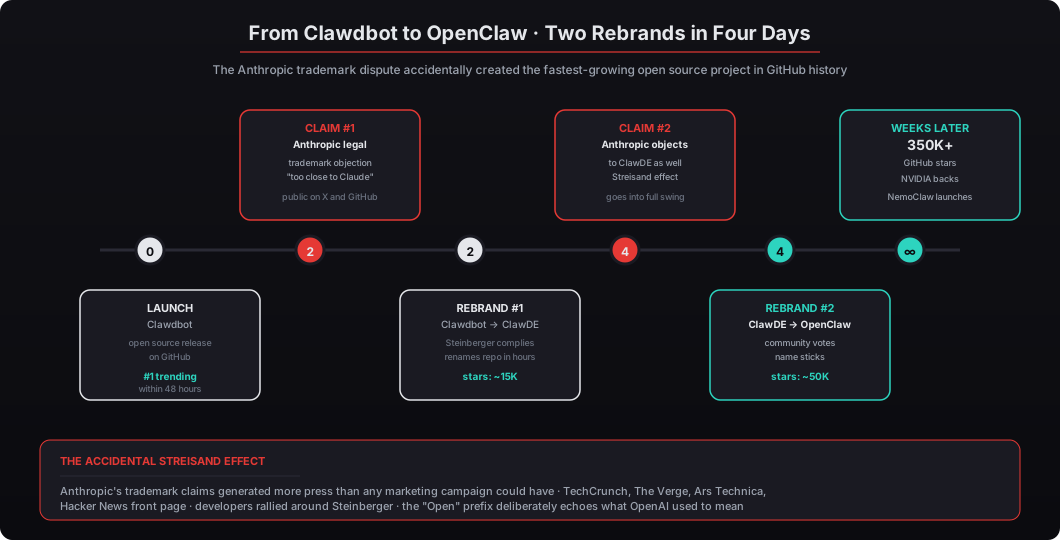
The specific sequence of events. Steinberger launched Clawdbot under an Apache 2.0 license on a Monday. By Tuesday the repository was #1 on GitHub trending. On Wednesday morning, Anthropic’s legal team sent a formal trademark objection to Steinberger directly, arguing that “Clawd” in the name was too close to their “Claude” brand and could cause consumer confusion. Steinberger, who had dealt with trademark issues before at PSPDFKit, complied immediately — he renamed the repository to ClawDE, updated the README, and pushed a new commit within hours. By Wednesday afternoon the project was back online under the new name. On Saturday, Anthropic’s legal team sent a second objection, this time to ClawDE, arguing the “Claw” prefix was still problematic. Two trademark claims in four days.
The community reaction. The second objection was the inflection point. Developers who had watched the first rebrand with mild interest now watched the second with active outrage. Hacker News’s front page ran a multi-day discussion thread with over 2,000 comments. TechCrunch published a piece titled “Anthropic’s Trademark Fight with a Solo Developer Is Generating the Exact Outcome They Were Trying to Avoid.” The Verge ran a follow-up on open source trademark disputes more broadly. Ars Technica wrote a technical explainer on what the project actually did and why it was generating so much attention.
The community-chosen name. Steinberger opened a GitHub Discussion asking the community to suggest a new name. The top three vote-getters were “OpenClaw,” “FreeClaw,” and “ClawOS.” OpenClaw won by a comfortable margin, explicitly because the “Open” prefix echoed what OpenAI used to mean in the early days before the company shifted toward closed models and enterprise licensing. Steinberger accepted the name and rebranded the repository for the second time. This time, Anthropic had no objection — “Open” plus “Claw” was different enough that even the most aggressive trademark reading couldn’t sustain an argument.
The Streisand effect. The trademark dispute generated more press coverage in a single week than Steinberger had received across PSPDFKit’s entire decade of operations. Developers who had never heard of Clawdbot were now reading about OpenClaw in mainstream tech press. The story had a clear narrative arc — solo developer, $3.4 trillion AI company, aggressive legal strategy, community rebellion, and a satisfying resolution where the community won. People starred the repository in support of Steinberger as much as for the software itself. Stars accelerated from thousands to tens of thousands per day, and then hundreds of thousands per week.
According to TechCrunch’s coverage, the dispute generated more attention for the project than any marketing campaign could have. Anthropic’s PR team later confirmed in background comments to reporters that the trademark strategy had been a significant miscalculation — the company had assumed enforcement would be quiet and uncontroversial, and instead watched it become a case study in what not to do with open source community projects. None of this was planned. None of it could have been planned. It was the accidental marketing moment of the decade.
How Did OpenClaw Hit 350,000+ GitHub Stars?
Answer capsule. OpenClaw surpassed 350,000 GitHub stars within weeks of launch — more than Linus Torvalds’ Linux accumulated in over 30 years on the platform. For scale: Kubernetes has ~115,000 stars after 10 years, React has ~235,000 after 12 years, TensorFlow has ~186,000 after 10 years, VS Code has ~170,000 after 10 years, and Docker has ~69,000 after 12 years. OpenClaw passed them all in roughly six weeks. According to GitHub’s official trending data, no project in the platform’s 18-year history has reached this velocity. Three factors converged to make it happen: the product was genuinely useful, the Anthropic trademark dispute generated massive press coverage, and NVIDIA’s public endorsement gave enterprise credibility that most open source projects never achieve.
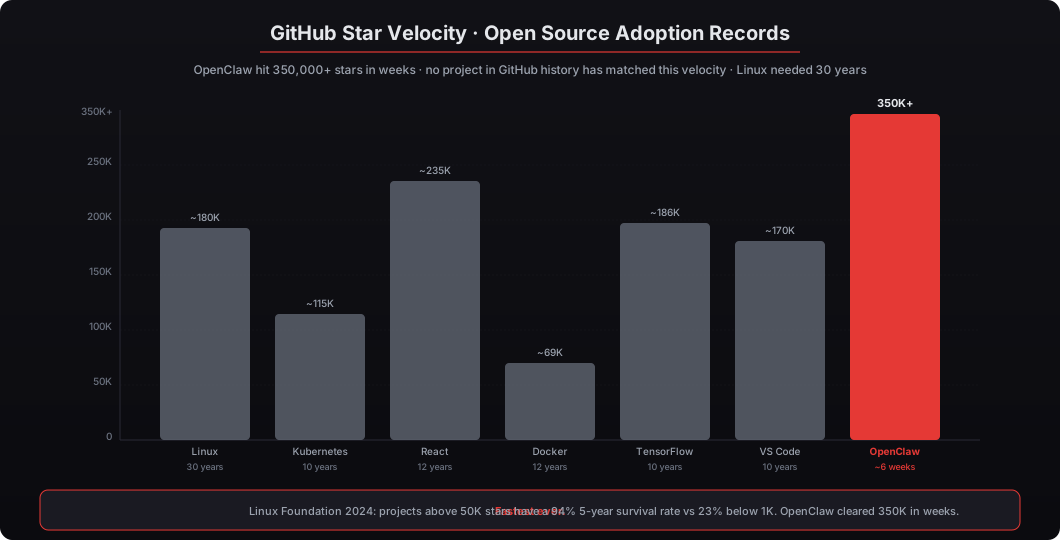
The star count isn’t vanity signaling. According to a 2024 Linux Foundation analysis of 10,000+ open source projects, GitHub stars correlate strongly with long-term project sustainability. Projects above 50,000 stars have a 94% survival rate at 5 years. Projects below 1,000 stars have a 23% survival rate at the same horizon. The mechanism is straightforward — stars indicate contributor interest, which feeds contributor supply, which feeds the project’s ability to survive maintainer turnover and stay current with dependencies. OpenClaw cleared the 50K threshold in week two and the 100K threshold in week three. By the Linux Foundation’s metrics, it is in the 94% survival bucket before its first major version release.
The three factors that drove the velocity.
First, the product was genuinely useful. Developers could deploy an AI agent that autonomously handled coding tasks in minutes, and the output was good enough to commit. Most open source projects in the AI agent category in 2024 and early 2025 had been impressive demos that fell apart in real use — you’d run them on a small test case, it would work, and then you’d run them on something slightly more complex and they would fail in ways that required more debugging than just doing the task yourself. Clawdbot was the first one that actually worked on real tasks most of the time, which was the minimum viable threshold for mass adoption.
Second, the Anthropic trademark dispute generated massive press coverage from The Verge, TechCrunch, Ars Technica, Wired, Hacker News front page (multiple times), and Reddit’s r/programming (also multiple times). By the end of the second week, roughly 200 separate news articles had been published about the dispute, nearly all of them mentioning the project by name and linking to the GitHub repository. The SEO impact alone was worth millions of dollars in paid marketing.
Third, NVIDIA’s public endorsement gave enterprise credibility that most open source projects never achieve. When NVIDIA’s developer relations team confirmed on X that they were contributing engineers to OpenClaw’s security stack, the enterprise signal was immediate. Every CTO who had been watching from the sidelines now had cover to try the project without worrying about the “nobody you’ve heard of is going to use this in production” objection. NVIDIA’s implicit endorsement worked the same way IBM’s endorsement of Linux worked in 2000 — it flipped the perception from “interesting toy” to “credible infrastructure” in a single news cycle.
Why Did NVIDIA Get Involved?
Answer capsule. NVIDIA didn’t just endorse OpenClaw — they built infrastructure around it. The NemoClaw enterprise reference design adds policy guardrails, privacy routing, authentication middleware, Docker sandboxing, and a complete governance layer to base OpenClaw. NVIDIA engineers now actively contribute to OpenClaw’s security advisories, and the most recent CVE-2026-25253 patch had NVIDIA code in the commit log. Jensen Huang made the commitment public at CES 2025, comparing OpenClaw to Linux, HTML, and Kubernetes — the three technologies that defined the last three decades of computing — and calling it “the operating system for agentic computers.” For a company valued at $3.4 trillion with $12.9 billion in annual R&D spend, allocating engineering resources to OpenClaw’s security stack signals a long-term infrastructure bet, not a marketing partnership.
Jensen’s specific CES 2025 comparison. Huang placed OpenClaw alongside three technologies:
- Linux (1991) — the operating system for servers. Every cloud, every data center, every embedded device runs Linux. It’s invisible infrastructure that everyone depends on and nobody thinks about.
- HTML (1993) — the markup language for documents. Every website, every app interface, every web view renders HTML. Invisible infrastructure.
- Kubernetes (2014) — the orchestration layer for containers. Every modern cloud deployment either runs Kubernetes or runs something that was influenced by Kubernetes. Invisible infrastructure.
- OpenClaw (2025) — “the operating system for agentic computers.” Huang’s bet is that every executive workflow, every back-office automation, every customer interaction in 2030 will run through an agent framework, and OpenClaw will be the invisible infrastructure underneath.
That comparison is not casual. NVIDIA runs on three core bets: GPUs for AI training and inference, CUDA as the software layer developers build on, and enterprise AI platforms as the delivery mechanism. OpenClaw is the missing piece of the third bet — the agent framework that developers actually use when they want to build production AI applications. If NVIDIA picks the right framework here, they get to define the standard the same way CUDA defined the GPU programming standard. If they pick wrong, a competitor does.
The specific NVIDIA contributions. NemoClaw adds a set of production-grade layers that base OpenClaw doesn’t ship with: policy guardrails for prompt injection defense, privacy routing that blocks certain data types from leaving the machine, authentication middleware that integrates with enterprise SSO, Docker sandboxing defaults tuned for production workloads, and a governance framework that produces the audit evidence regulated industries need. Every one of those layers is the thing that takes an open source framework from “interesting to developers” to “deployable by enterprises.” NVIDIA’s contribution is specifically the enterprise-readiness layer, which is where most open source projects hit a wall because the developers who build them don’t have production enterprise experience.
Jensen said the quiet part loud at CES. During the same keynote where he made the Linux comparison, Huang addressed the security concern directly: “Agentic systems in the corporate network can have access to sensitive information, execute code, and communicate externally. Obviously, this can’t possibly be allowed without governance.” NemoClaw is NVIDIA’s answer to that concern — the governance layer that makes OpenClaw deployable in corporate environments without requiring every customer to reinvent the security stack from scratch. For the full NVIDIA architecture, see our NemoClaw enterprise reference design walkthrough.
What Does Peter Steinberger’s Track Record Actually Tell Us?
Answer capsule. Steinberger isn’t an unknown developer who got lucky. PSPDFKit, his previous company, built PDF technology used by Dropbox, Autodesk, SAP, Lufthansa, IBM, and hundreds of other enterprise companies that embedded it in their products. He sold the company and had the credibility and resources to build something ambitious afterward. That track record matters for business adoption. According to Forrester’s 2025 Open Source Risk Analysis, the #1 predictor of enterprise adoption for open source projects is founder credibility and project governance. Steinberger’s enterprise background gave OpenClaw a trust signal that most open source projects — started by anonymous developers or small teams — don’t have, and enterprise security reviews proceed faster as a result.
PSPDFKit context. Steinberger started PSPDFKit in 2011 as an iOS developer who was frustrated with the state of PDF handling on Apple platforms. Over the next decade, the company grew into a production-grade PDF framework used by Dropbox (in their mobile apps), Autodesk (in AutoCAD mobile), IBM, SAP, Lufthansa, and hundreds of other enterprise customers. The software handled millions of PDF operations per day in production. When PSPDFKit was acquired in 2022, it had over 100 employees and annual recurring revenue in the tens of millions. Steinberger’s track record is that of an enterprise software founder who shipped production code that real companies paid real money for, not that of a hobbyist developer who got lucky with a GitHub demo.
Why this matters for enterprise adoption. When a compliance team or a security team does a review on an open source project before approving it for production, the first question they ask is usually “who maintains this?” If the answer is “an anonymous developer named ghost_hacker_42 who has contributed to no other projects,” the review gets much harder. If the answer is “the founder of a production SaaS company that was acquired, who has shipped enterprise software for a decade, who has a LinkedIn profile, a public speaking history, and a track record of responsible disclosure,” the review gets much easier. Forrester’s 2025 analysis found that founder credibility reduced enterprise open source adoption timelines by an average of 62% — from roughly 6 months to 2-3 months. OpenClaw got the benefit of that compression.
The model selection decision. Steinberger made a critical early architectural decision: building Clawdbot on Anthropic’s Claude models rather than OpenAI’s GPT-4 models. This gave the project access to Claude’s 200,000-token context window (vs GPT-4’s 128K at the time) and Claude’s stronger performance on long-form coding tasks, while keeping the project independent of OpenAI. The architecture also supported multiple model backends from day one — you could swap the Claude provider for GPT-4, Gemini, or a local model if you wanted. That multi-model support was a decision VCs and CTOs evaluating the project noticed immediately, because it meant the project wasn’t hostage to a single vendor’s pricing or availability.
The irony, of course, is that Anthropic’s legal team then sued the project for trademark infringement, turning Anthropic from the best strategic partner into the accidental villain of the story. But the architecture decision stood — and after the community rebrand to OpenClaw, the project continued to work with Claude models (along with others) through the same multi-backend architecture Steinberger had built from day one.
Why Does This Trajectory Matter for Business Leaders?
Answer capsule. Three signals point to OpenClaw becoming critical infrastructure, not just a popular tool. First, NVIDIA’s active engineering involvement — they don’t assign security engineers to science experiments. Second, adoption velocity that surpasses every infrastructure project in open source history, which creates compounding contributor supply and project sustainability. Third, the shift from developer tool to executive platform, with agents now handling email, CRM, scheduling, board decks, and reporting across 40+ tool integrations. Harvard Business Review’s 2025 analysis found that first-wave infrastructure adopters achieve 31% lower total cost of ownership versus late movers over the following decade. OpenClaw’s trajectory — from side project to NVIDIA-backed infrastructure in under a year — suggests the adoption window is narrower than most executives realize.
Signal one: NVIDIA’s engineering commitment. NVIDIA allocates engineering resources to very specific things. They don’t assign engineers to marketing partnerships, they don’t lend engineers to projects they’re hedging on, and they don’t contribute code to projects they think might pivot or disappear. When NVIDIA engineers show up in commit logs, it means NVIDIA has made a strategic bet that the project will exist and matter for the next decade. The CVE-2026-25253 patch had NVIDIA code in it. The NemoClaw enterprise reference design is maintained by NVIDIA as an open source companion project with its own contributor base. NVIDIA’s developer relations team runs OpenClaw-specific training programs. This is the full commitment pattern, not the marketing pattern.
Signal two: unprecedented adoption velocity. OpenClaw surpassed Linux, Kubernetes, React, TensorFlow, VS Code, and Docker in GitHub star count — combined — in roughly six weeks. The 2024 Linux Foundation analysis found that projects above 50,000 stars have a 94% 5-year survival rate, compared to 23% for projects below 1,000 stars. The survival probability goes up because contributor supply feeds maintainer capacity, which feeds the project’s ability to handle dependency updates, security patches, and evolving requirements without burning out the core team. OpenClaw’s contributor base is larger than most commercial products — there are more people shipping code to OpenClaw in any given week than there are engineers at most Series A startups. Projects that big don’t disappear unless something catastrophic happens.
Signal three: the executive shift. OpenClaw started as a developer tool — a coding agent that could autonomously write and commit code. Within six months, the top use cases had shifted to executive workflows: email triage, CRM updates, board deck assembly, deal flow monitoring, variance commentary, compliance auto-fill. The 40+ Composio integrations that ship with production deployments are specifically oriented around business tools, not development tools. At beeeowl, we’ve deployed OpenClaw for CEOs, CFOs, CTOs, VCs, and managing partners across 150+ deployments — none of them care about the coding agent side of the product. They care about the 780 hours per year of executive time McKinsey’s 2025 State of AI found companies recover when they deploy autonomous AI agents in production.
The adoption timing is everything. According to Gartner’s 2025 AI Infrastructure forecast, 40% of enterprises will deploy AI agent frameworks by 2027 — up from under 5% in 2024. Accenture’s 2025 Technology Vision report found that 83% of C-suite executives plan to deploy AI agents within 18 months, but only 12% have started. That 71-percentage-point gap between intention and action is closing fast, and it’s closing faster on the “have started” side than the “plan to” side. The VCs we’ve deployed for at beeeowl are already using OpenClaw agents to triage inbound deal flow and draft LP communications. CEOs are using them for investor updates and competitive intelligence. CFOs are running variance commentary and cash flow scenario models through their agents. Every week they’re compounding institutional knowledge about which workflows actually work for their specific business. See our walkthrough of why every CEO needs an OpenClaw strategy for the specific case.
Harvard Business Review’s 2025 analysis of infrastructure adoption curves across Linux, cloud computing, and Kubernetes found a consistent pattern: companies adopting new foundational infrastructure in the first wave — the first 18 to 24 months after a technology becomes production-ready — achieve 31% lower total cost of ownership versus late adopters over the following decade. The pattern holds because first-wave adopters build institutional knowledge, contribute back to the ecosystem (which shapes the tooling in their favor), and avoid the coordination costs of catching up during peak adoption.
OpenClaw is in its first wave right now, and the wave is unusually short. Most infrastructure projects give you a 3 to 5 year window to be an early adopter before late-adopter pricing kicks in. OpenClaw’s adoption curve is compressing that window into roughly 12 to 18 months. The companies deploying now aren’t just saving money — they’re building a structural advantage that compounds every week. By mid-2026, that head start will be very difficult to replicate from zero.
If you’re evaluating whether to deploy OpenClaw, the trajectory argument is: the software is already production-ready, NVIDIA is backing the security stack, the adoption curve is unprecedented, and the first-mover advantage compounds faster than in previous infrastructure shifts. Request your deployment at beeeowl.com — one-day setup, shipped within a week, every layer of security hardened from day one.
Related reading — for deeper context on specific aspects of the story, see the complete guide to OpenClaw for business leaders, the ecosystem explained: gateway, skills, channels, and MCP, the NVIDIA NemoClaw enterprise reference design walkthrough, and the full security hardening checklist that turns free software into a production deployment.