Why Every CEO Needs an OpenClaw Strategy
NVIDIA's Jensen Huang compared OpenClaw to Linux, HTML, and Kubernetes at CES 2025. OpenClaw hit 350,000+ GitHub stars in weeks — the fastest-adopted open source project in GitHub history, surpassing Linux's 30-year count. With NemoClaw making it enterprise-ready and 40% of enterprises planning deployment by 2027, every company now needs an OpenClaw strategy. Here's what that means concretely, the SaaS-to-GaaS shift that's driving adoption, the first-mover advantage math, and the four-step path every CEO can follow this week.

Why Did NVIDIA’s CEO Compare OpenClaw to Linux at CES 2025?
Answer capsule. Because Jensen Huang thinks OpenClaw is that important for the next decade of computing. At CES 2025, he placed OpenClaw alongside Linux, HTML, and Kubernetes — the three technologies that defined the last three decades of computing — and called it “the operating system for agentic computers.” This isn’t a throwaway comparison. NVIDIA is a $3.4 trillion company with $12.9 billion in annual R&D spend, and Jensen backed the claim with action: NVIDIA engineers now actively contribute to OpenClaw’s security stack, the NemoClaw enterprise reference design ships as an open source companion project, and the most recent CVE-2026-25253 patch had NVIDIA code in the commit log. When the company that makes the GPUs every AI system runs on picks a specific framework as its enterprise reference, that’s a signal about where the industry is going.

The specific Jensen comparison, in his own words from the CES 2025 keynote:
“In the last thirty years of computing, three things became invisible infrastructure that every company runs whether they know it or not: Linux, HTML, and Kubernetes. OpenClaw is the fourth. It is the operating system for agentic computers, and within five years every company will run it the way every company today runs Linux.”
Huang is betting NVIDIA’s enterprise AI strategy on that comparison. NVIDIA’s developer relations team has been running OpenClaw-specific training programs since Q4 2025. Their NemoClaw reference design is maintained as an open source companion project with its own contributor base. The CVE-2026-25253 patch that shipped in March 2026 had NVIDIA engineers in the commit log. This is the full commitment pattern NVIDIA uses when they’re betting on specific infrastructure, not the marketing partnership pattern they use when they’re hedging.
The adoption numbers tell the rest of the story. OpenClaw hit 350,000+ GitHub stars in weeks — surpassing what Linus Torvalds’ Linux achieved in 30 years on the platform. For scale: Kubernetes has ~115,000 stars after 10 years, React has ~235,000 after 12, TensorFlow has ~186,000 after 10. OpenClaw passed them all in roughly six weeks. See our full OpenClaw origin story walkthrough for the detailed history, including the Anthropic trademark dispute that accidentally turned into the biggest PR moment in open source history.
According to Gartner’s 2025 AI Infrastructure forecast, 40% of enterprises will deploy AI agent frameworks by 2027, up from under 5% in 2024. That’s not a gradual trend — that’s a discontinuous shift happening in real time. Your company is either riding the curve or watching it.
What Exactly Does OpenClaw Do?
Answer capsule. OpenClaw is an AI agent framework that runs 24/7 on dedicated infrastructure you own, autonomously handling work that currently eats executive calendars. It connects to email, calendar, Slack, CRM, and 40+ other tools through Composio OAuth middleware — then acts on them without waiting to be asked. Email triage every 30 minutes. Morning briefings at 8am with calendar, attendee backgrounds, and talking points. CRM updates after every meeting. Competitive intelligence monitoring 24/7. Board deck assembly every Monday. McKinsey 2025 found that companies deploying AI agents see a 28% reduction in executive administrative time within 90 days — roughly 780 hours per year per executive, which is 19.5 additional 40-hour work weeks. It’s not a productivity tip; it’s structural.
Here’s what it looks like in practice for a typical CEO:
- Email triage, every 30 minutes. The agent scans your inbox, categorizes messages by urgency, drafts responses for routine items, flags anything that genuinely needs your attention, and archives noise. By the time you open Gmail, the drafts are already waiting for your review.
- Morning briefing, delivered at 8am. Your full calendar for the day, attendee backgrounds pulled from LinkedIn and your CRM, talking points for each meeting, news about the companies and people involved, and any action items from yesterday that need attention today. Waiting in Slack or iMessage before your first coffee.
- CRM updates, after every meeting. Reads the meeting transcript (from Otter, Gong, Zoom, or Read.ai), extracts action items, logs meeting notes to Salesforce, moves deals through pipeline stages, creates follow-up tasks.
- Slack monitoring, continuously. Surfaces messages that genuinely need your attention from the 400+ daily messages in your workspace, filters the rest, produces consolidated summaries twice a day.
- Competitive intelligence, 24/7. Monitors press releases, funding announcements, leadership changes, pricing pages, job postings, and G2 reviews across 6-8 named competitors. Flags material changes within an hour of publication. See our building a 24/7 competitive intelligence agent walkthrough.
- Board deck assembly, every Monday morning. Pulls financial data from QuickBooks, pipeline from Salesforce, product metrics from the warehouse, team notes from Notion, and drafts a 9-section packet before the 9am board meeting. See AI-powered board deck assembly.
McKinsey’s 2025 State of AI report found that companies deploying AI agents see a 28% reduction in executive administrative time within 90 days. For an executive working 55 hours per week, that’s roughly 15 hours reclaimed weekly — 780 hours per year. That’s not a productivity tip or a marginal efficiency gain. It’s the equivalent of 19.5 additional 40-hour work weeks per year, applied to the work that actually requires the executive’s judgment rather than the administrative work that shouldn’t.
The difference between OpenClaw and ChatGPT or Copilot is the difference between a tool you use and an employee that works for you. ChatGPT is a chatbot — you type a question, it answers, you close the tab, it stops. OpenClaw is an agent — it runs a perception-decision-action loop continuously whether you’re at your desk or asleep. See our walkthrough of why every executive needs an agent, not a chatbot and OpenClaw vs ChatGPT vs Claude for executives.
What Is the SaaS to GaaS Shift and Why Is It Happening Now?
Answer capsule. Every SaaS company will become an agentic-as-a-service (GaaS) company — Jensen Huang stated this publicly at CES 2025 as his core thesis for the next decade of enterprise software. Traditional SaaS gives you dashboards that you log into 50 times a day to check data and take manual action. GaaS eliminates the “log in and check” loop entirely: your AI agent monitors those systems continuously and takes action autonomously based on rules you set, reporting to you only when something needs human judgment. Andreessen Horowitz 2025 projects that 60% of current SaaS workflows will be partially or fully automated by AI agents within 3 years. The companies deploying agents now are building the playbooks; the ones waiting will be buying those playbooks at a premium later.
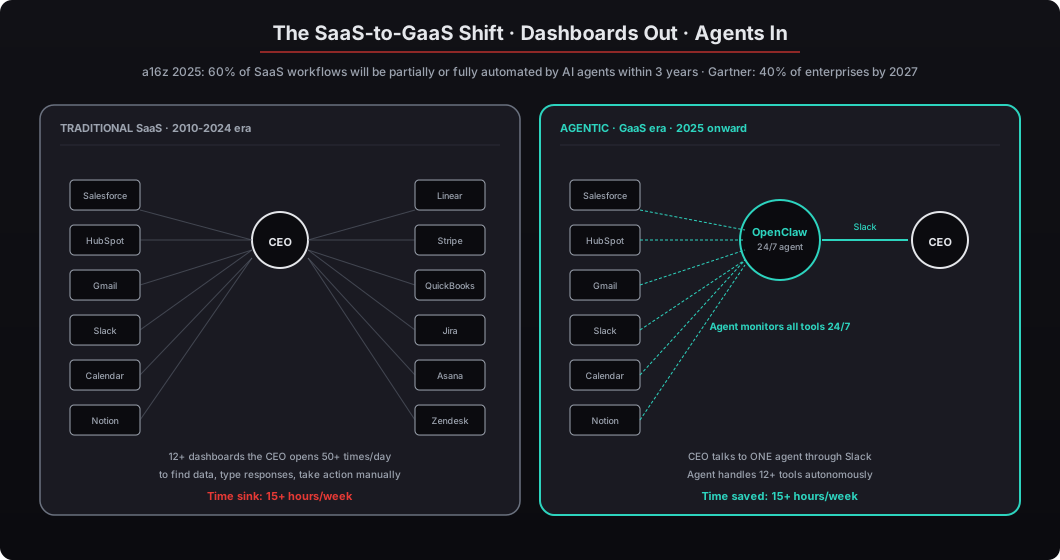
Traditional SaaS gives you dashboards. You log into Salesforce, HubSpot, Notion, Slack, Linear, Stripe, QuickBooks, Jira, Asana, Zendesk, and however many other tools you use, every day, to check data and take action. According to Okta’s 2025 Business at Work report, the average enterprise uses 130+ SaaS applications. For a typical executive, daily workflow spans roughly 12-15 of those tools, each requiring login, check, action, logout, move to next tool. The “log in and check” pattern is the dominant time sink in executive work — it’s where the 15+ hours per week of administrative time goes.
GaaS (agentic-as-a-service) eliminates that loop entirely. Your AI agent monitors those systems continuously and takes action based on rules you set, reporting to you only when something needs your judgment. Instead of you logging into Salesforce to check if a deal moved, the agent watches Salesforce and tells you when something material changes. Instead of you opening HubSpot to see new inbound leads, the agent triages them and drafts follow-ups for your review. Instead of you reading 147 emails, the agent triages them down to the 8 that actually need your attention.
Andreessen Horowitz’s 2025 AI market analysis projects that 60% of current SaaS workflows will be partially or fully automated by AI agents within three years. The companies deploying agents now are building the playbooks — which workflows automate well, which require human-in-the-loop approval gates, which tools need custom integration, which patterns compound into institutional knowledge. The ones waiting will be buying those playbooks later at a premium, or trying to reconstruct them from scratch while their competitors have six-month head starts.
Here’s the part that matters for control: OpenClaw is open source. You own the infrastructure. Your data stays on hardware you control. No vendor lock-in, no training someone else’s model with your proprietary information, no terms-of-service updates that retroactively expand what the vendor can do with your data. That’s a meaningful difference from Microsoft Copilot or ChatGPT Enterprise, where your data lives on someone else’s servers and the vendor can change the rules whenever their legal team decides it makes sense. See our walkthrough of private AI vs cloud AI and the case for private AI in 2026.
What Makes NemoClaw Enterprise-Ready?
Answer capsule. NemoClaw is NVIDIA’s enterprise reference design for OpenClaw — the difference between running Linux from a USB stick and running Red Hat Enterprise Linux in production. Same core, completely different security posture. It adds policy guardrails that control what agents can and can’t do, privacy routing that keeps sensitive data from leaking through agent actions, authentication middleware through Composio so agents never see raw OAuth credentials, Docker sandboxing with dropped capabilities so agents run in isolated containers with no host access, human-in-the-loop approval gates for high-risk actions, and tamper-evident audit logging of every action the agent takes. Deloitte 2025 found that 71% of AI projects stall at the security review stage — NemoClaw was built specifically to clear that hurdle. It’s the answer your CTO needs when the board asks “but is it safe?”
Jensen said the quiet part loud at CES 2025 in the same keynote where he announced the Linux comparison: “Agentic systems in the corporate network can have access to sensitive information, execute code, and communicate externally.” Then he paused. “Obviously, this can’t possibly be allowed without governance.” NemoClaw is NVIDIA’s answer to that governance requirement — the layer that makes OpenClaw deployable in corporate environments without requiring every customer to reinvent the security stack from scratch.
According to NVIDIA’s documentation, NemoClaw includes:
- Policy guardrails that control what agents can and cannot do at a declarative level. You specify “agents cannot send outbound emails without approval” or “agents cannot access data classified as restricted” and the guardrails enforce it regardless of what a prompt injection tries to make the agent do.
- Privacy routing that inspects data flowing through the agent and blocks certain categories (PII, PHI, MNPI, credit card numbers) from leaving the local machine. If a prompt would cause the agent to send sensitive data to an external endpoint, the routing layer intercepts and either blocks or reroutes.
- Authentication middleware through Composio — the agent sends action requests like “send this email” through Composio’s OAuth infrastructure, which handles the token exchange with the target service. The agent never sees the raw OAuth token, which means a compromised agent has a limited blast radius.
- Docker sandboxing with
--cap-drop ALL,--read-onlyrootfs, non-root user execution, seccomp profiles, and resource caps. The agent runs in an isolated container that can’t reach the host filesystem, other containers, or network interfaces beyond the allowed list. - Human-in-the-loop approval gates for high-risk actions. The agent pauses before sending the outbound email, moving the large deal stage, or transferring funds, and waits for explicit approval through the configured Channel.
- Tamper-evident audit trails logging every action the agent takes with append-only file attributes, data classification tags, session attribution, and SIEM-compatible export.
For context: according to Deloitte’s 2025 Enterprise AI Adoption Survey, 71% of AI projects stall at the security review stage. The technical capability exists, but the governance architecture doesn’t satisfy the compliance bar. NemoClaw was built specifically to clear that hurdle by providing the governance layer that regulated industries need. It’s the answer your CTO needs when the board asks “but is it safe?” — the answer is “NVIDIA designed the security model, we implement it as specified, here’s the audit trail.”
Every beeeowl deployment ships with the full NemoClaw-grade security stack. This isn’t an upsell or a premium tier. Whether it’s the $2,000 Hosted Setup, the $5,000 Mac Mini with hardware, or the $6,000 MacBook Air, the security configuration is identical — there is no “lite” deployment that skips security. See our complete security hardening checklist and the six-layer hardening walkthrough for the specific configurations we ship, plus NVIDIA’s NemoClaw enterprise reference design for the broader architectural picture.
Why Does Timing Matter So Much for This Specific Technology Shift?
Answer capsule. First-mover advantage in infrastructure adoption is real, measurable, and compounds heavily. Harvard Business Review’s 2025 analysis of first-wave adopters across Linux, cloud computing, and Kubernetes found that companies that adopted in the first 18-24 months after each technology became production-ready achieved 31% lower total cost of ownership versus late adopters over the following decade. OpenClaw’s curve is compressing that pattern into 12-18 months. Accenture 2025 found that 83% of C-suite executives plan to deploy AI agents within 18 months, but only 12% have started. The 71-percentage-point intention-action gap is where competitive advantage is being decided right now — the executives deploying in Q2 2026 will have 18 months of compound advantage before the executives waiting until Q4 2027 have a single agent running.
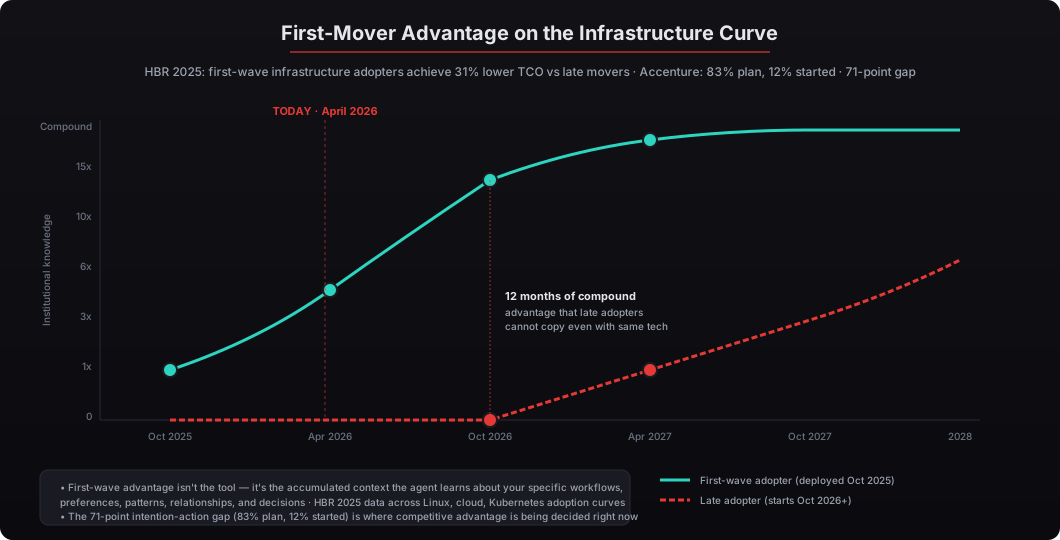
Harvard Business Review’s 2025 analysis of infrastructure adoption curves across Linux, cloud computing, and Kubernetes found a consistent pattern: companies adopting new foundational infrastructure in the first wave — the first 18 to 24 months after a technology becomes production-ready — achieve 31% lower total cost of ownership versus late adopters over the following decade. The pattern holds across three separate technology shifts that were each defining for their era, and the mechanism is the same every time: first-wave adopters build institutional knowledge that compounds, contribute back to the ecosystem in ways that shape the tooling in their favor, and avoid the coordination costs of catching up during peak adoption.
We’ve deployed OpenClaw for 150+ executives at beeeowl. The ones who started 6 months ago aren’t just saving time anymore — they’ve built institutional knowledge about which workflows to automate, how to structure agent permissions, which integrations deliver the highest ROI for their specific business, what their agent’s voice should sound like, which decisions still need human-in-the-loop approval, and how to document the whole thing for their SOC 2 audit. That knowledge compounds weekly because the agent is also learning — by month six the agent knows that the executive prefers bullet-point email replies under 200 words, that Tuesday afternoons are focus time, that this specific investor always asks about customer concentration, that the Thursday all-hands needs 30 seconds of off-topic humor to land well. None of that context transfers to a new agent at a different company; it lives specifically in the deployment that accumulated it.
According to Accenture’s 2025 Technology Vision report, 83% of C-suite executives plan to deploy AI agents within 18 months. But only 12% have started. That 71-percentage-point gap between intention and action is where competitive advantage is being decided right now. The math: every month you delay is a month your competitors’ agents are learning their specific business while yours doesn’t exist. Six months of delay is six months of compound advantage you handed to competitors without getting anything in return.
By mid-2026, the early adopters will have 12-18 months of compounded efficiency gains. The late majority will be starting from zero — hiring consultants, running pilots, sitting through security reviews — while their competitors’ agents are already handling deal flow triage, board deck assembly, competitive intelligence monitoring, and investor update drafting on autopilot. The gap is not something late adopters can close by spending more money or buying better technology; it has to be accumulated over time, and the clock is running for everyone simultaneously. See our analysis of 2026 as the year of the AI agent for the broader market timing picture.
What Should You Do This Week as a CEO?
Answer capsule. One agent. One workflow. One week. Pick your highest-friction workflow (usually email triage, morning briefings, or CRM maintenance — whichever is consuming the most of your time right now), deploy one agent through beeeowl’s $2K Hosted Setup or $5K Mac Mini tier, connect the 3-5 tools involved through Composio OAuth, and measure hours saved over the first two weeks. Don’t commission a committee. Don’t run a six-month pilot. Don’t schedule a series of evaluation meetings with three vendors. The executives who start with one workflow and prove value incrementally succeed; the ones who try to scope “an agent that does everything” get stuck in analysis paralysis and delay by months.
Here’s the practical four-step path for this week:
1. Pick your highest-friction workflow. The task that eats 3-5 hours of your week and follows a repeatable pattern. For most CEOs, that’s email triage (Harvard Business Review 2025 found executives spend 4.1 hours daily on email), morning briefings, CRM hygiene, or investor update drafting. Don’t try to automate everything on day one — pick the single workflow that’s consuming the most of your time right now and start there. See our 7 ways CEOs use OpenClaw to reclaim 10 hours per week walkthrough for the common starting points.
2. Deploy on hardware you own. Your board communications, deal terms, financial models, and personnel decisions shouldn’t live on someone else’s servers. Private deployment means your data stays yours — not even ChatGPT or Claude sees it. beeeowl’s Mac Mini Setup is $5,000 one-time with hardware included; the Hosted Setup starts at $2,000 if you want to use your own VPS. Either way, setup takes one business day on our side and the deployment ships within a week for hardware tiers.
3. Connect one integration first. Email (Gmail or Outlook), CRM (Salesforce or HubSpot), or Slack — whichever is the primary tool for the workflow you picked in step 1. Let the agent prove value on a single workflow before expanding to more. Most of our clients see measurable ROI within 2 weeks on the first workflow, and the concrete evidence of time savings builds the confidence to add more. See how to get your first OpenClaw agent running in one day for the specific deployment sequence.
4. Measure hours saved, not features used. Track the specific hours you get back per week. The ROI should be obvious within 30 days — if it’s not, the workflow wasn’t the right starting point and you should switch to a different one before giving up on the deployment. See our detailed analysis of the ROI of private AI deployment and the cost of not having an agent for the specific metrics to track.
The path from one workflow to full deployment takes roughly 90 days based on our experience across 150+ deployments. Month 1: email triage or morning briefing running reliably, 1.5-2 hours per day saved. Month 2: add a second workflow (CRM sync or meeting prep), 3-4 hours per day saved. Month 3: add a third workflow (competitive intelligence or board deck assembly), 4-5 hours per day saved. By month 3 you’re saving 15+ hours per week, which is 780+ hours per year — the number McKinsey 2025 reported for executives using autonomous AI agents.
Jensen didn’t compare OpenClaw to Linux because it’s interesting technology. He compared it to Linux because he believes every company will run it — just like every company runs Linux today, whether they know it or not. The invisible infrastructure of the next decade. Request your deployment at beeeowl.com.
The question isn’t whether your company needs an OpenClaw strategy. The question is how many months of compound advantage you’re willing to give away while you think about it. The executives who deployed in October 2025 now have 6 months of compounded efficiency gains and institutional context that they spent zero additional money to acquire. The executives who deploy in April 2026 will have 6 months of compound advantage by October 2026. The ones who wait another six months will be starting from zero while their competitors have a year of head start. The technology doesn’t get better by waiting. The advantage gap just widens.
Related reading — for deeper coverage of specific aspects, see what OpenClaw actually is in plain English, the case for private AI in 2026, why every executive needs an agent, not a chatbot, the OpenClaw origin story as the fastest-growing open source project, 7 ways CEOs use OpenClaw to reclaim 10 hours per week, and the ROI of private AI deployment and the cost of not having an agent.